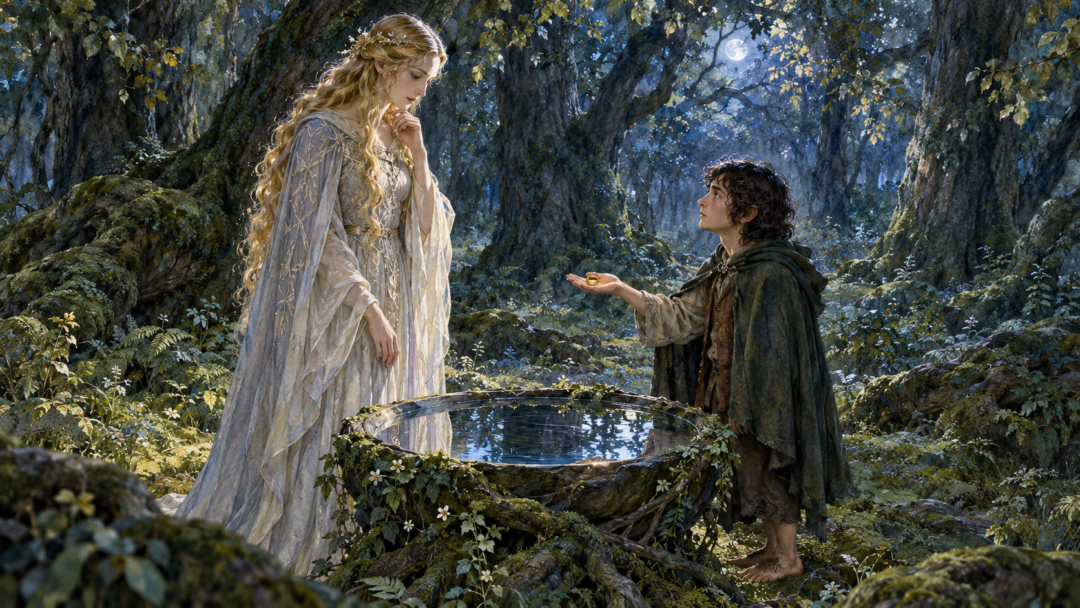
In Lothlórien, Galadriel holds out the possibility of another fate: take the One Ring from Frodo, become a queen of terrible power, and refuse the fading appointed to her people. Instead she lets the Ring go. Her decision seems to complete a long story of exile, but the beginning of that story is far less settled than its ending. How did she leave the Blessed Realm in the first place?
One account places her among the Noldor who rebelled and crossed the ice into Middle-earth. A very late account has her resist Fëanor at the Telerin haven of Alqualondë and sail independently with Celeborn. These are not separate legs of a single journey. They belong to different attempts to explain her past, including whether she was barred from returning and why she remained away.
A Lady of Lórien before a daughter of the Elder Days
Galadriel appeared while The Lord of the Rings was being written, not as a fully established participant in the older First Age tales. Early Lothlórien drafts show the lord and lady of the woodland realm taking shape as the Fellowship approaches, with names and relationships still unsettled. The commanding presence readers know from The Fellowship of the Ring came before a settled account of what she had done when the Noldor departed Aman.
Her place in the older history grew afterward. In the Annals of Aman, she becomes a daughter of Finarfin and Eärwen, connected through her mother to the Teleri, and a notably valiant figure in the exile of the Noldor. The House of Finwë now had to accommodate an Elf already familiar to readers. Her descent from Eärwen also connected her to the Teleri harmed at Alqualondë, a bond later revisions would bring to the foreground. These annals did not yet explain a personal prohibition on her return.
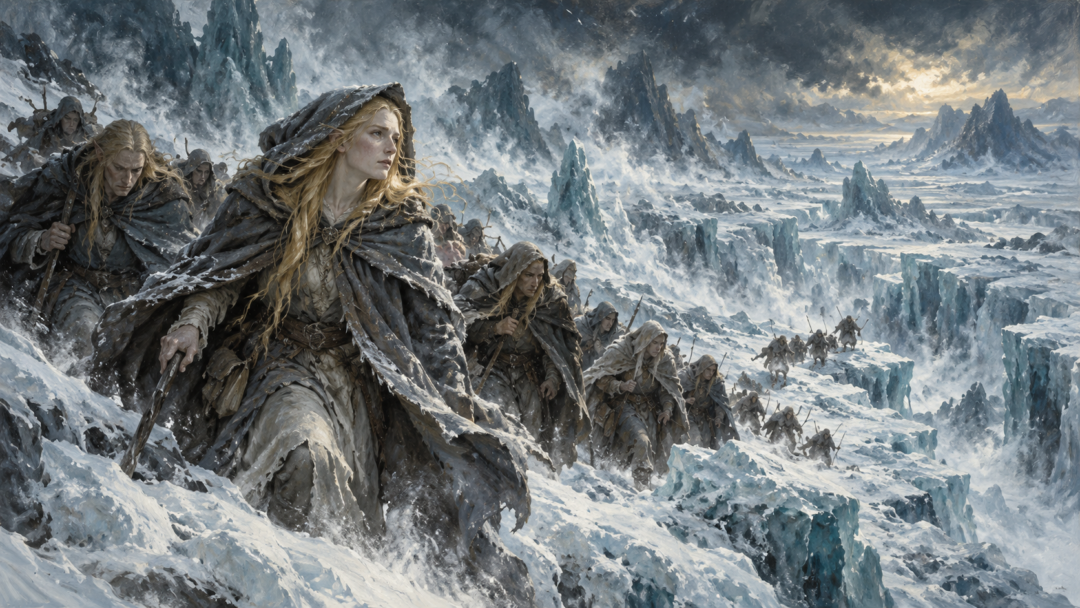
A later note can alter an earlier narrative’s premise without describing another incident within it. The published Silmarillion tells of Galadriel refusing to turn back with her father Finarfin and following the host that endured the Helcaraxë, the grinding ice of the far north. Finarfin's decision to turn back after the Doom of Mandos throws Galadriel’s onward journey into relief, though the moral meaning later given to her choice was still unsettled. It offers a coherent departure scene, not a container for every subsequent idea.
Staying in Middle-earth was not always a sentence
One substantial account, usually called “Concerning Galadriel and Celeborn” and preserved in Unfinished Tales, follows the couple through the Second Age. They are associated with Eregion, the response to Sauron, and lands east of the Misty Mountains. The manuscript has difficulties of its own. Crucially, it does not explain her continued presence through a personal ban for rebellion.
In that account, love for Celeborn helps explain why she stays. The continuing threat of evil shapes her work, too. Neither reason belongs automatically to a later story of punishment. Choosing to remain with her husband differs from longing for home but being unable to return.
A related text from around 1959 considers the possibility of a return to Tol Eressëa, the Lonely Isle, rather than the places in Aman where Galadriel once lived. Love for Celeborn is involved, with pride suggested: the offered home might feel lesser than her former standing. Three propositions remain distinct. She might choose not to go, reject a pardon, or be forbidden to return. Those are not interchangeable explanations of exile.

How the rebel became an exile who could not return
In drafts of a 1967 letter, Galadriel’s role in the uprising of the Noldor acquires a sharper consequence. A leader in the rebellion, she is described as subject to a prohibition on returning to the West. Her refusal of the Ring then becomes the moment the restriction is lifted. Renouncing dominion in Middle-earth offers a way home.
The notes to “Namárië” in The Road Goes Ever On, published that year, likewise frame her longing for the West through revolt and prohibition. In this telling, pride complicates even the ban: she had answered the refusal with a declaration that she did not wish to return. Yet Christopher Tolkien cautioned against treating this as the original plan; the ban was not developed when the Lothlórien farewell was written.
The later account in The Shibboleth of Fëanor, written after 1967, is more intricate than the simple description “Fëanor’s follower” suggests. Galadriel distrusts Fëanor and independently wants lands of her own to order. Her Telerin family ties matter at Alqualondë: she fights in defense of her mother’s people against the assault upon their ships. Joining the movement out of Aman does not mean approving of or committing the Kinslaying.
Yet this version does not make her entirely free of fault. She participates in the exile and remains proud; after Morgoth’s defeat, she rejects the pardon that would permit her return. Opposition to Fëanor and resistance to his violence coexist with a desire for independence and a refusal to submit. She is neither a spotless victim nor an accomplice in every Noldorin crime. In this textual frame, her eventual yielding before Frodo’s Ring is an answer to an old struggle with power.
A final projected departure takes another ship
The most radical change arrived in August 1973, shortly before Tolkien’s death. In a letter and an accompanying projected history, Galadriel is described as “unstained”: she had done no evil deeds. Her wish to leave Aman is legitimate, and she is not part of Fëanor’s rebellion. She wants to exercise her abilities in Middle-earth and expects that the Valar might allow her to depart. This does not soften her place in Fingolfin’s host; it replaces her route.
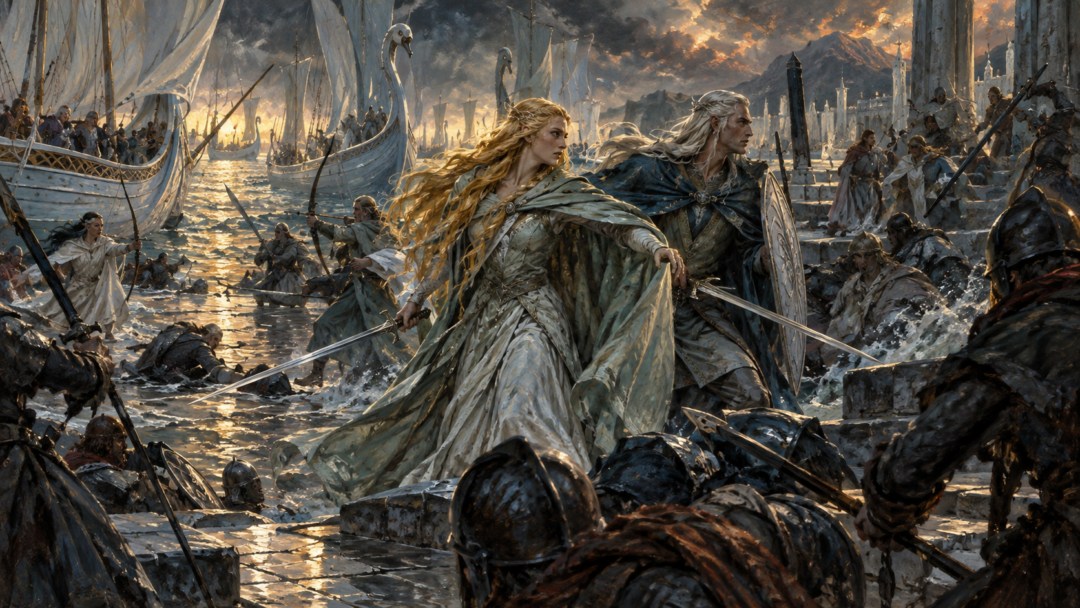
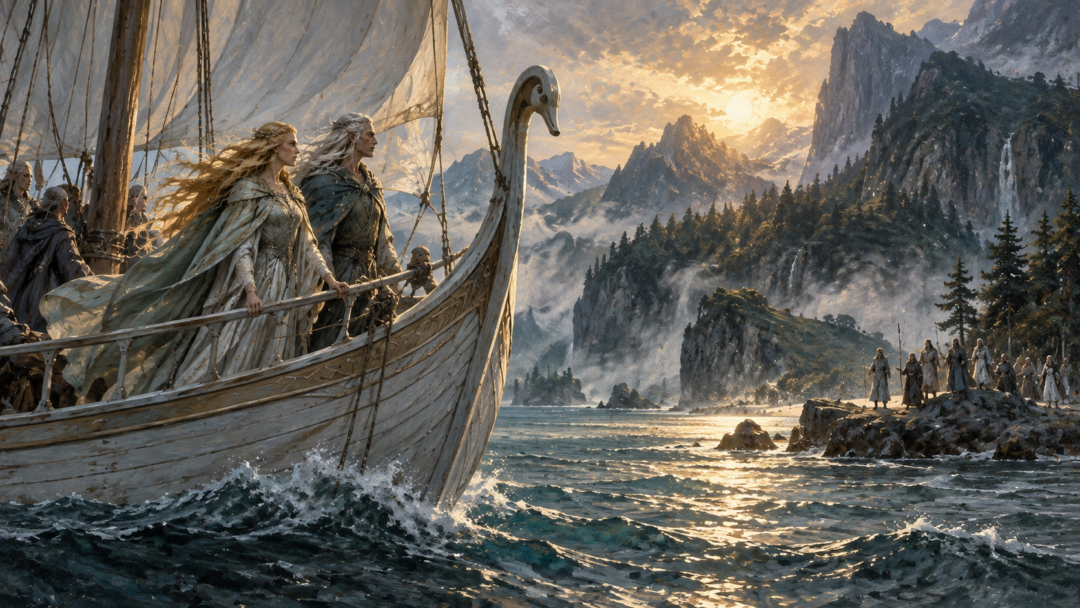
In the projected story she comes to Alqualondë, the harbor of the Teleri, where she meets Celeborn as a prince of that people. They plan to build a vessel and seek permission to sail. Before that happens, the Two Trees are destroyed and Fëanor revolts. At the Kinslaying, Galadriel and Celeborn defend the Teleri; Celeborn’s ship is saved from the attackers. The pair then sail toward Middle-earth on their own, without having obtained Manwë’s leave.
This makes her innocence precise, not unlimited. She neither endorses the rebellion nor joins the slaughter, but departs during a ban on emigration. The late outline says this has consequences for her return, though permission is subsequently granted after the First Age and declined. Being unstained by evil deeds is not the same as having faced no prohibition at any stage of the story.
The route changes more than the vessel. Galadriel and Celeborn arrive before Fëanor and are welcomed by Círdan; they do not make the Helcaraxë crossing with Fingolfin. Nor do they follow the familiar pattern of Galadriel’s long residence in Doriath: in this outline, they counsel a course apart from the war against Morgoth and eventually pass east over the Blue Mountains before that age ends. Putting this voyage after the ice crossing would make her leave Aman twice.
Celeborn changes the starting point too
Celeborn’s ancestry makes the conflict impossible to disguise as a disputed itinerary. In the published Silmarillion, he is Thingol’s kinsman, met by Galadriel in Doriath. The Road Goes Ever On identifies him as one of the Sindar. This Celeborn lives in Middle-earth before her arrival, helping explain why she remains. Their meeting belongs to the guarded kingdom of Doriath, not to a Telerin harbor on the verge of attack.
In the late Alqualondë conception, Celeborn is instead a Telerin prince of Aman, a grandson of Olwë and thus a cousin of Galadriel. He and Galadriel know one another before departure and escape together in his ship. Changing his birthplace shifts their relationship’s origin, not just his pedigree. One cannot keep the first meeting in Doriath while also treating the journey by his boat from Alqualondë as another chapter in the same sequence.
Christopher Tolkien confronted these difficulties while preparing the posthumous Silmarillion. Publication in 1977 did not weld every surviving note into one chronology. He used the more developed First Age narratives rather than reconstructing the entire book around a late, unfinished plan. In Unfinished Tales he made the tension visible instead of presenting the materials as a single finished history. That editorial decision reflects the state of the manuscripts, not a declaration that the last outline had been withdrawn. No completed revised Silmarillion settled its ramifications.
Reading the versions without flattening Galadriel
The useful question is therefore not simply, “Which boat did she take?” Ask which textual account supplies the boat, whether a personal ban exists in that account, and where its Celeborn comes from. In the published Silmarillion framework, the rebel exile crosses the ice and meets him in Doriath. In the 1973 project, the independent travelers sail from Alqualondë. In the later ban-centered explanations, pride gives Galadriel’s eventual return a particular moral weight.
These differences are evidence of a developing literary history, not proof that Galadriel secretly offered incompatible reports of her own life. The image that survives them is the one at the end: beneath the trees of Lórien, she turns from the power that could keep her great in Middle-earth, and eventually takes a westward ship. That final sailing is clear enough to make the uncertain first departure worth examining.
Sources & Notes
- Christopher Tolkien, introduction to Unfinished Tales of Númenor and Middle-earth (adapted extract, The Tolkien Estate) — explains that Galadriel and Celeborn’s history never acquired a settled final form and that conflicting versions are preserved rather than harmonized: https://www.tolkienestate.com/writing/christopher-tolkien-unfinished-tales-of-numenor-and-middle-earth/
- Tolkien Gateway, The History of Galadriel and Celeborn — chapter guide to Unfinished Tales, Part Two, IV; distinguishes the Shibboleth material, the separate 1973 sailing conception, and the earlier account without a personal ban: https://tolkiengateway.net/wiki/The_History_of_Galadriel_and_Celeborn
- Tolkien Gateway, Letter 320 — summary of Tolkien’s letter to Mrs Ruth Austin, 25 January 1971; documents the penitent rebel conception, refusal of forgiveness, and pardon following resistance to the Ring: https://tolkiengateway.net/wiki/Letter_320
- Tolkien Gateway, Letter 353 — summary of Tolkien’s letter to Lord Halsbury, 4 August 1973; documents the later unstained Galadriel, independent departure, and Manwë’s ban on emigration: https://tolkiengateway.net/wiki/Letter_353
These references distinguish Tolkien’s changing conceptions rather than combine them into one journey. The Tolkien Estate extract supplies Christopher Tolkien’s editorial explanation; the linked chapter and letter guides identify the relevant published texts.