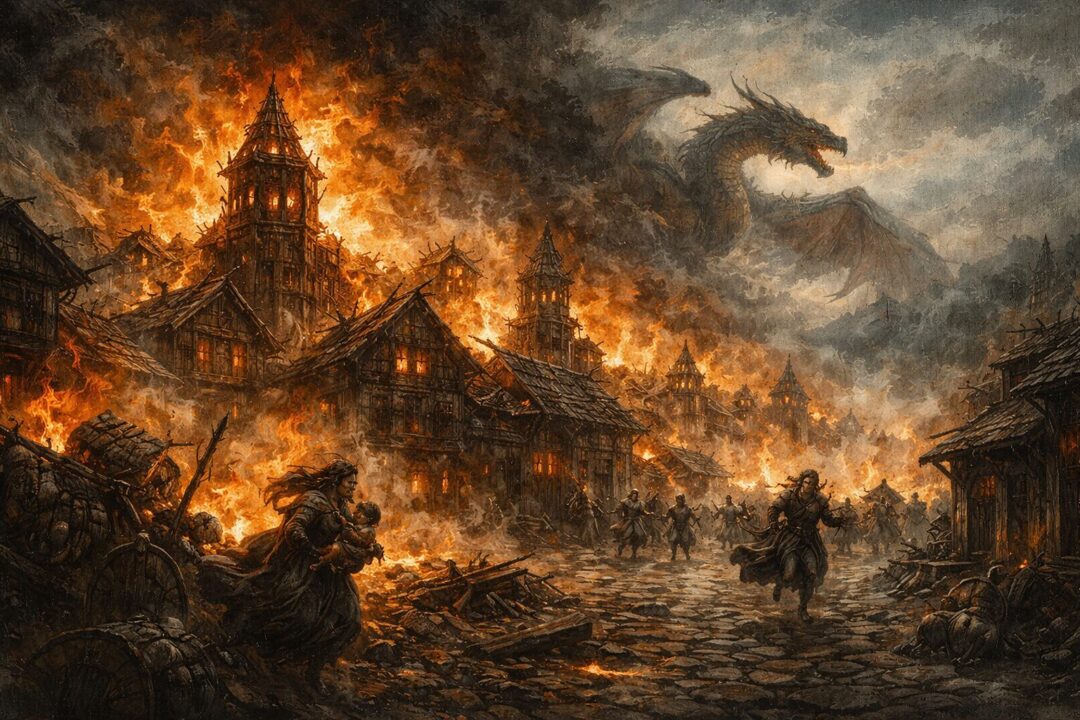
By the end of the Third Age, Sauron did not lack armies.
He had Orcs beyond counting, Easterlings and Haradrim drawn by fear or reward, the Nazgûl to break the will of kings, siege engines perfected through centuries of warfare, and decades of careful preparation. His strength was vast, methodical, and relentless. Yet even with all this, Sauron still faced a problem that force alone could not solve.
What he lacked was not soldiers—but certainty.
The Free Peoples of Middle-earth were fragile, divided, and dwindling, but they were stubborn. They endured. They resisted longer than logic suggested they should. Sauron could win a war of attrition, but it would cost time, risk unforeseen interference, and leave room for chance.
What Sauron needed was something far more dangerous than another army: a force capable of shattering resistance instantly, before alliances could form and hope could spread.
That force already existed.
Smaug the Golden: A Relic of the Elder World
Smaug the Golden was not merely a powerful beast or an oversized weapon. He was the last great fire-drake of the North, a lingering echo of Morgoth’s ancient war against Elves, Men, and Dwarves. Dragons like Smaug were not created to rule territory or command legions; they were made to devastate—to burn, to terrify, and to erase civilizations from the map.
By the Third Age, most of these creatures were gone. Some had been slain, others faded into deep places of the world, their time passed. Smaug was different.
Smaug was active.
Unlike Balrogs, which hid deep beneath mountains, or other dark things that survived only in forgotten corners, Smaug ruled openly. In the year 2770 of the Third Age, he descended upon Erebor, the Lonely Mountain, driving out the Dwarves and destroying the Kingdom of Dale in a single, catastrophic campaign. No alliance opposed him. No power challenged him. His victory was swift and absolute.
And then he remained.
For nearly two hundred years, Smaug sat uncontested upon his hoard, a living monument to the fact that the world had grown too weak to remove him. Entire generations lived and died knowing that the North was under the shadow of a dragon—and that nothing would be done about it.
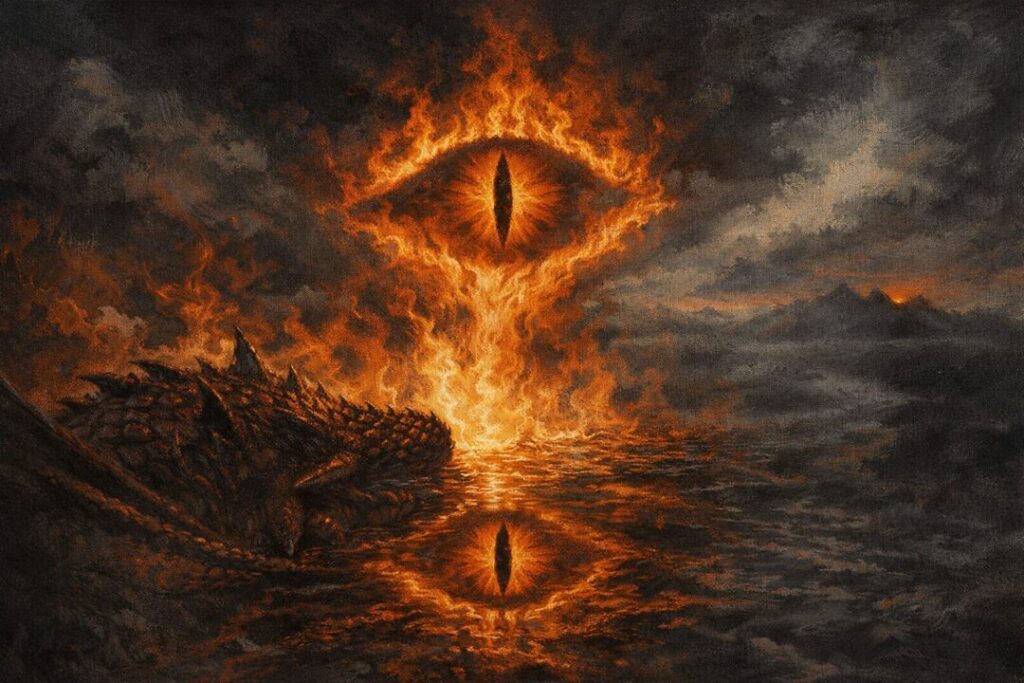
Sauron Was Aware of Smaug
There is no serious doubt that Sauron knew of Smaug’s existence.
The Dark Lord was not ignorant of the world beyond his borders. His servants moved widely. His influence spread quietly through fear, rumor, and corruption. Creatures of great power did not escape his notice—especially not one whose very presence destabilized an entire region of Middle-earth.
Gandalf makes this awareness clear when explaining his concern over Smaug. His fear is not that Smaug already serves Sauron, but that Sauron could use him—or at the very least, ensure that Smaug was never turned against Mordor.
This distinction matters.
Sauron does not require loyalty in the modern sense. He does not seek obedience born of affection or ideology. He exploits pride, fear, greed, and mutual advantage. The Nazgûl themselves stand as proof of this principle: once-great kings who were not created evil, but slowly bent by promises of power and immortality.
Smaug would never kneel.
He would never accept a collar or swear an oath.
But he would not need to.
Alignment Without Obedience
Smaug’s nature already aligned with Sauron’s goals.
He was greedy, cruel, prideful, and contemptuous of all other beings. He delighted in destruction and viewed the lives of Men and Dwarves as insignificant. He did not need instruction to attack cities or burn strongholds. Left to his own devices, he would do exactly what Sauron required: weaken the West through terror.
An aligned dragon is more dangerous than a commanded one.
Sauron would not need to direct Smaug toward specific targets. He would only need to ensure that Smaug was undisturbed—and that no force strong enough to slay him arose in the North. Every year Smaug lived was a year in which hope diminished and resistance eroded.
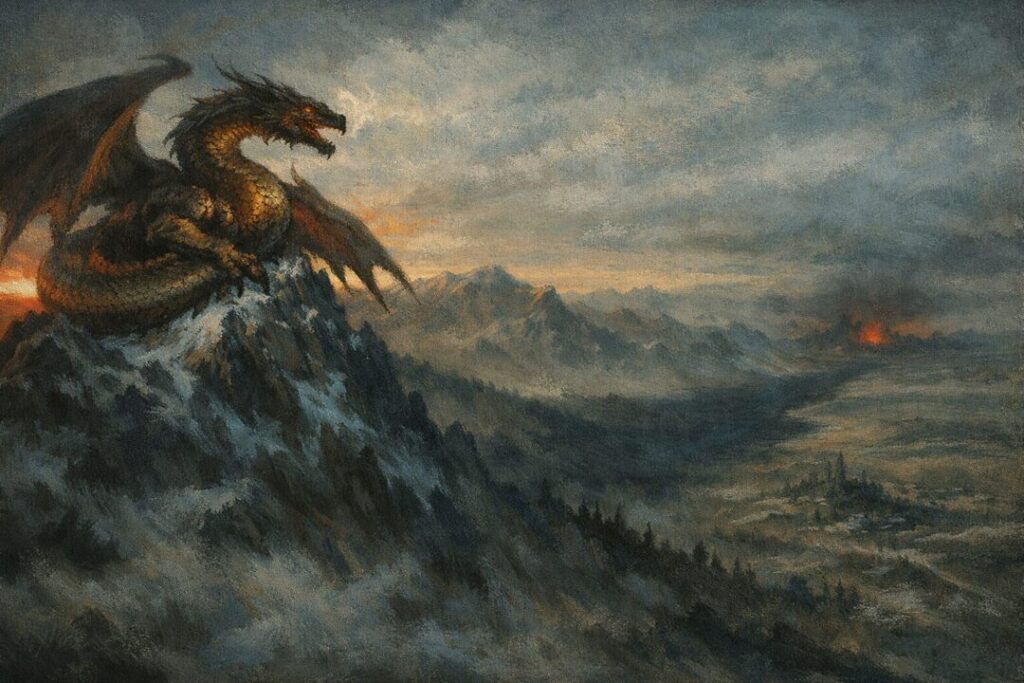
Why Smaug Never Flew South
So why does Smaug never appear in the War of the Ring?
The answer is not strategy or restraint. It is timing.
Smaug dies in the year 2941 of the Third Age. The War of the Ring begins in earnest more than seventy years later. By the time Sauron openly declares himself and moves his armies, the dragon is already gone, slain in a moment that few understood the full importance of at the time.
But imagine a single change.
Imagine Smaug survives the events of The Hobbit.
Suddenly, the entire strategic balance of Middle-earth shifts.
The Collapse of the North
With Smaug alive, Erebor remains fallen. The Dwarves never reclaim their ancestral home. Dale is never restored as a kingdom of Men. The North remains fractured, fearful, and politically irrelevant.
Trade routes collapse. Communication between regions weakens. Refugees spread instability rather than strength. And when the War of the Ring begins, the Free Peoples lose one of their most important—yet often overlooked—advantages.
In the actual timeline, the Men of Dale and the Dwarves of Erebor play a crucial role by holding the northern front. They resist Easterling invasions, prevent enemy forces from sweeping westward unchecked, and ensure that Rivendell and Lórien are not isolated from the rest of Middle-earth.
With Smaug alive, that resistance never forms.
The Easterlings face no organized opposition. The North burns or submits. Rivendell becomes dangerously exposed. Lórien stands alone.
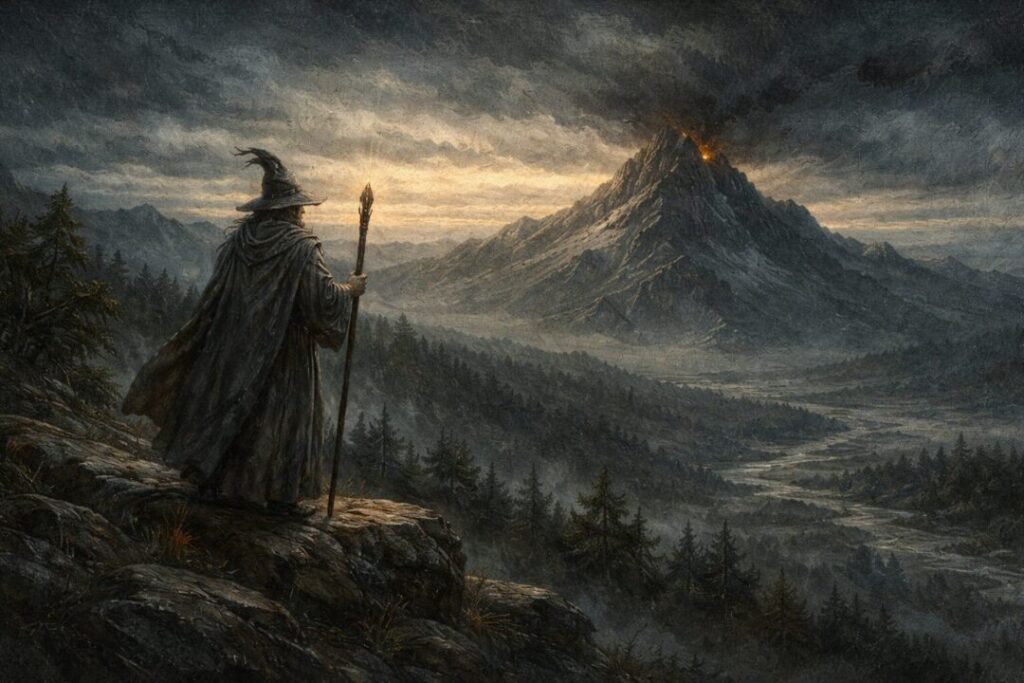
A Dragon Does Not Need Orders
Smaug’s greatest weapon was not his fire.
It was terror.
Dragons do not besiege cities. They annihilate them. No walls in Middle-earth were built to withstand dragon-fire—not in the Third Age. Even Minas Tirith, mighty as it was, was designed to repel armies, not living infernos descending from the sky.
And Smaug would not need to coordinate with Mordor.
All Sauron would need to do is wait.
Every city Smaug destroyed weakened the West.
Every refugee destabilized kingdoms.
Every burned stronghold forced leaders to choose between unity and survival.
Even Rivendell, hidden as it was, would face a threat it had not confronted since the Elder Days. Concealment means little against a creature that can burn forests and valleys on a whim.
Gandalf’s Quiet Intervention
This is why the Quest of Erebor matters far more than it first appears.
Gandalf does not orchestrate the downfall of Smaug out of greed, curiosity, or nostalgia. He does it because a dragon surviving into the War of the Ring is unacceptable.
The Ring cannot be destroyed if Middle-earth is already in flames.
The Quest of Erebor is not a side story—it is a preemptive strike against catastrophe. By removing Smaug decades before Sauron reveals himself, Gandalf eliminates the single greatest wild card on the board.
The War of the Ring becomes a struggle of endurance, sacrifice, and secrecy—not a desperate scramble against annihilation from the sky.
A Victory No One Celebrates
Smaug’s absence from The Lord of the Rings is not a narrative gap.
It is a victory achieved before the war even begins.
Middle-earth does not survive because it is strong enough to face Sauron and a dragon.
It survives because one of those threats is quietly, deliberately removed in advance—without banners, without prophecy, and without most of the world ever realizing what was prevented.
And in a world where hope often survives only through small, unseen choices, that may be one of the most important victories in the entire history of the Third Age.
Sources & Notes
- J.R.R. Tolkien, The Hobbit, “Inside Information” and “Fire and Water” — Smaug’s greed, pride, destructive fire, and death by Bard frame the dragon as a catastrophic rather than governable power.
- J.R.R. Tolkien, The Lord of the Rings, Appendix A, “Durin’s Folk” — records Smaug’s descent on Erebor and Dale in Third Age 2770 and the later restoration made possible by his death.
- J.R.R. Tolkien, Unfinished Tales, “The Quest of Erebor” — Gandalf explains that Smaug could have been used by Sauron with devastating effect, which is the key source for this what-if scenario.
- J.R.R. Tolkien, The Lord of the Rings, Appendix B, “The Tale of Years” — sets Smaug’s death in 2941 against Sauron’s later open war and notes the northern fighting around Dale and Erebor.
- J.R.R. Tolkien, The Letters of J.R.R. Tolkien, Letter 131 — useful background for Sauron’s preference for rule, order, and domination rather than simple destruction.