
Húrin had survived Morgoth’s imprisonment, the destruction of his family, and the loss of almost everything that had once given his life meaning. Yet one of the most consequential moments in his remaining story begins not with a battle, but with a wooden stool thrown across a chieftain’s hall.
Five hundred headmen are required to assemble. A prisoner is brought before a stone of judgment. An accuser must present his charge, a friend may speak for the accused, and ancient customs determine who is permitted to judge.
The gathering is meant to settle one man’s offence. Instead, it becomes the occasion for a political catastrophe that destroys the ruling House of Haleth.
In The Wanderings of Húrin, preserved in The War of the Jewels, Morgoth’s curse does not simply continue through sorrow. It enters the institutions of a frightened community, where lawful judgment gives way to suspicion, factional struggle, and violence.
The Grieving Stranger Who Entered Brethil
Húrin comes to Brethil after years of captivity and suffering. Morgoth has released him, but that freedom is itself part of the Enemy’s malice.
His son Túrin and daughter Niënor are dead. Near the memorial raised for them, Húrin encounters his wife Morwen, exhausted by wandering and grief. She dies beside him.
The discovery turns his anguish toward the people of the forest. Húrin believes that those who lived near the resting place of his children have failed his family.
Yet the people he encounters have suffered terribly themselves. The dragon Glaurung has devastated their land, their former chieftain Brandir has been killed by Túrin, and fear governs much of their remaining life.
When Húrin is discovered near Haudh-en-Elleth, some of the woodmen consider him dangerous. Avranc, son of Dorlas, even proposes killing him before he can cause trouble.
Their captain Manthor prevents this and treats Húrin with greater respect.
The difficulty deepens when Manthor brings him before Hardang, the reigning Halad or chieftain.
Hardang receives the famous warrior without proper courtesy. He offers him no seat until Húrin has been left standing and then sitting on the floor. Húrin answers this humiliation with insults and hurls the stool at Hardang, injuring his forehead.
Hardang has a genuine grievance. But he is also the ruler responsible for ensuring that justice is done.
And among the Haladin, those two roles cannot simply be combined.
Five Hundred Headmen and the Authority of the Folk
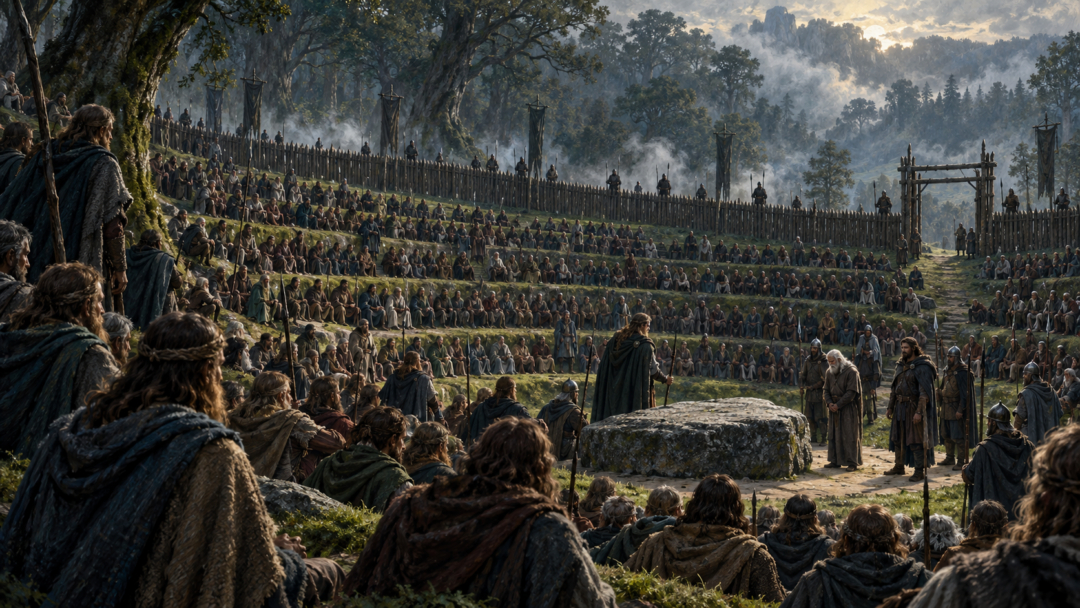
By the custom of Brethil, a full Folkmoot requires at least five hundred headmen. Once that number has arrived, the assembly for Húrin’s judgment can be announced.
By the time proceedings begin, almost a thousand have gathered.
The Moot-ring is a great crescent cut into a hillside. Seven tiers of grassy seating rise around a central floor. A stockade encloses the gathering, with entry through a gate.
At the lowest tier stands the Angbor, the Doom-rock, a great flat stone associated with the chieftain’s seat of judgment.
The accused stands before this stone, facing the assembled people.
Hardang opens the meeting with customary invocations of Manwë and Mandos, reflecting traditions learned from the Eldar. He then uses the old language of his people to declare the assembly formally constituted.
It is identified as the three hundred and first Moot of Brethil.
Even the practical demands of frontier survival matter: many who might otherwise have attended must continue guarding the marches.

Why Hardang Cannot Judge His Own Offence
The ordinary procedure of the Folkmoot is remarkably clear.
When someone is brought to judgment, the Halad presents the accusation. The accused may deny the allegation or offer a defence, personally or through a chosen friend. Witnesses can be summoned where facts remain disputed.
Manthor has already offered to act as Húrin’s friend and counsellor.
But when Hardang begins presenting the charge, Manthor interrupts with a decisive objection.
The chieftain is accusing Húrin of an assault committed against Hardang himself.
Under Haladin law, a man may not preside in judgment over his own grievance.
Manthor appeals to that established rule, and the assembly acknowledges it.
Hardang must surrender the judgment seat for this case.
Manthor cannot take it either, because he has already committed himself to Húrin’s defence.
The chieftain retains the right to appoint a substitute, however, and makes a disastrous choice.
He names Avranc.
Avranc is young, openly hostile to Húrin, and already associated with the suggestion that the stranger should be killed. His appointment offends many of the older headmen.
Although the formal requirement has been met, the selection undermines confidence in the proceedings.
Avranc then presents the accusation in its harshest form.
He portrays Húrin as a dangerous stranger emerging from Angband, possibly acting on Morgoth’s behalf, who deliberately attempted to kill Brethil’s chieftain.
The assault with the stool is transformed into an allegation of murderous intent, potentially deserving death.
Húrin really did strike Hardang. But the wider claims about his allegiance and purpose are not established by that act.
The Fetters and the Drugged Food
The prosecution nearly benefits from Húrin’s refusal to defend himself.
Brought before the Angbor in chains, he will not cooperate. Avranc treats his silence as an opportunity to conclude the case.
Manthor instead challenges the treatment of an uncondemned prisoner.
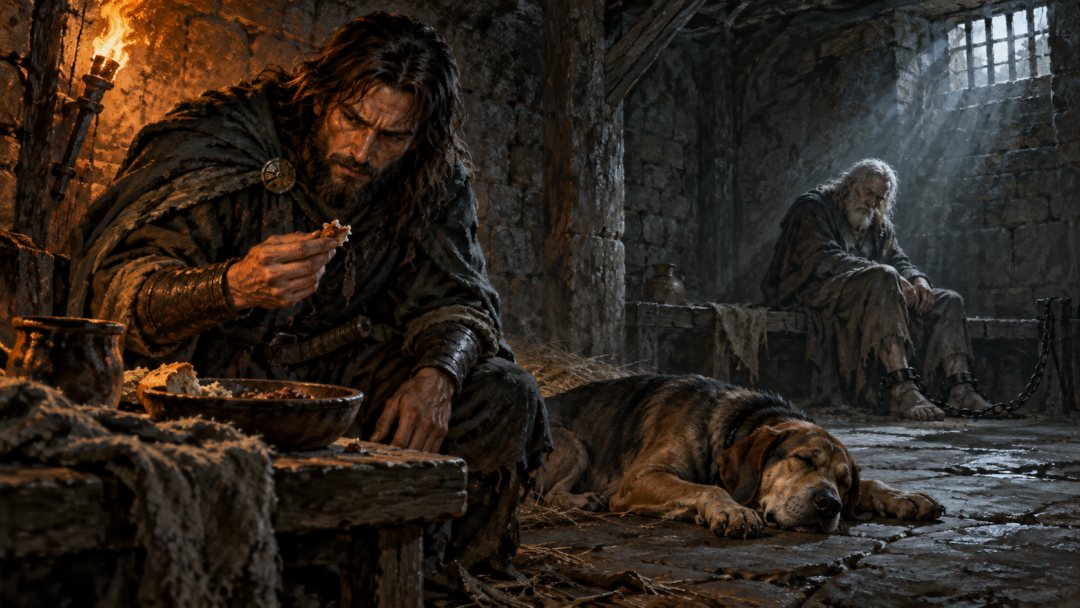
Why has an aged, exhausted, unarmed man been dragged before the assembly in fetters?
The assembled headmen show their displeasure, and Hardang eventually orders the restraints removed.
The incident also reveals another feature of Haladin custom.
For grave or disputed matters, votes may be cast using black and white pebbles, representing opposing choices. A formal count is contemplated, although Hardang removes the need for one by withdrawing his own order.
During his imprisonment, the food given to him has been drugged.
Manthor discovers that the prisoner’s unusual drowsiness is not simply the result of old age or exhaustion. He preserves some of the food and tests it on a hound, which falls into a prolonged sleep.
He then brings this evidence before the assembly.
The text does not establish with certainty that Hardang personally ordered the drugging. Manthor himself allows for the possibility that another person acted to please the chieftain.
Manthor also refuses to pretend that Húrin’s assault never occurred.
His defence rests substantially on provocation, the humiliating reception in Hardang’s hall, and the dishonourable treatment that followed.
The assembly’s sympathy shifts toward Húrin.
When the Prisoner Becomes the Accuser
Manthor’s defence succeeds in winning strong public support for Húrin.
The headmen call for his freedom, and some seek his pardon. Others turn openly against Hardang.
But the legal dispute does not end with a calm, formally completed judgment.
Húrin now addresses the gathering himself.
Instead of merely defending his conduct, he demands an accounting for the deaths and suffering of his family.
He speaks of Túrin and Niënor, then turns to Morwen, whose body he found beside the memorial stone.
Húrin believes she was neglected and left to die. He directs his accusation toward Hardang, interpreting the chieftain’s cruelty toward him as evidence of how Morwen might have been treated.
His grief gives the charge tremendous emotional force.
Yet the crucial allegation is not substantiated.
Afterward, Manthor explains that the people of Brethil have avoided the place of Túrin’s death out of horror and sorrow. He believes Hardang did not know Morwen was there.
The distinction between what Húrin knows and what he assumes has catastrophic consequences.
Morwen truly is dead. Húrin truly has been mistreated. But those facts do not establish that Hardang ordered her abandonment.
The Folkmoot has exposed one injustice, only to become consumed by another accusation that has not been examined.
Hardang retreats before Húrin and the hostile assembly. Some interpret his movement as an admission of guilt.
Others defend him, not necessarily because they approve of his actions, but because they oppose attacking a man before he can answer the charge.
The people who have just asserted Húrin’s right to fair treatment are suddenly divided over whether to extend comparable protection to Hardang.
Manthor tries to stop the violence.
He fails.
The Burning Hall and the End of the House of Haleth
Fighting erupts around the Moot-ring, and the conflict spreads to the Hall of the Chieftains at Obel Halad.
Hardang’s supporters withdraw into the fortified hall. Their opponents besiege it.
Manthor attempts to negotiate a settlement, including a renewed appearance before the Folkmoot. But violence defeats the possibility of another hearing.
The hall is eventually set on fire.
Hardang attempts to escape and is struck by a spear. He dies from his wound, while Avranc escapes.
The assembly began as a demonstration that even a chieftain must obey the law. It ends with the destruction of the chieftain’s seat and the killing of the man who occupied it.
Manthor does not celebrate Hardang’s death. He recognizes that the wrongdoing of the chieftain did not justify the manner of his end.
His defence of Húrin was principled in important respects, but his involvement also exposed the political rivalry surrounding Hardang’s leadership.
When the people call upon Manthor to become chieftain, he insists that the matter must properly be brought before a full Moot.
Even after the catastrophe, he recognizes the difference between public acclamation and lawful appointment.
First, however, he helps arrange the burial of Morwen.
The people who had feared the place of her death finally go there. They honour her, and her grave becomes a place of remembrance rather than only dread.
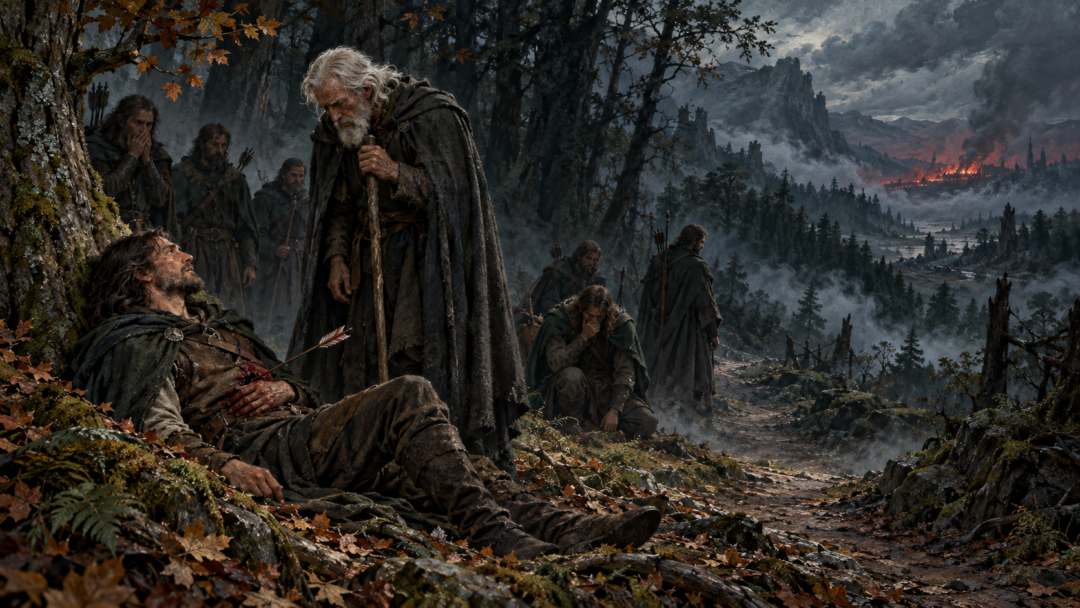
But on the return journey, Avranc shoots Manthor with an arrow.
The wound is fatal.
With Manthor’s death, the narrative declares the House of Haleth ended.
This means the destruction of its ruling line in Brethil, not the immediate extinction of every member of the Haladin people. Survivors remain, but the hereditary house that had led them is gone.
The Forgotten Political Tragedy Behind Húrin’s Wanderings
This detailed sequence belongs to The Wanderings of Húrin, published in The History of Middle-earth, Volume XI: The War of the Jewels.
It was not incorporated into the published Silmarillion. Christopher Tolkien later discussed the difficulty of compressing the elaborate narrative into the form of that book.
The surviving material also contains revisions and abandoned details, so it should not be treated as a finished constitutional history of the Haladin.
Nevertheless, the extended Moot sequence gives an unusually substantial picture of law and public authority among the Edain of the First Age.
That is how the curse reaches beyond Húrin’s household. It becomes a disaster for an entire community, ending not merely in another death, but in the destruction of the political house that had once held the Folk of Haleth together.
Sources & Notes
This article is based on close reading and interpretation of Tolkien's published works and related source material where relevant.