The fall of Sauron feels final.
The One Ring is destroyed. Barad-dûr collapses in fire and ruin. The Dark Tower, raised by centuries of malice and will, is unmade in a single day. For readers, this moment carries an enormous sense of closure—the Shadow is lifted, the war is over, and Middle-earth is saved.
And yet Tolkien never says that the Orcs simply disappear.
This absence is striking. After all, Orcs were the most visible instruments of Sauron’s power. They filled his armies, guarded his borders, and carried out his will across Middle-earth. If Sauron fell, surely they fell with him.
But the text of The Lord of the Rings tells a quieter, far more unsettling story—one rooted not in sudden annihilation, but in fear, dependence, and slow decay.
Orcs Did Not Die When Sauron Fell
At the Battle of the Morannon, Tolkien gives us our clearest picture of what happens when Sauron’s will is finally removed from the world.
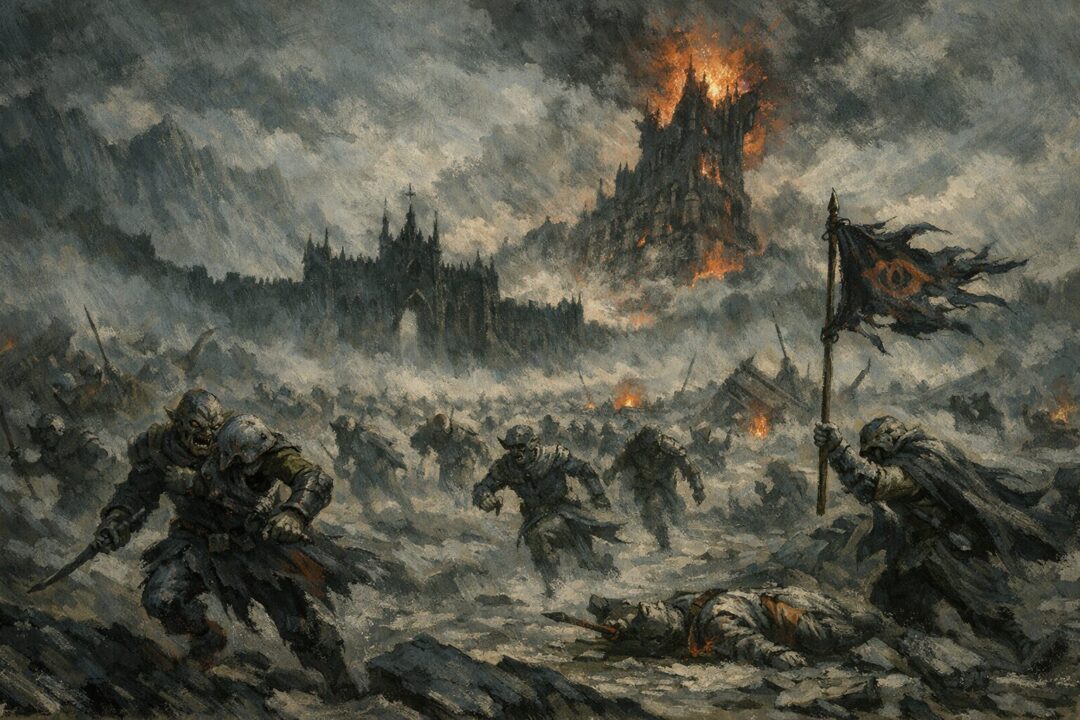
When the Ring is destroyed and the Dark Lord’s power collapses, his armies do not vanish. Instead, they react like creatures whose inner structure has been ripped away.
Some Orcs flee in blind panic.
Some throw themselves into pits or rivers.
Others sit down, weeping or staring into nothing, as if all meaning has drained from them.
This reaction matters deeply.
If Orcs were sustained purely by magic—if they were animated extensions of Sauron’s power, like the Ringwraiths—then they would have perished instantly. But they do not. They survive the moment of his fall, even if they cannot endure its consequences.
This tells us something essential: Orcs were not created as automatons. They were living beings, capable of fear, pain, resentment, and despair. Sauron did not keep them moving through enchantment alone. He ruled them through domination.
When that domination vanished, what followed was not death.
It was collapse.
The Nature of Orc Obedience
Throughout the story, Orc society is shown to be brutally hierarchical. Power flows downward through fear. Orders are enforced by whips, threats, and violence. There is no loyalty in the human sense—only survival.
Orcs obey because they are terrified.
And Tolkien repeatedly shows us what happens when that terror weakens.
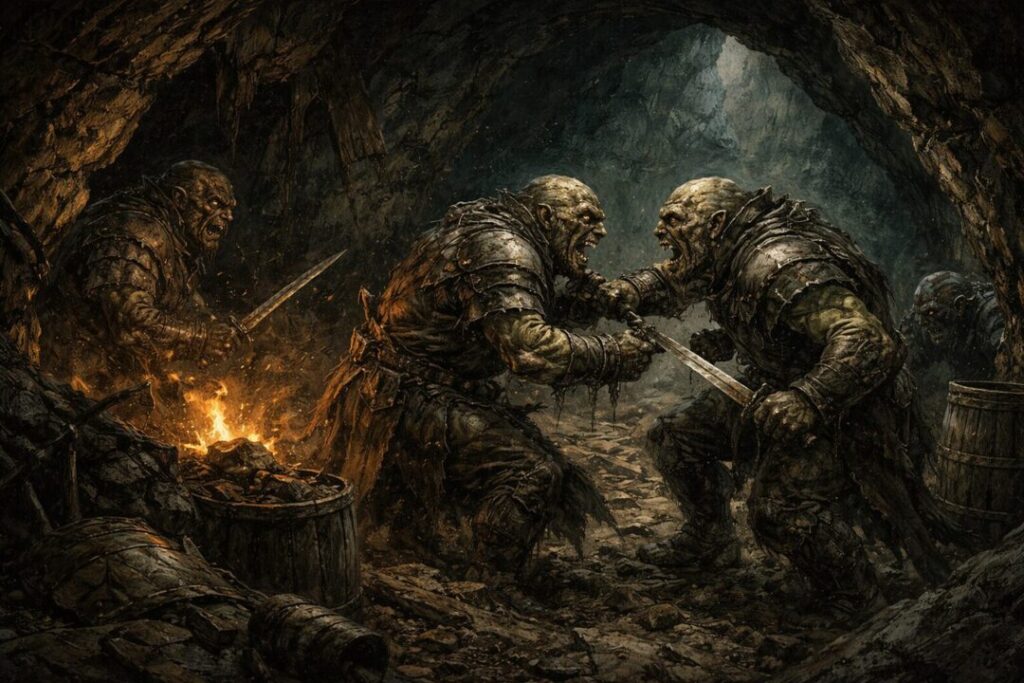
Even while Sauron still rules, Orcs constantly betray one another. They argue, steal, lie, and kill over scraps of authority or loot. In Mordor, Shagrat and Gorbag openly plot against each other while still nominally serving the same master. Their conversation reveals a deep resentment of distant overlords and an instinctive desire to escape domination—if only they could.
But that desire is never paired with the ability to build anything better.
Orc society has no foundation except fear.
So when Sauron falls, that fragile structure disintegrates almost instantly.
There is no central command.
No shared goal.
No reason to endure hardship together.
What remains are scattered bands of creatures who have never learned cooperation without coercion.
The Loss of Purpose
One of the most tragic aspects of the Orcs’ fate is that they are not merely defeated—they are purposeless.
For generations, Orcs were bred and trained for war. Their identity, such as it is, revolves entirely around serving a Dark Lord’s designs. They do not farm in any sustainable sense. They do not create enduring cultures. They do not imagine futures beyond conquest or survival.
When Sauron’s will is gone, they are left with nothing to replace it.
Freedom does not liberate them.
It paralyzes them.
This is why Tolkien describes some Orcs as simply stopping—sitting down, refusing to move, or giving themselves up to despair. Their world has not been destroyed physically, but it has been emptied of meaning.
Survival in the Fourth Age
Tolkien never describes a final war in which the Free Peoples wipe out the Orcs completely. There is no genocidal campaign, no cleansing fire sweeping across Middle-earth.
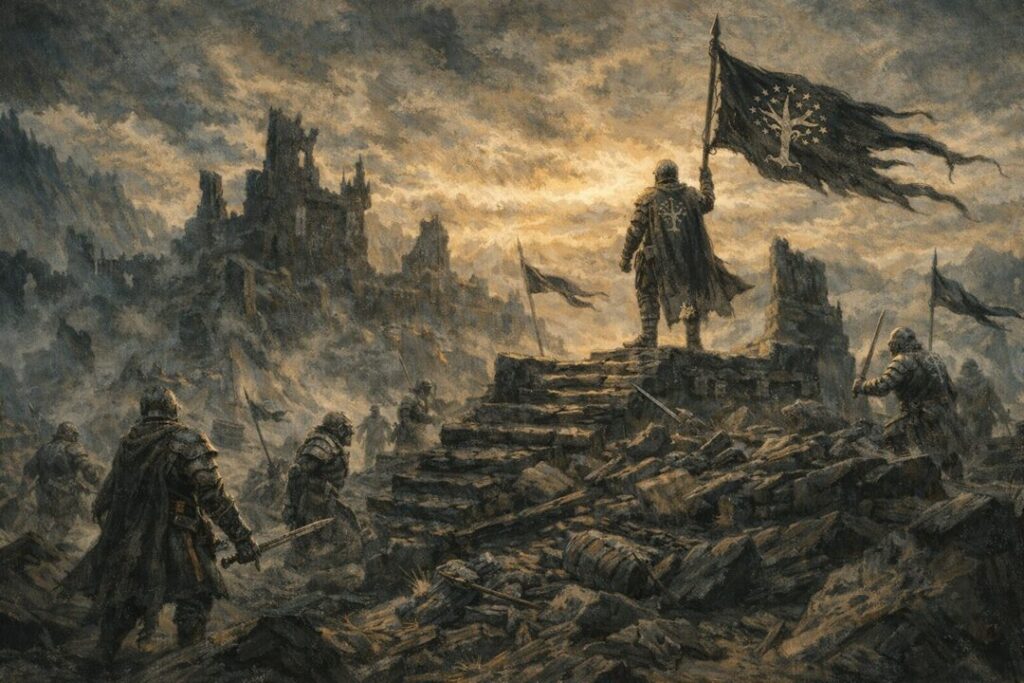
Instead, we are told that the reign of King Elessar focuses on restoring order, rebuilding lands, and driving hostile creatures from places where they threaten others.
This implies something far more restrained—and far more consistent with Tolkien’s moral vision.
Orcs were hunted when they attacked.
They were driven out of reclaimed regions.
They were denied the ability to gather into armies again.
But they were not erased from existence.
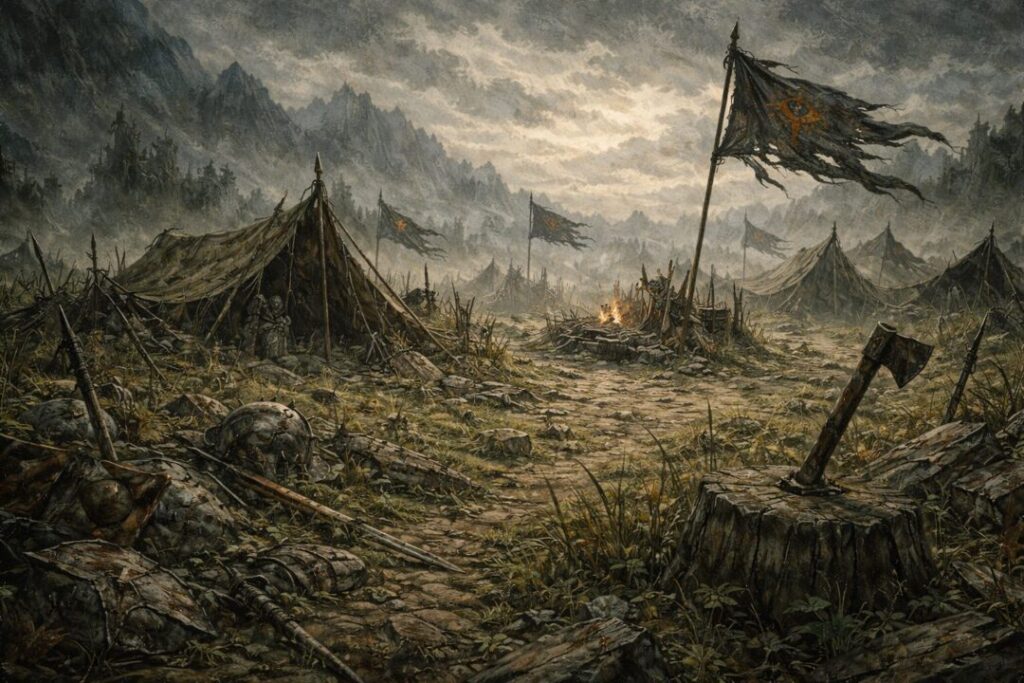
In remote regions—deep mountains, abandoned tunnels, dark forests—small bands survived. Leaderless. Quarrelsome. Diminishing.
Without Dark Lords to organize them, Orcs could no longer shape history. They became a problem to be managed, not a force to be feared.
This is not a triumphant ending.
It is a slow withering.
No Redemption, No Healing
Just as important as what does happen to the Orcs is what does not happen.
Orcs are not redeemed.
They are not cured.
They are not shown choosing a better way of life.
Tolkien is explicit that their corruption runs too deep. Whatever their distant origins may have been, they have been twisted beyond recovery. Even when they speak of escape from tyranny, they imagine only smaller tyrannies of their own.
Their end is not noble.
It is not dramatic.
It is not even especially just.
It is ignoble.
They fade because they cannot endure freedom.
Why Tolkien Leaves Their Fate Unfinished
Tolkien avoids neat moral closure. Evil, in his world, is not always destroyed in a single, satisfying stroke. More often, it is weakened, scattered, and rendered incapable of ruling others.
The fate of the Orcs mirrors this philosophy.
They are not a puzzle to be solved or a moral debt to be balanced. They are a warning.
A people shaped entirely by domination cannot survive when domination collapses.
This is why Tolkien does not linger on their end. To do so would shift the story’s focus away from healing, renewal, and humility—and toward vengeance or spectacle.
Middle-earth moves on.
Not cleansed of darkness entirely.
Not free of suffering.
But no longer ruled by it.
That is Tolkien’s ending.
Quiet.
Uneasy.
And profoundly human.
Sources & Notes
- J.R.R. Tolkien, The Lord of the Rings, Book VI, Chapter 4, “The Field of Cormallen” — shows Sauron’s armies breaking after the Ring’s destruction; Orcs and other servants panic, flee, or destroy themselves rather than simply vanish.
- J.R.R. Tolkien, The Lord of the Rings, Book VI, Chapter 1, “The Tower of Cirith Ungol” — Shagrat and Gorbag’s quarrels, plotting, and resentment reveal Orc obedience as fear-driven and unstable even before Sauron falls.
- J.R.R. Tolkien, The Lord of the Rings, Book III, Chapter 3, “The Uruk-hai” — the rival Mordor, Isengard, and northern Orcs show factional loyalties and coercive discipline, supporting the article’s point that Orc society was not a unified moral community.
- J.R.R. Tolkien, The Silmarillion, “Of the Coming of the Elves and the Captivity of Melkor” — gives the traditional account of Orcs as beings bred and corrupted by Morgoth long before Sauron, so their existence is not dependent on Sauron’s survival.
- J.R.R. Tolkien, The Lord of the Rings, Appendix A, “Annals of the Kings and Rulers: The Tale of Aragorn and Arwen” — frames the Fourth Age around Elessar’s restoration of order and renewed kingdoms, not a narrated extermination of every surviving Orc.