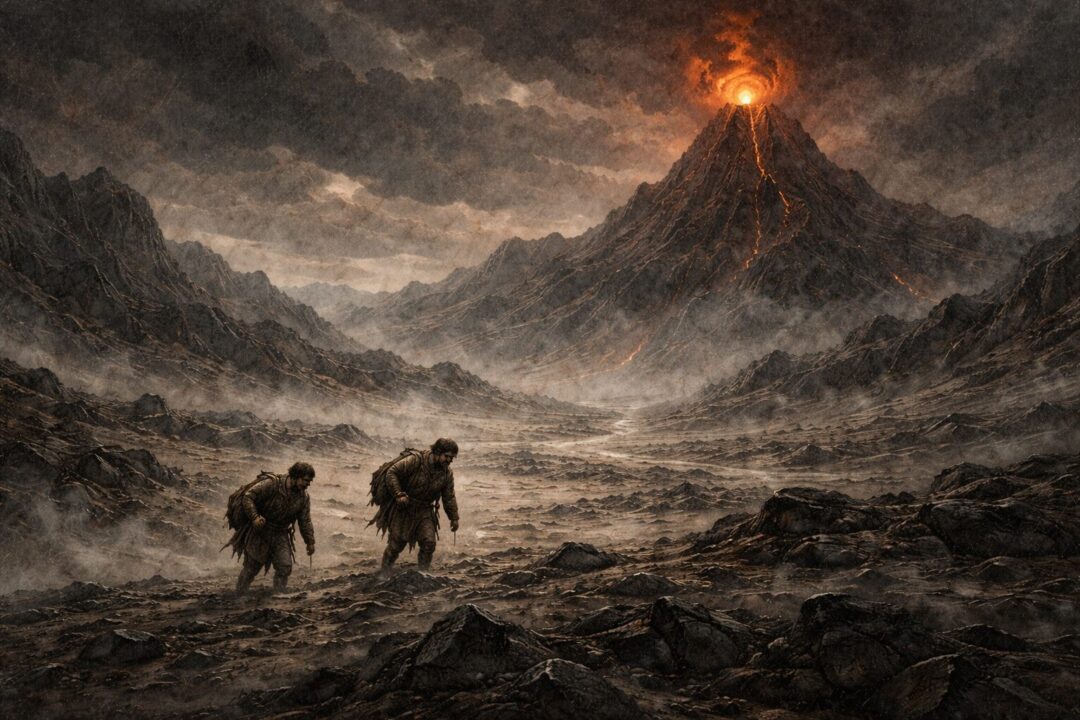
It is easy to assume that Sauron lost the War of the Ring because he was outmaneuvered, outnumbered, or undone by his own arrogance.
After all, his armies were vast, his fortresses rebuilt, his spies everywhere. He dominated much of Middle-earth through fear alone. When the final battles come, the Free Peoples stand on the edge of annihilation.
And yet, Sauron falls.
Not because his plans failed—but because they never accounted for the way the war would actually be won.
Sauron’s failure in The Lord of the Rings is not primarily a military or strategic mistake. It is a philosophical one.
From the moment the One Ring is lost at the end of the Second Age, Sauron’s thinking becomes fixed around a single, unexamined assumption: power will always be contested by power.
This belief shapes every decision he makes throughout the Third Age. It determines where he looks, whom he fears, and—most importantly—what he never considers possible.
Sauron’s View of Power
Sauron is not chaotic. He is not impulsive. He is not a mindless force of destruction.
He is, above all else, a planner.
Even before his rise as the Dark Lord, Sauron was defined by his love of order. He believes the world is meant to be structured, regulated, and dominated by a single will. To him, chaos is not freedom—it is inefficiency.
Power, therefore, exists for one purpose: to be exercised.
In Sauron’s mind, strength that is not used is wasted. Authority that is not enforced is meaningless. Dominion that is not expanded is weakness.
This is the lens through which he understands every being in Middle-earth.
Kings seek thrones.
Lords seek mastery.
The mighty seek control.
No one, in his worldview, would ever choose restraint if domination were possible.
This is why the One Ring is, to Sauron, not merely a weapon but a necessity. It is the perfect expression of his philosophy: a tool that concentrates power, enforces obedience, and allows a single will to command many.
The Ring does not tempt him. It confirms him.
To Sauron, the Ring is not dangerous because it corrupts. It is valuable because it reveals the truth of the world as he understands it: that power defines destiny.
Why Destruction Never Truly Enters His Mind
The idea that the One Ring could be destroyed requires a mindset Sauron simply does not possess.
To destroy the Ring is not a strategic decision—it is a moral one.
It requires valuing freedom over control.
Sacrifice over victory.
Endurance over domination.
These are not just foreign values to Sauron; they are incomprehensible.
Even among the Wise, the notion of unmaking the Ring is treated with hesitation and dread. It is unprecedented. No being in Middle-earth has ever willingly destroyed an object of absolute power when claiming it was possible.
The Ring offers strength, authority, and the chance to reshape the world. To refuse that offer is, in Sauron’s understanding, irrational.
So he never plans for it.
Instead, Sauron assumes what he always has: that the Ring will be used.
By Gondor, to restore its ancient power.
By Aragorn, to claim kingship through force.
By some rival who believes they can master the Ring and overthrow him.
This assumption explains many of Sauron’s most puzzling decisions.
It explains why Mount Doom—the only place where the Ring can be destroyed—is left unguarded.
Not because it is unimportant, but because it is unthinkable that anyone would go there for that purpose.
Sauron defends against armies.
He defends against challengers.
He does not defend against renunciation.
Aragorn as the Perfect Confirmation
When Aragorn reveals himself through the palantír, Sauron’s worldview is not challenged—it is validated.
Here is a king.
Here is ancient lineage.
Here is ambition and authority made visible.
To Sauron, Aragorn’s emergence confirms everything he expects from his enemies. Of course the heir of Isildur would seek the Ring. Of course he would attempt to wield it quickly, before Sauron’s power grows too great.
From this moment on, Sauron interprets every action through that assumption.
The sudden boldness of Gondor.
The mustering of the West.
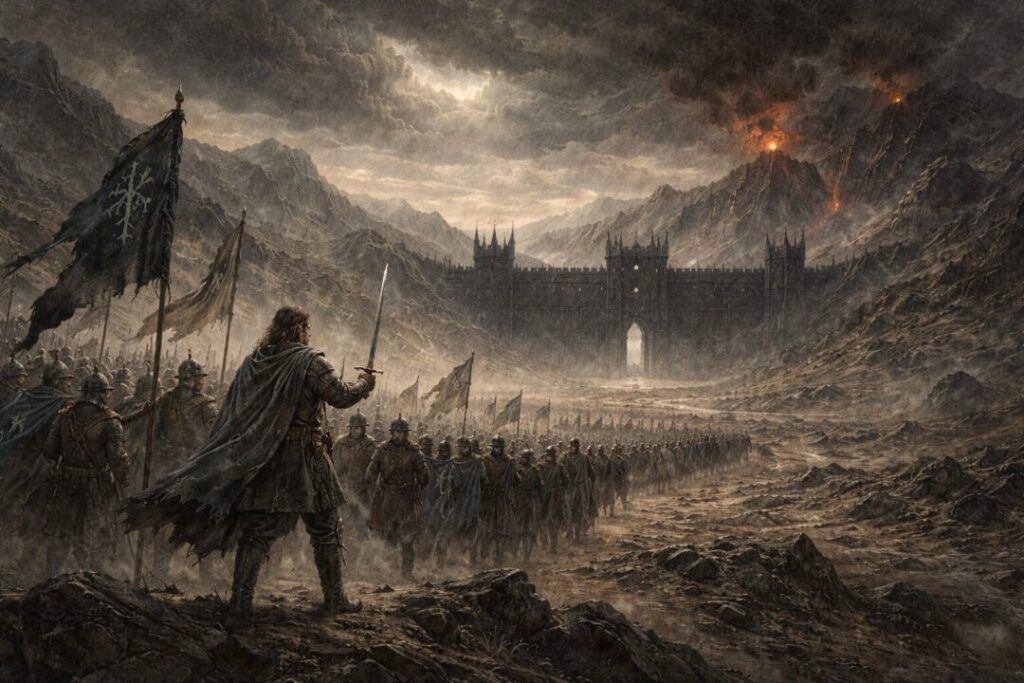
The march on the Black Gate.
To Sauron, this can only mean one thing: the Ring has been claimed, and its bearer is overconfident.
This belief leads to his greatest miscalculation.
He empties Mordor.
Not recklessly, but deliberately—drawing his forces out to crush what he believes is the final confrontation between rival powers.
The march on the Black Gate is not a bluff to Sauron. It is proof.
And in focusing on that proof, he looks everywhere except the path that truly matters.

Why Hobbits Were Invisible to Him
Hobbits are not merely small in stature. They are small in ambition.
They do not seek power.
They do not desire domination.
They do not dream of ruling others.
To Sauron, this makes them irrelevant.
His attention is always drawn upward: toward kings, lords, generals, and warriors. These are the figures who matter in a world defined by conquest.
Hobbits endure quietly.
They survive rather than conquer.
They value home over empire.
This is why Frodo Baggins remains invisible to Sauron for so long.
Frodo’s strength is not physical resistance, nor military skill. It is the capacity to carry a burden without seeking to transform it into power over others.
This kind of strength does not register in Sauron’s understanding of the world.
Even when danger is sensed, it is misinterpreted. The movement of the Ring is assumed to be toward use, not destruction. The presence of Hobbits is assumed to be incidental, not essential.
Only at the very end—when the Ring is claimed within Mount Doom—does Sauron finally perceive the truth.
And by then, there is no time left to act.
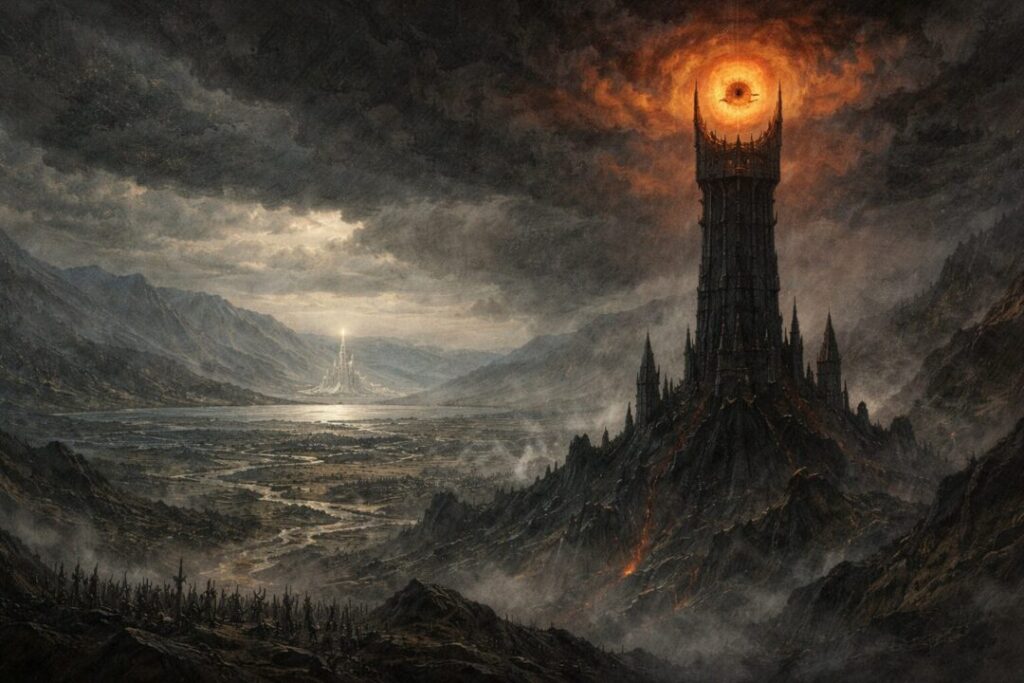
The Tragedy at the Heart of Sauron’s Defeat
Sauron does not fall because he lacks strength.
He does not fall because his enemies outfight him.
He falls because he cannot imagine a world in which power is refused.
The tragedy of Sauron is not that he is evil—but that he is limited by his own certainty. His worldview is so rigid, so internally consistent, that it blinds him to the one form of resistance he cannot counter.
Humility.
Patience.
Endurance without domination.
The Ring is not destroyed through mastery, but through rejection.
Victory is achieved not by seizing power, but by letting it go.
In the end, Sauron loses not to armies, but to a moral reality he cannot comprehend.
And that is the deepest irony of the War of the Ring.
The Dark Lord prepared for conquest.
He prepared for rebellion.
He prepared for defeat at the hands of a rival king.
But he never prepared for the possibility that the world might choose freedom over power.
And because of that, he never truly expected the way the war would end.
Sources & Notes
- J.R.R. Tolkien, The Silmarillion, “Of the Rings of Power and the Third Age” — Sauron forges the One Ring to dominate the other Rings and bend their bearers to his will.
- J.R.R. Tolkien, The Lord of the Rings, Book II, Chapter 2, “The Council of Elrond” — the Wise reject using the Ring and choose the seemingly hopeless road of destroying it in Orodruin.
- J.R.R. Tolkien, The Lord of the Rings, Book V, Chapter 9, “The Last Debate” — Gandalf explains that Sauron will read Aragorn’s challenge as a rival Ring-lord moving too soon.
- J.R.R. Tolkien, The Lord of the Rings, Book VI, Chapter 3, “Mount Doom” — only when Frodo claims the Ring in the Fire does Sauron finally perceive the true danger.
- J.R.R. Tolkien, Letter 131 — Tolkien describes Sauron’s fall into a will to order and control, clarifying the philosophical root of his domination.