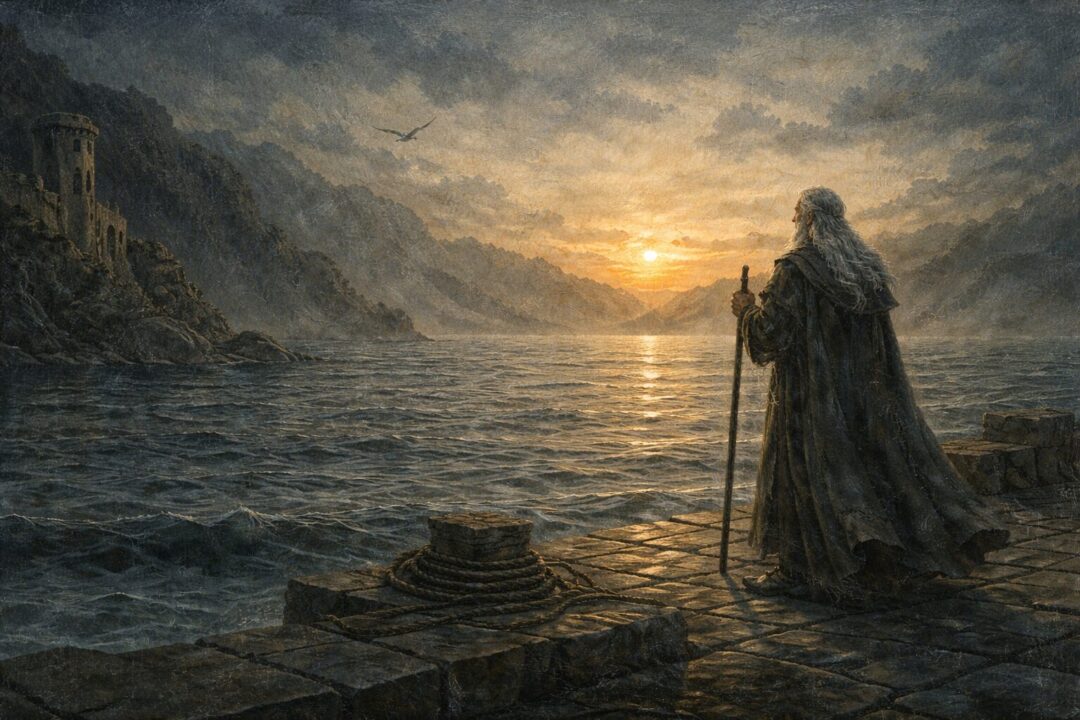
When the Third Age ends, Middle-earth begins to empty of its oldest voices.
The Rings of Power lose their strength. The Straight Road opens once more. The long decline of the Elves reaches its final turning point, and the world quietly passes into the hands of Men.
Elrond departs from Rivendell, carrying with him the memory of ancient wars and the wisdom of ages. Galadriel leaves Lórien, her power diminished but her task complete. One by one, the bearers of the Three Rings pass west over the Sea, knowing they will never return to the lands they helped preserve.
This is not portrayed as a tragedy. It is not a defeat. It is the natural ending of a story that has been unfolding since the Elder Days.
And yet, one Elf does not board a ship.
Círdan remains.
This choice is never dramatized. There is no speech explaining it. No farewell scene framed as momentous. The text does not linger on his decision or call attention to its significance. We are simply told that Círdan stays at the Grey Havens while others depart.
But once we understand who Círdan truly is—and what his role has always been—this quiet decision becomes one of the most meaningful acts in the entire history of Middle-earth.
Who Círdan Really Is
Círdan is not a minor figure who happens to be present at the end of the story.
He is one of the oldest Elves still remaining in Middle-earth at the close of the Third Age—older than Galadriel, older than Elrond, and among the very first of the Elves to awaken beside the waters of Cuiviénen before the rising of the Sun and Moon.
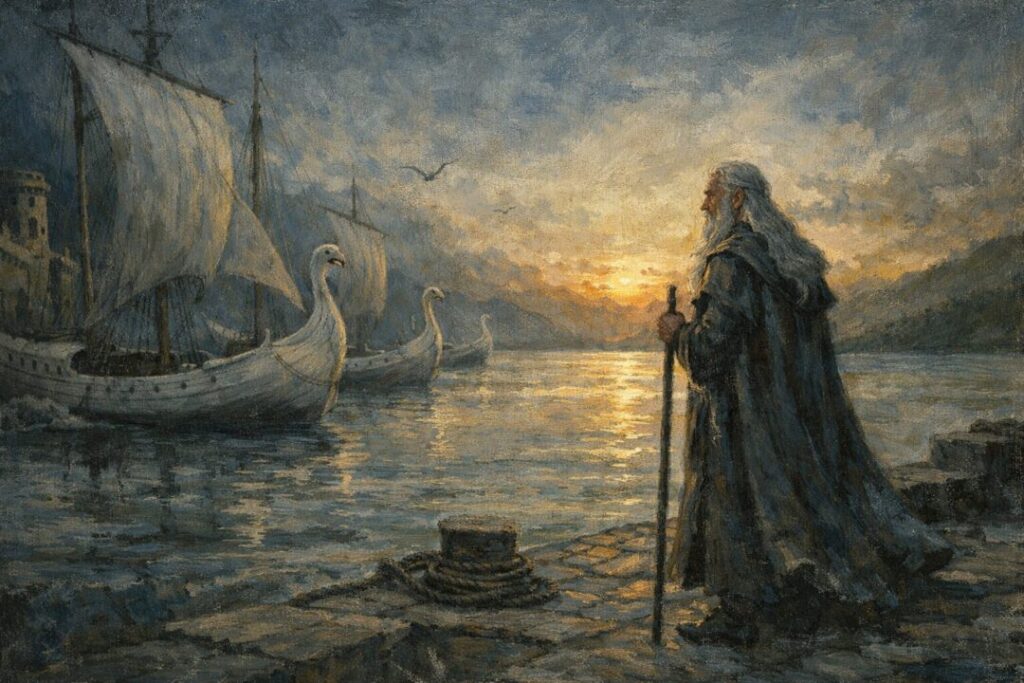
While many of the Eldar journeyed west to Valinor in the earliest days, Círdan remained. He became lord of the Falas, the western shores, and later the Grey Havens. His realm was not marked by towering cities or glittering courts, but by harbors, ships, and the endless sound of the Sea.
Unlike many of his kin, Círdan never sought dominion, conquest, or renown. He did not found a great inland kingdom or carve his name into the great battles of the First Age. His calling was quieter, but no less ancient.
He was a keeper of borders.
From the very beginning, Círdan’s role was liminal. He stood at the threshold between Middle-earth and the West, between what had been and what would soon pass away. He was not a ruler of lands, but a guardian of passages.
This is why the Grey Havens exist at all.
They are not merely ports or shipyards. They are the final door out of Middle-earth—the last place where the immortal may linger before leaving the world behind.
The Keeper Who Does Not Go
By the end of the Third Age, the purpose of the Grey Havens appears, at first glance, to be fulfilled.
The Ring has been destroyed. The power that preserved the Elven realms is gone. The ships are ready. The Straight Road lies open.
Everything suggests that it is time for Círdan to depart.
And yet, he does not.
Why?
Because his task was never to leave first.
Círdan’s role has always been to remain while others go—to wait while the long exodus unfolds, ensuring that no one who must leave is left behind without guidance or passage. He is the last witness of an age, not its final celebrant.
This patience defines his character more than any deed of arms ever could.
Where others act, Círdan endures.
He does not resist the passing of the Elves. He facilitates it. He does not cling to the past. He tends it until it is ready to be released.
In this way, Círdan embodies a kind of greatness that Tolkien consistently elevates: not the greatness of domination, but the greatness of stewardship.

Círdan and the Ring of Fire
Nowhere is this clearer than in Círdan’s relationship with Gandalf.
When the Istari first arrive in Middle-earth, appearing as old men clothed in humility, it is Círdan who immediately perceives who Gandalf truly is. While others see only a wandering Wizard, Círdan recognizes his inner nature and the burden he will bear.
Without being asked—and without explanation—Círdan gives Gandalf Narya, the Ring of Fire.
This moment is easy to overlook, but it is extraordinary.
Círdan is one of the last rightful bearers of a Ring of Power. He could have kept it, preserving his own strength and authority in a fading world. Instead, he relinquishes it freely, trusting that its power is better placed in the hands of one whose task is to kindle hope in others.
This single act reveals everything about Círdan.
He does not seek the center of the story.
He does not claim power meant for preservation.
He recognizes when his role is to step aside.
Círdan enables history rather than shaping it directly.
Why Círdan Cannot Leave Yet
Círdan’s refusal to depart is not an act of defiance against fate. Nor is it hesitation born of fear or nostalgia.
It is submission to responsibility.
Someone must remain while the world changes hands.
Someone must witness the ending—not as a hero or a conqueror, but as a caretaker. The passing of the Elves is not a single moment but a long, gradual fading, and Círdan’s presence ensures that it happens with dignity rather than abandonment.
As long as there are Elves who hesitate, who linger, who are not yet ready to leave the lands they love, Círdan’s place is at the shore.
Only when the last ship sails—only when there is no one left to guide—can he finally follow.
The text implies, quietly but clearly, that one day he will.
But not yet.
The Last Elf of the Old World
Círdan embodies one of the deepest themes running through Tolkien’s legendarium: that true greatness often lies in service that goes unnoticed.
He does not fight in the War of the Ring.
He does not rule a realm of beauty or power.
He does not even depart when it would be easiest to do so.
Instead, he waits.
In doing so, Círdan becomes something rare in Tolkien’s world: a figure who does not resist change, but shepherds it. He accepts that the Age of the Elves is ending and that his task is not to prevent that ending, but to see it through with care.
Middle-earth does not end in fire or cataclysm.
It does not collapse beneath the weight of its history.
It ends quietly.
With ships departing west.
With the Sea calling softly.
And with one ancient Elf remaining behind to close the door.
That Elf is Círdan.
And in his waiting, Tolkien offers one of his most subtle truths: that the end of an age is not marked by those who leave first—but by those who stay until there is nothing left to guard.
Sources & Notes
- J.R.R. Tolkien, The Lord of the Rings, Appendix B, “The Tale of Years”: Círdan remains at the Grey Havens and is said to stay there until the Last Ship sails.
- J.R.R. Tolkien, The Lord of the Rings, Book VI, Chapter 9, “The Grey Havens”: Elrond, Galadriel, Gandalf, Frodo, and others depart west from Círdan’s havens.
- J.R.R. Tolkien, The Silmarillion, “Of the Sindar”: Círdan is established as lord of the Falas and a maker and keeper of ships on the western shore.
- J.R.R. Tolkien, Unfinished Tales, “The Istari”: Círdan perceives Gandalf’s hidden stature and gives him Narya, the Red Ring, to aid his mission.
- J.R.R. Tolkien, The Silmarillion, “Of the Rings of Power and the Third Age”: the Three Rings fade after the One is destroyed, leading to the departure of their bearers over the Sea.