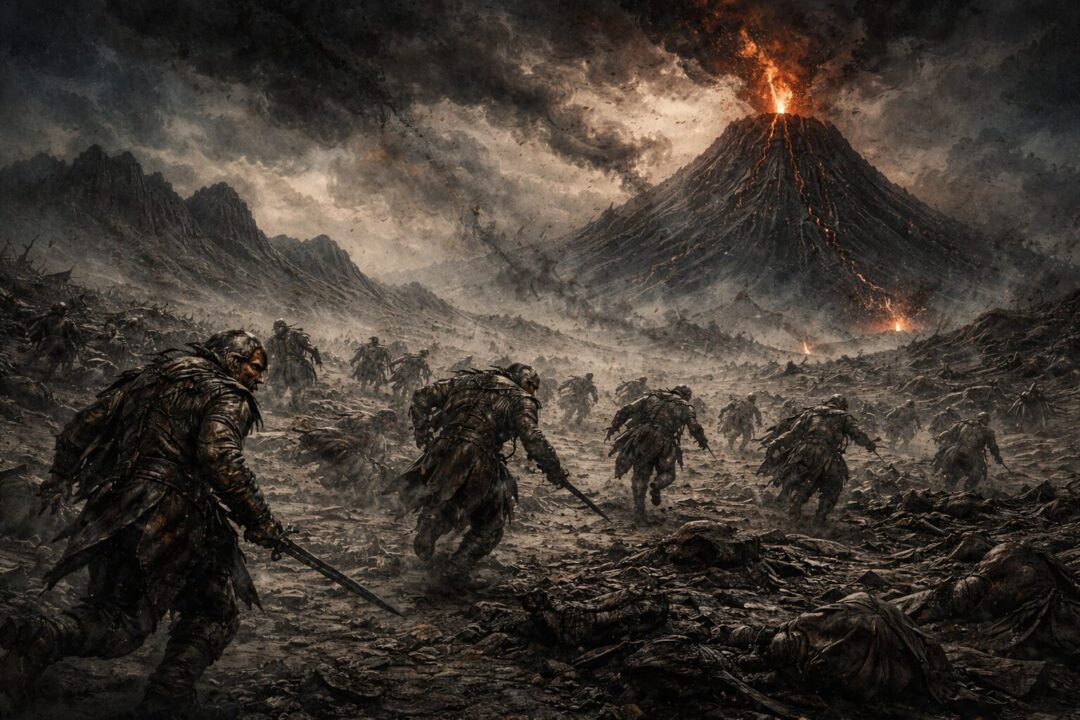
When the One Ring is destroyed and Sauron is overthrown, readers naturally expect closure.
Barad-dûr falls.
The Eye collapses into nothing.
The Captains of the West stand victorious before the Black Gate.
It feels final. Complete. Clean.
But Tolkien never describes Mordor as suddenly empty.
And that omission is not an accident.
Throughout The Lord of the Rings, Tolkien is meticulous with language—especially when describing the aftermath of great evils. He tells us exactly what ends, and just as importantly, what does not.
The Shadow passes.
But the land remains.
Understanding why Mordor was never truly empty requires looking beyond the fall of Sauron as a single moment and instead seeing Mordor as Tolkien presents it: not merely a throne-room of evil, but a scarred, inhabited, long-occupied land shaped by centuries of domination.
Mordor Was More Than Sauron’s Throne
It is tempting to think of Mordor as nothing more than Sauron’s personal domain—a place animated solely by his will, collapsing the instant that will is broken.
But the text does not support this.
Mordor is not just a battlefield. It is a system.
By the time of the War of the Ring, Mordor contains:
- Fortified cities and strongholds
- Roads engineered for mass troop movement
- Watchtowers and garrisons
- Slave camps and work-forges
- Agricultural zones in the south and east
- Long-established supply routes
This is not the infrastructure of a temporary occupation. It is the framework of an empire.
Mordor has been shaped, reshaped, and inhabited for centuries—first under Morgoth’s shadow in the ancient world, and later under Sauron’s direct rule. Entire generations of Orcs are born there. Men from the East and South are brought into its orbit. Systems of fear and obedience become normalized.
That matters.
Empires do not vanish just because the throne falls.
They fracture. They decay. They linger.
What Tolkien Actually Says Happens
When the Ring is destroyed, Tolkien is precise—and restrained.
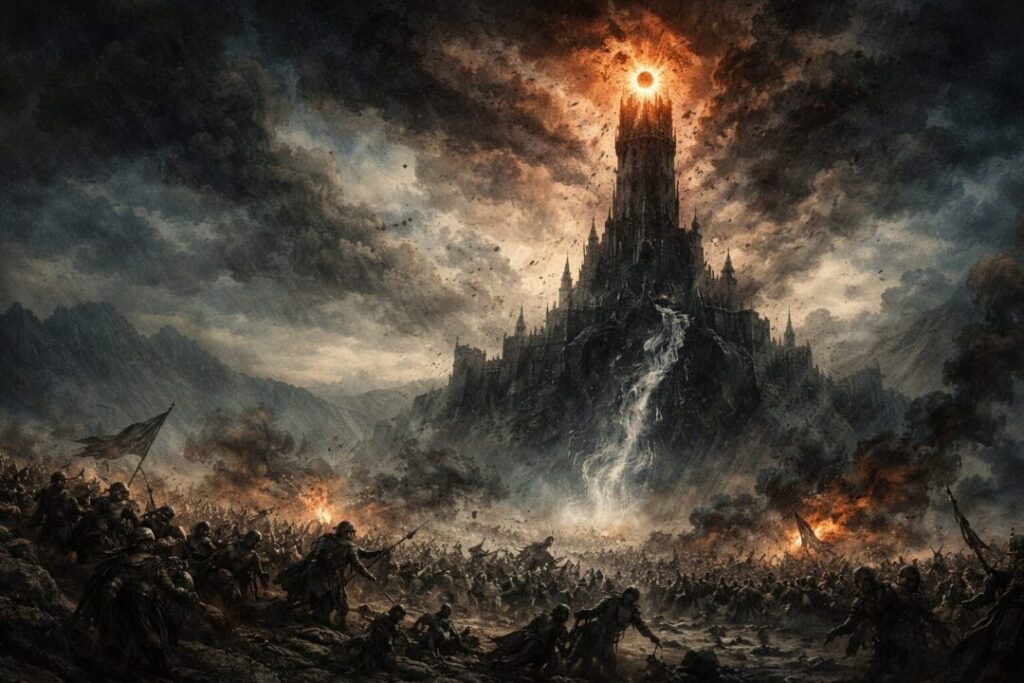
He does not describe a cleansing fire sweeping the land. He does not say that Mordor is emptied or purified. Instead, he describes chaos.
Armies break.
Formations collapse.
Command disintegrates.
Many of Sauron’s servants are driven mad by terror as the will that dominated them vanishes. Some throw themselves into pits or flames. Others flee in blind panic, scattering without direction or leadership.
But Tolkien is equally clear about something else:
Not all perish.
Some escape eastward, beyond the immediate reach of Gondor.
Some hide in the ruins and ash-fields.
Some simply survive, leaderless and afraid, but alive.
There is no passage stating that Mordor is “cleared.”
No declaration that the land is emptied of all its inhabitants.
The victory Tolkien describes is moral and spiritual—not geographical.
The Eye is gone.
The Shadow is lifted.
But the land remains poisoned by history.
Orcs Without a Master
One of Tolkien’s most uncomfortable truths is that Orcs do not disappear when evil is defeated.
They are creatures shaped by Morgoth and Sauron—twisted, brutal, and cruel—but they are also living beings. They eat. They argue. They fear. They survive.
Throughout the legendarium, Tolkien shows us that Orcs do not require constant supervision to exist. They require it to be unified.
Without a master’s will binding them, Orcs revert to patterns seen again and again in Middle-earth’s history:
- Infighting
- Fragmentation into rival bands
- Raiding nearby lands
- Retreat into inaccessible places
- Gradual decline rather than sudden extinction
This is why Aragorn’s victory does not mean an end to war.
The Fourth Age is more peaceful—but not naive.
Evil remnants must be hunted. Borders must be guarded. Peace must be enforced.
Tolkien does not romanticize this necessity. He presents it as the cost of history.
Mordor After the War
What, then, becomes of Mordor?
Tolkien offers hints rather than a full account—and those hints are telling.
Mordor does not become a thriving kingdom.
It is not resettled or redeemed.
It is not healed like the Shire.
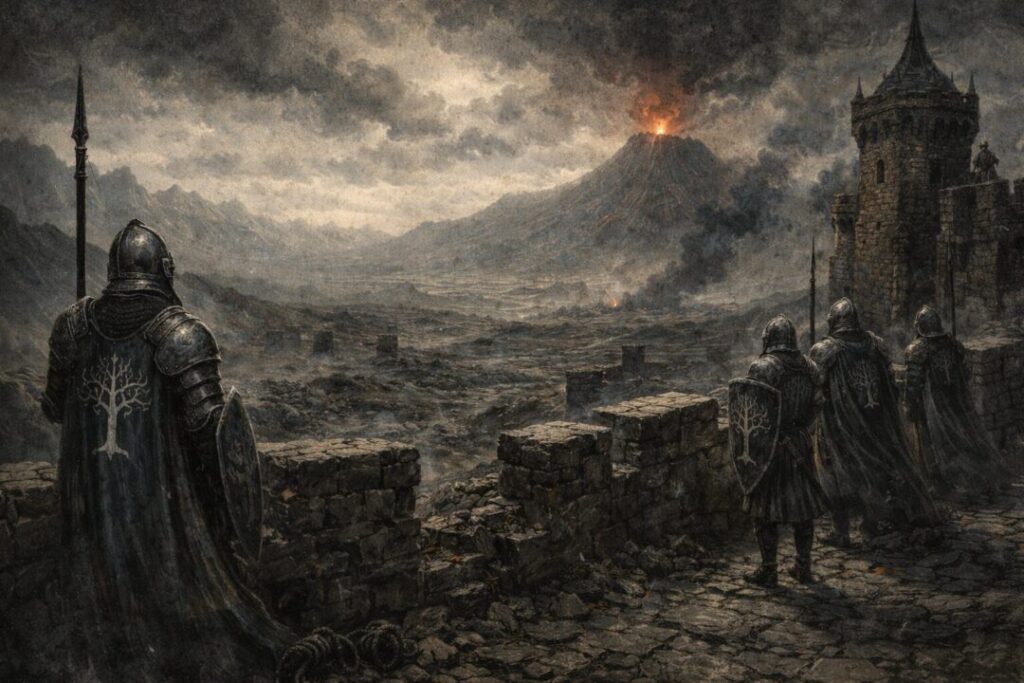
Instead, it becomes something closer to a quarantined wasteland.
Gondor watches it.
The borders are secured.
The land is largely left untouched.
This is not mercy—it is realism.
Mordor is too damaged, too corrupted, too bound to the memory of domination to be easily reclaimed. Tolkien never suggests that every place must be healed, or even can be.
Some lands bear the cost of evil longer than others.
Why Mordor Is Not Healed Like the Shire
The contrast between Mordor and the Shire is deliberate.
The Shire is wounded by Saruman’s petty tyranny, but it can be restored because its corruption is shallow and recent. The Hobbits cleanse it themselves, replanting and rebuilding.
Mordor is different.
Its mountains were reshaped for war.
Its soil was poisoned for generations.
Its identity was forged entirely around domination.
Healing Mordor would require not just rebuilding, but forgetting—and Tolkien does not believe forgetting is always possible or even desirable.
Some scars exist to remind the world what nearly was.
Why Tolkien Leaves This Unresolved
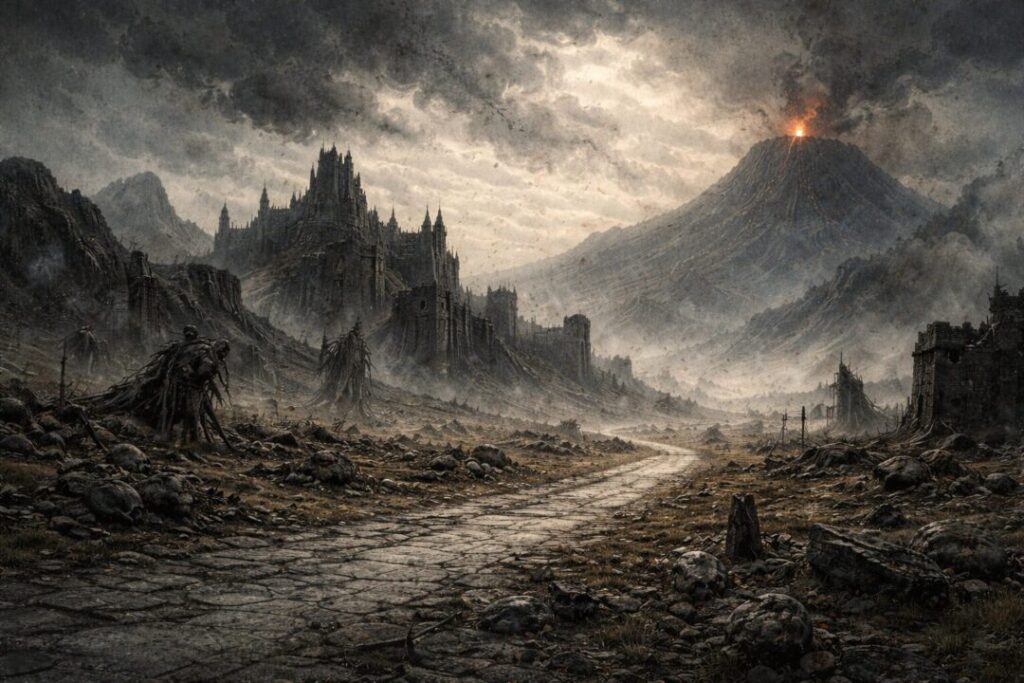
Tolkien avoids tidy endings when they would cheapen the cost of victory.
If Mordor simply vanished, evil would feel reversible. Temporary. Almost cosmetic.
Instead, Tolkien leaves us with a world where good wins—but must remain vigilant.
The Shadow passes.
Its damage remains.
This is not pessimism.
It is moral seriousness.
Tolkien fought in a war where victory did not erase ruins, trauma, or loss. He understood that defeating evil does not reset the world—it merely stops further destruction.
Why This Still Matters
Modern fantasy often erases consequences. Villains fall, landscapes reset, and the world returns to equilibrium as if history itself were reversible.
Tolkien refuses to do this.
Mordor stands as a reminder that evil reshapes the world even when it fails. Victory halts the spread—but it does not undo the past.
The war is won.
The Ring is destroyed.
But the world carries forward what it has endured.
And that is why Mordor was never truly empty—because some scars, once carved into the world, do not simply fade when the darkness falls.
They remain.
As warnings.
As boundaries.
As memory.
Sources & Notes
- J.R.R. Tolkien, The Lord of the Rings, Book VI, Chapter 2, “The Land of Shadow” — describes Mordor’s roads, towers, camps, and the slave-worked fields around Lake Núrnen that fed Sauron’s armies.
- J.R.R. Tolkien, The Lord of the Rings, Book VI, Chapter 4, “The Field of Cormallen” — after the Ring is destroyed, Sauron’s host breaks in terror; the passage shows collapse and flight rather than a magically emptied land.
- J.R.R. Tolkien, The Lord of the Rings, Book VI, Chapter 5, “The Steward and the King” — Aragorn frees the slaves of Mordor and gives them the lands about Lake Núrnen, confirming surviving people and a postwar settlement issue.
- J.R.R. Tolkien, The Lord of the Rings, Appendix B, “The Tale of Years” — frames Mordor as Sauron’s long-established realm across the Second and Third Ages, not a temporary battlefield that vanishes with him.
- J.R.R. Tolkien, The Silmarillion, “Of the Rings of Power and the Third Age” — recounts Sauron’s fortifying of Mordor and Barad-dûr, supporting the article’s view of Mordor as an entrenched imperial system.