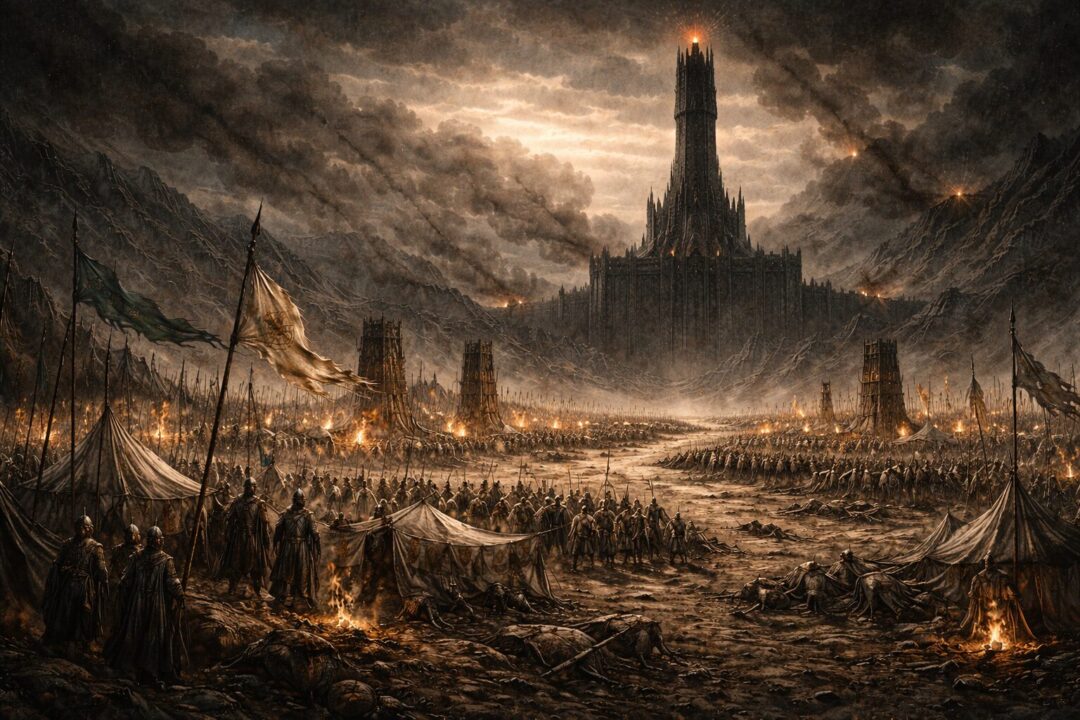
When most readers think about the War of the Last Alliance, they picture a single, iconic moment.
Sauron stepping onto the battlefield in person.
Elendil and Gil-galad standing side by side.
The Dark Lord overthrown.
The Ring cut from his hand.
It is one of the most dramatic scenes in the entire legendarium, and understandably, it has become the focal point of how the war is remembered.
But that moment was not the turning point.
It was the aftermath.
By the time Sauron emerged from Barad-dûr to confront the leaders of the Last Alliance, the war had already been decided—quietly, relentlessly, and without spectacle.
The real decision was made years earlier, on a desolate plain before the Black Gate of Mordor.
That place was called Dagorlad—the Battle Plain.
Dagorlad: The Battlefield Meant to Break the Alliance
Dagorlad lies north of Mordor, before the Morannon, the Black Gate. It was not chosen at random.
This was the ground Sauron intended to use as a killing field.
Any army marching east into Mordor would have to cross it. Exposed, far from supply lines, under the shadow of the Ephel Dúath and the fumes of Orodruin, Dagorlad was meant to exhaust and destroy invaders before they ever reached Sauron’s inner realm.
And for most of the Second Age, that strategy worked.
Sauron’s strength did not come only from raw power, but from preparation, timing, and control. He preferred wars of attrition, wars where enemies broke themselves against his defenses long before reaching him.
But Dagorlad did not unfold the way Sauron planned.
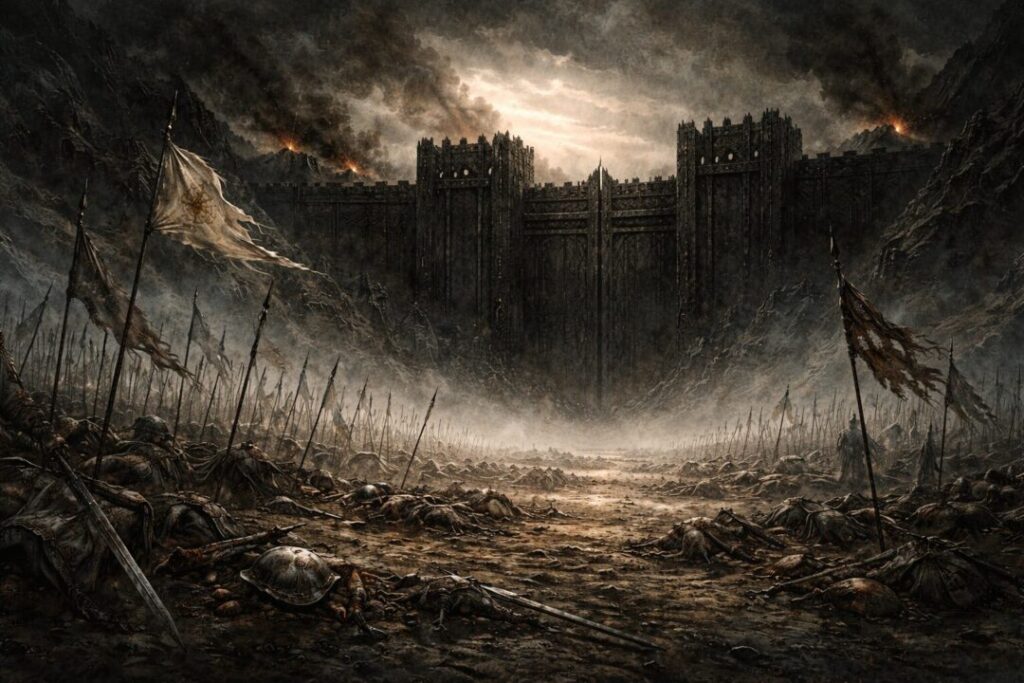
A War Sauron Could Not Control
The Last Alliance of Elves and Men did not arrive cautiously.
They did not test the ground, probe the defenses, or retreat when the fighting grew fierce.
They advanced in full force.
This alliance represented something Sauron had not faced since the downfall of Morgoth: a united front of the Free Peoples, led by the greatest remaining powers of Middle-earth.
Elves of Lindon and Rivendell.
Men of Arnor and Gondor, still strong, still unified, still carrying the authority of Númenor’s legacy.
When these hosts met Sauron’s armies on Dagorlad, the battle was not swift. It was long, violent, and devastating on both sides. Tolkien gives few tactical details, but the outcome is clear.
Sauron’s forces were not merely delayed.
They were broken.
The Moment Initiative Was Lost
Dagorlad did not destroy Sauron’s power outright.
What it destroyed was something far more important.
It destroyed his initiative.
Before Dagorlad, Sauron controlled the tempo of the war. His armies advanced when he chose. His enemies reacted. Even when challenged, he retained freedom of movement.
After Dagorlad, that freedom vanished.
His surviving forces were driven back behind the Black Gate. The Morannon was shut. Mordor was sealed.
For the first time since his rise in the Second Age, Sauron was contained.
Barad-dûr—built as the seat of dominion over Middle-earth—became a fortress under siege.
And that single fact reshaped everything that followed.
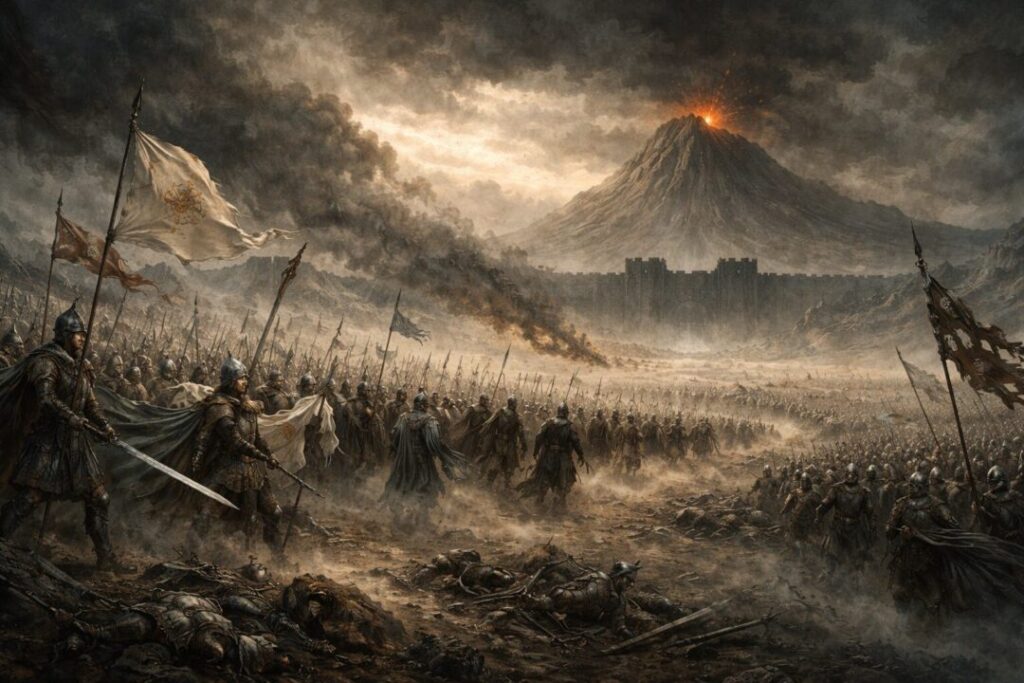
Barad-dûr Becomes a Prison
The Siege of Barad-dûr lasted seven years.
Seven years is a long time for Men.
It is an eternity for Elves.
But for a being like Sauron—whose identity is bound to control, order, and domination—it was something worse.
It was stasis.
There are no accounts of great counterattacks during the siege. No mention of relief forces breaking through. No indication that Sauron ever regained the initiative he lost at Dagorlad.
The hosts of the Alliance held their ground. They endured.
And every year that passed weakened Sauron in a way no battlefield defeat ever could.
The Cracking of Authority
Sauron’s power was never purely physical.
It rested on fear, perception, and the belief—shared by allies and enemies alike—that resistance was ultimately futile.
Dagorlad shattered that belief.
The siege reinforced it.
Sauron could no longer present himself as the unstoppable force shaping the fate of the world. He was trapped, contained, and forced to wait.
Even if his strength remained immense, his authority was visibly failing.
This distinction matters deeply in Tolkien’s world.
Power is not just the ability to destroy. It is the ability to command loyalty, inspire terror, and bend events without direct action. At Dagorlad, Sauron lost that subtle dominance.
By the time the siege dragged on into its later years, the outcome of the war was no longer uncertain.
Only its ending was.
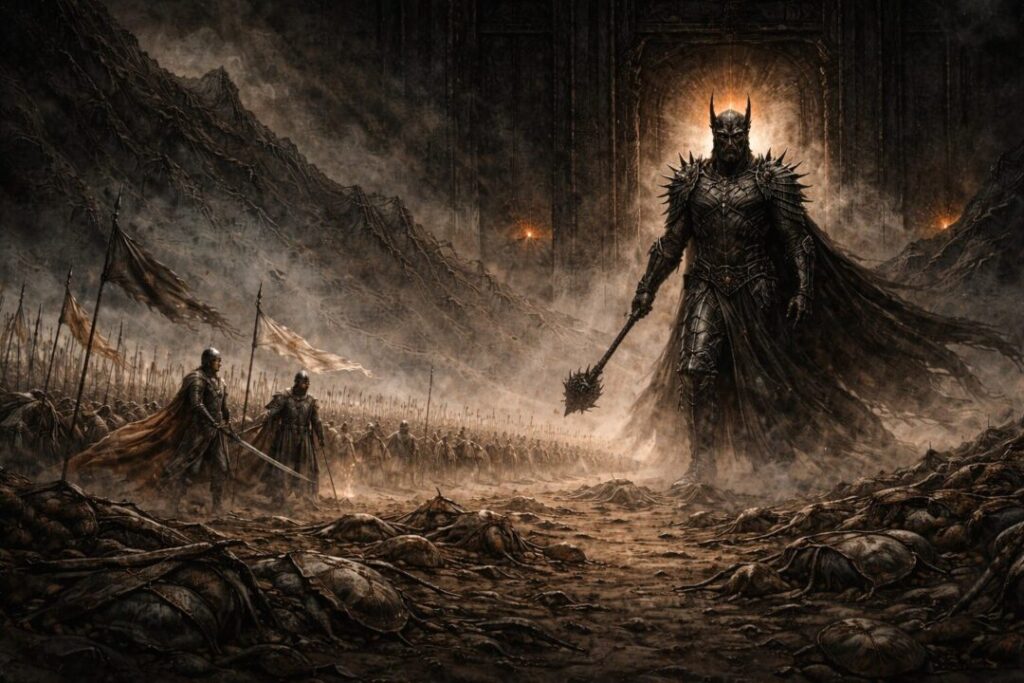
Why Sauron Finally Emerged
When Sauron eventually came forth from Barad-dûr, it was not the move of a conqueror pressing advantage.
It was the move of a ruler with no options left.
Either he would personally break the leaders of the Alliance…
Or the siege would never end.
The duel with Elendil and Gil-galad was not a bold gamble. It was a last resort.
This reframes the famous final confrontation in a crucial way.
It was not the moment when the war turned.
It was the moment when a decision made years earlier finally played out.
The Final Duel as Consequence, Not Cause
The deaths of Elendil and Gil-galad are rightly remembered as tragic and heroic. Their sacrifice mattered. The cutting of the Ring from Sauron’s hand changed the course of history.
But none of that would have been possible without Dagorlad.
If Sauron had retained control of the battlefield…
If his armies had not been broken…
If Mordor had remained open instead of sealed…
There would have been no seven-year siege.
No desperate emergence.
No final duel on terms set by his enemies.
Dagorlad removed Sauron’s ability to choose how the war would end.
From that point on, he could only react.
Why Dagorlad Receives So Little Attention
Dagorlad is easy to overlook because it lacks a single, dramatic image.
There is no named hero standing alone.
No artifact changing hands.
No clear moment of triumph.
And that is precisely why it matters.
Tolkien understood something fundamental about war and history: the most important moments are often the least theatrical.
Wars are not decided only by final blows. They are decided when one side loses the ability to dictate events—when strategy collapses into endurance.
Dagorlad represents that collapse.
It is the moment when Sauron’s long game failed.
The End of the Second Age Was Decided There
After Dagorlad, the Second Age entered its final chapter.
Not because Sauron was weak.
Not because evil was suddenly fragile.
But because domination had given way to delay.
From the Battle Plain onward, time itself worked against Sauron. Every year favored the Alliance. Every delay tightened the trap.
When the war finally ended, it did so not in a blaze of surprise, but with the slow certainty of something long foreseen.
Dagorlad did not end the War of the Last Alliance.
It made the ending inevitable.
And once you see that, the entire conflict takes on a quieter, more unsettling shape—one where the Dark Lord’s fall was not sudden, but already written into the ground before Mordor itself.
Sources & Notes
- J.R.R. Tolkien, The Silmarillion, “Of the Rings of Power and the Third Age” — the Last Alliance defeats Sauron’s host on Dagorlad, enters Mordor, and then besieges Barad-dûr for seven years.
- J.R.R. Tolkien, The Lord of the Rings, Appendix B, “The Tale of Years” — Second Age entries for 3434 and 3441 place the Battle of Dagorlad before the long siege and Sauron’s overthrow.
- J.R.R. Tolkien, The Lord of the Rings, Book II, Chapter 2, “The Council of Elrond” — Elrond recalls the Last Alliance, the deaths of Gil-galad and Elendil, and Isildur cutting the Ring from Sauron’s hand.
- J.R.R. Tolkien, The Letters of J.R.R. Tolkien, Letter 131 — Tolkien describes Sauron’s will to order and dominate, useful context for reading containment and loss of initiative as a decisive strategic wound.