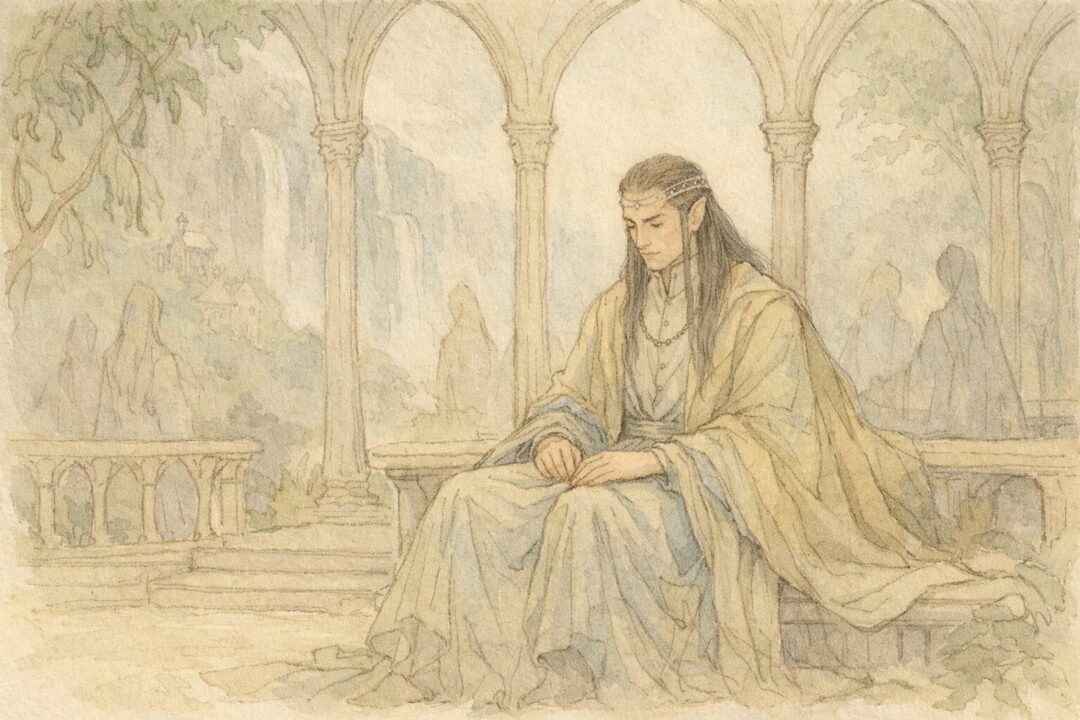
Let’s stay with this thought a little longer.
What lingers after considering Elrond’s quiet authority is not admiration, but a subtle ache.
Because his restraint isn’t neutral. It costs him something every single day.
Elrond’s life is shaped by a unique psychological burden: he remembers everything, but controls almost nothing.
Immortality, in his case, does not grant escape from grief — it guarantees proximity to it.
Where mortals are eventually released by forgetting, Elrond remains.
Not frozen, but continuously present to loss as an ongoing condition.
This changes the nature of responsibility.
For him, leadership is not about winning a moment but about preventing collapse across centuries.
Every decision he makes is haunted by unintended consequences he has already lived through.
Not hypothetically — personally.
This creates a form of restraint that can look like emotional distance but is actually emotional saturation.

When you’ve seen hope fail loudly, you learn to protect it quietly.
There’s an unspoken exhaustion in Elrond’s posture.
Not weariness of living, but weariness of watching others repeat avoidable pain.
And yet he never withdraws.
That is the part most often missed.
Elrond could retreat into beauty, into song, into preservation.
Instead, he remains engaged with a world that keeps asking him to believe again.
This engagement carries a private cost.
To remain open after centuries of disappointment requires a deliberate vulnerability.
One of the least acknowledged aspects of Elrond’s psychology is his relationship to helplessness.
He knows, better than almost anyone, that wisdom does not guarantee influence.
This is devastating knowledge for someone tasked with guidance.
To see danger clearly and still be unable to prevent it entirely.
So his authority adapts.
It becomes invitational rather than directive.
Elrond doesn’t command trust — he earns it through consistency.
Through being the one who does not panic when others do.
There is also something quietly radical in his refusal to harden.
After enough betrayal and loss, bitterness would be understandable.
But bitterness would simplify the world, and Elrond refuses simplicity.
He knows too much for that.
Instead, he practices a form of moral patience that allows others to arrive at truth themselves.
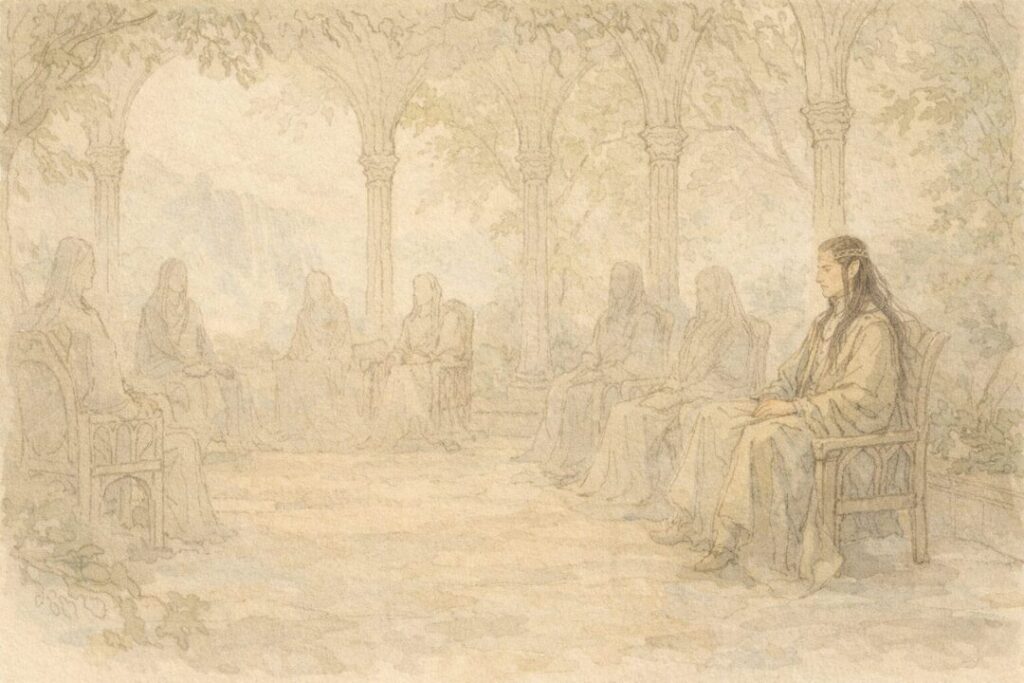
Even when it would be easier to decide for them.
This patience is not passive.
It is actively maintained, like a structure that must be reinforced every day to avoid collapse.
Another overlooked element is how Elrond relates to hope.
He does not expect it to win quickly.
He expects it to survive barely.
Hope, for him, is not an emotion but a discipline.
Something practiced quietly when optimism would feel dishonest.
This is why his spaces feel different.
Rivendell is not safe because nothing bad happens there.
It is safe because grief is allowed to exist without becoming corrosive.
That environment is a direct extension of Elrond’s inner life.
A place shaped by someone who understands that healing requires time without pressure.
There is also the matter of succession.
Elrond knows he will outlast many of those he prepares.
This creates a particular sorrow: investing deeply in futures you will never personally inhabit.
Planting seeds you won’t see mature.
Yet he does it anyway.
That may be the clearest expression of his authority.
Not power over outcomes, but commitment to continuity.
Elrond stands at a threshold between ages, cultures, and kinds of beings.
He belongs fully to none of them anymore.
That liminal existence sharpens his perception but isolates him emotionally.
Authority, in his case, grows out of solitude rather than dominance.
What Tolkien implies, without ever stating, is that Elrond leads from a place of accepted limitation.
He does not believe he can fix the world — only hold it steady long enough for others to act.
This resonates far beyond Middle-earth.
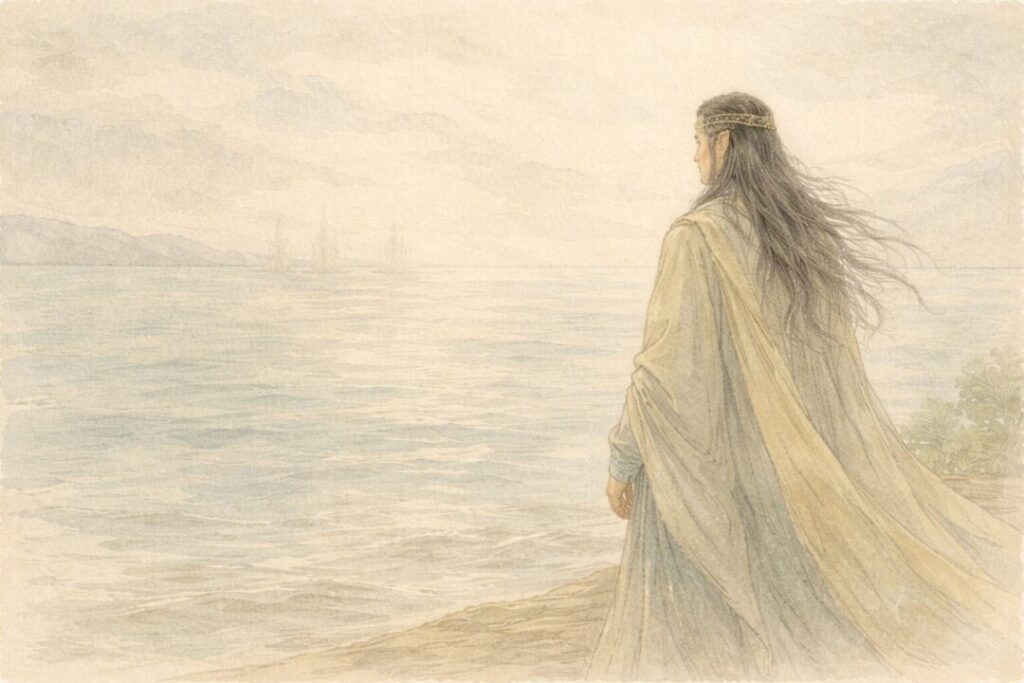
Many people carry responsibility without recognition.
They absorb chaos so others can move forward unbroken.
They are often misread as distant or overly cautious.
But what they are really doing is managing invisible weight.
Elrond gives language to that experience without ever naming it.
He embodies a form of strength that refuses urgency and survives by steadiness.
There is something deeply human in that restraint.
In choosing care over control, even when control would be tempting.
By the time Elrond steps back, it isn’t because his authority has diminished.
It’s because he understands when to release what he has held.
Not everyone will notice the shape of that sacrifice.
But it leaves a quiet order behind it.
And perhaps that is the point.
Some forms of authority exist only so that others may forget how fragile things truly are.
They leave no monument — only the absence of collapse.
When Elrond fades from the center of the story, the world continues.
Not because he conquered anything, but because he kept something intact long enough to matter.
And then, quietly, he lets go.
Sources & Notes
- J.R.R. Tolkien, The Lord of the Rings, Book II, Chapter 1, “Many Meetings” — Rivendell’s quiet shelter and Elrond’s presence frame him as a healer and keeper of memory rather than a ruler who dominates by force.
- J.R.R. Tolkien, The Lord of the Rings, Book II, Chapter 2, “The Council of Elrond” — Elrond guides the debate with patience and authority, but the choice to take the Ring is reached through counsel rather than command.
- J.R.R. Tolkien, The Silmarillion, “Of the Voyage of Eärendil and the War of Wrath” — Elrond’s family history and the sundering of Eärendil, Elwing, Elros, and Elrond support the article’s emphasis on ancient grief behind his restraint.
- J.R.R. Tolkien, The Lord of the Rings, Appendix A, “The Númenórean Kings” — Elrond’s kinship with Elros and the long burden of preserving memory across ages help explain his liminal role between Elves and Men.
- J.R.R. Tolkien, The Lord of the Rings, Book VI, Chapter 6, “Many Partings” — Elrond’s later withdrawal and Arwen’s choice show his authority ending in release, sacrifice, and the acceptance that others must act beyond his keeping.