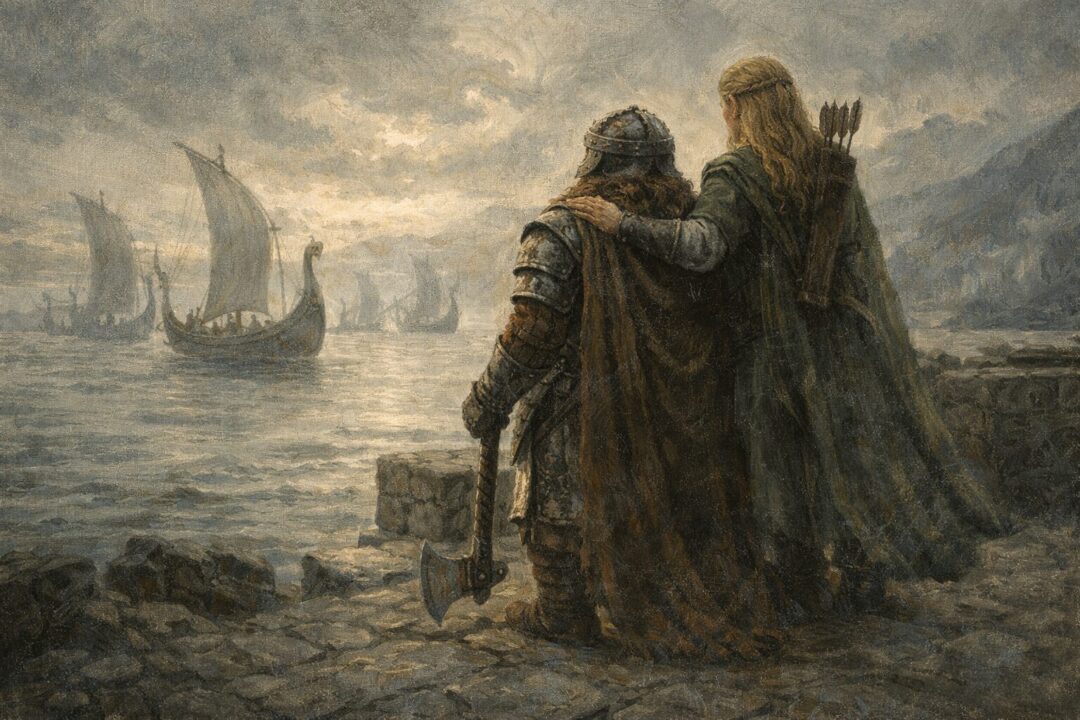
Among the many transformations that unfold in The Lord of the Rings, one of the most overlooked is also one of the most meaningful.
It is not the rise of a king.
It is not the fall of a Dark Lord.
It is the loyalty of a Dwarf—and how deeply it unsettles the Elves who witness it.
In a story filled with ancient powers, immortal beings, and world-shaping events, Gimli’s journey seems almost modest by comparison. He does not wield hidden magic. He does not claim a throne. He does not bear a destiny foretold in prophecy.
And yet, by the end of the War of the Ring, Gimli has altered something far older than kingdoms or battles.
He changes how the Elves understand loyalty itself.
Inherited Suspicion on Both Sides
When Gimli first appears at the Council of Elrond, he carries more than an axe. He carries centuries of inherited memory.
Suspicion of Elves is not personal to Gimli—it is cultural. Passed down through stories of betrayal, exclusion, and loss. The memory of Doriath and the Nauglamír still lingers in Dwarvish history, even if it is never spoken aloud. Old wounds are not reopened; they are simply never allowed to close.
Likewise, the Elves come with their own assumptions.
To them, Dwarves are secretive, possessive, stubborn, and bound tightly to their own kind. Loyal, yes—but only within the narrow circles of blood and stone. Reliable craftsmen. Dangerous hoarders. Allies of convenience, never of the heart.
Neither side expects trust.
At best, they expect tolerance.
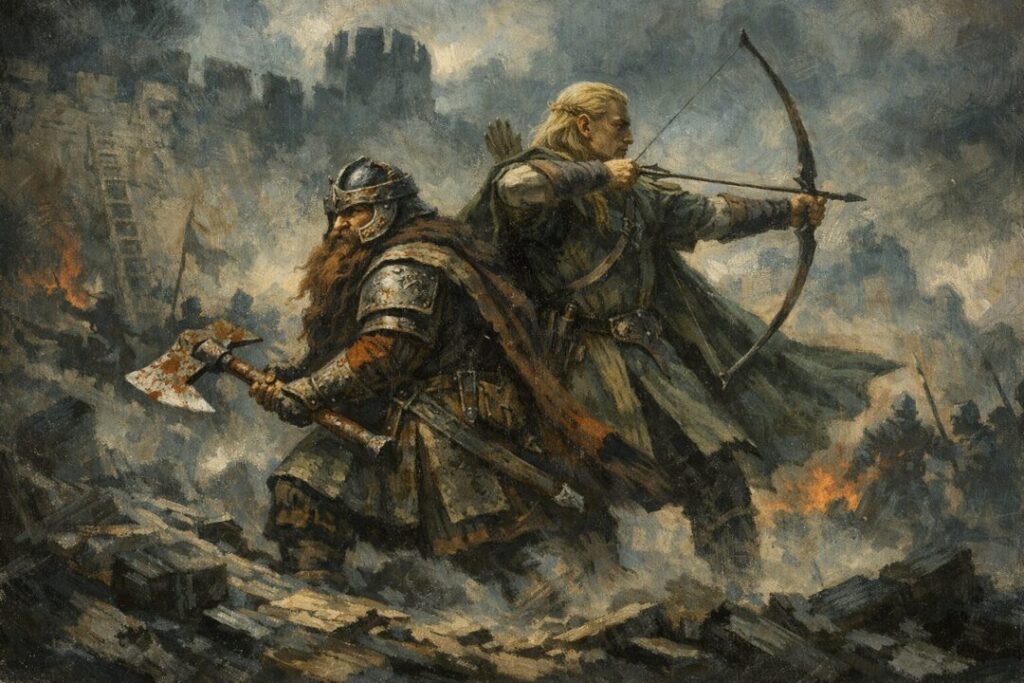
Dwarvish Loyalty Was Never in Question—Its Direction Was
In Tolkien’s world, Dwarves are already loyal.
They are loyal to family and clan.
Loyal to craft and labor.
Loyal to oaths sworn and wrongs remembered.
Loyal to the memory of their dead.
What surprises the Elves is not that Gimli is faithful—but that he extends that faith beyond the boundaries history assigned him.
This matters because Elvish loyalty functions differently.
Elves are bound by memory stretching across ages. Their alliances are shaped by ancient events as much as by present choice. To forgive, for an Elf, often means to remember and endure—not to forget. Time does not dull their recollections; it sharpens them.
Gimli’s loyalty, however, is rooted in something else entirely.
It is rooted in choice.
He chooses to trust Legolas despite every inherited grievance.
He chooses to honor Lothlórien, even when he feels unwelcome and watched.
He chooses to fight for realms that are not his own, without promise of reward or recognition.
And most importantly, he does so without abandoning who he is.
Gimli does not become “less Dwarvish” to earn Elvish respect. He becomes more himself—and invites others to see him clearly.
Lothlórien: The Moment Everything Changes
Nowhere is this transformation more evident than in Lothlórien.
From the moment Gimli enters the Golden Wood, he is uneasy. The air itself seems to judge him. He expects suspicion, surveillance, perhaps even humiliation. He knows the stories his people tell of Elves—and he knows the stories Elves tell of Dwarves.
Instead, he is tested—not with accusation, but with perception.
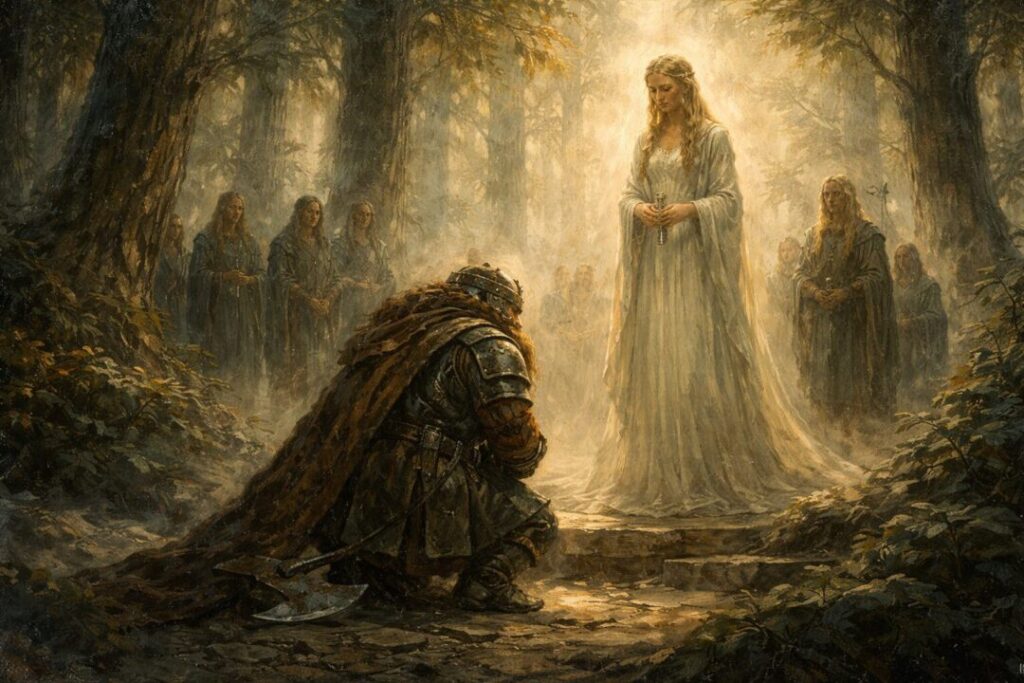
When Galadriel offers gifts to each member of the Fellowship, Gimli’s request stands apart from all the others. He asks for a single strand of her hair.
Not as a trophy.
Not as possession.
Not as wealth.
But as remembrance.
The request astonishes the Elves.
For them, hair is not a trivial thing. It carries memory, beauty, and identity. To ask for it without desire to own or exploit is almost unheard of—especially from a Dwarf, whose people are often associated with possessiveness and hoarding.
Gimli’s request reveals something unexpected: reverence without entitlement.
He understands something essential about Elvish beauty—that it is not meant to be owned, but honored. Preserved in memory, not claimed by force.
From this moment onward, Gimli is no longer merely tolerated in Lothlórien.
He is trusted.
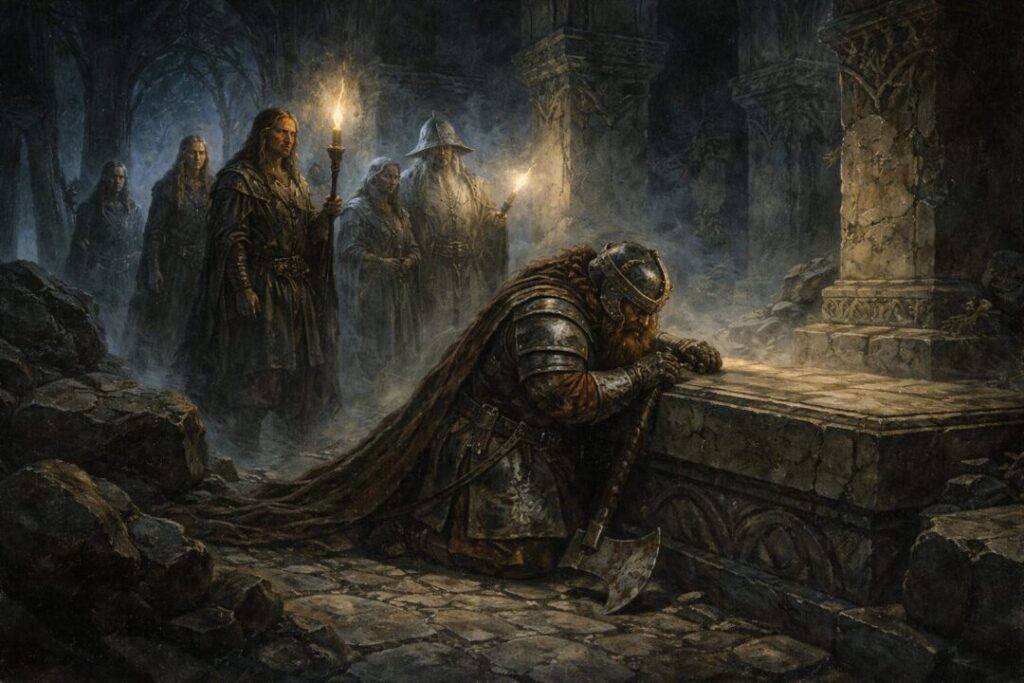
Friendship Forged in Battle, Not Forgetfulness
The friendship between Gimli and Legolas is often remembered for its humor and rivalry, but its true significance lies elsewhere.
Their bond does not erase history.
They argue.
They compete.
They remember the past differently.
What unites them is not agreement, but endurance.
They fight side by side through Moria, where ancient wounds are reopened in stone and shadow.
They stand together at Helm’s Deep, where hope is measured in moments rather than years.
They endure the Pelennor Fields, where death falls without regard for age or immortality.
Their friendship is forged through shared danger, not shared origin.
This distinction matters deeply in Tolkien’s world.
Elves often form bonds through long familiarity—through centuries of shared song, memory, and place. Gimli forms his bonds through action. Through remaining when retreat would be easier. Through choosing loyalty again and again under pressure.
He does not turn aside.
He does not retreat into grievance.
He does not demand acknowledgment.
To the Elves—whose time is vast, but whose presence in Middle-earth is fading—this kind of steadfast loyalty is rare and quietly moving.
Why This Loyalty Matters in a Fading World
By the end of the Third Age, the Elves are preparing to leave Middle-earth. Their role is no longer to shape its future directly, but to preserve what remains before departing.
They are not defeated.
They are weary.
Gimli’s loyalty arrives at precisely this moment.
It reassures the Elves that the world they are leaving behind will not be abandoned to bitterness alone. That reconciliation is still possible—even between peoples burdened by ancient wrongs. That memory does not have to harden into resentment.
Gimli does not symbolize the future because he is new.
He symbolizes it because he chooses differently.
He carries memory without being ruled by it.
He honors the past without becoming imprisoned by it.
He remains loyal without demanding immortality or reward.
Loyalty as Tolkien Defines It
In Tolkien’s legendarium, loyalty is not blind obedience.
It is faithfulness under strain.
It is choosing the good without certainty of success.
It is remaining when departure would be easier—and safer.
This kind of loyalty is quiet. Often unseen. Frequently misunderstood.
Gimli embodies it completely.
That is why his loyalty shocks the Elves.
Not because it is unexpected—but because it reminds them of something ancient, essential, and quietly hopeful.
Something they themselves once embodied, long ago, before time taught them to endure rather than to trust.
And in that reminder, Gimli becomes more than a Dwarf of the Fellowship.
He becomes a bridge—between peoples, between ages, and between a fading world and the one that must continue without it.
Sources & Notes
- J.R.R. Tolkien, The Lord of the Rings, Book II, Chapter 6, “Lothlórien” — shows the inherited suspicion around Gimli entering the Golden Wood, including the blindfold dispute and Legolas’s response.
- J.R.R. Tolkien, The Lord of the Rings, Book II, Chapter 8, “Farewell to Lórien” — Galadriel’s gift-giving and Gimli’s request for a strand of her hair, the clearest scene behind the article’s emphasis on reverence rather than possession.
- J.R.R. Tolkien, The Lord of the Rings, Book III, Chapter 8, “The Road to Isengard” — Legolas and Gimli’s promised exchange of visits to Fangorn and the Glittering Caves, showing their friendship becoming more than battlefield comradeship.
- J.R.R. Tolkien, The Lord of the Rings, Appendix A, “Durin’s Folk” — records the exceptional later friendship of Legolas and Gimli, including the tradition that Gimli sailed West with Legolas after Aragorn’s death.
- J.R.R. Tolkien, The Silmarillion, “Of the Ruin of Doriath” — gives the ancient Dwarf-Elf wound around the Nauglamír and Thingol, useful background for why Gimli’s trust in Lórien is so striking.