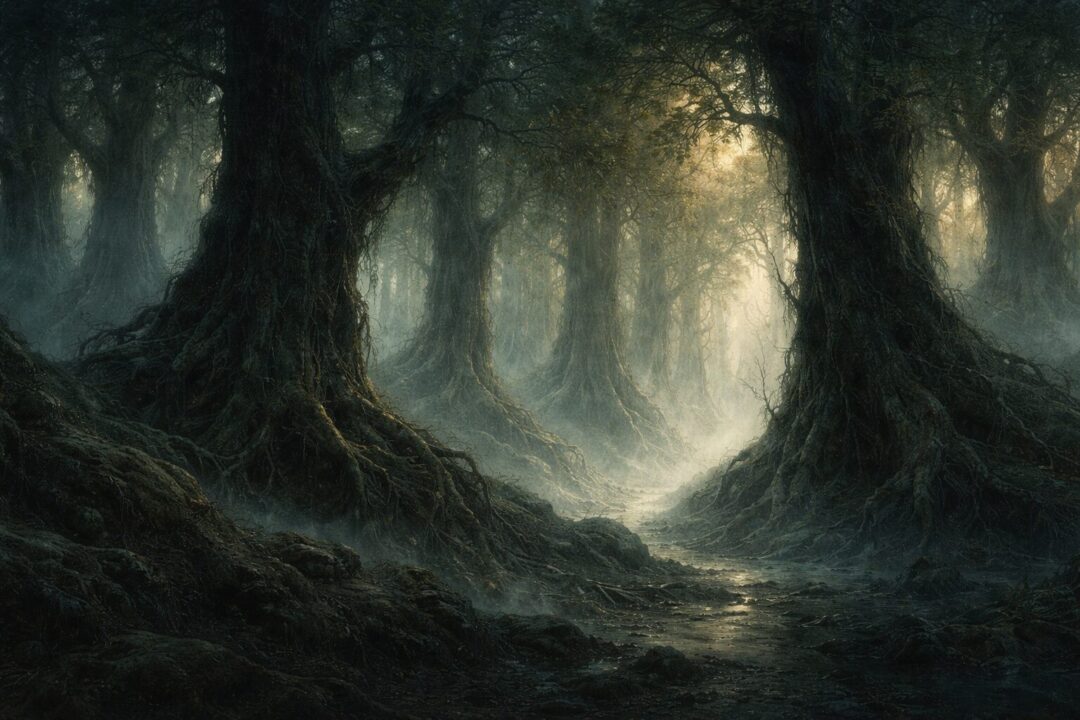
Fangorn Forest is one of the oldest surviving places in Middle-earth. By the time of the War of the Ring, it is already ancient beyond counting—its roots sunk into ages that predate most kingdoms, most histories, and even much of recorded memory.
Yet for all its age and power, Fangorn is never presented as entirely safe.
This unease is not loud. Tolkien never introduces a visible monster lurking beneath the trees. There is no climactic confrontation, no named horror rising from the earth. Instead, he allows discomfort to seep in through implication, half-spoken memories, and deliberate silence.
And that is precisely where the fear lies.
Fangorn Is Older Than the Wars We Know
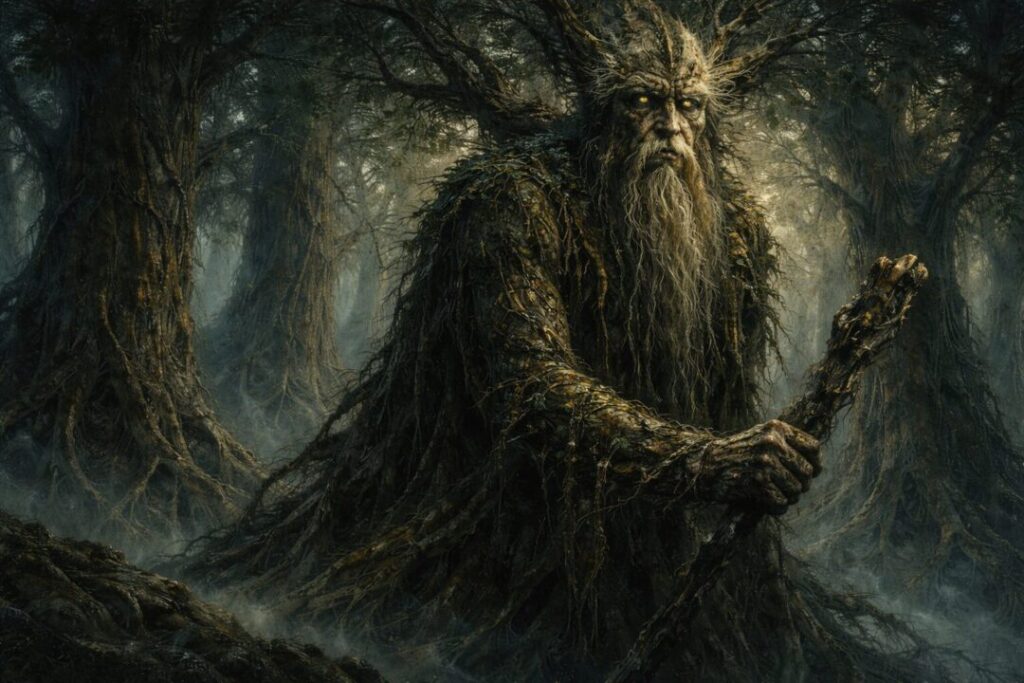
When the Hobbits first meet Treebeard, they encounter not merely a guardian of the forest, but a living remnant of a world that has largely passed away. Treebeard describes himself as the oldest living thing that still walks beneath the Sun. He remembers the shaping of the lands, the coming of Elves, and forests that once stretched unbroken across vast distances.
His memories do not feel curated. They wander. They circle. They hesitate.
This matters.
Treebeard does not speak as a ruler recounting dominion. He speaks as a watcher remembering responsibility. He knows the forest intimately, but he never claims absolute ownership of it.
The Ents, as Treebeard explains, are shepherds of the trees—not their masters. They tend, guard, and preserve, but they did not create Fangorn. They did not shape its deepest foundations.
That distinction is subtle, but crucial.
It suggests that Fangorn existed before the Ents fully awoke to their purpose—and that some things within it were never entirely under their control.
A Forest That Remembers Too Much
Throughout Tolkien’s legendarium, great age is rarely presented as comforting. Ancient places remember more than they reveal. They carry layers of history compressed into stone, root, and shadow.
Fangorn is described as dim, tangled, and resistant to easy passage. Paths vanish. The forest closes behind travelers. Time itself seems to behave differently beneath the canopy.
This is not merely atmosphere.
Tolkien repeatedly associates deep time with lingering consequences. Wars may end, kingdoms may fall, but not everything wrought in the ancient world is undone. Some remnants are simply… left behind.
And Fangorn feels like a place where such remnants could endure.
“Nameless Things” and Buried Evils
Later in the story, Gandalf recounts his battle with the Balrog beneath Moria. In describing his fall through the depths of the world, he makes one of the most chilling statements in all of The Lord of the Rings.
He speaks of “nameless things”—creatures older than Sauron, unknown even to the Wise, gnawing at the roots of the world.
This remark is brief. Gandalf refuses to elaborate. He explicitly says these things are best left unnamed.
That refusal is telling.
The Balrog itself—Durin’s Bane—is a known terror, a remnant of Morgoth’s ancient power. Yet Gandalf implies that even the Balrog is not the deepest or most unsettling presence beneath Middle-earth.
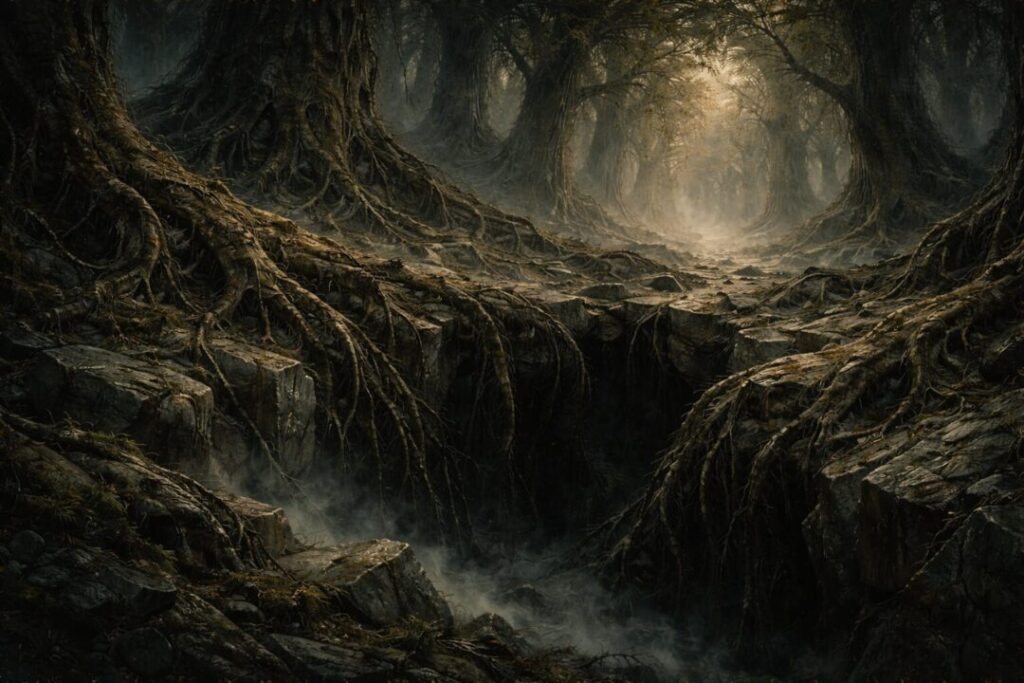
If such beings exist beneath stone and mountain, it is not unreasonable—within Tolkien’s own framework—to consider that forests like Fangorn might shelter their own forgotten depths.
Tolkien consistently implies that not all ancient evils were destroyed.
Some fled.
Some hid.
Some were buried so deeply that even memory faded.
Fangorn is vast, largely untouched, and avoided. It is precisely the kind of place where such remnants could endure—not active threats, but lingering presences.
Why the Ents Rarely Leave
Treebeard’s sorrow is often read as grief for lost forests. But it is also something else: vigilance.
The Ents do not roam freely across Middle-earth. They do not seek dominion, adventure, or expansion. They remain close to Fangorn, bound to it in a way that feels less like choice and more like duty.
This has often been interpreted as weariness—a sign that the Ents, like the Elves, are fading.
But Tolkien’s text allows for another possibility.
What if the Ents stay because someone must?
If Fangorn shelters ancient dangers—not enemies to be fought, but forces to be contained—then the Ents’ long watch becomes something more solemn. They are not merely tending trees. They are preserving balance. Preventing disturbance. Ensuring that what should remain buried is not awakened.
Some things, in Tolkien’s world, are not meant to be conquered.
They are meant to be endured.
Saruman’s Fear of Fangorn
The behavior of Saruman offers another telling clue.
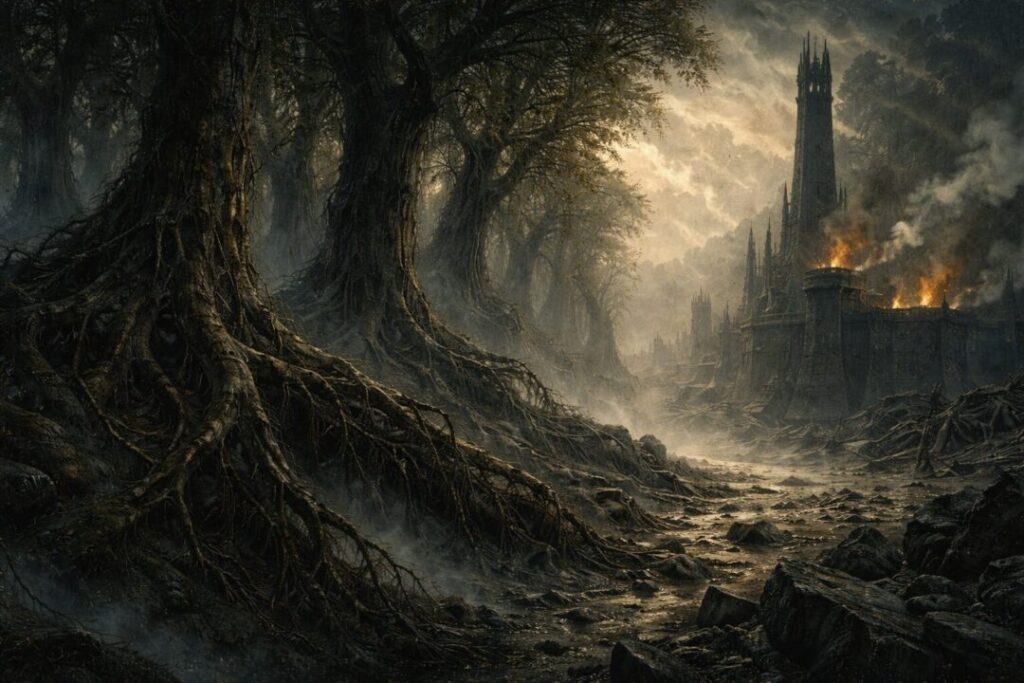
Saruman destroys forests without hesitation. He strips the land around Isengard for fuel, feeding his furnaces and war-machines. He has no reverence for growing things.
And yet—he never dares to cut into Fangorn itself.
Isengard rises beside the forest, not within it. Even at the height of his power, Saruman avoids provoking Fangorn directly.
This is not restraint born of respect.
It is fear.
Saruman understands ancient power. He has studied the lore of the Elder Days. He knows that some forces cannot be bent, only unleashed—and that unleashing them is not the same as controlling them.
Fangorn is not merely inconvenient to him. It is unpredictable.
And unpredictability terrifies those who seek absolute control.
Why Tolkien Never Explains the Fear Fully
Tolkien does not believe every mystery should be solved.
In fact, some of his most powerful worldbuilding arises from deliberate incompleteness. He leaves spaces where imagination, unease, and humility can take root.
Fangorn is unsettling precisely because it remains unresolved.
No name is given to what might lie beneath.
No history is recorded.
No confrontation is staged.
This mirrors the real world more than modern fantasy often does. Not every ancient danger rises again. Not every buried thing demands resolution.
Some evils are held at bay by memory, patience, and silence.
The Ents do not speak plainly about what lies beneath Fangorn because speaking gives shape to fear—and shape invites awakening. Silence, in Tolkien’s moral universe, is sometimes an act of wisdom.
Fangorn’s Role in Middle-earth
Fangorn Forest represents a truth Tolkien returns to again and again: the world is older, deeper, and more dangerous than any single story can fully capture.
The War of the Ring feels absolute while we are inside it. But Tolkien constantly reminds us that it is not the first great struggle, nor will it be the last. It is merely the one we are allowed to witness.
Beneath Fangorn’s roots lie echoes of older ages—reminders that even victory does not cleanse the world entirely.
Some things are not defeated.
Some are not redeemed.
Some simply remain.
Watching.
Waiting.
Buried—for now.
And Fangorn stands over them, silent and enduring, a reminder that Middle-earth is not only a place of heroes and battles—but of ancient fears that never needed to rise to matter at all.
Sources & Notes
- J.R.R. Tolkien, The Lord of the Rings, Book III, Chapter 4, “Treebeard” — for Fangorn as an ancient, watchful forest and Treebeard’s account of the Ents as shepherds rather than masters of the trees.
- J.R.R. Tolkien, The Silmarillion, “Of Aulë and Yavanna” — for the origin and purpose of the Ents as guardians awakened in answer to Yavanna’s concern for living things.
- J.R.R. Tolkien, The Lord of the Rings, Book III, Chapter 5, “The White Rider” — for Gandalf’s reference to “nameless things” older than Sauron beneath the world, supporting the article’s buried-ancient-fear reading.
- J.R.R. Tolkien, The Lord of the Rings, Book III, Chapter 8, “The Road to Isengard” — for the Ents’ wrath against Saruman and the contrast between Isengard’s machine-destruction and Fangorn’s older, less governable power.
- J.R.R. Tolkien, The Lord of the Rings, Book III, Chapter 9, “Flotsam and Jetsam” — for the aftermath at Isengard and the story’s emphasis on Saruman misjudging powers outside his control.