Some of the most important moments in The Lord of the Rings happen without armies watching.
No banners are raised.
No horns are blown.
No songs are written afterward.
History often remembers the clash of shields on the Pelennor Fields or the crowning of a king beneath white stone. But Tolkien is careful to show that the fate of Middle-earth does not turn only on open battle. Sometimes, it turns in narrow corridors, behind closed doors, in moments where no one is meant to see.
One such moment unfolds high within the walls of Minas Tirith, while the city waits in dread for news from the battlefield below.
At its center stands Beregond—a man with no prophecy attached to his name, no lineage of kings, and no destiny beyond the one he chooses for himself.
Beregond: A Man of Law, Not Legend
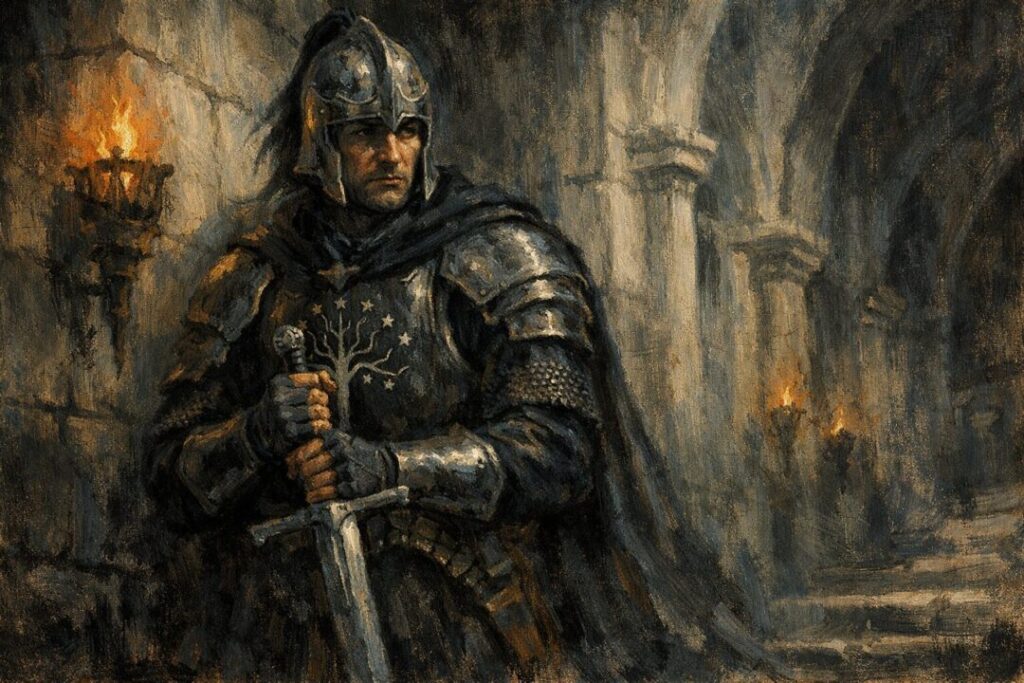
Beregond enters the story quietly. He is not introduced as a hero, nor even as a figure of particular importance. He is simply a guard of the Citadel: vigilant, courteous, and deeply loyal to Gondor.
His life is defined by rules.
He serves the Steward.
He guards the Tower.
He obeys orders without question.
And above all, he honors the ancient laws of the Citadel—laws older than many living men, established to preserve order in a realm that has endured centuries without a king.
Among these laws are two that matter most in his story:
No guard may abandon his post.
No blade may be drawn within the sacred precincts of the Citadel.
These rules are not arbitrary. They exist to prevent chaos at the heart of Gondor’s governance. If steel is drawn where judgment should reign, the realm fractures from within.
Beregond believes in these laws. He does not resent them. He does not look for exceptions.
Which makes what he does next so significant.
When Authority Collapses
The tragedy of Denethor is not sudden. Tolkien is careful to show that his fall is gradual, shaped by long years of pressure, loss, and despair.
Denethor has ruled Gondor in dark times. He has watched its borders shrink, its strength fade, and its allies fall silent. Worst of all, he has lost his elder son, Boromir—his pride, his hope, and his chosen heir.
All of this weighs heavily on him.
But there is something else at work.
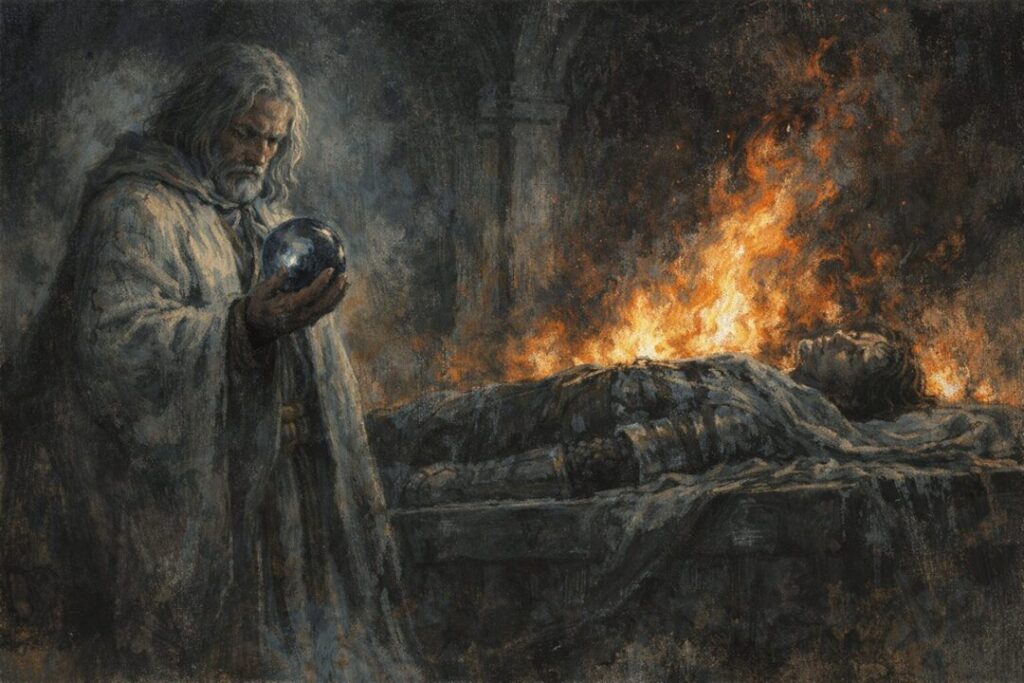
Through the palantír, Denethor has looked too often and too deeply into the mind of the Enemy. He sees truth—but never the whole truth. Sauron shows him only what feeds despair: overwhelming force, inevitable defeat, and the futility of resistance.
By the time Faramir is brought back wounded from the defense of Osgiliath, Denethor is no longer ruling with clear reason.
He orders that his son be burned alive upon a pyre.
This command carries authority.
It is spoken by the Steward of Gondor.
It is delivered from the Tower.
But it has lost legitimacy.
And Tolkien draws a crucial moral line here: power does not equal moral right.
The Moment of Recognition
Beregond is not a philosopher. He does not pause to weigh abstract ethics or political theory. He is a soldier who understands duty.
Yet he recognizes something fundamental: this command is wrong.
Not unlawful in the narrow sense—but unjust.
Faramir is not dead.
The Steward is not acting in reason.
The law that protects Gondor has been turned against its own future.
Beregond does not fully articulate this realization. Tolkien does not give him a speech. Instead, the truth presses in on him slowly, painfully, until obedience itself becomes a betrayal.
And so he chooses.
The Forbidden Act
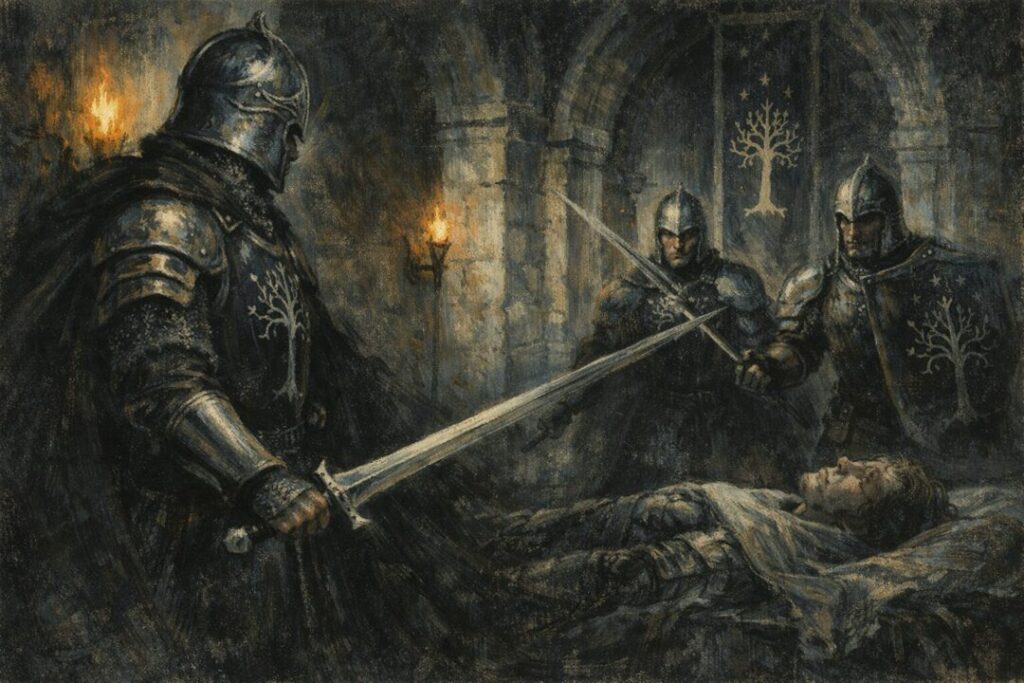
To stop Denethor, Beregond commits acts that Gondor explicitly forbids:
- He abandons his post
- He draws his sword within the Citadel
- He kills another guard who stands in his way
By the letter of Gondor’s law, these are capital crimes.
Tolkien does not soften this. Beregond knows exactly what he is doing. He does not expect forgiveness. He does not imagine reward.
What matters is not survival—but preventing a greater wrong.
Crucially, Beregond does not act from ambition or rebellion. He does not seek to overthrow the Steward or seize authority for himself. His loyalty has not shifted away from Gondor.
It has shifted toward it.
This is obedience to the spirit of the law, not its broken letter. The same law that forbids violence in the Citadel exists to protect the realm. When authority collapses into madness, preserving that purpose requires resistance.
Tolkien is careful here. Beregond is not presented as flawless. He is shaken. Horrified by what he has done. Yet his action stands.
Judgment Under the King
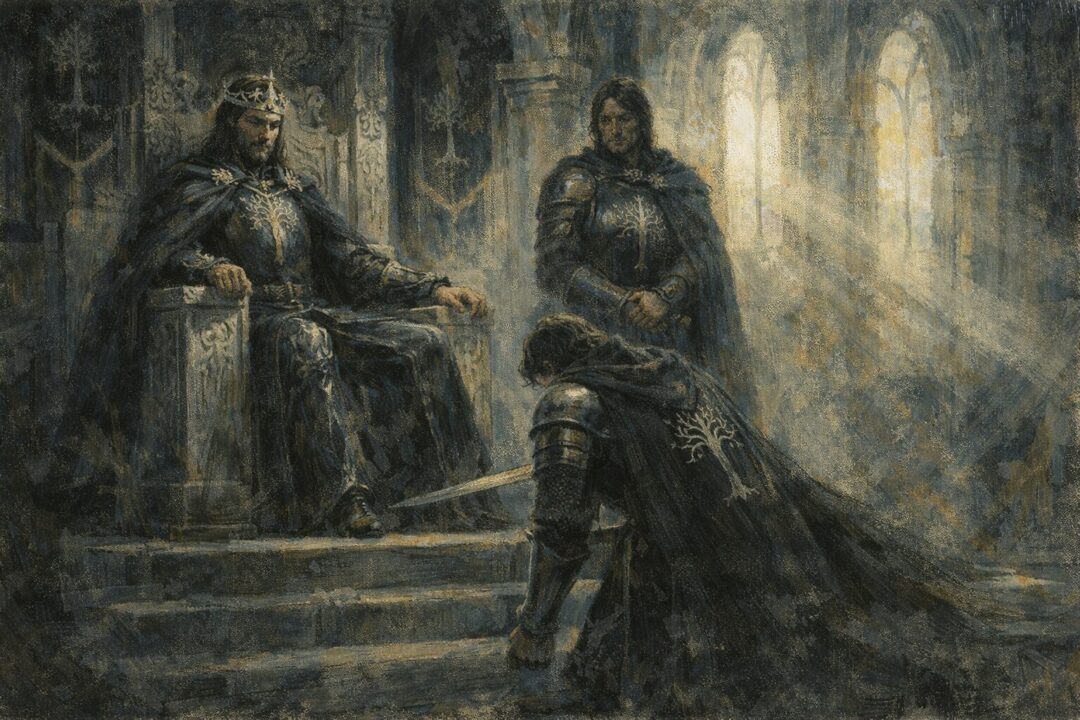
After the war, when Aragorn returns to Minas Tirith and claims the throne, Tolkien presents a moment of quiet but profound importance.
Aragorn does not erase Gondor’s laws in the name of mercy. He does not declare that rules no longer matter in the new age.
Instead, he upholds them.
Beregond is judged guilty.
This matters.
A realm that abandons law for sentiment does not heal—it simply replaces one form of disorder with another. Aragorn understands that justice must remain intact if Gondor is to endure.
But justice, in Tolkien’s world, is not blind severity.
Beregond’s punishment is transformed. Rather than death or disgrace, he is reassigned to serve Ithilien, guarding Faramir, now Prince of that land.
The law is honored.
Mercy is extended.
The future is secured.
This balance defines Aragorn’s kingship. He is neither tyrant nor indulgent ruler. He recognizes the difference between crime and conscience.
Why This Moment Matters
Beregond’s choice illustrates one of Tolkien’s deepest moral truths:
Evil is not defeated only by force of arms.
The Battle of the Pelennor Fields is won through courage, sacrifice, and valor. But the shape of Gondor’s future is preserved in a quieter place.
If Beregond obeys, Faramir dies.
If Faramir dies, the Steward’s line ends in despair.
If that line ends, Gondor enters the Fourth Age diminished—saved, perhaps, but broken at its heart.
Instead, Gondor is renewed.
Not through prophecy.
Not through destiny.
But because one man refused to obey an order that had lost its moral authority.
The Measure of a Realm
Tolkien shows us that a just society is not defined by unthinking obedience.
It is defined by whether its people can recognize when authority has severed itself from wisdom, restraint, and mercy.
Beregond is not celebrated in song. His name is not spoken in grand councils. History does not linger on him.
But Gondor’s future quietly rests on his choice.
And that is exactly how Tolkien wants it.
Because in Middle-earth—as in the real world—the greatest acts of courage often pass unnoticed, except by the future they make possible.
Sources & Notes
- J.R.R. Tolkien, The Lord of the Rings, Book V, Chapter 1, “Minas Tirith” — introduces Beregond of the Guard and the strict customs governing service in the Citadel.
- J.R.R. Tolkien, The Lord of the Rings, Book V, Chapter 4, “The Siege of Gondor” — shows Faramir’s wounding, Denethor’s despair, and the Steward’s order to prepare the funeral pyre.
- J.R.R. Tolkien, The Lord of the Rings, Book V, Chapter 7, “The Pyre of Denethor” — recounts Beregond leaving his post, drawing sword in the Citadel, and helping save Faramir from being burned alive.
- J.R.R. Tolkien, The Lord of the Rings, Book VI, Chapter 5, “The Steward and the King” — gives Aragorn’s judgment: Beregond is guilty under the law, yet spared and assigned to Faramir’s service in Ithilien.