
The Nazgûl are often described as some of the most terrifying beings in Middle-earth. Cloaked riders. Screaming voices. Black horses with eyes full of malice. Blades that chill the blood and leave wounds no healer can easily mend.
They seem, at first glance, like perfect killing machines.
And yet, when we look closely at what they actually do throughout The Lord of the Rings, a strange and unsettling pattern emerges.
They inspire overwhelming fear — yet they rarely kill.
This is not because they are merciful.
It is because killing has never been their primary purpose.
To understand the Nazgûl properly, we have to stop thinking of them as monsters of flesh and start seeing them as what they truly are: creatures of domination, fear, and spiritual erosion.
What the Nazgûl Really Are
The Ringwraiths were once mortal Men. Kings, warriors, sorcerers — figures of power in their own right — who accepted Rings of Power from Sauron. At first, those Rings granted long life, influence, and authority. But over centuries, they did not merely enslave their bearers.
They erased them.
By the time of the Third Age, the Nazgûl no longer fully exist in the physical world. They are “wraiths,” beings whose true presence lies in what Tolkien calls the Unseen World. Their cloaks, armor, and mounts are not their essence — they are props, anchors that allow something fundamentally incorporeal to interact with the material realm.
This distinction matters deeply.
Because beings of the Unseen do not dominate through muscle, steel, or brute force. They dominate through spirit.
They press against the will.
They weaken resistance before a blow is ever struck.
And this is where fear enters the picture.
Fear, in Middle-earth, is not just an emotion. It is a metaphysical condition. When terror takes hold, the boundaries between the Seen and Unseen grow thin. The mind falters. The will loosens. A person becomes vulnerable not just to violence, but to control.
Fear makes you reachable.
Why Fear Is More Useful Than Death
Sauron does not need corpses.
He needs obedience, silence, and despair.
A village slaughtered raises alarms.
A village paralyzed by dread polices itself.
This is why the Nazgûl operate the way they do. They do not charge screaming into settlements unless necessary. They arrive quietly. They ask questions. They let their presence be felt rather than their blades.
Rumors spread faster than blood.
A single sighting of a Black Rider can empty roads, close doors, and still tongues for miles. People stop helping one another. They stop trusting strangers. They stop acting at all.
This is strategic terror.
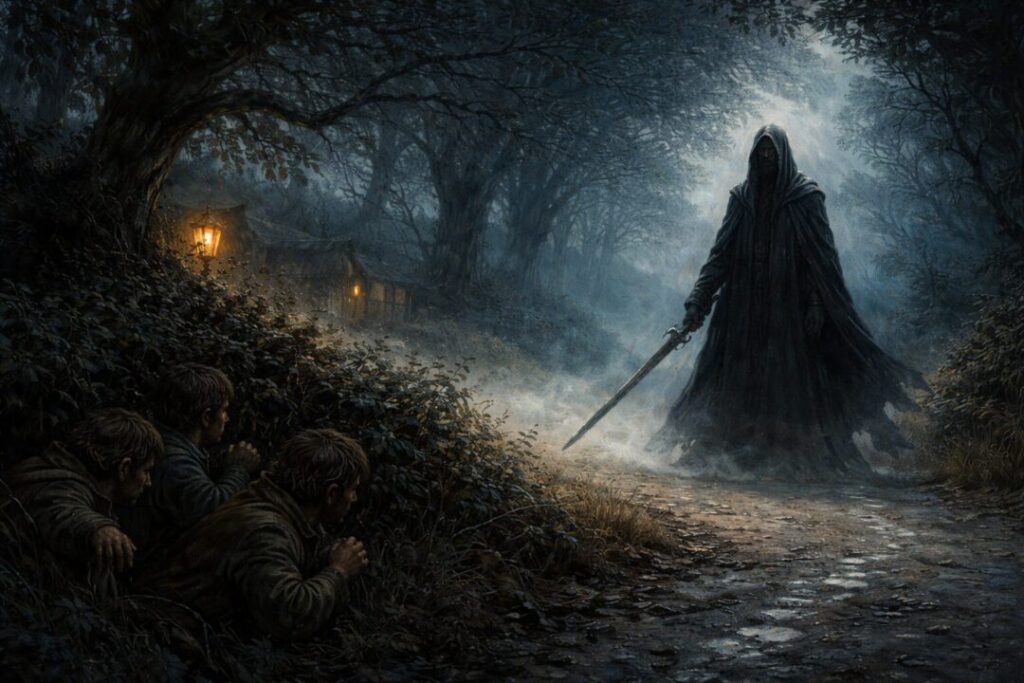
When the Nazgûl question Hobbits in the Shire, they rely almost entirely on fear to loosen tongues. They do not need to torture. Their voice, their nearness, the sense of being hunted is enough.
When they pursue Frodo, they do not attempt to overwhelm him immediately. They shadow him. They let exhaustion, anxiety, and isolation do the work.
And when Frodo puts on the Ring, they do not rush him.
They wait.
Because in the Unseen World, fear is like a signal flare. A terrified bearer shines more brightly than a confident one. Panic draws attention. Despair opens doors.
To strike too early would be inefficient.
The Witch-king and the Limits of Terror
The Witch-king of Angmar embodies this philosophy most clearly. He is not merely a commander; he is fear made articulate.
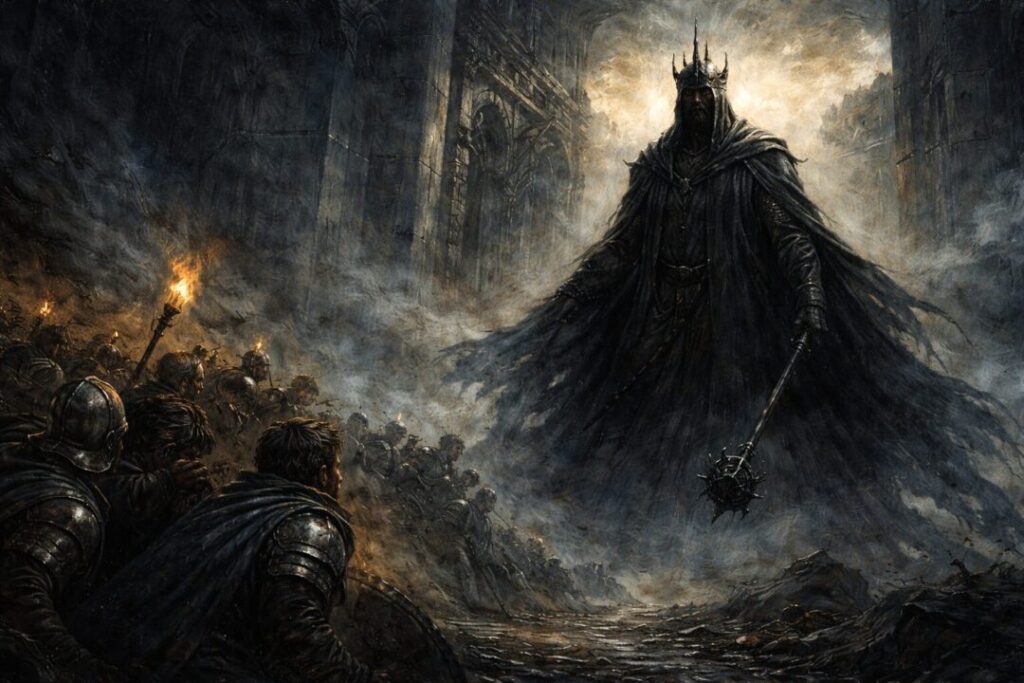
At the siege of Minas Tirith, his presence alone begins to break the city. His voice carries despair. Men lose hope before a single blow lands. Even the great gates fail under the weight of terror as much as physical force.
But his downfall reveals something crucial about the Nazgûl as a whole.
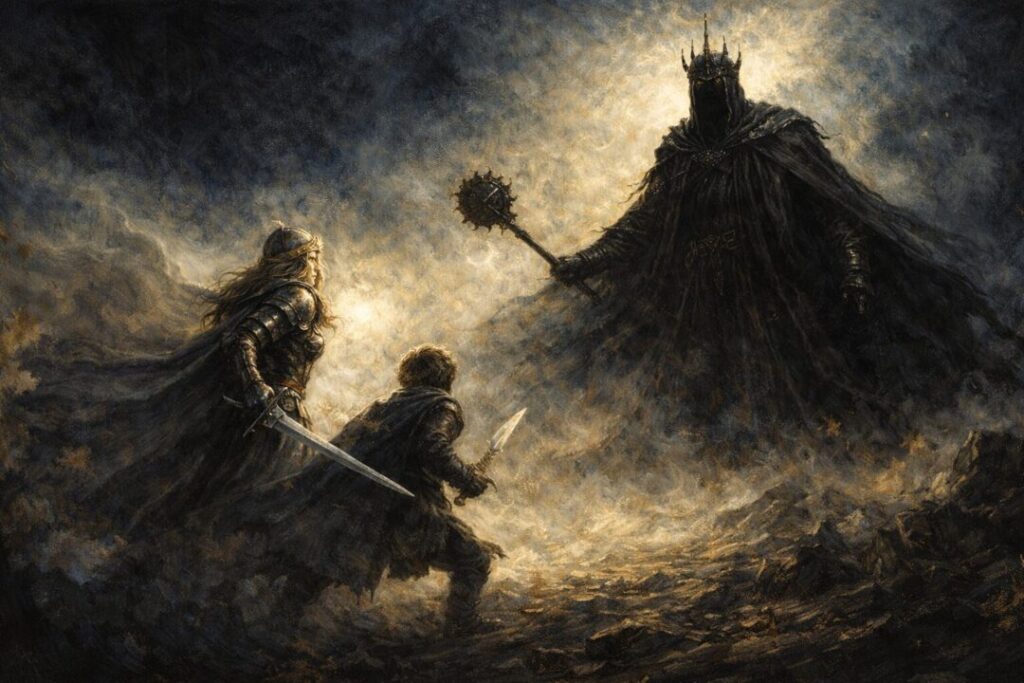
When he confronts Éowyn and Meriadoc Brandybuck, fear no longer controls the field.
Éowyn is afraid — but she does not flee.
Merry is terrified — but he strikes anyway.
And in that moment, something changes.
The Witch-king’s advantage collapses, not because weapons suddenly become stronger, but because fear stops functioning as his primary weapon. Courage does not erase terror; it renders it ineffective.
This is a pattern we see again and again.
The Nazgûl are devastating when fear dominates.
They falter when it does not.
Why Hobbits Are So Dangerous to the Nazgûl
Hobbits are not fearless.
They shake. They hesitate. They long for safety and home. They feel dread as keenly as anyone.
But their fear behaves differently.
Hobbits endure. They cling to one another. They keep going even when every instinct tells them to stop. Their courage is not grand or defiant — it is stubborn, domestic, and deeply resistant to domination.
This makes them uniquely dangerous to creatures like the Nazgûl.
The Ring tempts Hobbits more slowly. Their small ambitions limit its immediate leverage. Likewise, the Nazgûl struggle to overwhelm them completely. Terror alone does not cause Hobbits to surrender their will as easily as it does others.
Frodo survives not because he is strong, but because he continues to act while afraid.
Fear that does not lead to submission starves the Ringwraiths.
Creatures That Cannot Win Alone
The Nazgûl are terrifying precisely because they are incomplete.
They require:
– A master to direct them
– Fear to empower them
– Submission to finish their work
Without these elements aligned, they retreat.
This is why Glorfindel can drive them back. His presence is too bright in the Unseen World; fear cannot take root around him.
This is why Aragorn can stand against them with fire. He does not deny fear — he masters it.
This is why they flee at the Ford of Bruinen. Once momentum breaks and terror fails, their position collapses rapidly.
They are strongest where hope is weakest.
They are weakest where fear is challenged, even briefly.
The Quiet Truth About Their Defeat
The Nazgûl do not lose because they are hunted down one by one.
They lose because Middle-earth slowly learns to resist fear.
Every stand taken.
Every refusal to submit.
Every act of courage performed while terrified.
These moments do not look impressive on the battlefield. They do not come with trumpets or banners. But they erode the Nazgûl’s power more effectively than any sword.
By the time the Ring is destroyed, their strength has already been diminishing. They are still dreadful — but they are no longer inevitable.
They fed on fear.
And in the end, fear could no longer sustain them.
That is the true reason the Black Riders fail.
Not because they were slain — but because the world learned, slowly and painfully, how not to give them what they needed most.
Sources & Notes
- J.R.R. Tolkien, The Lord of the Rings, Book I, Chapter 2, “The Shadow of the Past” — Gandalf explains the Nine Rings, their mortal bearers, and how they became Ringwraiths under Sauron’s power.
- J.R.R. Tolkien, The Lord of the Rings, Book I, Chapter 11, “A Knife in the Dark” — the Black Riders use dread, pursuit, and the Morgul-knife wound to draw Frodo toward the wraith-world rather than simply kill him.
- J.R.R. Tolkien, The Lord of the Rings, Book I, Chapter 12, “Flight to the Ford” — Glorfindel’s revealed power in the Unseen and the Riders’ defeat at the Ford show the limits of their terror when opposed by stronger courage and light.
- J.R.R. Tolkien, The Lord of the Rings, Book V, Chapter 4, “The Siege of Gondor” — the Witch-king’s arrival at Minas Tirith is framed through despair, paralysis, and psychological assault as much as physical force.
- J.R.R. Tolkien, The Lord of the Rings, Book V, Chapter 6, “The Battle of the Pelennor Fields” — Éowyn and Merry’s stand against the Witch-king illustrates courage acting inside fear rather than the absence of fear.
- J.R.R. Tolkien, Letter 131 — Tolkien describes Sauron’s central desire as domination and ordering of wills, supporting the article’s reading of the Nazgûl as instruments of fear and control.