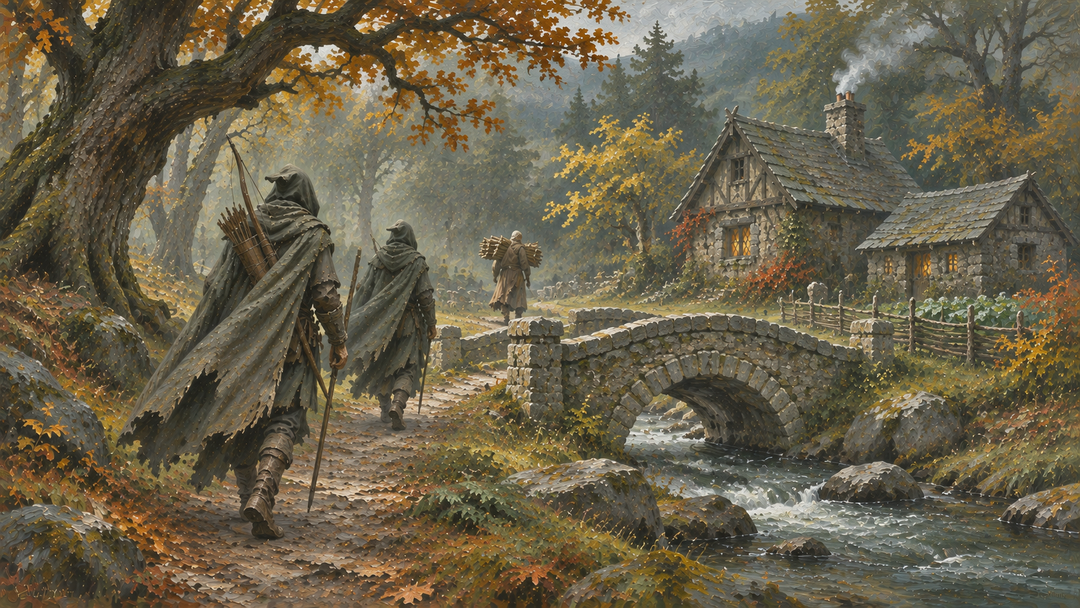
In 2933 of the Third Age, Arathorn II was killed by an Orc-arrow. His widow, Gilraen, took their two-year-old son Aragorn to Rivendell, where Elrond raised him under another name. Appendix A of The Lord of the Rings thus establishes what the image of solitary Rangers can obscure: northern Dúnedain had families and lives outside their patrols.
They were not simply an order of professional soldiers. They were the surviving people of a fallen kingdom, some of whom served as Rangers. They almost certainly had homes and places where families could live, although Tolkien described few of them. Their culture was closely related to Gondor’s, but shaped by political collapse, secrecy and contact with Elves.
From the kingdom of Arnor to the wandering Rangers
The distinction begins with chronology. Arnor was founded by Elendil after Númenor’s downfall, while his sons Isildur and Anárion established Gondor in the south. Arnor’s people were not originally a band of wilderness scouts. They belonged to a kingdom with rulers, towns, roads, towers and ordinary inhabitants. Annúminas, beside Lake Evendim, was its first royal seat; Fornost later became the chief city of Arthedain, its principal surviving successor state.
In 861, Arnor divided into Arthedain, Cardolan and Rhudaur. Wars against Angmar destroyed their strength. Rhudaur fell under hostile control, Cardolan lost its independence, and in 1974 the Witch-king captured Fornost. The following year Angmar was defeated, but that victory did not bring back the lost population or institutions of the North-kingdom.
Aranarth, son of the last king Arvedui, therefore became the first Chieftain of the Dúnedain rather than ruling as king. Appendix A explains that the Dúnedain became a secret, wandering people after the kingdom’s end. Their leaders continued in an unbroken succession, and Elrond fostered the sons of the chieftains and preserved their family’s heirlooms at Rivendell.
This is the historical setting for the Rangers encountered by Frodo. Their ancestors had once governed a territory; now their authority survived chiefly through memory, kinship and service. The Shire and Bree-land benefited from their protection without knowing their identity. In The Fellowship of the Ring, Bree’s inhabitants regard Strider and his fellows as suspicious wanderers, not descendants of the kings who had once ruled the region.
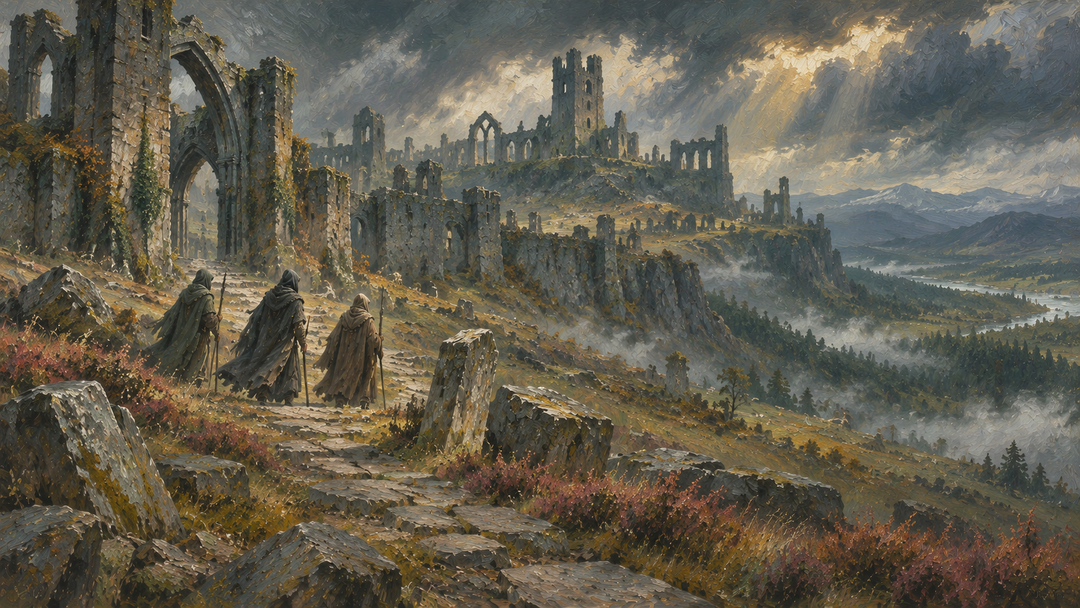
Even so, it would be misleading to imagine that everyone of northern Dúnadan descent spent every day patrolling the roads. The word Ranger describes the visible activity of the people most often encountered by outsiders. Tolkien does not provide a census, a formal distinction between civilian and military status, or a description of how their community distributed work. They were a hidden people, not simply a surviving regiment.
Families, homes and the evidence for settlements
Gilraen is the clearest evidence that the Rangers had a wider society. Appendix A recounts her marriage to Arathorn and the concerns of her parents, Dírhael and Ivorwen. Dírhael objected partly because Gilraen was young by the customs of her people; Ivorwen favoured the marriage. These details show family life and marriage customs, not just warriors assembling.
After Aragorn grew up, Gilraen eventually left Rivendell and returned to her own people in Eriador, living alone. This matters because her people evidently existed somewhere outside Elrond’s house. Rivendell was a refuge and a place of education for the chieftains’ heirs, not a stated replacement for every northern Dúnadan home. Tolkien never identifies the dwelling in which Gilraen spent her last years, however, so it cannot be used to locate a particular village.
Other evidence comes from Tolkien’s drafts and later-published writings, which should not be treated as identical to the finished narrative. A draft of the tale of Aragorn and Arwen, printed in The Peoples of Middle-earth, associates Dírhael and his household with a concealed stronghold in the wilds of Eriador. This suggests a substantial home, though it establishes neither a town nor a population.
There is also a geographical clue in The Nature of Middle-earth. A note in Tolkien’s writings places many northern Dúnedain in wooded country between the Hoarwell and Loudwater, and describes a house of the chieftain near the Hoarwell, north of the Trollshaws, in Arador’s time. The country between those rivers is known as the Angle, but Tolkien names no permanent Ranger village there or specifies how long it remained inhabited.
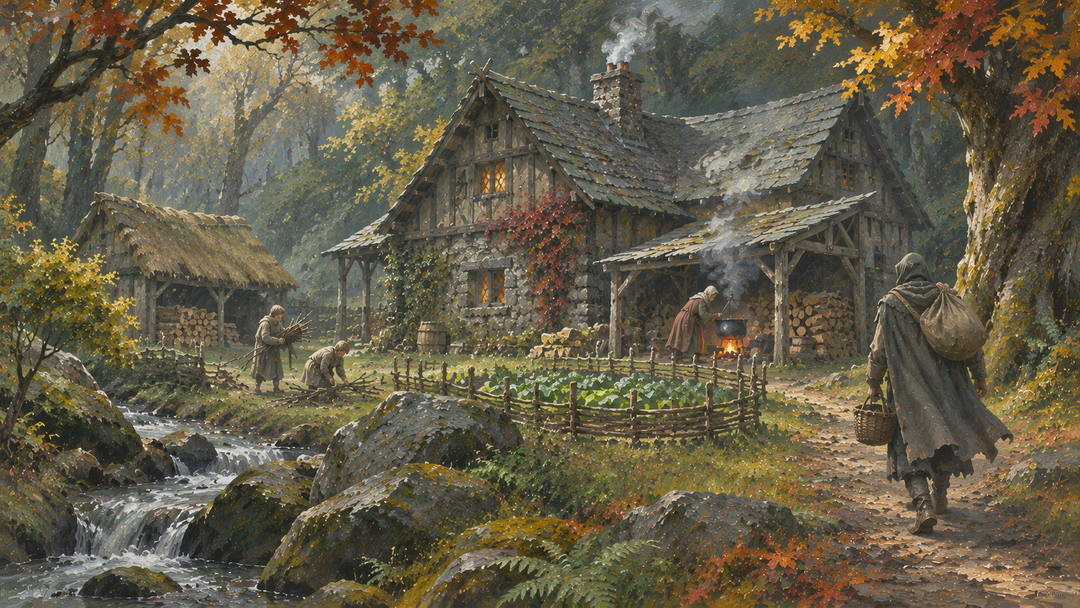
These sources support inhabited refuges, perhaps households spread through woodland rather than a single conspicuous settlement. They do not establish the number, size or appearance of such places. Possibilities include fortified houses, hamlets and hidden farms. Only the general existence of families and places to live is secure; describing a complete network of villages would go beyond the text.
Practical questions remain unanswered. Who cultivated food, tended animals, repaired clothing or taught children while Rangers were away? A long-lived community must have met such needs somehow, by its own work, exchange or assistance from allies. Those are reasonable deductions, not documented economic arrangements. Tolkien offers no account of northern Dúnadan agriculture, markets, taxation or the occupations of most women. Tolkien concentrates on leaders and their journeys.
Nor should the Grey Company be mistaken for the population of the North. In The Return of the King, Halbarad arrives with thirty Rangers, accompanied by Elladan and Elrohir, after gathering what men he could in haste. The scene illustrates the small force available for that urgent mission, not a total headcount of every Dúnadan, every capable fighter, or every person related to them.
A northern culture preserved without a kingdom
The northern Dúnedain and the people of Gondor descended from the same Númenórean world. Both inherited loyalty to Elendil’s house, reverence for earlier ages, knowledge of the West and traditions of Elvish friendship. Neither people was a wholly separate civilisation from the other. The question is how those shared traditions developed under radically different conditions.
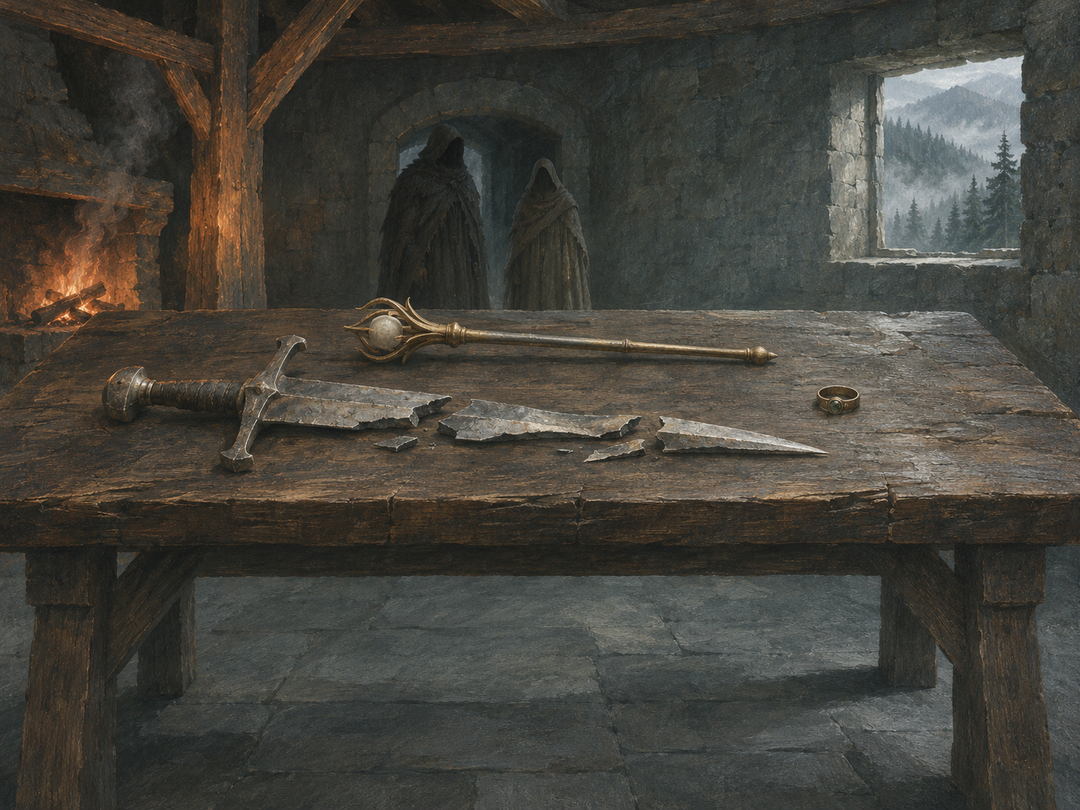
In the North, kingship became a family responsibility without a functioning state. The chieftains preserved their claim across roughly a thousand years without a throne or capital. Their sons were fostered in Rivendell, where the shards of Narsil, the Ring of Barahir, the Sceptre of Annúminas and other heirlooms carried historical meaning. This brought the ruling family close to Elrond while reducing public culture to guarded inheritance.
Names are another sign of continuity. Aragorn, Arathorn and many of their predecessors bore Sindarin names, as did Gilraen and Halbarad. Elvish learning remained important to their identity. Aragorn himself could speak and understand Elvish languages, but it would be unjustified to assume that every Ranger was equally learned or that all families conducted ordinary conversation in Sindarin. The Common Speech was available across the western lands, and Tolkien supplies no detailed account of a distinct northern vernacular.
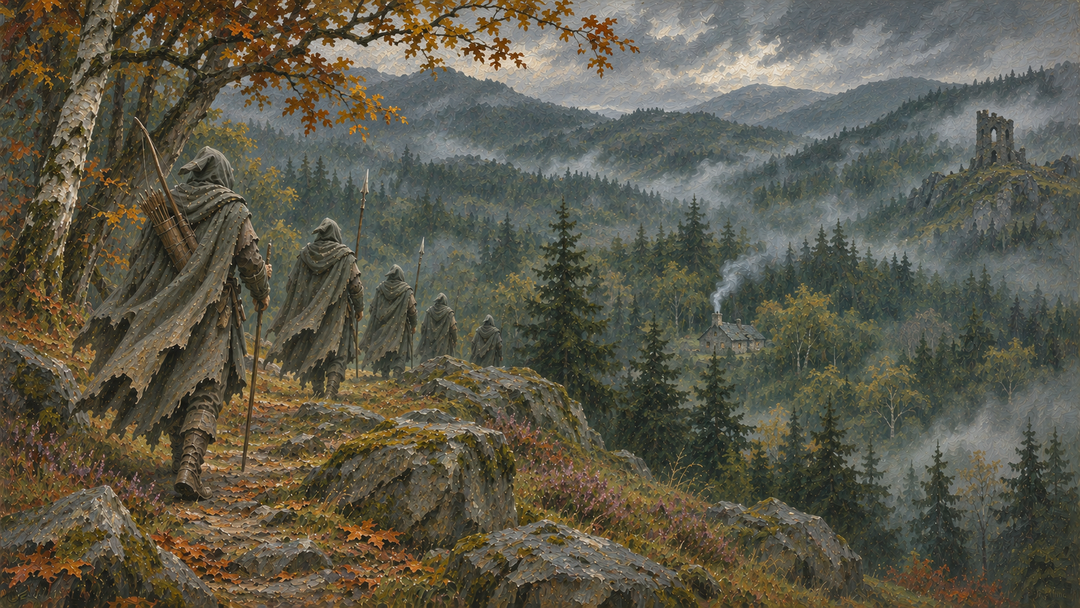
Their outward appearance expressed both heritage and concealment. The Grey Company wore subdued cloaks and carried silver stars as badges, recognisable to those who understood the sign but hardly royal splendour in the manner of Minas Tirith. Their reputation among the Bree-folk was poor, yet their work maintained relative safety around communities that did not thank them. Guarding people who misunderstand them is a central element of the Rangers’ role in the novel.
There was also a tradition of endurance and practical knowledge. Aragorn’s ability to track, travel in difficult country and recognise the healing use of athelas reflects skills suited to his life. His learning is partly personal and partly associated with his ancient lineage and Elvish upbringing. It should not automatically be transferred to every northern Dúnadan as a standard curriculum. Tolkien tells us much more about Aragorn than about the ordinary training of his relatives.
The culture was not entirely military or grim. Gilraen’s story suggests family loyalties, long memory, foresight and sorrow over a declining people. The continued use of heirlooms, names and genealogies indicates a strong sense of historical identity. Yet the books supply no reliable list of Ranger festivals, traditional foods, marriage ceremonies or styles of domestic architecture. Elaborate reconstructions of these customs belong to fan speculation, even if some are plausible.
How different were they from Gondor, and what do adaptations change?
Gondor remained a state when Arnor ceased to be one. It had Minas Tirith, provincial lords, soldiers, administrators, archives and established public ceremonies. Northern Dúnedain identity survived in dispersed families and concealed service; Gondorian identity continued through cities, law, government and a larger population. The contrast was therefore mainly historical and institutional, not a division between two unrelated peoples.
Gondor also possessed its own Rangers. Faramir’s men in Ithilien used secrecy, woodland knowledge and swift movement against enemies occupying their country. Ranger was not a uniquely northern ethnicity or separate culture. Northern Rangers and those of Ithilien had related skills but different political situations: one protected the remnants of a kingdom that had fallen centuries earlier, while the other served a still-functioning Gondorian command.
Some cultural distinctions were nevertheless genuine. The northern line maintained the direct male descent from Isildur through its chieftains, whereas Gondor passed to the rule of Stewards after its royal line failed. Appendix A also contrasts the longevity of the northern chieftains with the more rapid waning of long life in Gondor after its kings ended. Neither fact proves that every northern family lived longer or followed customs wholly unknown in the South.
Aragorn’s career further resists a simple North-versus-South division. Before the War of the Ring, he served in Rohan and Gondor under the name Thorongil. He could understand Gondor from within as well as inherit Arnor’s traditions. His eventual kingship reunited related branches of Númenórean history; it was not the conquest of one alien civilisation by another.
Adaptations can create a different impression. Peter Jackson’s The Lord of the Rings films concentrate the northern Ranger identity almost entirely in Aragorn and do not reproduce the book’s Grey Company riding south to aid him. They give little space to his people’s families or settlements. That choice says nothing about whether Tolkien’s Dúnedain had homes.
Games can add the opposite impression. The Lord of the Rings Online, for instance, depicts organised Ranger bases and a settlement called Tornhad in the Angle. Such locations provide useful settings for play, but they should be identified as game continuity rather than named settlements established by Tolkien’s published narrative. The same applies to fan maps filled with hidden villages.
A final counterfactual helps define the limits. A people surviving for generations could not have consisted solely of unmarried men wandering permanently without children or shelter. That reasoning confirms the need for a wider community, but it cannot settle whether most Dúnedain lived in hamlets, scattered houses, fortified refuges or some changing combination. Tolkien’s evidence points most strongly towards families living discreetly in parts of Eriador, especially near the eastern rivers, while Rangers travelled beyond them.
So the answer is yes to civilians and domestic life, a qualified yes to settlements, and yes to a recognisable northern culture. There is no securely described network of named Ranger villages, nor a complete account of a separate northern civilisation. The Dúnedain of the North were Gondor’s kin, preserving much of the same inheritance under conditions so different that their way of life had become unmistakably their own.
Sources & Notes
- Tolkien Gateway, Arnor — the North-kingdom founded by Elendil after the Downfall of Numenor, later divided into Arthedain, Cardolan and Rhudaur, destroyed by Angmar in T.A. 1974, after which Aranarth took the title Chieftain and led his dwindling people as secretive wanderers. https://tolkiengateway.net/wiki/Arnor
- Tolkien Gateway, Dunedain — the Numenorean descendants in Middle-earth; after the Angmar War the Dunedain of the North were reduced to Rangers wandering secretly in the wild while the heirs of Isildur were harboured in Imladris. https://tolkiengateway.net/wiki/D%C3%BAnedain
- Tolkien Gateway, Chieftain of the Dunedain — the hereditary title created after the final destruction of Arthedain in T.A. 1974, held by the rulers of the Rangers of the North in unbroken descent from Aranarth. https://tolkiengateway.net/wiki/Chieftains_of_the_D%C3%BAnedain
- Tolkien Gateway, Angle — the wedge of land between the Hoarwell and the Loudwater; in the time of Chieftain Arador many Dunedain of the North lived in those woods and Arador had a house near the Hoarwell north of the Trollshaws, while the Ranger village Tornhad belongs to The Lord of the Rings Online. https://tolkiengateway.net/wiki/Angle
- Tolkien Gateway, Grey Company — the thirty Rangers led by Halbarad, with Elladan and Elrohir, who rode south to Aragorn in haste and passed through Rohan to Dunharrow and the Paths of the Dead. https://tolkiengateway.net/wiki/Grey_Company
- Tolkien Gateway, Gilraen — daughter of Dirhael and Ivorwen, wife of Arathorn II and mother of Aragorn; her kin's objections to the marriage, her later return to her own people in Eriador, and her death in T.A. 3007. https://tolkiengateway.net/wiki/Gilraen
Reference basis: the Tolkien Gateway entries used here follow Appendix A for the fall of Arnor and the Chieftainship, for Gilraen's family and Dírhael and Ivorwen's objections to her marriage, and for the Grey Company gathering thirty Rangers in haste on 6 March T.A. 3019. The Angle entry records the note in The Nature of Middle-earth that in Arador's time many northern Dunedain lived in the woods between the Hoarwell and the Loudwater and that the chieftain had a house north of the Trollshaws, and separately identifies the Ranger village Tornhad as a Lord of the Rings Online location rather than a settlement named in Tolkien's published narrative. The article's deductions about food, clothing and teaching while Rangers were away are reasoned inference from the existence of families, not documented northern Dunadan economy.