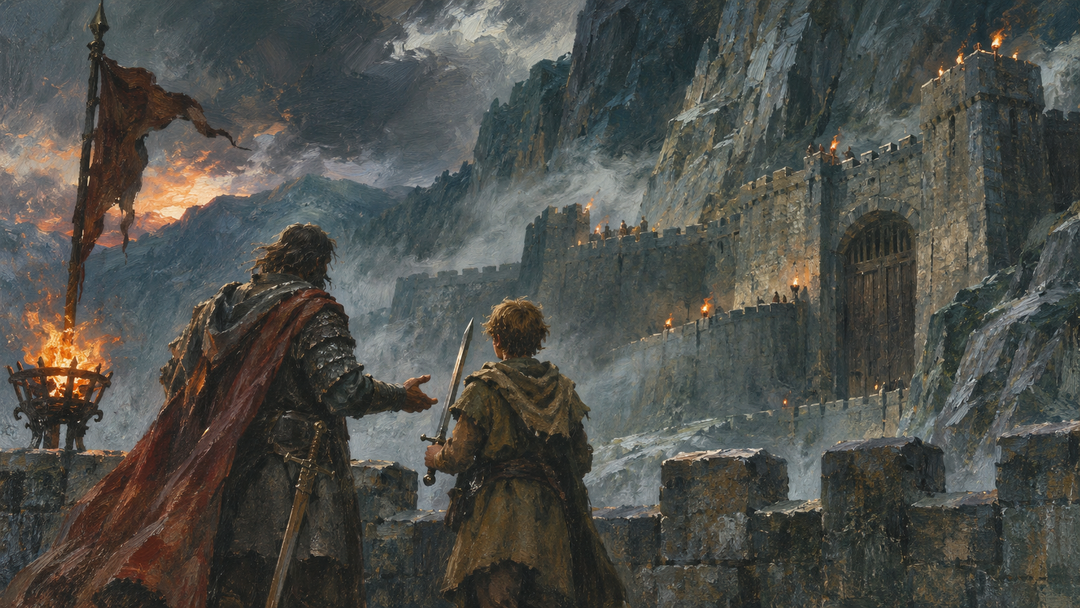
Before the assault on Helm’s Deep in Peter Jackson’s The Two Towers, Aragorn takes a sword from a frightened young defender, tests its weight and hands it back. The boy introduces himself as Haleth, son of Háma. Hearing that the men expect to die, Aragorn reassures him: there is always hope. It is a memorable exchange, but it is not a scene from Tolkien’s novel. The book contains neither this conversation nor a young soldier identified as Háma’s son.
That distinction matters because there really is a young defender mentioned at the Hornburg in The Two Towers. He is not named Haleth. He is the grandson of Gamling, an elderly commander among the men of Westfold. Tolkien gives him no age, speech or individual fate. Treating them as the same person turns an adaptation choice into an unsupported claim.
The film’s Haleth and the question of identity
In the 2002 film, Haleth stands among the ill-equipped people preparing to defend the fortress against Saruman’s army. His sword looks battered; his uncertainty is obvious. Aragorn gives the young soldier a brief sign of respect without promising survival. A weapon that still works, and an adult who takes its bearer seriously, become grounds for courage.
The name Haleth is spoken aloud, as is the relationship to Háma. Earlier in the film, Háma, one of Théoden’s guards, dies during an attack by Warg-riders on the journey from Edoras. Putting the two scenes together gives the boy an implied recent bereavement. The later scene does not explain the family history.
Nothing on screen securely establishes Haleth’s precise age, whether he kills an attacker, or what happens to him after the fighting. The film does not provide a definite final scene for him. Claims that he certainly dies, survives to adulthood, or becomes an important figure in Rohan’s subsequent history go beyond what this appearance establishes. Those are invented continuations.
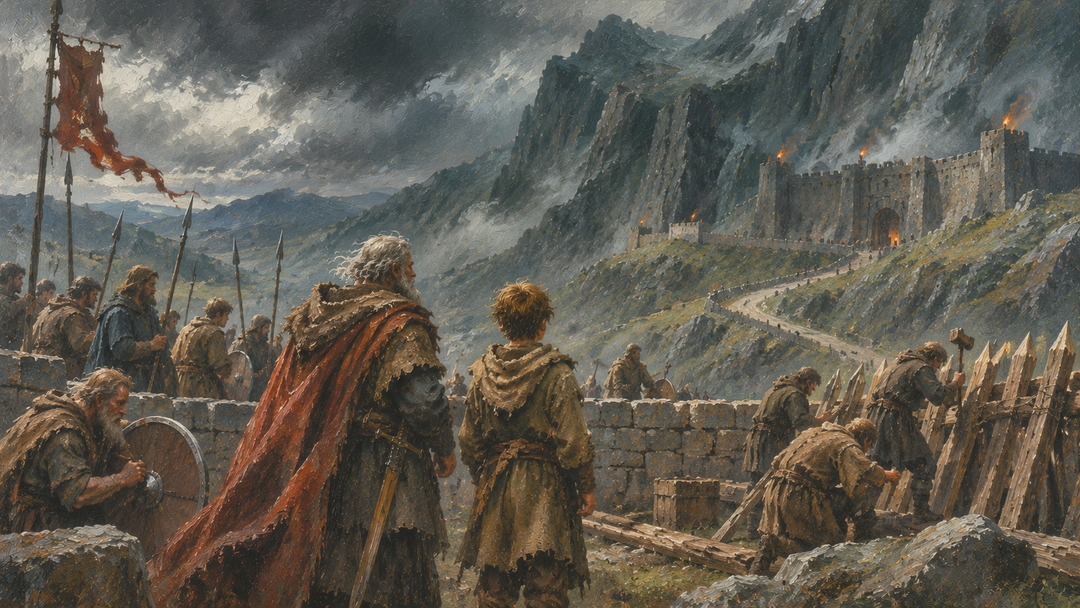
The script also places this moment within a wider sequence of civilians receiving weapons. Théoden’s defenders include farmers, tradesmen and boys, as well as older men. A young person facing Saruman’s army intensifies the danger. The film needs no detailed biography for Haleth to make its point: war has reached people who would ordinarily be protected from it.
The unnamed grandson in Tolkien’s account
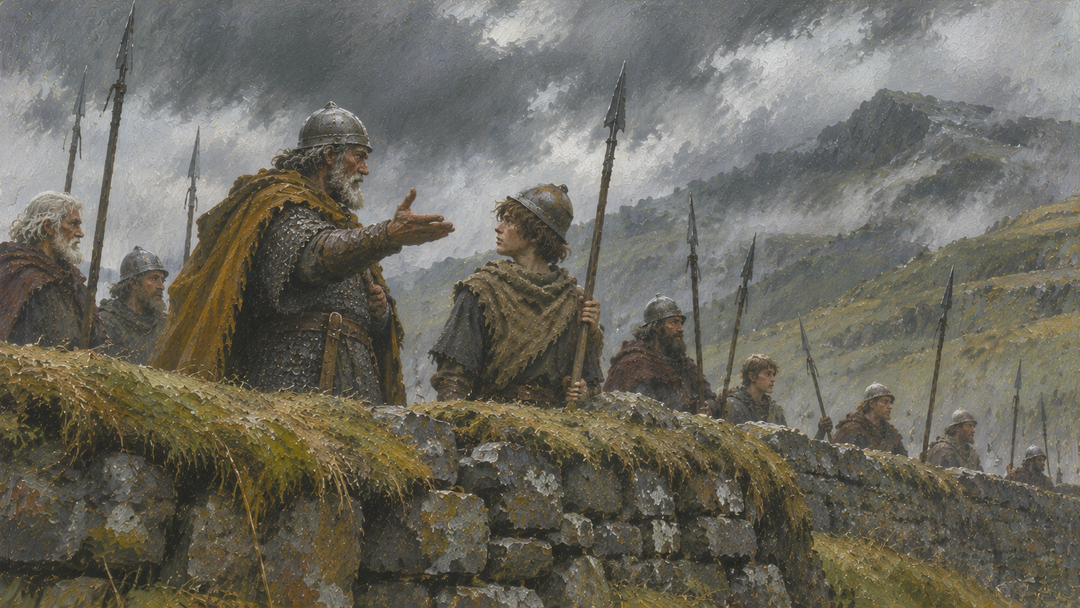
The closest passage in the novel occurs in Book Three, chapter seven, ‘Helm’s Deep’. Théoden’s riders reach Helm’s Gate after learning that Saruman’s forces are advancing through the Westfold. Erkenbrand has already strengthened the Hornburg and left men to defend it. Gamling, who leads the watchers at Helm’s Dike, estimates that about a thousand men there are fit to fight on foot. Many, he says, have lived either too many winters or too few; he indicates his own son’s son as an example of the latter.
This is more specific than a general reference to frightened children. Gamling has a grandson present among the defenders, and the grandfather himself considers the young man’s experience or maturity limited. But the wording supplies no birthday or minimum age. It does not say he is twelve, thirteen or sixteen. It does not describe his equipment, his training or his feelings. Calling him a boy is understandable; assigning him an exact age is not.
Nor does the text describe Gamling’s grandson as the last child available to fight, or as the only minor at the fortress. The comment about too few winters suggests a broader shortage of men in their prime. Yet the number of young defenders, their exact ages and the process by which they were armed are not set out. An emergency levy evidently included inexperienced people.
Gamling’s own position is important. In the novel he is a Westfold leader stationed at the Dike, not simply an attendant in Théoden’s hall. He knows the local defences and speaks the language of Dunland, a detail that later becomes relevant when enemies call out to the Rohirrim. The grandson belongs to this local military setting. Tolkien identifies him through family, not through Aragorn.
The civilian arrangements are also different from the film’s. In the novel, Théoden rides west intending to confront Saruman’s threat. At Edoras, he entrusts his people to Éowyn, who is to lead them to the mountain refuge of Dunharrow. The inhabitants sheltering in the caves behind the Hornburg are chiefly people of Westfold who have gathered there before the king’s arrival. Gamling refers to old and young people, women and children, and to provisions and livestock stored with them.
That means Tolkien does place children near the battle. But that does not mean every child is conscripted or that Edoras has marched to Helm’s Deep. The novel distinguishes a fighting force holding the walls from civilians seeking shelter behind them. The film brings these groups into one immediate crisis, with Éowyn herself among those at the fortress.
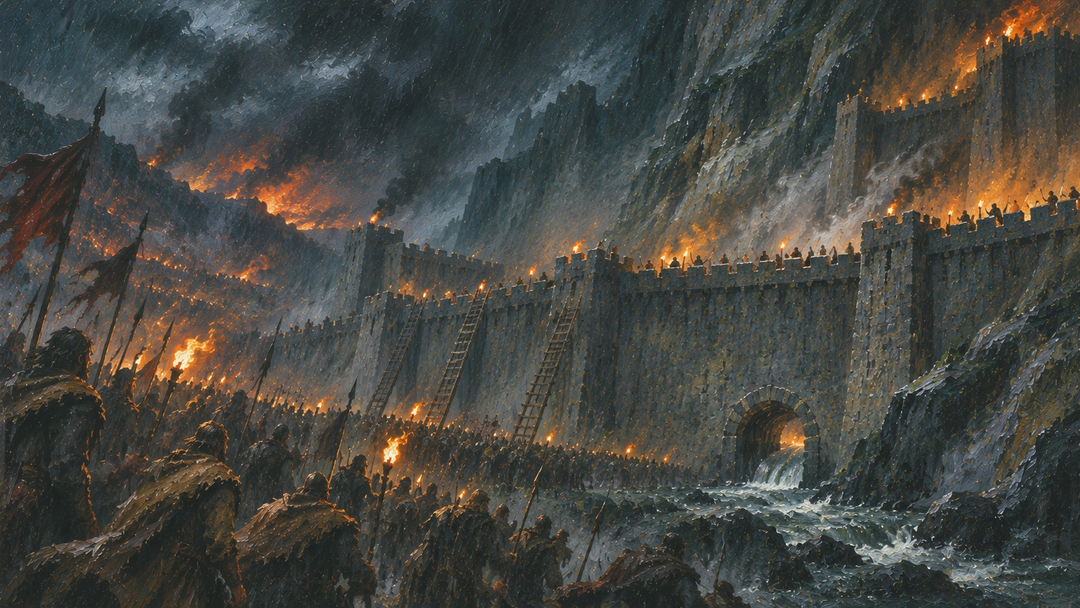
When the assault comes, Tolkien concentrates on the changing defence rather than on an individual adolescent. He follows the fighting at the Deeping Wall, the attempted passage through the culvert, the breach, and the withdrawals towards the Hornburg and the caves. Gamling remains involved, helping respond to the incursion beneath the wall. His grandson is not singled out again. No particular attack, rescue or death is attributed to him.
Why the names Haleth and Háma cause confusion
Tolkien does have a character named Háma in the War of the Ring. He is Théoden’s doorward at Meduseld, and he plays a recognisable part in ‘The King of the Golden Hall’. He allows Gandalf to retain his staff despite the restrictions on weapons, and he later proposes Éowyn as the person trusted to lead the people left behind. He accompanies the king to war. Unlike the film’s guard, he survives the journey to Helm’s Deep.
His death is recorded after the battle, in ‘The Road to Isengard’. He falls before the gate of the Hornburg, and Théoden mourns him and casts the first earth on his separate grave. In ‘The Voice of Saruman’, the king recalls the violation of Háma’s body among Saruman’s injuries against Rohan. These details make Háma’s fate in the book unambiguous, but no accompanying passage mentions a son. His lack of a recorded son does not prove he had none.
There is also a Haleth in Rohan’s much older history. Appendix A to The Lord of the Rings, in the account of the House of Eorl, describes Haleth as the elder son of Helm Hammerhand. He dies defending the doors of Meduseld when Wulf takes Edoras during the invasion of 2758 of the Third Age. Helm’s younger son, named Háma, later leads a desperate expedition for food from the besieged refuge and is lost in the snow.
Those royal brothers lived roughly two and a half centuries before Théoden’s war, and their relationship is the reverse of the film boy’s stated parentage: that Haleth was Háma’s brother, not his son. The recurrence of the names is striking, particularly because the older story is connected to the place called Helm’s Deep. It is reasonable to see a possible historical echo in the filmmakers’ naming. It is not reasonable to claim that Tolkien wrote the film boy into the appendix, or that the film explicitly confirms a deliberate homage.
Another famous Haleth appears in the First Age stories: a woman who becomes leader of her people, associated with the House of Haleth and described in The Silmarillion and Unfinished Tales. The shared name does not make them interchangeable. Neither the First Age leader nor Helm’s son is the youngster whom Aragorn encourages in the film.
The battle’s supporting cast further separates the continuities. In the film, Haldir arrives with Elven warriors from Lórien, and Éomer returns with Gandalf at the climax. In Tolkien’s account, there is no such Elven detachment at the Hornburg. Éomer fights beside the defenders, while Gandalf brings Erkenbrand and men on foot to break the assault. Confusing these versions invites invented scenes and genealogies.
What the text allows us to conclude
There are several different questions hidden inside the phrase ‘the boy at Helm’s Deep’. If it means the child to whom Aragorn offers reassurance, the answer is straightforward: Haleth, son of Háma, belongs to Jackson’s adaptation, not to the corresponding scene in Tolkien’s prose. If it means the young defender actually identified by kinship in the book, the answer is Gamling’s unnamed grandson. The novel does not establish that these are alternate names for one character.
Can the novel’s young defender be assumed to have survived? No. Tolkien records substantial losses among the men of Rohan but does not provide a complete list. The grandson’s presence before the fighting, followed by the absence of an individual account afterwards, supports neither a confirmed death nor a confirmed escape. A story in which he later meets Aragorn or returns home is fan speculation.
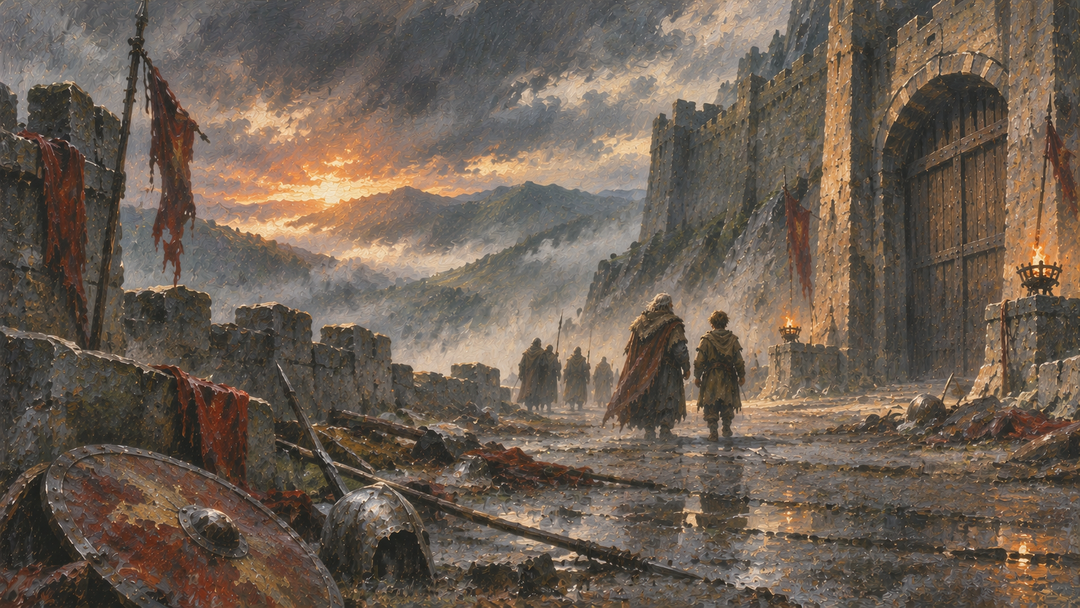
One should be equally careful with the film. Haleth is visible and named, which makes him more vivid than his possible literary counterpart, but being named does not give him a documented future. Some read the conversation optimistically; others anticipate tragedy. Aragorn promises neither outcome. The remark offers hope in the face of uncertainty, not advance knowledge of who will stand alive at dawn.
There is, however, a sound thematic comparison. Tolkien’s Gamling measures the garrison through generations: an old commander and his young grandson are pressed into the same defence because the danger threatens everyone. Jackson compresses a similar predicament into a face-to-face exchange between Aragorn and Haleth. One version uses a passing remark to show the manpower crisis; the other gives the audience a frightened individual with whom to identify. Both make the cost of war visible beyond its famous leaders.
That comparison should not erase Tolkien’s distinct choices. His account gives the local men of Westfold considerable agency: they have repaired defences, gathered stores, sheltered their neighbours and held out before Théoden arrives. The young grandson is part of a community resisting an invasion, rather than simply one more civilian handed a sword in a sudden evacuation from the capital. His grandfather’s line is evidence of strain, but also of an organised defence already under way.
Readers looking for proof of a particular moral judgement should likewise separate evidence from argument. One might argue that allowing an adolescent to fight is a terrible necessity, or that no commander ought to permit it. Neither judgement is attributed by Tolkien to Gamling’s grandson. The text tells us that the defenders were stretched across age groups. It does not tell us whether this particular youth volunteered, was ordered to stand guard or had any realistic alternative.
The firm answer is therefore narrower, and more interesting, than many retellings suggest. Tolkien gives Helm’s Deep a young defender with a known grandfather but no name or recorded fate. Jackson gives the siege a boy named Haleth, a father named Háma and a private conversation with Aragorn. Tolkien also wrote other people named Haleth and Háma, whose histories must not be folded into that film scene. The shared truth is the presence of the very young in a desperate defence; everything more personal requires a clear distinction between what is written, what is filmed and what readers imagine.
Sources & Notes
- Encyclopedia of Arda, Gamling — the leader of the watchers of Helm's Dike, an old man but still a commanding presence at the Battle of the Hornburg; his 'son's son' fought in the battle though Gamling thought him too young, and neither son nor grandson is ever named (citing The Two Towers III 7, 'Helm's Deep'). https://www.encyclopedia-of-arda.com/g/gamling.html
- Tolkien Gateway, Hama — Doorward of Theoden and captain of the King's Guard; in Peter Jackson's The Two Towers he is killed during the Warg attack on the road to Helm's Deep rather than in the battle, and Aragorn is later seen speaking with 'Haleth, son of Hama'. https://tolkiengateway.net/wiki/H%C3%A1ma
- Tolkien Gateway, Haleth (film character) — a boy of Rohan, son of Hama, invented by Warner Bros. for The Lord of the Rings film series and portrayed by Calum Gittins; the character appears only in the adaptation, not in Tolkien's published text. https://tolkiengateway.net/wiki/Haleth_%28film_character%29
- Wikipedia, Helm's Deep — summary of the book account: Theoden's army rides to the Hornburg, the local people are commanded by Gamling the Old, many of the men there are very old or young, and the women and children of Edoras are sent to Dunharrow under Eowyn. https://en.wikipedia.org/wiki/Helm%27s_Deep
- Tolkien Gateway, Battle of the Hornburg — the assault on Helm's Dike and the Hornburg, the battering of the gate, and the dawn arrival of Erkenbrand and the Huorns that ends the battle. https://tolkiengateway.net/wiki/Battle_of_the_Hornburg
- Tolkien Gateway, Gamling — an old man of Rohan, probably Erkenbrand's lieutenant, who led the garrison of Helm's Dike and was a commanding presence during the Battle of the Hornburg. https://tolkiengateway.net/wiki/Gamling
Reference basis: the Encyclopedia of Arda entry for Gamling, which cites The Two Towers III 7 'Helm's Deep', records that Gamling refers to his 'son's son' as having seen 'too few winters' and that neither son nor grandson is ever named. Tolkien Gateway's entries for Hama and Haleth (film character) document the adaptation side: Hama is killed in the film during the Warg attack on the road to Helm's Deep rather than in the battle, and Haleth, son of Hama, is a character invented for Peter Jackson's film series. Wikipedia's Helm's Deep article summarises the book account of Gamling the Old and a garrison of men who were very old or young. Claims about Haleth's exact age, his death or survival, and any later career are not supported by the film or the novel and are treated in the article as inference or invention.