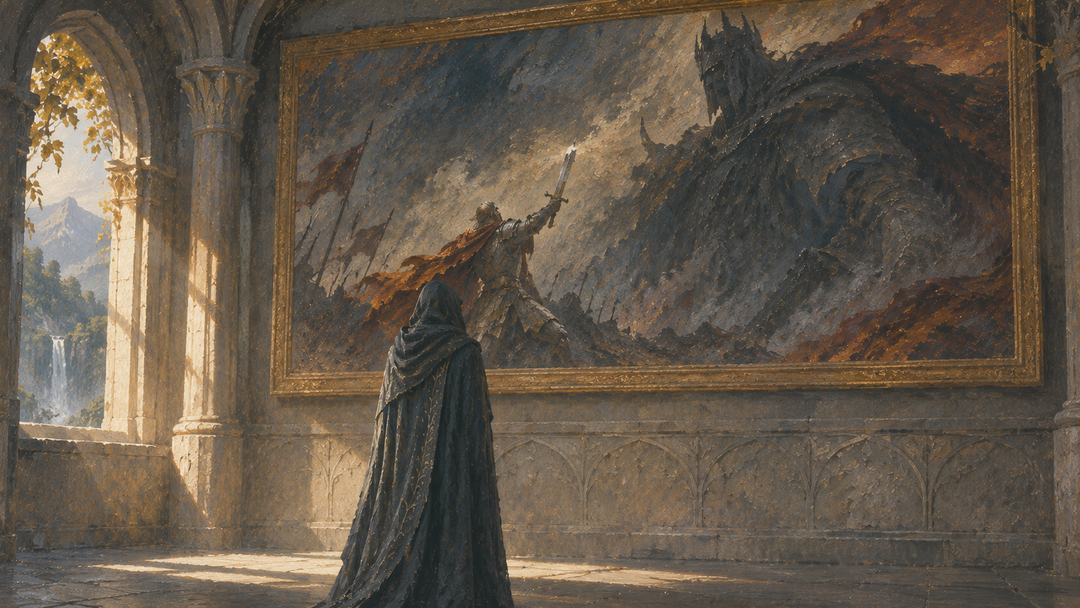
During a scene in Peter Jackson’s 2002 film The Lord of the Rings: The Two Towers, Elrond stands before a large painting in Rivendell while Galadriel speaks to him about the growing danger to Middle-earth. The image shows an armoured figure confronting an enormous dark opponent. Despite its resemblance to Fingolfin’s challenge to Morgoth, it shows Isildur facing Sauron at the end of the Second Age, with the broken sword Narsil providing the most useful clue.
Tolkien wrote two much-illustrated confrontations between a small warrior and a towering Dark Lord, each involving a consequential sword stroke. Yet the identities, dates and results are different. Knowing which scene the film uses changes the meaning of Elrond’s reaction and connects the painting directly to the One Ring.
What the painting in Rivendell actually depicts
The artwork is a historical mural rather than a portrait in the usual sense. It presents a violent moment, not a formal likeness of its subjects. In the film, the central human figure raises a damaged sword towards Sauron. That broken weapon identifies Isildur, the son of Elendil, who took up the remnants of his father’s sword during the final confrontation of the War of the Last Alliance. Fingolfin carried an entirely different sword, Ringil, which was never described as the broken blade of Narsil.
The mural was painted by Alan Lee, an established Tolkien illustrator who worked on the films’ visual design. It belongs to the elaborate decoration of the screen version of Rivendell and can also be seen in The Fellowship of the Ring. The fact that it appears in more than one film matters: it is part of the filmmakers’ consistent visual account of the Last Alliance, not a sudden insertion of a separate First Age story into The Two Towers.
Its placement is also deliberate in narrative terms, even if an individual viewer may initially overlook it. Galadriel’s words concern the possibility that the free peoples will have to face the coming war without sufficient help. Elrond studies an image of an earlier coalition that defeated Sauron but failed to end the threat permanently. The image recalls an incomplete victory while the dialogue asks who will act decisively now.
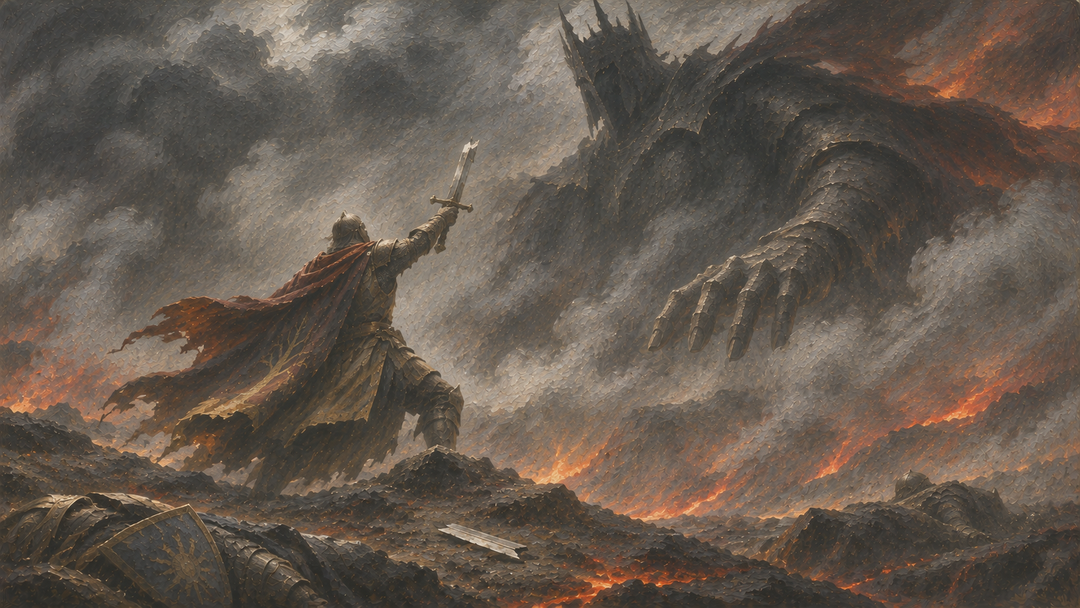
Details near the fallen figures are difficult to distinguish in a brief shot, so they should not be used to invent further identifications. The broken Narsil, the setting and the film’s account of the Ring establish the scene. No Fingolfin-versus-Morgoth mural is identified in this sequence.
The distinction between film and novel is essential. Tolkien’s The Two Towers does not describe Elrond examining this painting while speaking with Galadriel. Their conversation and the use of the mural belong to Jackson’s adaptation. That does not mean a comparable work of art could not have existed somewhere in Tolkien’s fictional Rivendell; it means the book does not establish one. A film prop cannot be cited as a newly discovered passage from the novel.
Isildur, Sauron and the memory of the Last Alliance
The event represented by the mural took place at the close of the Second Age, long after Fingolfin’s death. Elves under Gil-galad and Men under Elendil formed the Last Alliance against Sauron. Their armies fought at Dagorlad, entered Mordor and besieged Barad-dûr. In the final struggle on the slopes of Orodruin, Gil-galad and Elendil were killed, Sauron was overthrown, and Elendil’s sword Narsil broke. Isildur used a fragment of it to cut the One Ring from Sauron’s hand.
There is an important difference in emphasis between Tolkien’s book and Jackson’s opening sequence in The Fellowship of the Ring. The film makes Isildur’s desperate cut the immediately decisive blow against an advancing Sauron. In the book, Elrond recounts the fall of Gil-galad and Elendil and says that Sauron had been overthrown before Isildur cut off the Ring. Reading the mural as a record of the film’s version is straightforward; using it to settle the precise choreography of Tolkien’s written account would be a mistake.
Elrond has a particularly strong connection to this history. In the chapter ‘The Council of Elrond’ in The Fellowship of the Ring, he recalls serving as Gil-galad’s herald and witnessing the last combat. He remembers not merely a tale handed down across generations but an event in which he was present. His identity as a long-lived Elf gives the painting the weight of personal recollection. For him, the failure to destroy the Ring is not an abstract lesson from a distant age.
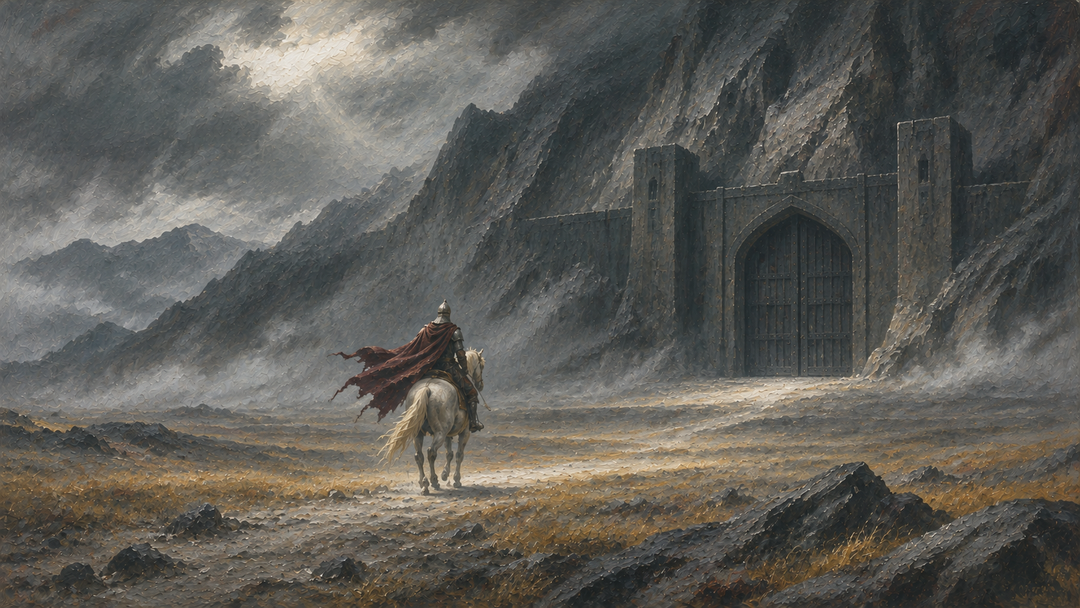
After Sauron’s overthrow, Isildur kept the Ring rather than casting it into the fire where it had been made. Elrond and Círdan counselled its destruction, but Isildur refused. He treated it as compensation for the deaths in his family. The decision left Sauron’s power tied to an object that survived his bodily defeat. Isildur later died in the disaster at the Gladden Fields, and the Ring disappeared from recorded history for many centuries.
This sequence explains why the mural is more than a picture of military success. It commemorates a victory whose chief danger remained unresolved. By the time of The Two Towers, the same Ring has reached Frodo, and Sauron is once again building his strength. Elrond’s apparent contemplation of the scene therefore suggests regret as well as responsibility. That reading fits the film’s dramatic context, although the camera does not provide an explicit statement of every thought passing through his mind.
The sword also connects the artwork to Aragorn, Isildur’s heir. In Tolkien’s novel, Narsil is reforged as Andúril before the Fellowship leaves Rivendell; Jackson’s films delay that moment until The Return of the King. The adaptation therefore keeps the broken sword visible as an emblem of unfinished history. The mural helps explain the burden that Aragorn inherits alongside his claim to kingship.
Fingolfin’s real duel with Morgoth
Fingolfin’s confrontation belongs to the First Age and is told in The Silmarillion, in the chapter ‘Of the Ruin of Beleriand and the Fall of Fingolfin’. Fingolfin was High King of the Noldor in Middle-earth, fighting a war against Morgoth, the original Dark Lord. After the catastrophe of the Dagor Bragollach, the Battle of Sudden Flame, he believed that his people had suffered ruin beyond repair. In rage and despair, he rode alone to the gates of Angband and challenged Morgoth to come out.
Morgoth was not simply an earlier name for Sauron. He was one of the Valar, the mighty beings involved in shaping the world, who had rebelled against the others. Sauron was a Maia who became Morgoth’s servant and later established himself as a Dark Lord in his own right. The two characters belong to the same history of evil in Middle-earth, but they are separate persons with different powers, careers and ultimate fates.
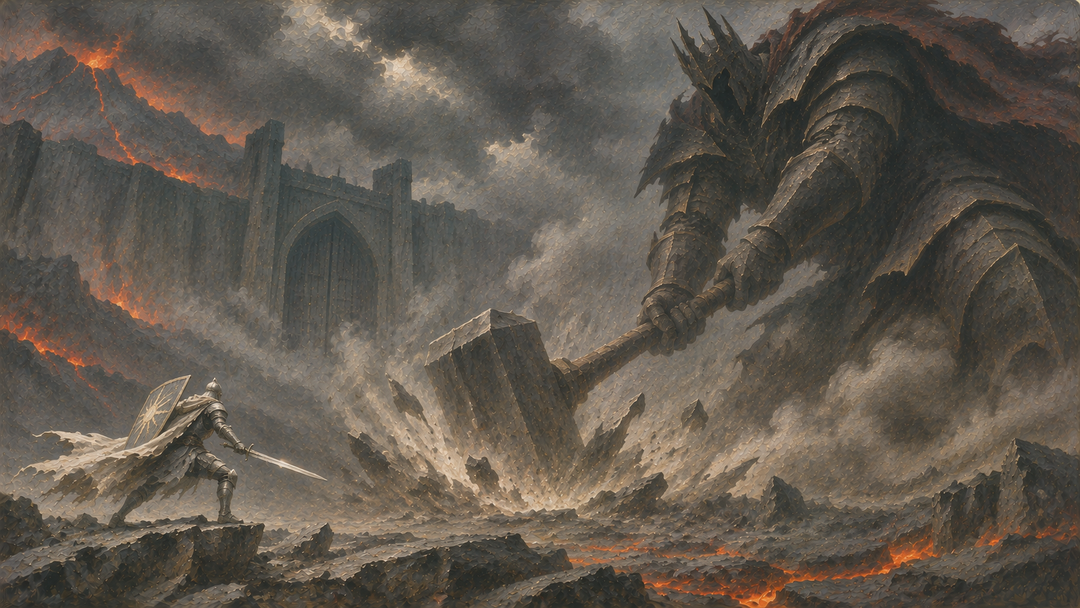
Morgoth accepted Fingolfin’s challenge reluctantly, according to the story, because refusing before his captains would expose his fear. He emerged in black armour, carrying an immense shield and the hammer Grond. Fingolfin wore shining mail, bore a blue shield set with crystals and drew the sword Ringil. This description offers illustrators an immediate contrast of scale and colour: a solitary bright figure beneath the shadow of an overwhelmingly larger enemy.
The fight was not a victory for Fingolfin. He evaded repeated hammer blows, which tore pits into the ground, and wounded Morgoth seven times. Eventually he tired, stumbled and fell. Morgoth pressed a foot upon his neck, but Fingolfin struck that foot with Ringil before dying. Thorondor, the great Eagle, then attacked Morgoth’s face and carried away Fingolfin’s body. His son Turgon later raised a burial cairn on a mountain overlooking Gondolin.
Those wounds are important because they demonstrate that Morgoth could be hurt even though Fingolfin could not defeat him. The published narrative says Morgoth afterwards limped and retained the scars of the encounter. Fingolfin’s stand did not bring down Angband or end the war. Morgoth’s eventual defeat came much later, through the intervention of the powers of the West in the War of Wrath. Treating Fingolfin’s final blow as the defeat of Morgoth would reverse the tragedy of the episode.
Published after Tolkien’s death and edited by Christopher Tolkien, The Silmarillion gives the familiar account of the duel. Tolkien’s First Age stories underwent revisions, so not every detail should be presumed fixed across every draft. None of those complexities, however, turns Ringil into Narsil or Morgoth into Sauron.
Why the mistaken identification remains appealing
As a visual comparison, the Fingolfin theory has a clear attraction. A smaller warrior faces a vast armoured antagonist; an apparently hopeless action changes the physical fate of a Dark Lord; and the image gains force from the losses surrounding it. Those are genuine parallels between Tolkien’s two stories. They explain why a glimpse of the mural might prompt a reader of The Silmarillion to remember Fingolfin before noticing Isildur’s broken blade.
But resemblance is not identification. Fingolfin went to Angband alone and died after wounding Morgoth. Isildur acted at the end of a long alliance war, survived the final encounter with Sauron and took possession of the Ring. Morgoth’s lasting injury was a damaged foot; the decisive object in Sauron’s defeat was the Ring severed from his hand. The settings are different as well: Angband in the First Age and Mordor at the close of the Second.
There is also no sound basis for saying that the painting is a confirmed hidden tribute to Fingolfin. That claim would require evidence of the filmmakers’ intention, not just a shared arrangement of figures. It is fair to describe the visual similarity as fan speculation. It is not fair to promote the speculation into an official explanation when the artwork is already identifiable as the Isildur scene. Alan Lee and other Tolkien artists have depicted many subjects from the legendarium, but one illustration should not automatically be substituted for another.
Another tempting argument is that Elrond could have known the story of Fingolfin, so the mural must depict it. The first half is plausible: Elrond’s family history is deeply connected to the Elder Days, and the deeds of Fingolfin were part of Elvish memory. Yet Elrond was born after Fingolfin’s death, whereas he personally witnessed Sauron’s fall at the end of the Second Age. His knowledge of an earlier event does not override what the painting actually shows.
The distinction becomes especially useful when interpreting the film’s themes. Fingolfin’s story asks what courage can mean when victory is impossible. Isildur’s story asks what happens when a military victory is undermined by a disastrous choice. Jackson’s Rivendell sequence needs the second question because the surviving Ring is the immediate cause of the present danger. The painting also suits Elrond’s concern about the strength of Men and the uncertain decisions of their heirs, without requiring the viewer to know the whole First Age.
The Two Towers contains a Rivendell painting resembling the duel between Fingolfin and Morgoth, but its figures are Isildur and Sauron. The First Age duel is a separate episode, described in The Silmarillion, and the novel The Two Towers contains no corresponding portrait scene. Recognising the difference does not weaken the parallel between the stories. It allows each one to make its own point: Fingolfin’s doomed resistance left Morgoth wounded, while Isildur’s incomplete victory left Middle-earth vulnerable to Sauron’s return.
Sources & Notes
- Tolkien Gateway — Isildur — https://tolkiengateway.net/wiki/Isildur
- The Encyclopedia of Arda — Fingolfin — https://www.encyclopedia-of-arda.com/f/fingolfin.php
- Wikipedia — Production of The Lord of the Rings film series (design) — https://en.wikipedia.org/wiki/Production_of_The_Lord_of_the_Rings_film_series
The Rivendell mural is an adaptation design, not a scene described in The Two Towers novel. Compare The Fellowship of the Ring, The Council of Elrond, with The Silmarillion, Of the Ruin of Beleriand and the Fall of Fingolfin. The sources distinguish Isildur's broken Narsil from Fingolfin's Ringil.