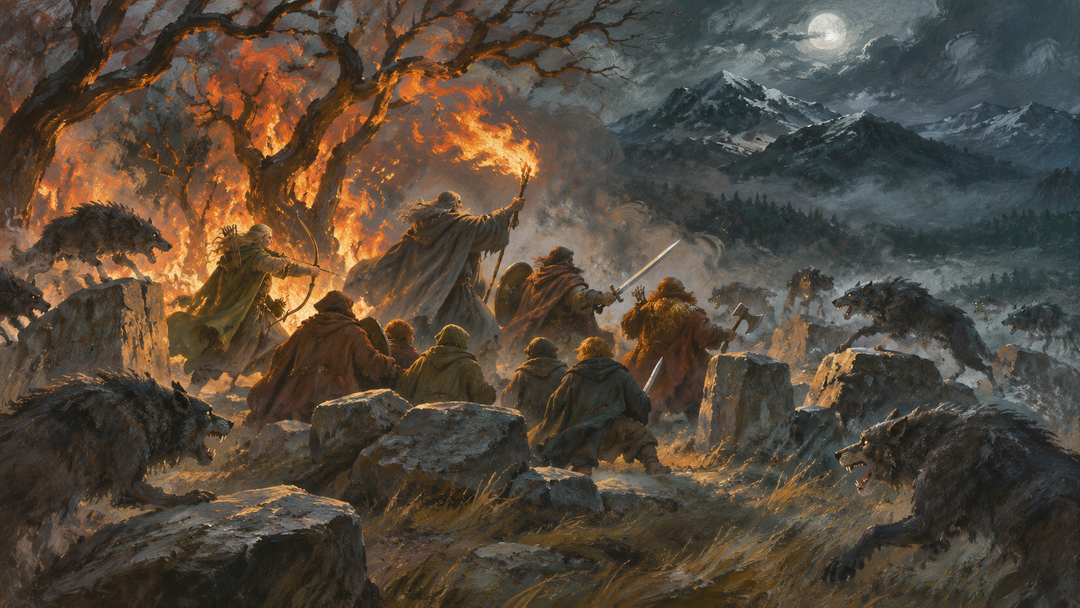
On a cold night in January 3019 of the Third Age, the nine members of the Fellowship of the Ring defended a small hill against attacking wolves. They had turned back from Caradhras and were heading for Moria. Their defensive position was a cluster of twisted trees surrounded by an incomplete ring of large stones. Legolas shot a leading wolf, Aragorn and Boromir fought others at close quarters, and Gandalf eventually drove the attackers away with fire.
The place is sometimes described as a ruin, but that description needs care. In The Fellowship of the Ring, Tolkien does not give the hill a name, identify its stones as the remains of a building, or explain who arranged them. The account appears in Book II, Chapter 4, “A Journey in the Dark”.
A circle of stones in the old land of Hollin
The hill stood west of the Misty Mountains, in or near the eastern reaches of Hollin, the country called Eregion by the Elves. The Fellowship had descended from its failed attempt at the Redhorn Pass and was moving south towards Moria. The fight happened before they reached the Doors of Durin.
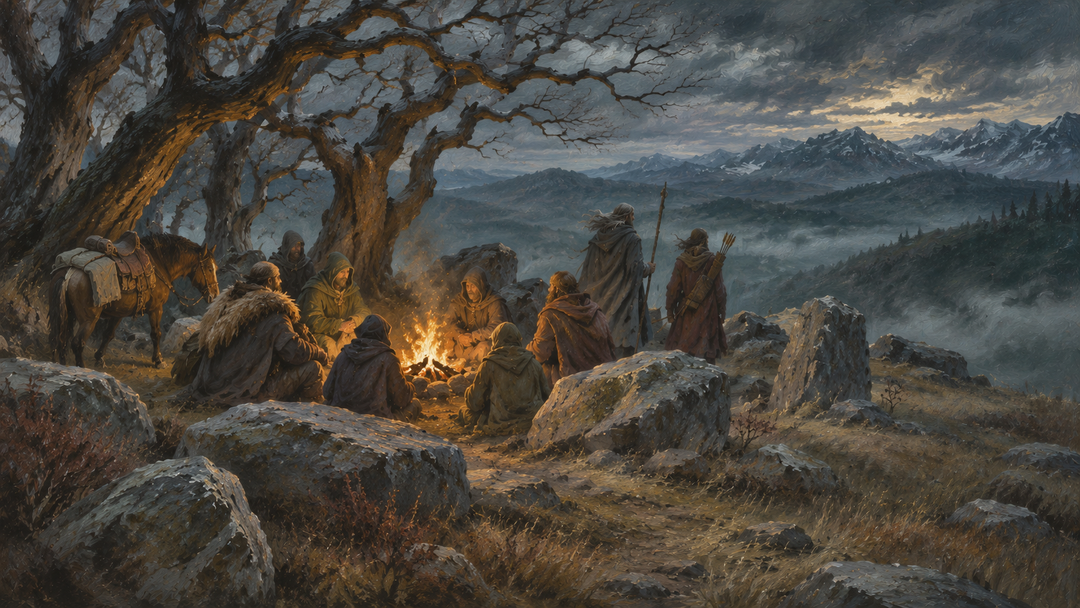
Tolkien describes the site in practical terms. The travellers had first sheltered below a small hill. Once the howling began, they moved to its summit, where old, crooked trees stood among boulders forming a broken circle. They built a fire inside that boundary. The high ground offered visibility, and the stones a rough obstacle. They were not substantial walls: during the assault, wolves jumped across them.
Nothing in the passage establishes that the circle was deliberately built. The stones may suggest a ruined enclosure to a reader, but Tolkien does not call them masonry, mention foundations, or supply any former purpose. An Elven watch-post, forgotten shrine or outwork of Moria would be fan speculation.
That distinction matters because Hollin really does have a ruined civilisation behind it. During the Second Age, Eregion was a realm of Elven craftsmen, including Celebrimbor and the smiths associated with the Rings of Power. Its people maintained a close relationship with the Dwarves of Khazad-dûm. Sauron’s war destroyed their kingdom centuries before Frodo’s journey. The area’s name, its holly trees and its abandoned roads all help establish that the Fellowship is crossing a once-inhabited landscape.
Yet the historical background cannot be attached automatically to every stone. Later on the approach to Moria, the travellers encounter the remains of an ancient road and eventually the West-gate, whose decoration records cooperation between the Elven smith Celebrimbor and the Dwarf Narvi. Those are identifiable works of an earlier age. The circle on the hill has no comparable inscription or explanation. It is reasonable to read the scene against Eregion’s history, but not to label the hill as a particular Eregion ruin.
It should not be confused with Weathertop, either. Also called Amon Sûl, Weathertop held a ruined watchtower, where the Black Riders attacked Frodo earlier. The entire Fellowship had not yet been formed at that point. The wolf fight near Moria happens later, in different country, against different enemies.
Why the Fellowship stopped there
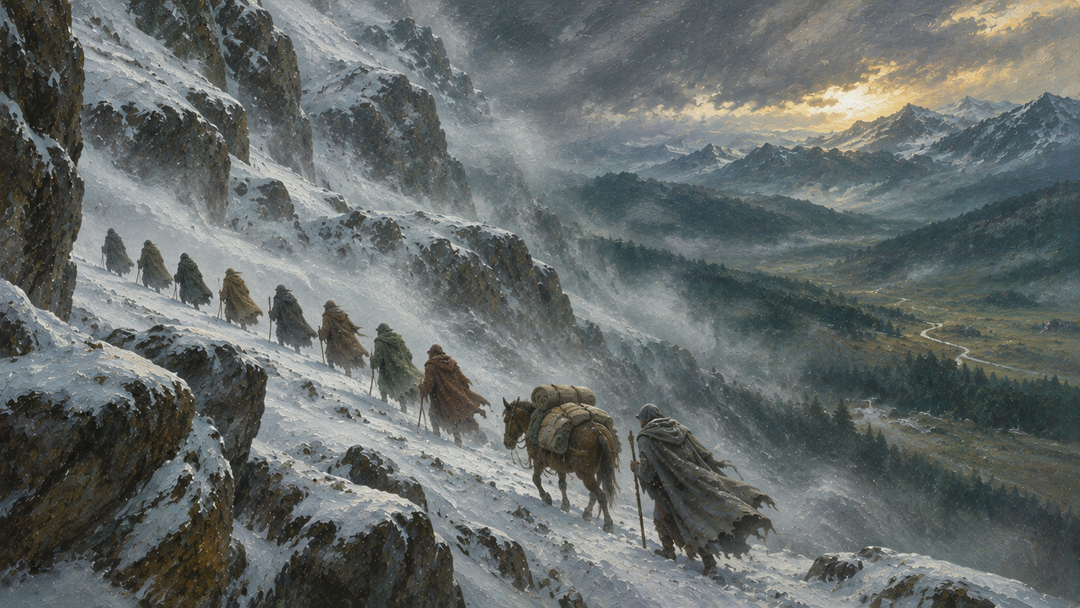
The Company reached the hill because its intended mountain crossing had failed. Aragorn had favoured attempting Caradhras, but severe snow and wind forced the travellers to retreat. Tolkien leaves room for debate about the mountain’s hostility: characters wonder about hostile powers, yet the text does not prove that Sauron, Saruman or a conscious mountain caused every part of the storm. The practical result is clear. Exhausted and exposed, the travellers need another route east.
Gandalf proposes passing beneath the mountains through Moria. Gimli wants news of the Dwarves who had gone there with Balin, but the others have serious objections. Boromir argues for a southern alternative; Aragorn is especially troubled by the danger to Gandalf; and Frodo asks that a decision wait until morning. Moria offers a shorter crossing but carries a frightening reputation, while travelling towards the Gap of Rohan risks drawing closer to Saruman’s influence at Isengard.
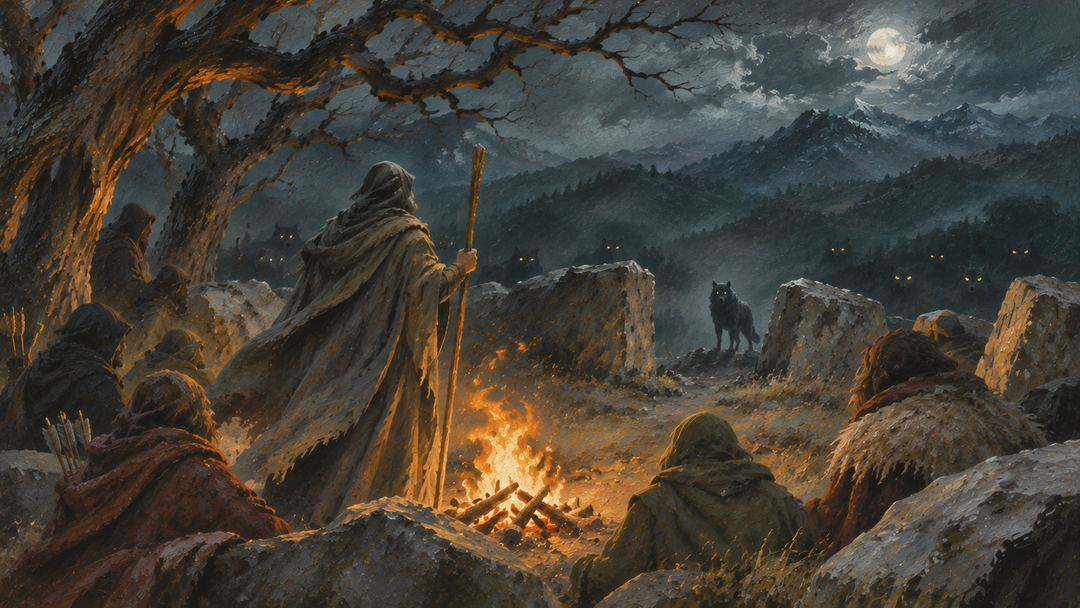
Then the wind begins to sound like howling. Aragorn recognises Wargs and is alarmed that they have come west of the mountains. He also associates Wargs with Orcs, although no Orcs are shown taking part in this particular attack. The threat makes travelling south with a hunting pack following them far less attractive.
The hill is chosen for defence, not because anyone knows it to be a stronghold. Gandalf and the others expect their trail to be found, so they light a fire rather than attempt complete concealment. Some keep watch while the rest sleep uneasily. Bill the pony, still travelling with the Company, is frightened. Despite its fighters, the Company has no fortifications or refuge.
The text gives a useful measure of the surrounding geography without fixing the camp to a precise point on a modern-style map. Gandalf estimates that the door of Moria lies about fifteen miles away in a straight line, and farther by the route a wolf would take. After the fight he urges everyone to reach it before sunset. The hill belongs on the western approach to Moria, but its exact coordinates are unknown.
What happened during the attack
The wolves do not simply charge once. First, shining eyes appear around the hill, and a large dark figure waits at a gap in the stones as though directing the pack. Gandalf challenges this leader as a “Hound of Sauron”, warning it away. Legolas shoots it in the throat when it leaps forward. The other wolves withdraw, and for a time the hillside becomes quiet.
The pause is important. The first exchange looks like a successful deterrent, but the attackers have not gone for good. Later, as the moon sets, Frodo wakes to renewed howling. A far greater number of Wargs rushes the position from several directions. They are organised, not merely hungry animals.
The defenders answer with different skills. Gandalf tells the hobbits to feed the fire and draw their blades, arranging themselves for protection. Aragorn drives his sword through one great wolf’s throat. Boromir cuts the head from another. Gimli fights with his axe, and Legolas keeps shooting. Tolkien gives these actions to named combatants, but he does not provide a tidy count of every creature killed or a separate heroic exploit for each hobbit. Their presence and their defence are clear; additional invented kills are not.
Gandalf’s intervention ends the battle. Carrying a burning branch, he confronts the wolves and speaks a command involving fire. A tree catches alight, then flames spread from crown to crown. Legolas’s final arrow catches fire as it flies and strikes a wolf-chieftain. The surviving attackers flee. This is not ordinary campfire management: the narration presents Gandalf’s words and actions as an extraordinary release of power.
In daylight comes the episode’s strangest evidence. The Company finds no wolf bodies, although several had plainly been struck down. Legolas’s arrows remain on the hill, largely undamaged, while one has been burnt almost to its point. The scorched trees are the main visible evidence of the battle. Gandalf concludes that these were not ordinary wolves hunting for food. They are unnatural, but the mechanism of their disappearance is unexplained.
Nor does Gandalf’s name for the first leader prove it was an individual with the formal title Hound of Sauron. He is addressing an enemy he connects with Sauron’s power. Tolkien does not trace the animal’s history, identify its master in a separate scene, or establish the identities of the other wolf-chieftains killed during the assault. The story does not supply a definitive list of named monsters.
What the stones and wolves mean beyond the battle
Wargs belong to a wider pattern in Tolkien’s fiction. In The Hobbit, intelligent and malicious wolves cooperate with Goblins, and Gandalf uses fire against them when Bilbo and the Dwarves are trapped in trees. The Hollin encounter recalls that danger but changes the circumstances. Here the travellers are not waiting for Eagles to rescue them, and the wizard’s fire helps end the assault rather than merely buying time. The Fellowship fights as a group, using the different strengths of Men, an Elf, a Dwarf, a Wizard and hobbits.
The missing bodies invite supernatural interpretations. One fan theory identifies these attackers with werewolves associated with Sauron’s older servants, while another treats the disappearance as evidence of some kind of sorcery or illusion. Those are possible readings, not settled facts. Tolkien’s language elsewhere distinguishes wolves, Wargs and the dreadful werewolves of earlier ages, but the scene never gives a full account of these particular creatures’ nature. A reader can accept Gandalf’s judgement without pretending to know more than he explains.
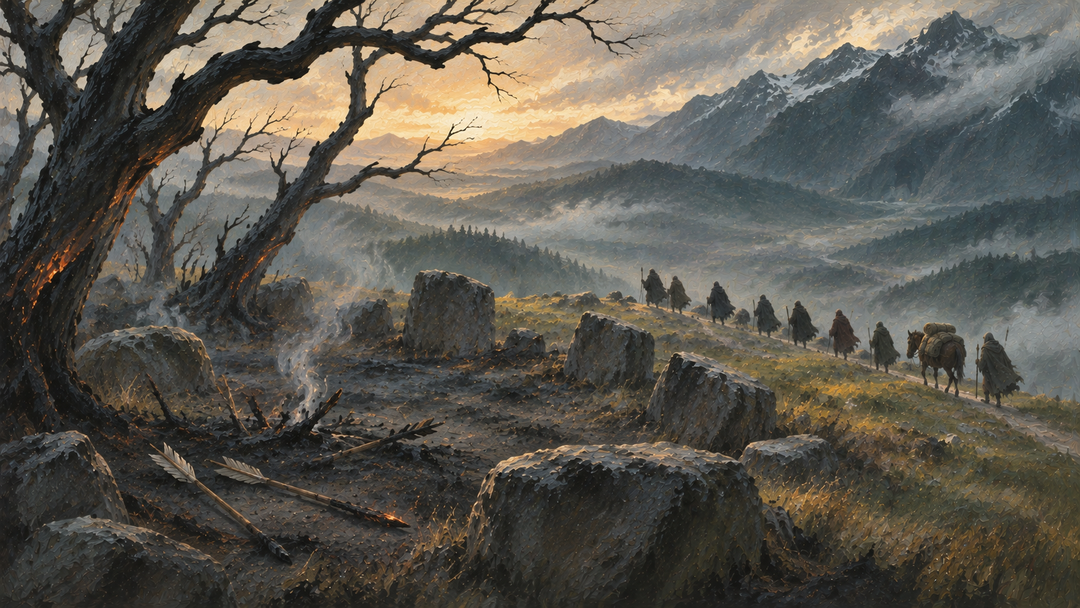
Another common speculation assigns the attack directly to Saruman, who later makes use of wolf-riders. That is not established here. Gandalf associates the leading wolf with Sauron, and the threatening pack fits the wider reach of the Enemy, but the book shows no order being sent to the animals. In a story where powerful figures sometimes act through agents at a distance, it is tempting to make every danger part of a single detailed plan. The narrative does not require that certainty.
The episode also differs from Peter Jackson’s film trilogy. The 2001 film The Fellowship of the Ring does not stage this hilltop battle on the route to Moria. Its sequence moves from the failed mountain crossing towards the mine without the book’s night-long defence. The notable Warg attack in the 2002 film The Two Towers occurs instead during the movement of Rohan’s people towards Helm’s Deep. Orc riders are involved, and Aragorn falls from a cliff. That film incident is not the Hollin fight relocated under a different name, and the cliff fall has no counterpart in Tolkien’s account of the Fellowship’s journey.
The wolves do affect the choice of route, although it is too strong to say they leave the group literally incapable of going anywhere except Moria. Before the attack, Frodo wants time to consider Gandalf’s proposal. Afterwards, the urgency of escaping the hunting packs makes Moria the course the travellers take. A counterfactual in which the wolves never appear cannot be resolved from the book: Gandalf might still have prevailed in the discussion, or the Company might have chosen another dangerous way. What Tolkien shows is how a dispute becomes a decision under pressure.
The broken stone ring offers a momentary boundary against danger, but it cannot stop the Wargs. The trees give shelter and then become fuel for Gandalf’s defence. Even victory leaves the ground burnt and the enemy’s nature uncertain. When the Company abandons the hill at dawn, it is heading towards the handiwork of Elves and Dwarves at Moria’s gate and then into a far older darkness beneath the mountains.
So the answer is specific but limited: the Fellowship fought the wolves on an unnamed, stony hill in Hollin, shortly before entering Moria. Calling it a ruin is an understandable interpretation of the broken circle of boulders, not Tolkien’s identification of a known structure. The text gives the place a shape, a position in the journey and a memorable battle. It does not give it a name, builders or a recoverable history.
Sources & Notes
- Tolkien Gateway — A Journey in the Dark — https://tolkiengateway.net/wiki/A_Journey_in_the_Dark
- The Encyclopedia of Arda — Wargs — https://www.encyclopedia-of-arda.com/w/wargs.php
- The Encyclopedia of Arda — Eregion — https://www.encyclopedia-of-arda.com/e/eregion.php
Primary reading: The Fellowship of the Ring, Book II, chapter 4, A Journey in the Dark. The wolf attack and Eregion's history are documented below; the unnamed stone circle is not identified in the text as a particular building or ruin.