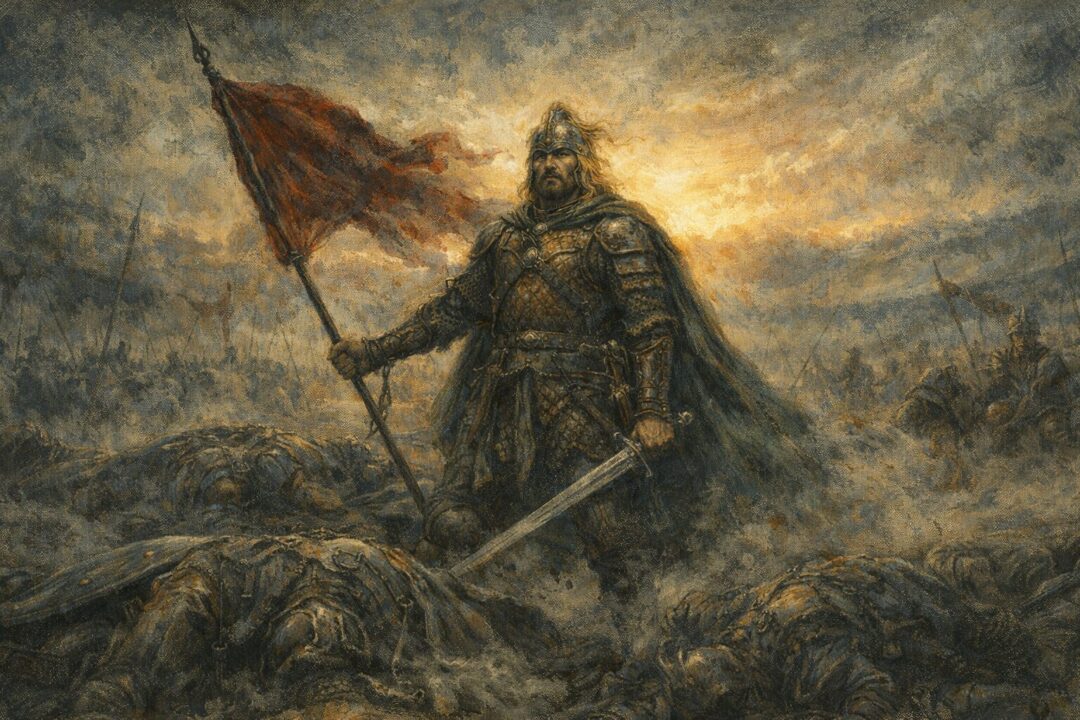
Rohan’s story is often told as a tale of decline and renewal.
A great king falls into weakness. Darkness creeps in. Enemies gather at the borders. Then, at the turning point, wisdom returns, the king rises, and the people ride out in glory.
That king is Théoden.
His awakening in Meduseld is one of the most emotionally charged moments in The Lord of the Rings. A man long bent by grief and manipulation stands tall again. His voice strengthens. His will returns. He chooses to fight rather than fade.
It feels like the moment everything changes.
But this reading misses something essential.
Because Rohan does not collapse during Théoden’s weakness—and that fact alone tells us someone else is holding it together.
That someone is Éomer.
Théoden: A King Restored Too Late
Théoden’s tragedy is not that he is cruel, foolish, or unworthy.
It is that he becomes passive at the worst possible time.
Under the influence of Gríma Wormtongue, Théoden retreats inward. His confidence erodes. He doubts his strength, his judgment, even his right to command. Decisions are delayed. Warnings are dismissed. Action is endlessly postponed.
This passivity is more dangerous than open tyranny.
While Théoden sits silent in Meduseld, Rohan’s enemies do not wait.
Saruman’s Orcs raid the Westfold. Villages burn. Farmers flee or are killed. The borders of the Mark—wide, open, and difficult to defend—are tested again and again.
The danger is not theoretical. It is happening in real time.
And Théoden does nothing.
Not because he does not care—but because he no longer trusts himself to act.
By the time Gandalf arrives and breaks Wormtongue’s hold, the damage has already been done. Rohan is not on the brink of danger. It is already bleeding.
This is what makes Théoden’s restoration so powerful—and so limited.
When he rises, we see a man reclaim his identity. His ride to Helm’s Deep is courageous. His charge at the Pelennor Fields is legendary. He dies as a king should: defending his people with sword in hand, unbroken at last.
But restoration is not creation.
The kingdom Théoden saves still exists only because it was never fully abandoned in the first place.
Éomer: Leadership Without Permission
Before Théoden is healed, Éomer is already acting as Rohan’s true defender.
As Third Marshal of the Mark, Éomer commands the Riders of the Eastfold—the most exposed and vulnerable region of Rohan. This is not a ceremonial role. It is relentless, dangerous, and thankless.
Orcs cross the plains.
Borders shift.
Messengers fail to return.
Éomer does not wait for approval that may never come.
He rides out.
He attacks enemies beyond his official orders. He disperses Orc-bands moving openly through Rohan’s lands. He chooses action over protocol because delay would mean death for his people.
This choice costs him everything.
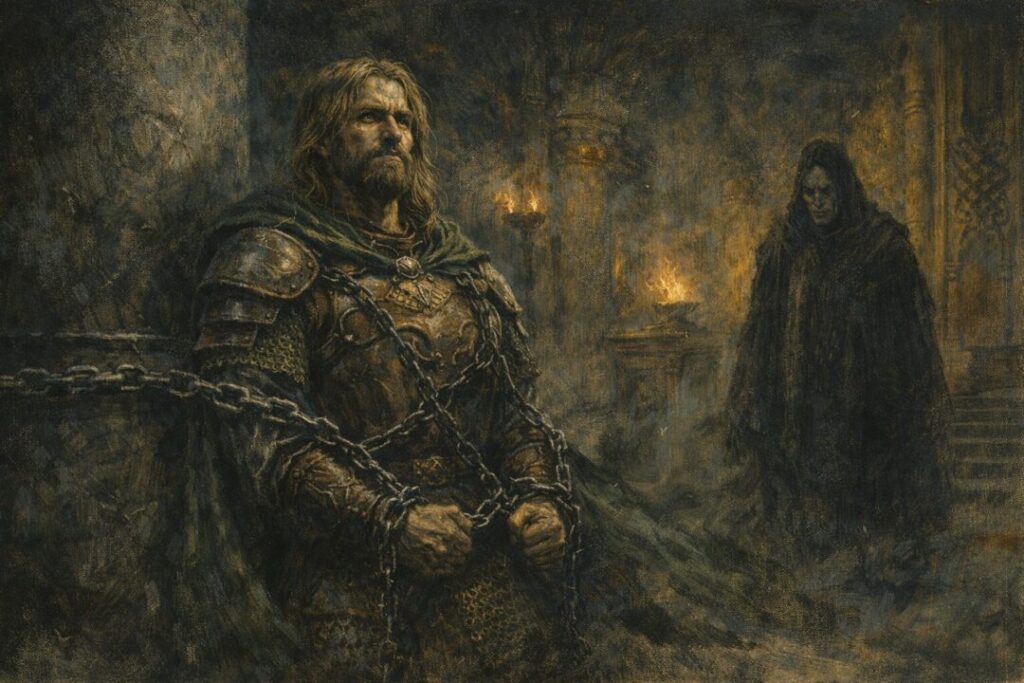
Wormtongue uses Éomer’s independence as a weapon against him. Officially, Éomer is punished for disobedience—acting without the king’s leave. In truth, he is imprisoned because he represents something Wormtongue cannot control.
Éomer is proof that Rohan still has teeth.
He cannot be manipulated into inaction. He cannot be persuaded to look away. He does not believe safety lies in silence.
And so he is removed.
The irony is devastating: the man most actively defending Rohan is labeled a threat to its stability.
But this is precisely why Éomer matters.
He does not lead because he has permission.
He leads because someone must.
This is leadership in Tolkien’s world at its most honest: responsibility taken, not granted.
The Quiet Evidence of Éomer’s Importance
There is no single speech declaring Éomer the backbone of Rohan. Tolkien does not announce it outright.
Instead, he shows it through absence.
Despite Théoden’s weakness, Rohan does not fracture into civil war.
The Riders do not disband.
The borders are not left entirely undefended.
Someone is making hard decisions.
Someone is riding out when it would be safer to stay silent.
That someone is Éomer—and men like him, inspired by his example.
Even Aragorn recognizes this immediately. When Éomer first meets the Three Hunters, he is cautious but decisive. He questions them, weighs the risk, then chooses mercy and trust—accepting consequences he knows may fall on him personally.
This is not recklessness.
It is moral courage.
The Moment That Reveals the Truth
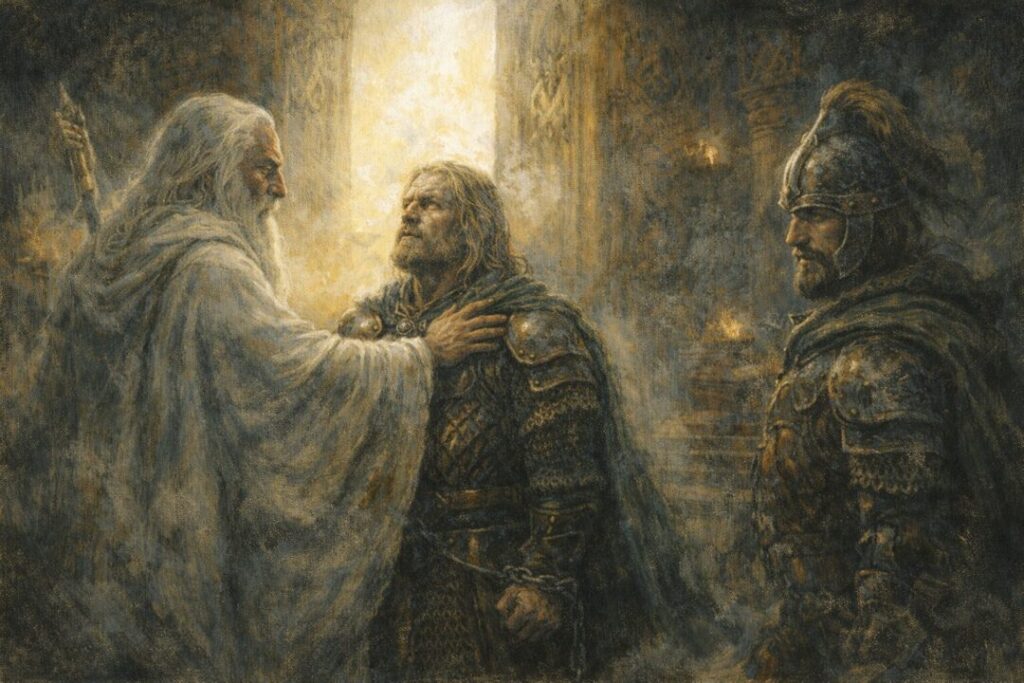
When Théoden is freed and Éomer is released from imprisonment, their relationship becomes suddenly clear.
Théoden does not question Éomer’s actions.
He does not rebuke him.
He does not demand explanation.
Instead, he restores Éomer immediately—to honor, command, and trust.
Not because Éomer is loyal.
But because Éomer has already proven himself indispensable.
From that moment forward, Théoden relies on Éomer not as a subordinate, but as a pillar. He listens to him. He rides beside him. He entrusts him with the future of the Mark.
And then Théoden falls.
At the Pelennor Fields, in the darkest hour of the battle, Rohan loses its king.
This is the moment that would shatter a weaker force.
But Éomer does not freeze.
He does not retreat.
He does not wait for instruction.
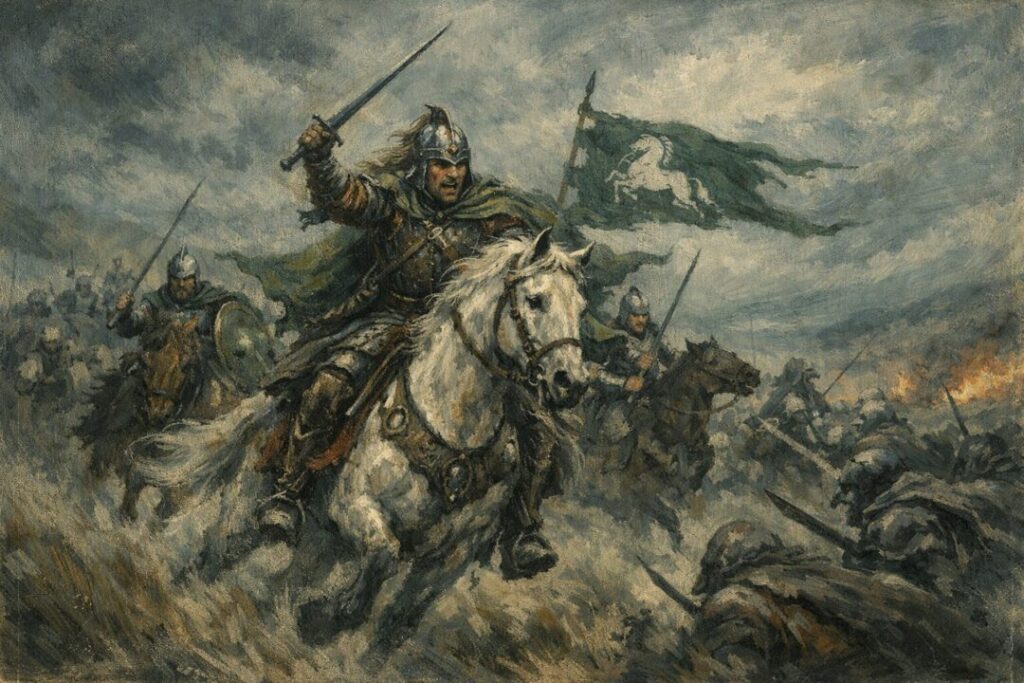
He takes command.
Grief nearly overwhelms him—Tolkien is explicit about this—but it does not paralyze him. Instead, it hardens into resolve. Éomer rallies the Riders and leads them back into the fight when hope itself seems dead.
This is not a restored king riding to glory.
This is a leader holding the world together after it breaks.
Why Éomer Must Live When Théoden Dies
Théoden’s arc is about redemption.
Éomer’s arc is about endurance.
Théoden dies at the height of meaning—his story complete, his purpose fulfilled. His death feels final, almost mythic, like the closing of a chapter that needed to end.
Éomer does not get that release.
He must live with the aftermath.
He becomes King of Rohan not because he sought the crown, but because he has already carried its weight. His reign belongs to the Fourth Age—not an age of songs and last stands, but of rebuilding, memory, and responsibility.
This is a pattern Tolkien returns to again and again.
The ones who burn brightest often fall.
The ones who endure must clean up the world they save.
Éomer represents continuity—the hard work of making victory mean something beyond the battlefield.
The Spine, Not the Crown
Théoden is the heart of Rohan’s story.
He embodies its sorrow.
Its courage.
Its last, defiant ride against the darkness.
But Éomer is its spine.
When the heart falters, the body survives because something else keeps it standing—quietly, stubbornly, without applause.
That is why Éomer was more important than Théoden.
Not because Théoden failed.
Not because Éomer was greater.
But because without Éomer, there would have been no kingdom left for Théoden to save.
And once you see it, Rohan’s story is no longer just about a king who rose again.
It is about the man who made that rising possible.
Sources & Notes
- J.R.R. Tolkien, The Lord of the Rings, Book III, Chapter 2, “The Riders of Rohan” — introduces Éomer as Third Marshal, shows his independent judgment with the Three Hunters, and makes clear he has risked the king’s displeasure by pursuing Orcs.
- J.R.R. Tolkien, The Lord of the Rings, Book III, Chapter 6, “The King of the Golden Hall” — presents Théoden under Wormtongue’s influence, Éomer’s imprisonment, and Théoden’s immediate restoration of Éomer to trust and command.
- J.R.R. Tolkien, Unfinished Tales, “The Battles of the Fords of Isen,” Appendix, “The Marshals of the Mark” — explains Rohan’s military command structure and Éomer’s practical importance during the crisis before Helm’s Deep.
- J.R.R. Tolkien, The Lord of the Rings, Book V, Chapter 6, “The Battle of the Pelennor Fields” — after Théoden’s fall, Éomer takes up the kingship in battle and rallies the Rohirrim in grief and defiance.
- J.R.R. Tolkien, The Lord of the Rings, Appendix A, II, “The House of Eorl” — records Éomer’s reign after the War of the Ring, supporting the article’s emphasis on continuity and rebuilding beyond Théoden’s heroic death.