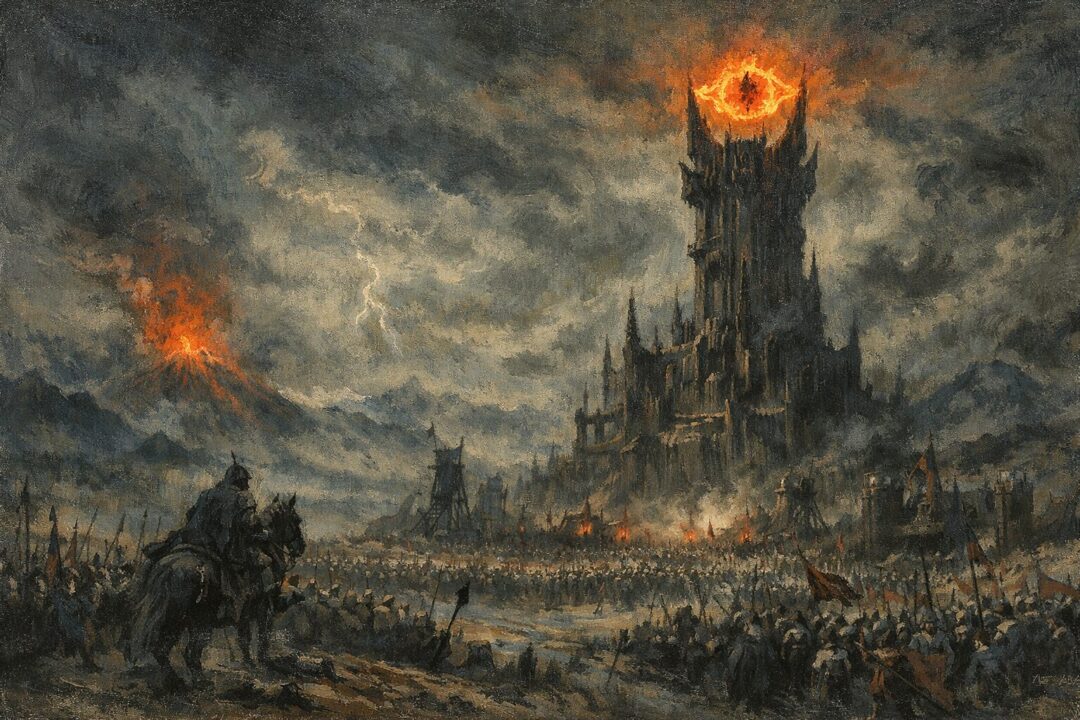
In the history of Middle-earth, no will is more dominant than that of Sauron. His shadow stretches across three Ages, shaping wars, kingdoms, and the fate of the One Ring itself. Long before the War of the Ring, his influence had already remade the map of the world: Númenor drowned, Eregion destroyed, the Elves diminished, and Men bent beneath fear.
And yet, for all his power, there is a remarkable restraint in how Sauron acts.
He does not personally pursue the One Ring.
He does not ride out to search for it.
He does not scour the wilderness himself.
He does not leave Mordor, even when victory seems close enough to grasp.
This is not weakness.
It is calculation.
Sauron’s Power Was Never Physical
By the Third Age, Sauron no longer rules as a warrior-king. That age ended with the downfall of Morgoth, whose brute domination of the world ultimately led to his own ruin. Sauron learned from that failure.
Where Morgoth expended his power directly—corrupting the substance of Arda itself—Sauron refined his. He concentrates it. He hoards it. He projects it through fear, order, and control.
His strength lies not in the sword, but in domination of will.
This is why his presence is felt even when he is unseen. Why his servants tremble even when he is silent. Why the world bends around Mordor without its master ever stepping beyond its borders.
Unlike the heroes of earlier Ages, Sauron does not need to fight personally to win. He binds others to his purpose, allowing them to act while he remains unmoving at the center of the web.
This is why Barad-dûr never empties.
Why the Eye watches, but does not walk.
To move personally would be to change the nature of the conflict. It would announce him not merely as a tyrant, but as a destabilizing force in the world’s order—one whose presence could no longer be ignored by powers far older than Men or Elves.
The Risk of Drawing Greater Powers
Sauron understands the limits placed upon Middle-earth after the downfall of Morgoth.
The Valar no longer rule the world openly. Their direct interventions belong to earlier Ages, when the structure of Arda itself was at stake. In the Third Age, their influence is subtle, restrained, and indirect.
The Valar tolerate evil so long as it does not openly threaten the balance of the world.
Sauron knows this.
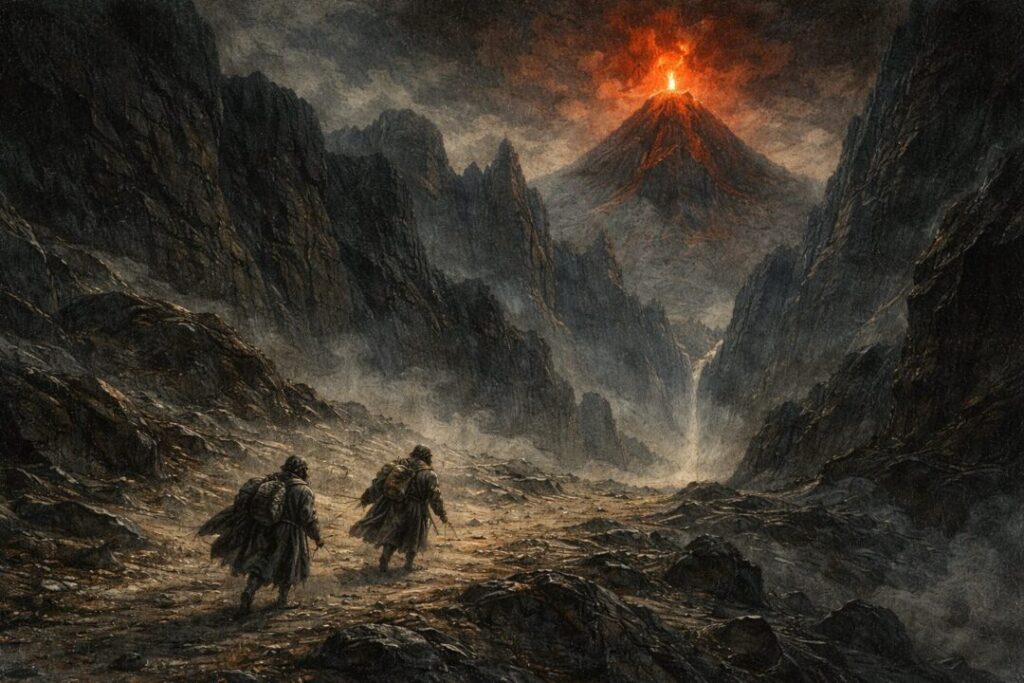
If he were to leave Mordor in full strength to hunt the Ring, he would no longer be acting as a regional tyrant waging war against rival kingdoms. He would become a cosmic threat—one whose personal movement across Middle-earth would echo in the unseen world.
And that would invite judgment.
Not armies.
Not alliances.
But intervention.
Thus, Sauron obeys an unspoken rule of the Third Age: never reveal yourself fully unless the world is already broken enough to survive it.
Instead, he acts through servants.
- The Nazgûl, whose terror spreads his will without revealing his presence.
- Saruman, whose ambition blinds him into becoming an extension of Mordor.
- Vast armies that conquer openly while their master remains unseen, watching from afar.
Sauron wages war without ever appearing to wage it himself.
Why He Assumes the Ring Will Return
Sauron’s greatest certainty is not rooted in arrogance, but in experience.
Power seeks power.
This belief has never failed him.
The One Ring has already betrayed its bearers once. Isildur claims it and refuses to destroy it. Gollum murders for it and hides with it. Even the Wise feel its pull the moment they consider it.
Sauron cannot imagine anyone willingly unmaking the instrument of absolute power.
Every precedent tells him the opposite.
Thus, he believes the Ring will reveal itself. That someone will attempt to use it. That ambition will announce its presence long before secrecy ever could.
A lord will claim it.
A king will wield it.
A challenger will arise.
And when that happens, Sauron will know.
This is why he watches Gondor relentlessly.
Why his gaze turns toward Minas Tirith rather than the Shire.
Why he fears Aragorn more than any Hobbit.
To Sauron, Aragorn makes sense. A claimant to power. A rival who would challenge him openly. A man who might dare to wield the Ring against its maker.
Hobbits do not fit into this logic.
And so Mordor waits.
The Fatal Blind Spot
What Sauron never understands is humility.
He understands fear.
He understands ambition.
He understands domination.
But he does not understand the choice to relinquish power.
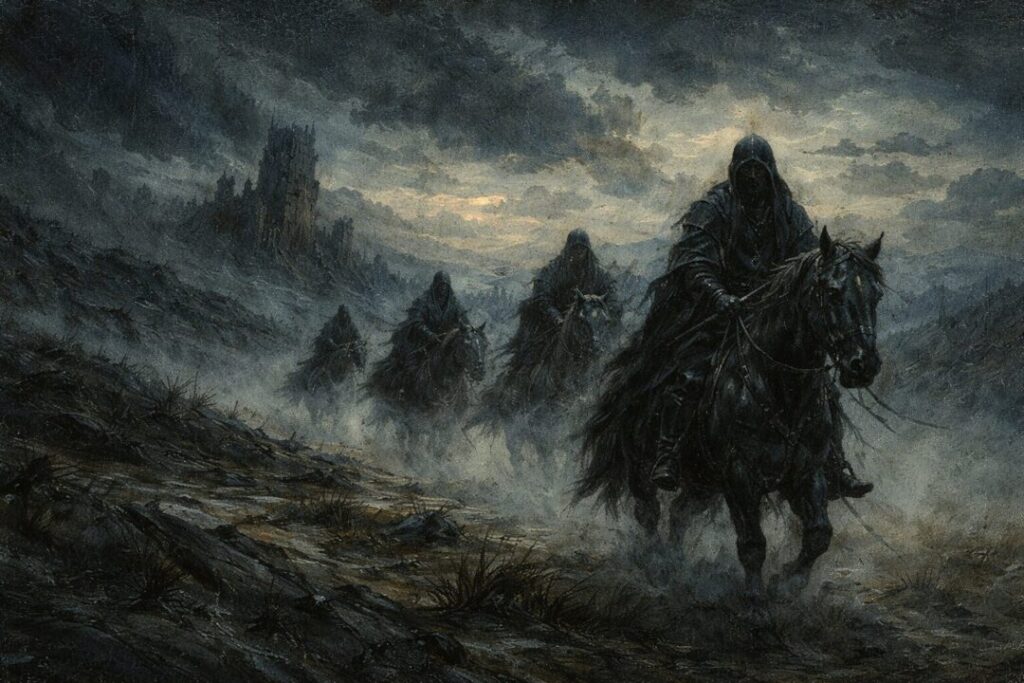
The Ring moves unseen not because it is hidden cleverly, but because it is carried by those who do not matter in Sauron’s calculations. Hobbits are invisible not magically, but philosophically.
They desire comfort, not dominion.
They seek home, not mastery.
They endure rather than conquer.
By obeying the unspoken rule—never acting directly—Sauron creates the very space in which his defeat becomes possible. His distance, his restraint, and his certainty that power will always announce itself allow the Ring to pass through his realm unnoticed until it is too late.
The irony is complete: the same patience that makes Sauron nearly invincible is what blinds him.
A Victory That Nearly Happens
This rule almost secures Sauron’s triumph.
Gondor is pushed to the brink.
Rohan nearly falls.
The West is outnumbered, exhausted, and fractured.
Sauron’s armies march. His enemies despair. His Eye fixes itself upon the final confrontation at the Black Gate.
And still—he does not move.
Even when the Ring enters Mordor, he does not sense it through vigilance or foresight. He learns of it only when the Ring itself betrays its bearer at the very brink of destruction.
Not through strength.
Not through strategy.
But through failure of imagination.
Why This Rule Defines Him
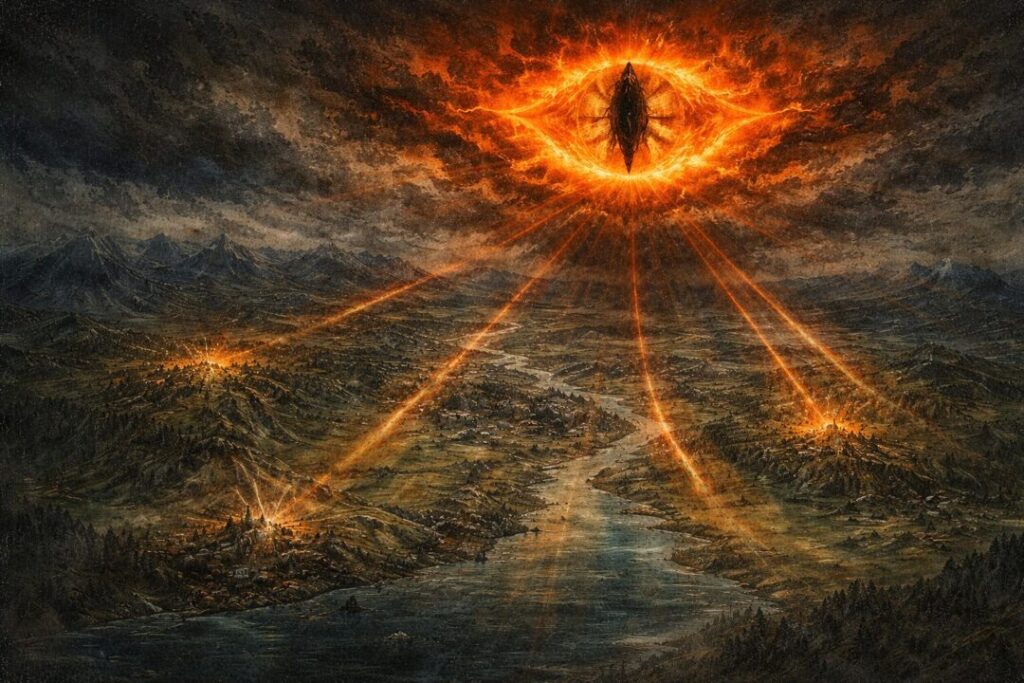
Sauron never breaks this rule because he believes it makes him invincible.
And for centuries, he is right.
He outlasts Númenor.
He survives the Last Alliance.
He returns even after seeming defeat.
But the world does not end because of power.
It ends because someone chooses to let go of it.
That is the one act Sauron never learns to see—and the one act his rule can never account for.
Sources & Notes
- J.R.R. Tolkien, The Lord of the Rings, Book II, Chapter 2, "The Council of Elrond" — Gandalf and Elrond explain Sauron’s assumption that a great power would try to wield the Ring rather than destroy it.
- J.R.R. Tolkien, The Lord of the Rings, Book VI, Chapter 3, "Mount Doom" — Sauron perceives the Ring only at the last moment, when Frodo claims it in Sammath Naur.
- J.R.R. Tolkien, The Lord of the Rings, Book V, Chapter 10, "The Black Gate Opens" — Aragorn’s challenge draws Sauron’s attention toward open military and political power.
- J.R.R. Tolkien, The Silmarillion, "Of the Rings of Power and the Third Age" — Sauron works through the Ring, Mordor, the Nazgûl, and armies after his return to Middle-earth.
- J.R.R. Tolkien, Letter 131 — Tolkien describes Sauron’s central motive as domination and ordering all things according to his own will, supporting the article’s theme of control over direct force.