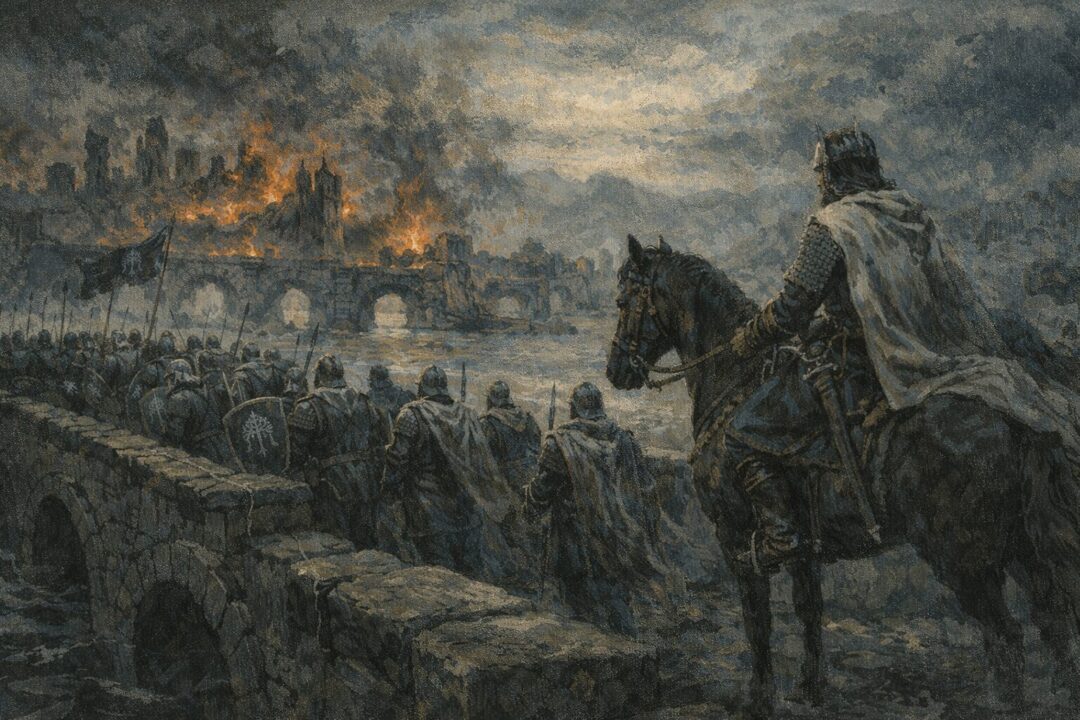
Boromir’s story is often reduced to a single failure.
For many readers, his name immediately calls up one moment: the Ring in his hands, the temptation, the breaking of trust. That scene is powerful, and Tolkien intended it to be. But when it becomes the only lens through which Boromir is remembered, something essential is lost.
Because Tolkien never wrote Boromir as a man defined by weakness.
When Boromir appears at the Council of Elrond, he does not present himself as a wandering knight, a seeker of glory, or a prince chasing adventure. He comes as a commander sent from a collapsing frontier, carrying the weight of a war that is already being lost.
That frontier was Osgiliath.
And Boromir held it longer than anyone else.
Osgiliath: Gondor’s Open Wound
By the end of the Third Age, Osgiliath was no longer a city in any meaningful sense. Once the capital of Gondor, it had been ruined centuries earlier during the Kin-strife and never truly rebuilt. Its great bridges and domes still spanned the Anduin, but they stood broken and exposed—closer to Mordor than to Minas Tirith, and impossible to defend in the long term.
Yet Osgiliath mattered enormously.
Whoever held it controlled the main crossings of the River Anduin. As long as Gondor maintained a presence there, the Enemy could not move freely westward. If Osgiliath fell entirely, the road to Minas Tirith would lie open, and the Pelennor Fields would become the next battlefield.
This is why Gondor continued to fight for Osgiliath long after hope had faded.
It was not a symbol of past glory. It was a delaying position—an open wound held shut by force of will.
And this is where Boromir enters the story.
Boromir’s Command — What the Text Actually Says
Tolkien is careful with words when he describes Boromir’s service, and he never exaggerates it.
At the Council of Elrond, Boromir states plainly that he is Captain of the White Tower and that he has long defended Osgiliath against the Enemy. Later, in The Return of the King, Faramir confirms this history, explaining that Boromir held the eastern bank of the river and the crossings for as long as it was possible to do so.
This phrasing is crucial.
Boromir is not said to have “won” Osgiliath.
He is not described as driving the Enemy back.
He is said to have held.
The language Tolkien uses implies prolonged resistance under steadily worsening conditions. Boromir’s task was not to triumph, but to delay—to absorb pressure, to buy time, and to keep Gondor’s enemies from crossing the river in force.
This was not a brief posting or a single campaign. The text implies years of repeated assaults, withdrawals, and counter-holds, fought in ruins that offered little cover and no lasting security.
Eventually, the defense fails.
Not because Boromir breaks.
But because the position becomes untenable.
The Retreat from Osgiliath
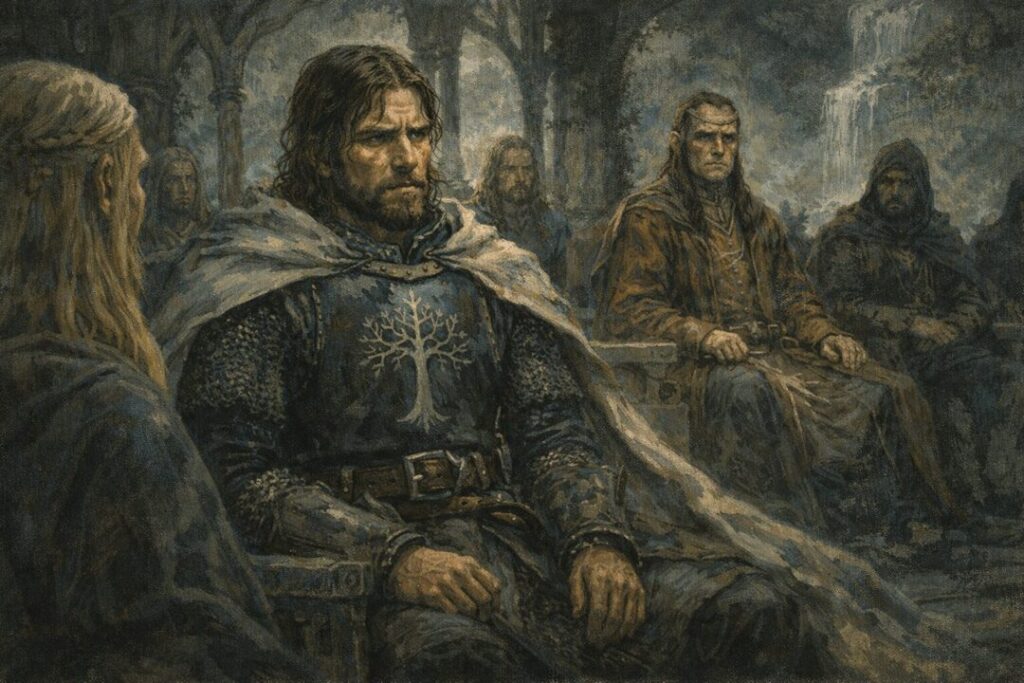
One of the most overlooked details in Boromir’s story is how Osgiliath is lost.
The retreat is not described as a rout. It is not a panic. It is an ordered withdrawal carried out when holding the city becomes impossible. Boromir survives, returns to Minas Tirith, and only afterward is sent north on his long journey to Rivendell.
This detail matters.
Tolkien never presents Boromir as a commander who collapses under pressure. He endures until endurance itself is no longer enough. He obeys orders, withdraws when withdrawal is commanded, and lives to fight again.
Boromir does not fail at Osgiliath.
Osgiliath fails around him.
A Man Already at His Limit
By the time Boromir reaches Rivendell, he is not a fresh hero stepping onto the stage of history. He is already worn.
Gondor has stood alone for generations.
Its allies are diminished or absent.
The Enemy grows stronger year by year.
Boromir has watched this reality unfold firsthand.
When he speaks at the Council, his words are not those of arrogance or ignorance. He does not deny the danger of the Ring. He does not misunderstand its corrupting nature. Instead, he speaks from desperation born of long experience.
He knows what Gondor is facing.
He knows how thin the line already is.
And he knows that holding actions eventually run out.
The Ring’s appeal to Boromir is not abstract power or personal domination.
It is relief.
Relief from watching the same battle fought again and again.
Relief from defending ruins instead of cities.
Relief from asking his people to die simply to delay the inevitable.
This does not excuse his failure—but it explains its timing.
Why Tolkien Doesn’t Emphasize This More
Tolkien never gives Boromir a long battlefield flashback. There are no extended scenes set in Osgiliath. No heroic monologues recounting his victories.
Why?
Because The Lord of the Rings is not written from Boromir’s perspective.
The story is largely filtered through Hobbits—characters who are intentionally distant from the great wars of Men. Much of what we know about Gondor’s struggle comes indirectly, through brief speeches, passing references, and later confirmation by Faramir.
This is not a narrative oversight.
It is a deliberate narrowing of focus.
Tolkien consistently resists turning his story into a chronicle of battles. He allows vast conflicts to exist at the edges of the narrative, shaping events without dominating them.
Boromir’s war is real.
It is brutal.
And it happens mostly offstage.
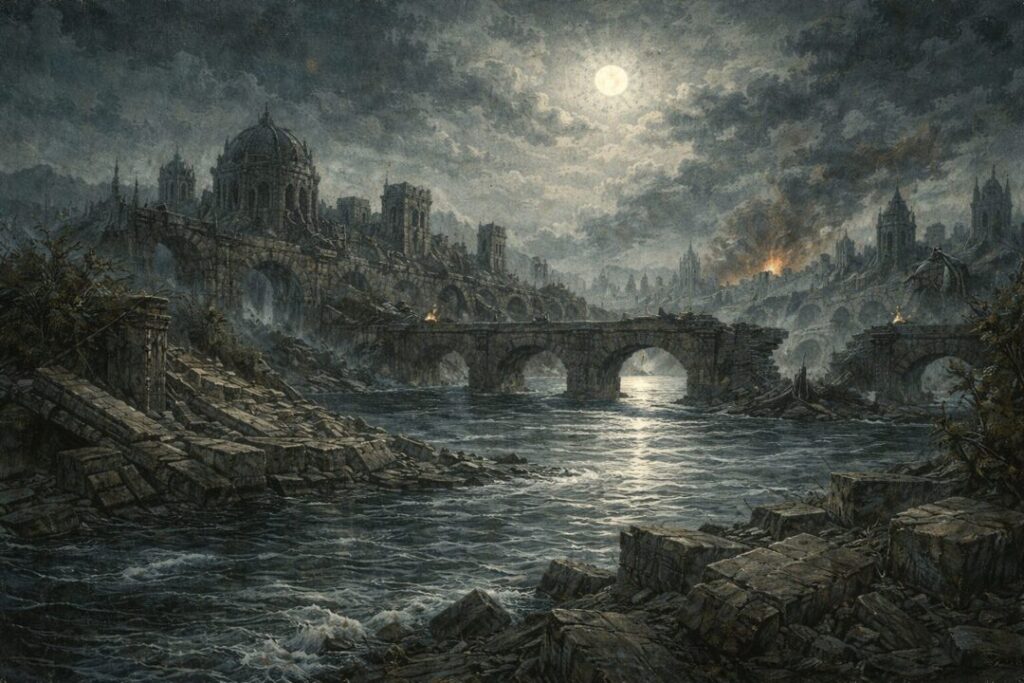
Boromir’s Fall in Context
Seen in isolation, Boromir’s attempt to take the Ring can appear sudden—a sharp moral collapse in a character who otherwise seems noble and disciplined.
Seen in context, it looks very different.
It looks like the final strain placed on a man who has already given everything he has to give.
Boromir does not betray the Fellowship for personal gain. He never seeks to flee with the Ring. And the moment he understands what he has done, he repents fully.
Tolkien restores balance to Boromir’s story immediately.
Boromir does not die grasping for power.
He does not die in disgrace.
He dies defending others—alone, outnumbered, and unyielding.
His last stand is not about redemption through spectacle. It is about consistency of character. Even in failure, Boromir remains what he has always been: a man who stands between danger and those he is sworn to protect.
How Gondor Remembers Him
In Gondor, Boromir is not remembered as a cautionary tale.
He is remembered as a captain who stood the longest at the most exposed frontier of the realm. His horn is placed in honor. His name is spoken with respect. His father’s grief is real not because Boromir failed—but because Gondor has lost one of its strongest defenders.
This perspective matters.
Tolkien does not erase Boromir’s mistake. But he refuses to let that mistake define the man.
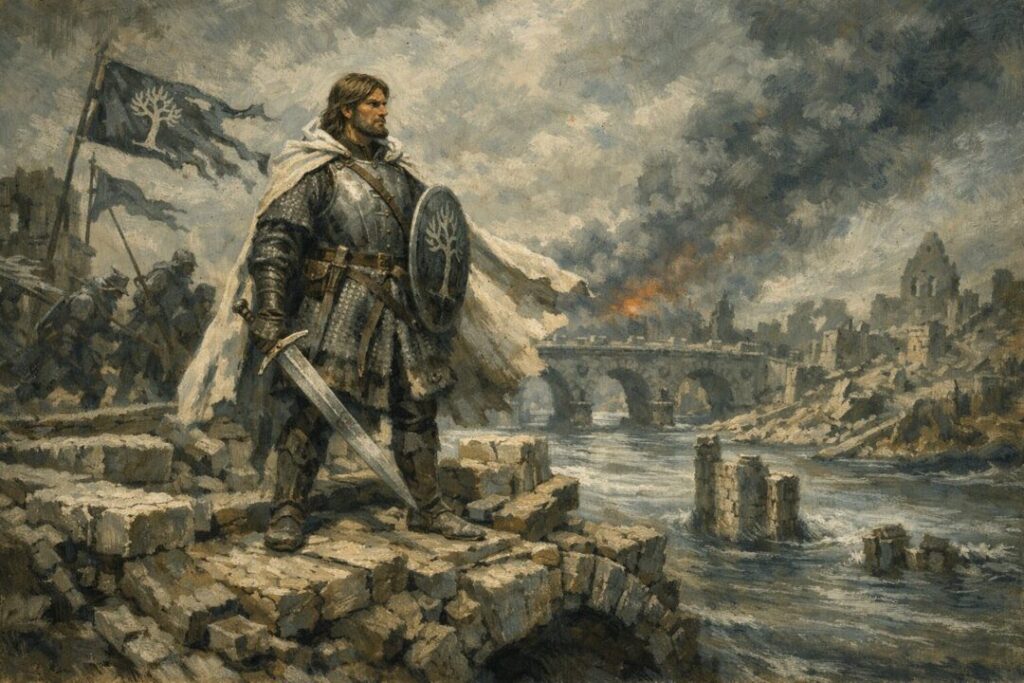
Osgiliath as the Key to Boromir’s Story
If Boromir’s story truly begins anywhere, it does not begin at Amon Hen.
It begins in the ruins of Osgiliath.
It begins with years of holding a line that cannot be held forever.
With command exercised under impossible conditions.
With a man shaped by endurance rather than triumph.
Seen this way, Boromir is not a warning about pride alone.
He is a study in what happens when even the strongest wills are asked to bear too much, for too long, with too little hope of relief.
And Osgiliath—the broken city between Gondor and Mordor—is where that truth becomes impossible to ignore.
That is where Boromir’s legacy truly belongs.
Sources & Notes
- J.R.R. Tolkien, The Lord of the Rings, Book II, Chapter 2, “The Council of Elrond” — Boromir describes Gondor’s defence of Osgiliath, the last bridge being cast down, and the few survivors escaping the river.
- J.R.R. Tolkien, The Lord of the Rings, Book IV, Chapter 5, “The Window on the West” — Faramir’s account gives Boromir’s family and military context, including his stature in Gondor and the pressure of the war.
- J.R.R. Tolkien, The Lord of the Rings, Book V, Chapter 4, “The Siege of Gondor” — the later fighting at Osgiliath and the Causeway Forts shows why the Anduin crossings were the exposed road toward Minas Tirith.
- J.R.R. Tolkien, The Lord of the Rings, Appendix A, “Gondor and the Heirs of Anárion” — provides the history of Osgiliath’s decline from Gondor’s old capital into a ruined frontier after the Kin-strife.
- J.R.R. Tolkien, The Lord of the Rings, Book III, Chapter 1, “The Departure of Boromir” — Boromir’s repentance and death defending Merry and Pippin support the article’s reading of his final character.