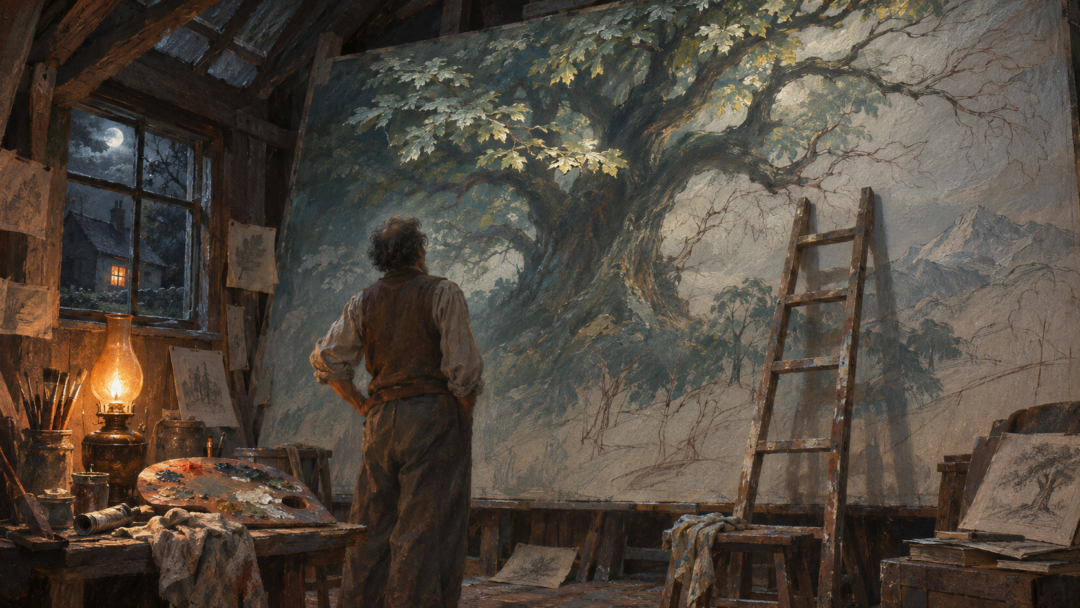
After the Scouring of the Shire, Sam Gamgee plants Galadriel’s silver nut where the Party Tree once stood. From that small beginning comes a living tree that no gardener could simply manufacture. A quieter Tolkien story begins with an equally modest object: a leaf caught in the wind. Its painter, Niggle, follows that leaf until his canvas holds an immense Tree, a forest, and snow-tipped mountains.
Leaf by Niggle is best read as a parable about artistic creation, unfinished work, purgatory, and humility. Niggle must abandon his painting before it is complete, yet eventually finds the Tree alive in a country beyond his studio. The story invites readers to hunt for an allegorical key, but it works on several levels at once: the life of an artist, the education of a soul, and the possibility that human making has a place within a greater Creation.
Why Niggle’s Leaf Keeps Growing
Niggle is not a grand master painting a masterpiece under ideal conditions. He is an unsuccessful painter with a weakness for detail. He can render the shape and sheen of a leaf, even the dew along its edge, more confidently than he can manage a whole tree. Nevertheless, one leaf becomes a trunk and branches; birds appear; a landscape opens behind them. He enlarges the canvas until he needs a ladder to work on it, in a shed occupying ground once used for potatoes.
That expanding picture captures a recognizable creative problem. A maker may begin with one image, melody, or character, only to discover that it belongs to something much larger. The imagined whole becomes clearer as the finished work falls further behind. Niggle can picture the light on a distant mountain, yet getting that light into paint requires time he does not have. His ambition is both his gift and his torment: he loves the thing he can glimpse, but cannot bring it fully into being.
This has an unusually close autobiographical echo. In a 1957 letter to Caroline Everett, Tolkien connected the story with his fear that The Lord of the Rings might never be finished, especially as war darkened the future. The connection matters, but Niggle is not simply the author wearing a painter’s coat. The tale also gives its hero idleness, irritability, and a longing for someone to praise his work and free him from ordinary demands. His problem is not just insufficient time; it is learning what his time and talent are for.
The Inspector, Parish, and the Cost of Being Useful
Those demands acquire a face in Mr. Parish, Niggle’s neighbour. Parish has a painful, lame leg, little interest in painting, and a roof damaged by bad weather. When his wife seems ill, he asks Niggle to fetch a doctor and contact a builder. Niggle cycles through the rain, knowing he is sacrificing precious hours at his canvas. He catches a chill himself. What looked like an interruption becomes a genuine act of care, however grudgingly performed.
Then the Inspector of Houses arrives. He insists that damaged buildings must be repaired and points to Niggle’s canvas, wood, and waterproof paint as materials for patching Parish’s roof. The official has a real concern: homes are damaged, and other families have suffered worse flooding. But his measure of value leaves no room for a painting except as something to cut up and use. The scene asks whether beauty is expendable whenever usefulness can be counted more easily.
The answer is not that artists deserve exemption from neighbours, laws, or leaking roofs. Niggle has neglected duties. Yet Parish also fails to see what matters to the painter, while Niggle overlooks his neighbour’s knowledge of soil and plants. Their quarrel is not a contest between good art and bad practicality. It shows two limited people, each undervaluing a kind of work the other understands.
The story later gives this attitude an outspoken champion in Councillor Tompkins, who dismisses Niggle as economically worthless. Atkins, a schoolmaster, remembers a torn corner of the canvas: a mountain peak and a spray of leaves. He cannot get the image out of his mind. One man measures usefulness by output; the other has been changed by looking. Their disagreement exposes something the Inspector’s rule cannot measure: art can matter even when it cannot patch a roof.
The Long Journey and the Workhouse
Before the Inspector finishes speaking, a black-clad Driver arrives to take Niggle on the journey he has dreaded and postponed. There is no time to pack. The train passes through a dark tunnel; at a dim station Niggle loses even the bag containing his paint-box and sketches. The story never explicitly names death at this point, but the forced departure, lost possessions, and disappearance from ordinary society make the meaning hard to miss.
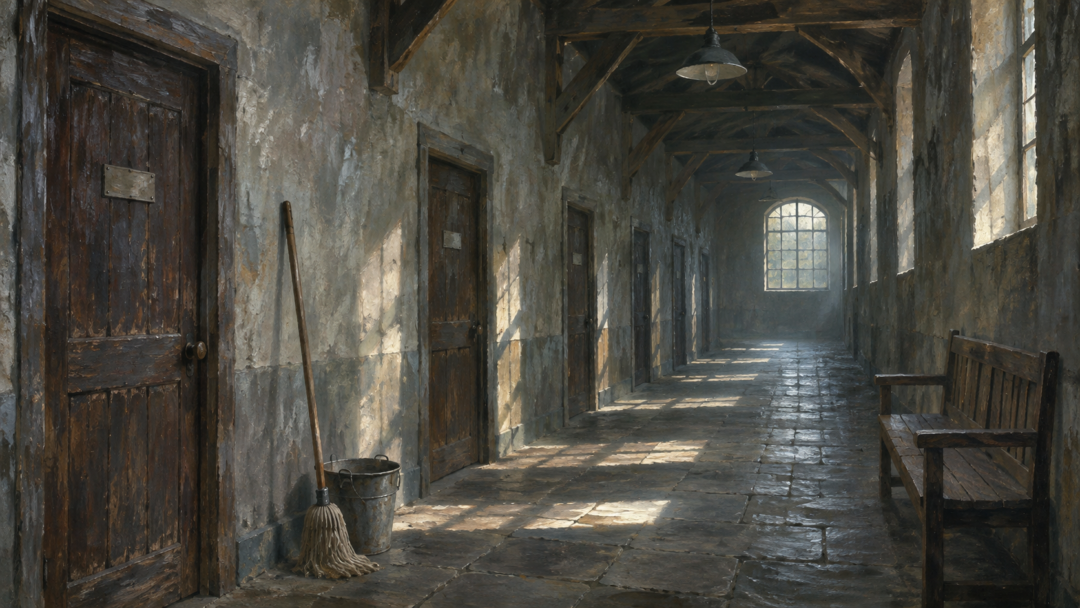
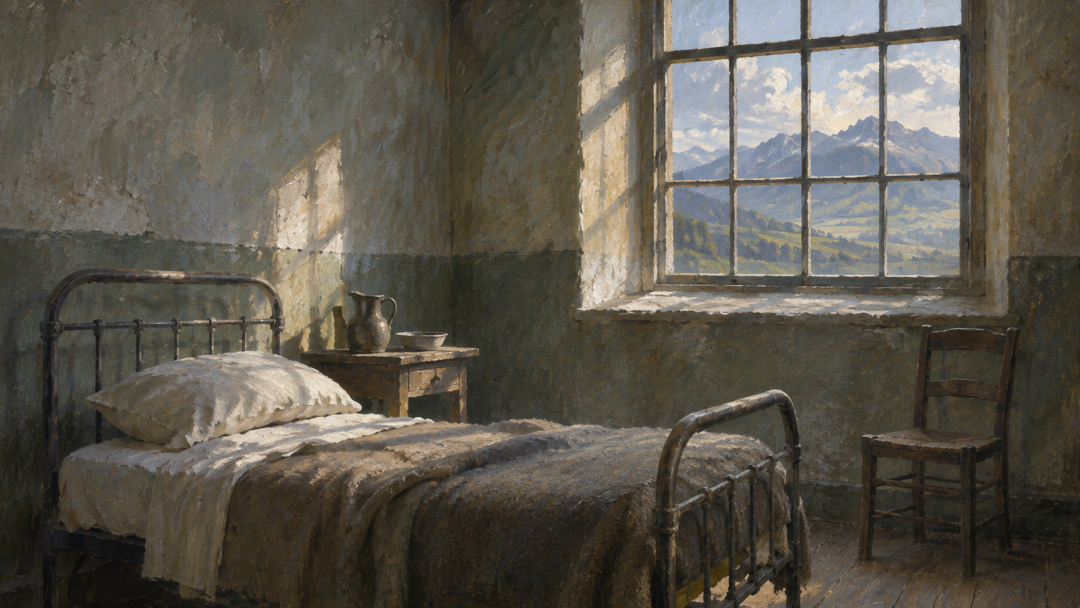
Niggle enters a Workhouse Infirmary that feels more like a prison than a hospital. He digs, does carpentry, and paints bare boards a single colour. His windows face inward, and he spends long periods in darkness. Initially he broods on squandered days and the help he might have offered Parish sooner. Gradually his habits change. He learns to begin promptly, finish small jobs properly, stop when work is done, and rest without frantic thoughts of the canvas.
The Workhouse suggests purgatory rather than punishment for trying to make art. In Catholic thought, purgatory involves purification and preparation; the story imagines correction through difficult, bewildering work. Niggle learns the discipline he lacked, but the treatment is not an exact map of Catholic doctrine. The institution’s severity remains unsettling. Its purpose becomes intelligible through the change in Niggle, not through a comforting explanation of its procedures.
While resting in darkness, he hears two Voices reviewing his life. The stricter one notes wasted time, poor preparation, and complaints; the gentler one weighs his modest artistry and the help he gave without expecting gratitude. Particular weight falls on the wet bicycle ride, when he suspected it might cost his last chance to paint. When asked to speak, Niggle does not plead for his masterpiece. He asks about Parish’s health. His attention has shifted toward another person, and he is allowed onward.
The Living Tree and the Gift of Sub-Creation
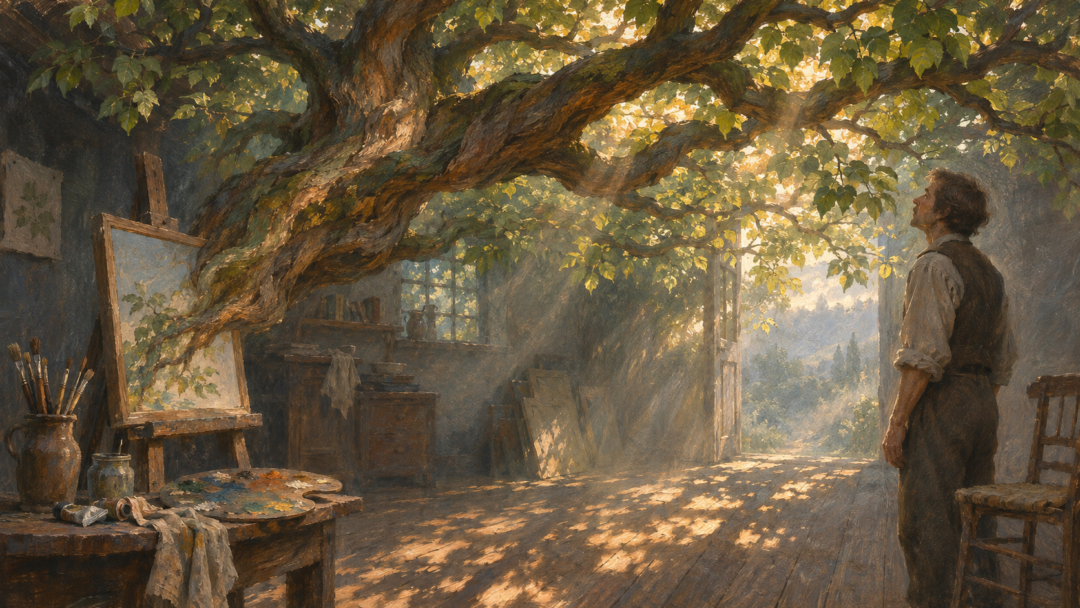
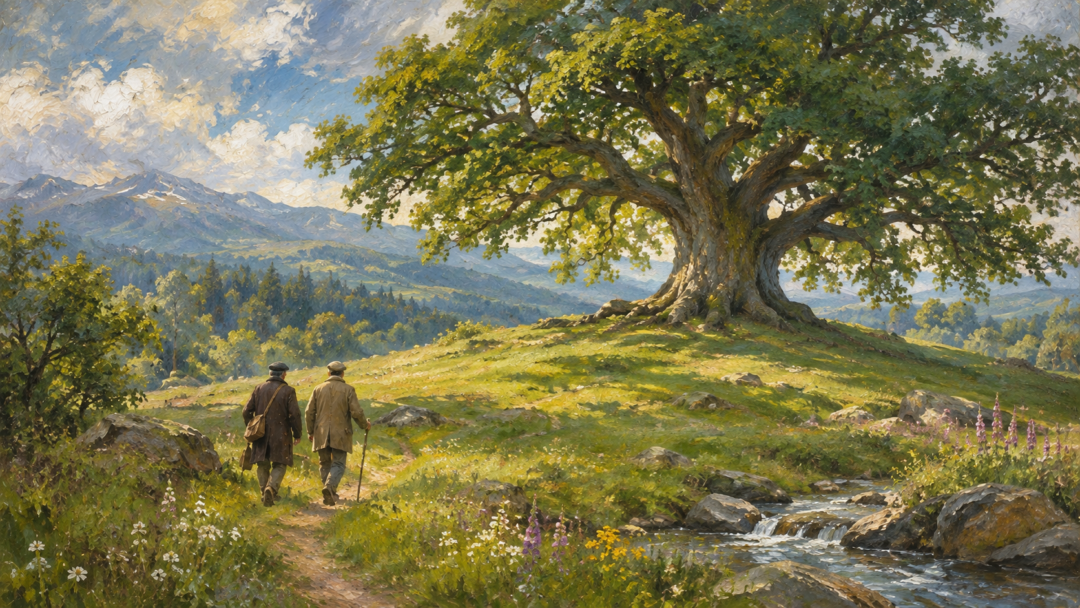
The next train is bright and small. After disembarking, Niggle finds a bicycle and rides into green country whose contours seem familiar. Then he looks up and falls off: his Tree stands before him, no longer a canvas but a living thing. Its leaves include those he painted, those he only imagined, and possibilities he never had time to conceive. Birds build nests and fly into the forest. The Tree is complete in a way his picture never could be.
Niggle exclaims, “It’s a gift!” That is the turning point of the artistic allegory. The Tree preserves his distinctive imagination without suggesting he produced this living reality unaided. In On Fairy-stories, Tolkien calls human imaginative making sub-creation: people fashion coherent secondary worlds, but their powers are derivative rather than absolute. The essay explains the idea; the story makes it palpable. Niggle recognizes his work, yet receives more than he could have secured by finishing the canvas himself.
Completion does not mean an eternity admiring a perfect product. Parts of the forest still need attention, and Niggle realizes he needs Parish’s practical expertise. When Parish arrives, they build a house and garden together. Their old habits reverse: Niggle becomes good at planning and getting things done, while Parish pauses over trees and flowers. They still disagree sometimes, but shared labour produces things neither could achieve alone. Artistic vision and ordinary care have become partners.
Their country benefits others, too. The Voices later describe it as a place of rest and recovery for travellers preparing for the Mountains. At its edge, a shepherd offers to guide them onward. Parish remains to await his wife; Niggle goes with the shepherd toward higher pastures. The narrator does not claim to know what lies beyond. The country is wonderful, but it is not the end of mystery, nor is the painter its final authority.
Why the Story Is More Than a Secret Code
It is tempting to assign each detail a fixed counterpart: Niggle equals Tolkien, the Tree equals The Lord of the Rings, Parish equals daily responsibilities, the Workhouse equals purgatory. These parallels illuminate the story, but full decoding flattens its characters. Parish is not merely a chore in human form; he suffers, gardens, changes, and helps shape the country. Niggle is not artistic genius personified; he makes excuses, performs kindnesses, and improves at tasks he once despised.
Tolkien’s letters preserve the tension. Writing to Peter Hastings, he described Leaf by Niggle as a purgatorial story exploring, allegorically, how human sub-creation might be taken up into Creation. Yet in a 1962 letter to Jane Neave he called it more mythical than strictly allegorical, because Niggle was intended as a person of mixed qualities rather than a single virtue or vice. These comments identify concerns behind the tale without turning it into a chart of compulsory meanings.
Nor does the ending promise fame as compensation for hardship. A surviving leaf from Niggle’s canvas is displayed in a museum, then lost when the building burns. Meanwhile his country offers rest to travellers who may never know his name. This is a sharper hope than posthumous recognition: something can have value beyond its maker’s skill and lifetime without making the maker the centre of the world.
Niggle never gets to stand back in his studio and pronounce the canvas finished. Instead, he finds a Tree whose branches move in a wind he once struggled to paint, then leaves it growing as he walks toward the Mountains. The leaf was worth making. The Tree was never his to command. And the story’s deepest consolation lies in the distance between those two truths.
Sources & Notes
- Priscilla Tolkien, ‘Leaf, by Niggle’ - The Tolkien Estate — https://www.tolkienestate.com/writing/priscilla-tolkien-leaf-by-niggle/
- Vincent Ferré, ‘Leaf, by Niggle: the hidden nucleus’ - The Tolkien Estate — https://www.tolkienestate.com/writing/vincent-ferre-leaf-by-niggle-the-hidden-nucleus/
- Verlyn Flieger, ‘On Fairy Stories’ - The Tolkien Estate — https://www.tolkienestate.com/scholarship/verlyn-flieger-on-fairy-stories/
Read Leaf by Niggle beside On Fairy-stories. Priscilla Tolkien and Vincent Ferré discuss the autobiographical and religious dimensions; Verlyn Flieger explains sub-creation. These readings illuminate the story without making every character a one-to-one allegorical cipher.