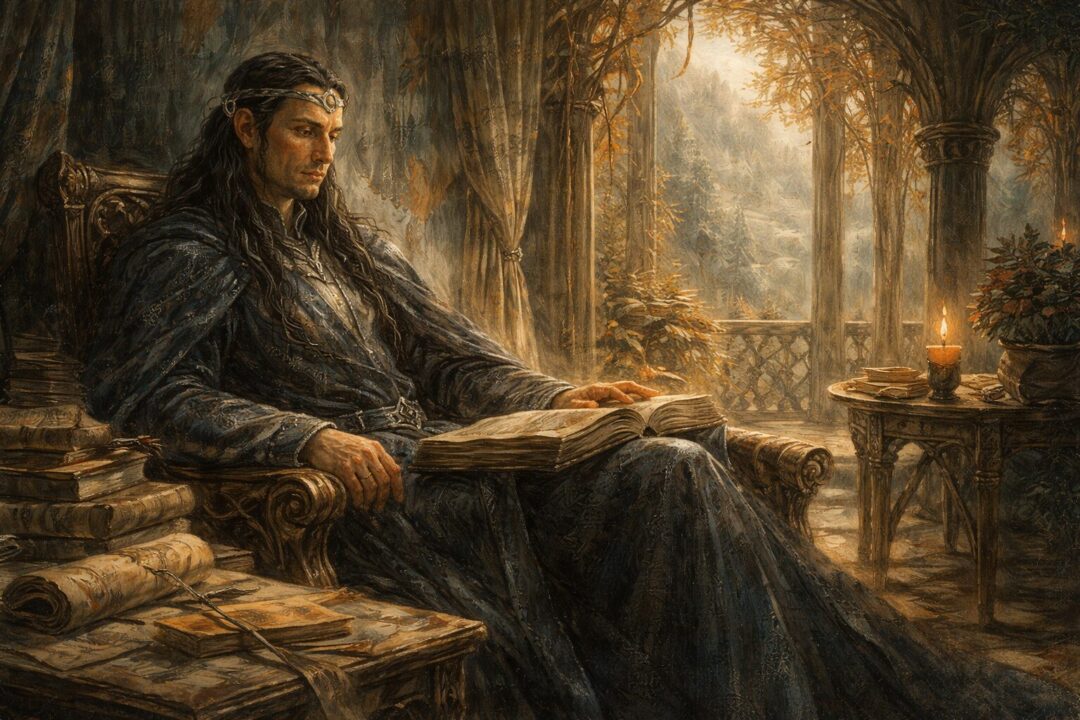
Elrond Half-elven stands at one of the most consequential crossroads in the history of Middle-earth.
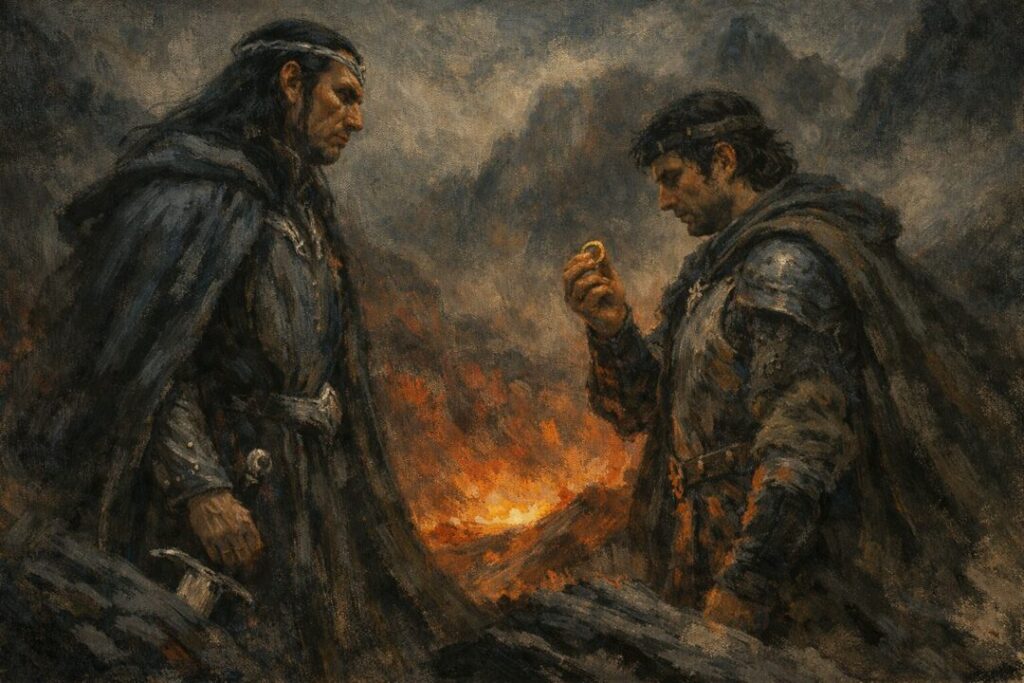
At the end of the Second Age, after the defeat of Sauron, Elrond accompanies Isildur to the fires of Orodruin. The One Ring, cut from Sauron’s hand, lies within reach of destruction. Its power has already cost countless lives, toppled kingdoms, and scarred the world itself.
Elrond urges Isildur to cast it into the fire.
Isildur refuses.
This moment is recorded plainly in the narrative, without dramatic flourish or moral judgment. Isildur claims the Ring as weregild for his father and brother, slain in the war against Sauron. Elrond does not strike him down. He does not seize the Ring. He does not force the matter.
And the world moves on — diminished, wounded, but not healed.
That quiet refusal echoes through the Third Age, shaping choices that are never explicitly explained, yet consistently felt.
Elrond as Witness, Not Judge
It is essential to understand Elrond’s role in this moment.
He is not a ruler of Men.
He is not their king, nor their moral authority.
He is a counselor, a witness, and above all, a keeper of memory.
Elrond’s power in Middle-earth is not exercised through command or conquest. It is exercised through preservation — of knowledge, of history, of wisdom learned at great cost. Throughout the legendarium, Elrond is defined less by action and more by remembrance.
He remembers the Elder Days.
He remembers the fall of Beleriand.
He remembers the ruin brought by pride, haste, and the slow corrosion of good intentions.
When Isildur refuses to destroy the Ring, Elrond does not declare Men unworthy. The texts never say this. There is no condemnation, no pronouncement of doom.
In fact, Elrond continues to support the Dúnedain for centuries afterward. Rivendell becomes a refuge for the heirs of Isildur’s line. Aragorn himself is fostered in Elrond’s house, raised with care, instruction, and patience.
This alone tells us something crucial.
Elrond does not abandon Men.
But he does not forget what he has seen.
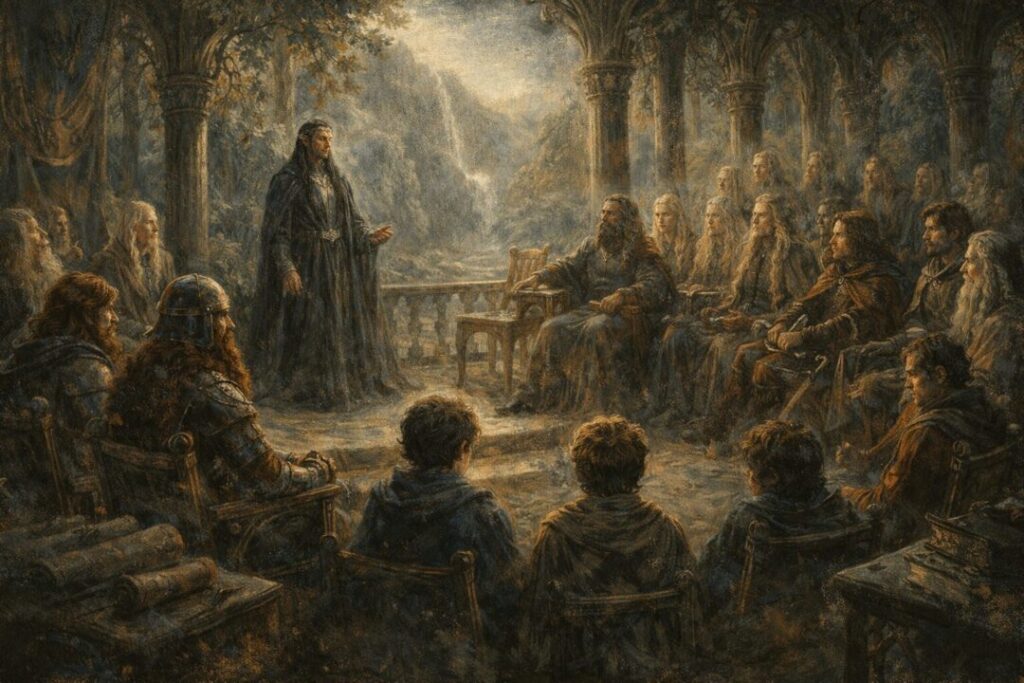
The Weight of Long Memory
Elrond’s perspective is shaped by time on a scale few others can comprehend.
By the end of the Second Age, he has already witnessed the rise and fall of entire civilizations. He has seen Men lifted to greatness — especially the Númenóreans — and then brought low by their own fear and ambition.
The Downfall of Númenor is not directly caused by the Ring, but it is driven by the same impulse: the refusal to accept limits, especially the limits imposed by mortality. The desire to seize what is forbidden. The belief that power can delay loss.
Elrond has seen this pattern before Isildur ever reaches Mount Doom.
So when Isildur claims the Ring, Elrond recognizes something tragically familiar. Not evil intent, but the beginning of a road that others have already walked — and fallen from.
This recognition does not harden Elrond into cynicism. Instead, it makes him cautious.
The Pattern of Men and Power
Tolkien is careful not to portray Men as uniquely corrupt. Elves fall. Wizards err. Even the Wise are tempted.
But Men possess a particular vulnerability: they are mortal.
The texts repeatedly suggest — though they do not state outright — that mortality creates a special relationship with power. Men fear loss more acutely because they know their time is short. They desire preservation, legacy, and control over a future they will not live to see.
The Ring offers all of this.
It promises mastery.
It promises endurance.
It promises delay — of death, of fading, of irrelevance.
For immortal beings, such promises are hollow. For Men, they strike at the deepest anxiety of their nature.
Isildur is not wicked. He is not portrayed as cruel or malicious. He is a Man standing at the edge of history, holding an object that feels like justice, inheritance, and recompense for unbearable loss.
Elrond sees this clearly.
And centuries later, when the Ring surfaces again, Elrond remembers exactly how such moments end.
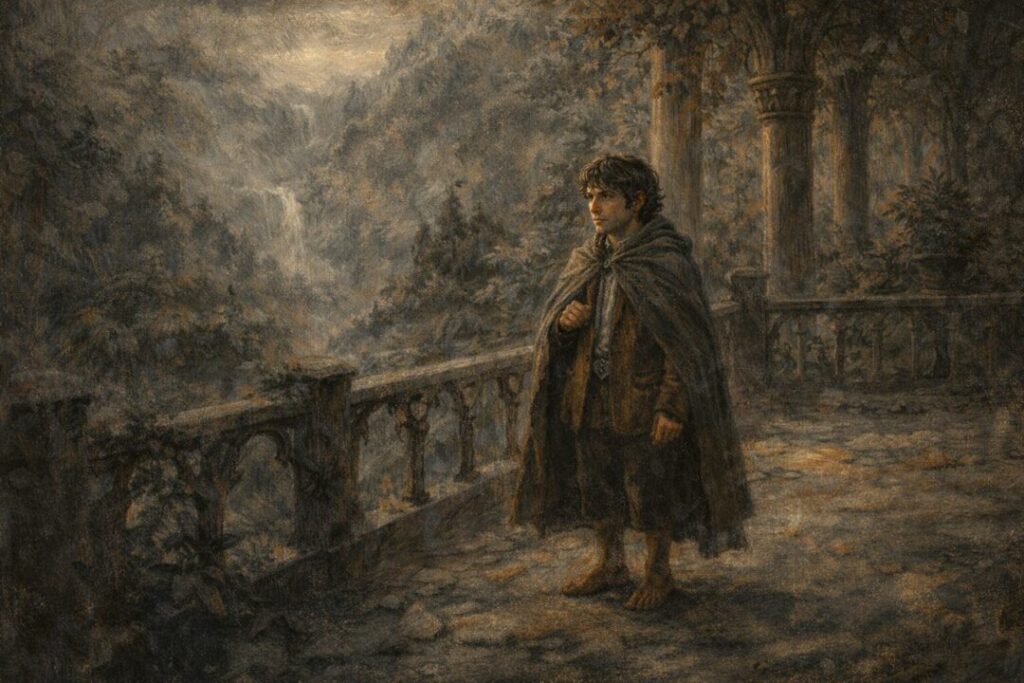
The Council of Elrond: A Silent Judgment
At the Council of Elrond, representatives of many peoples are present.
Elves.
Dwarves.
Men.
Hobbits.
Aragorn is there — the heir of Isildur himself, bearing the shards of Narsil and the weight of a broken legacy.
And yet, when the question arises of who should bear the Ring, Elrond does not look to Men.
This is never explained directly. There is no speech in which Elrond declares that Men have failed before and cannot be trusted again. Tolkien avoids such bluntness entirely.
Instead, the decision unfolds organically.
The Ring-bearer emerges not through strength, lineage, or right — but through humility and circumstance.
Frodo volunteers.
And Elrond accepts.
This acceptance is immediate, almost quiet. There is no hesitation, no attempt to redirect the burden to someone “greater.” Elrond recognizes that the Ring cannot be mastered. It cannot be wielded safely. It can only be carried — briefly, painfully — by those least inclined to dominate others.
This choice is consistent with everything Elrond has learned. Not just from Isildur, but from the entire tragic history of power in Middle-earth.
Elrond’s Own Nature: Between Elves and Men
Elrond’s caution toward Men is also shaped by who he himself is.
As Half-elven, Elrond belongs to both kindreds — and fully to neither. He understands the gifts and the weaknesses of Men intimately. He has watched those he loves age and die. He has seen how swiftly human greatness rises, and how swiftly it collapses.
This dual perspective grants Elrond empathy rather than contempt.
He does not mistrust Men because he despises them.
He mistrusts power placed upon them too quickly, too heavily, without time for wisdom to grow.
This is why he shelters Aragorn for decades before revealing his lineage. This is why Aragorn’s kingship is delayed, tested, and earned. Elrond does not repeat the mistake of sudden elevation.
Aragorn: The Exception That Proves the Rule
Some readers object to the idea that Elrond is cautious toward Men at all.
Does he not trust Aragorn?
Yes — deeply.
But notice the distinction.
Elrond does not give Aragorn the Ring. He gives him a sword reforged from shards — a symbol of kingship rooted in service, patience, and endurance rather than domination.
Aragorn must wait decades to claim his throne. He must walk the wilds, serve other rulers, and accept obscurity. He must prove that he can resist shortcuts — precisely the temptation that overcame Isildur.
Elrond’s trust in Aragorn is not blind faith in Men as a whole. It is trust in a man shaped deliberately against the failures of his forefather.
Aragorn does not take power when it is offered easily.
That difference matters.
What the Texts Actually Say — and Don’t Say
At no point does Tolkien write that Elrond “lost faith” in Men. Such language would be too modern, too psychological, too explicit.
Instead, Tolkien shows Elrond acting with restraint.
He advises rather than commands.
He remembers rather than condemns.
He chooses humility over strength when the stakes are absolute.
This is how wisdom operates in Middle-earth. Not through declarations, but through choices shaped by long memory and hard-earned understanding.
Elrond does not need to announce his caution.
It is visible in who he entrusts with the fate of the world — and who he does not.
A World That Learned the Hard Way
Elrond’s quiet caution toward Men is not bitterness.
It is earned knowledge.
He has seen what happens when good intentions meet absolute power. He has seen how easily even noble Men can falter — not because they are evil, but because they are human.
And so, when the fate of Middle-earth hangs in the balance, Elrond does something extraordinary.
He steps back.
He allows the smallest voices to carry the greatest burden.
Not because Men are unworthy — but because history has already shown what the Ring does to them.
And Elrond, above all else, remembers.
Sources & Notes
- J.R.R. Tolkien, The Lord of the Rings, Book II, Chapter 2, “The Council of Elrond” — records Elrond’s memory of Isildur taking the Ring as weregild and refusing the counsel to destroy it.
- J.R.R. Tolkien, The Lord of the Rings, Appendix A, “The Tale of Aragorn and Arwen” — shows Elrond fostering Aragorn in Rivendell, concealing his lineage for safety, and shaping his road toward kingship with patience rather than haste.
- J.R.R. Tolkien, The Silmarillion, “Akallabêth” — gives the larger Númenórean pattern behind Elrond’s caution: mortal fear, pride, and the desire to escape appointed limits.
- J.R.R. Tolkien, Unfinished Tales, “The Disaster of the Gladden Fields” — presents Isildur after the War of the Last Alliance and supports the reading of his failure as tragic and human rather than simply villainous.
- J.R.R. Tolkien, The Letters of J.R.R. Tolkien, Letter 131 — frames the Ring as a power of domination and explains why attempts to use it, however well meant, would corrupt its bearer.