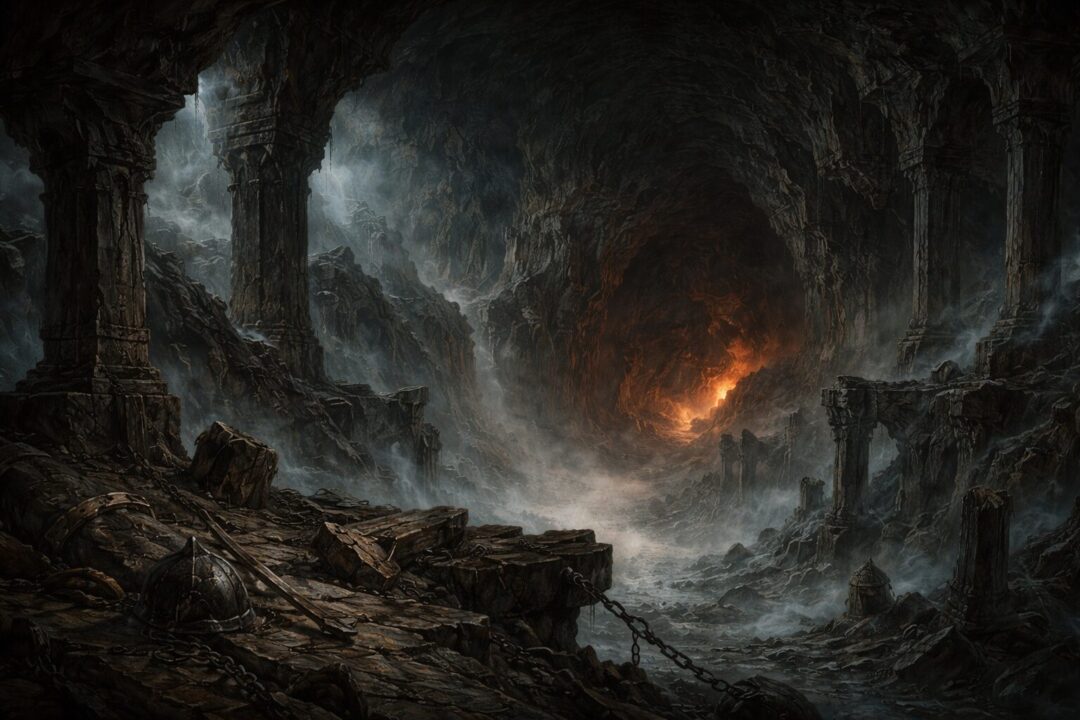
Middle-earth is often imagined as a world of open spaces: rolling green hills, ancient forests, long roads between distant lands, and ruined cities standing beneath the open sky. Most of its great conflicts unfold on the surface—armies march, banners rise, towers burn, and kingdoms fall in plain sight.
Yet some of the most disturbing moments in the legendarium do not look outward at all.
They look down.
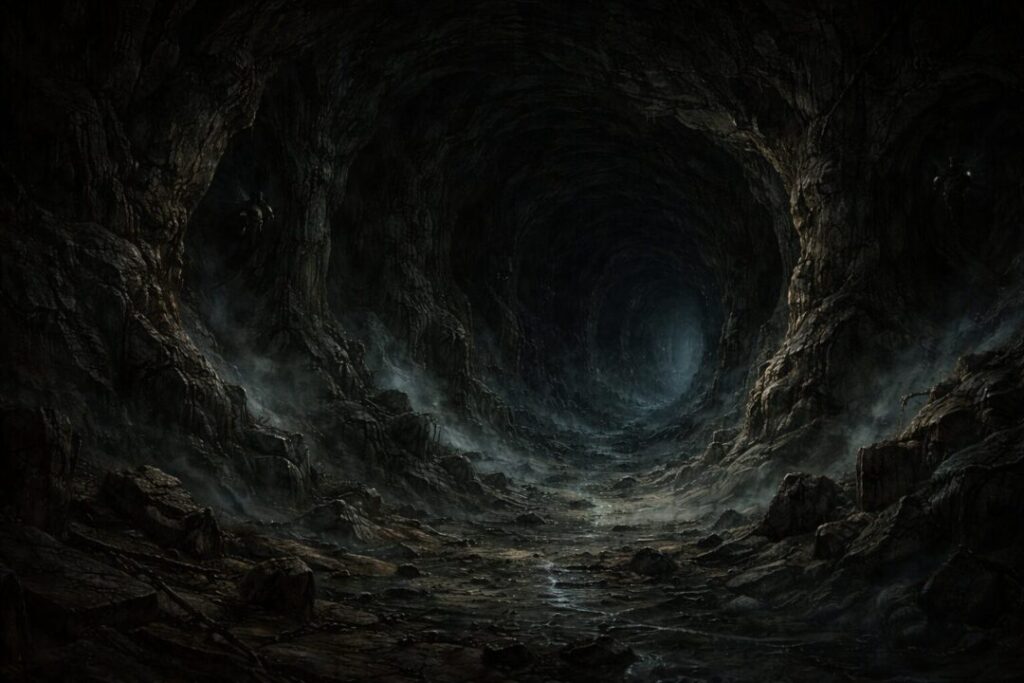
Beneath Middle-earth lies a deeper history—older than many realms, older than most peoples, and in some cases older than the Sun itself. During the Third Age, as the surface world enters its final great struggle, that buried history begins to stir.
This is not a story about new evils being created or summoned. Tolkien is careful to avoid that idea. What awakens beneath Middle-earth is not newly born darkness, but ancient presence—long hidden, long dormant, and gradually disturbed.
The Third Age does not invent these things.
It reaches them.
The Awakening Beneath Khazad-dûm
The clearest and most textually supported example of something awakening beneath Middle-earth occurs in Khazad-dûm, the greatest Dwarven realm of the age.
In Appendix A of The Lord of the Rings, Tolkien states plainly that the Dwarves, while delving ever deeper in their search for mithril, “awoke” a Balrog in the year 1980 of the Third Age. This creature—later called Durin’s Bane—had survived the end of the First Age and fled from the War of Wrath, hiding beneath the roots of the Misty Mountains.
This is not implied. It is explicit.
The Balrog was not created in the Third Age. It was not summoned by Sauron. It was not drawn by magic or command. It was already there—concealed, inactive, and forgotten.
For thousands of years, it slept.
Its awakening was caused by excavation. By ambition. By the relentless downward drive of a people whose skill lay in shaping stone and seeking what lay beneath it.
The consequences were immediate and devastating.
The king of Khazad-dûm was slain.
The Dwarves fled their greatest city.
A thriving realm became a place of dread.
Importantly, Tolkien does not frame this as mere misfortune. The language of “delving too deeply” appears elsewhere in the legendarium as a warning. The fall of Moria is not only a tragedy—it is a lesson. Some powers are not meant to be confronted directly, and some depths are not meant to be reached.
The Balrog does not pursue conquest. It does not raise armies. It simply exists—and its existence is enough to end a kingdom.
The Watcher in the Water
Outside the West-gate of Moria, another presence appears—one far less understood, and far more mysterious.
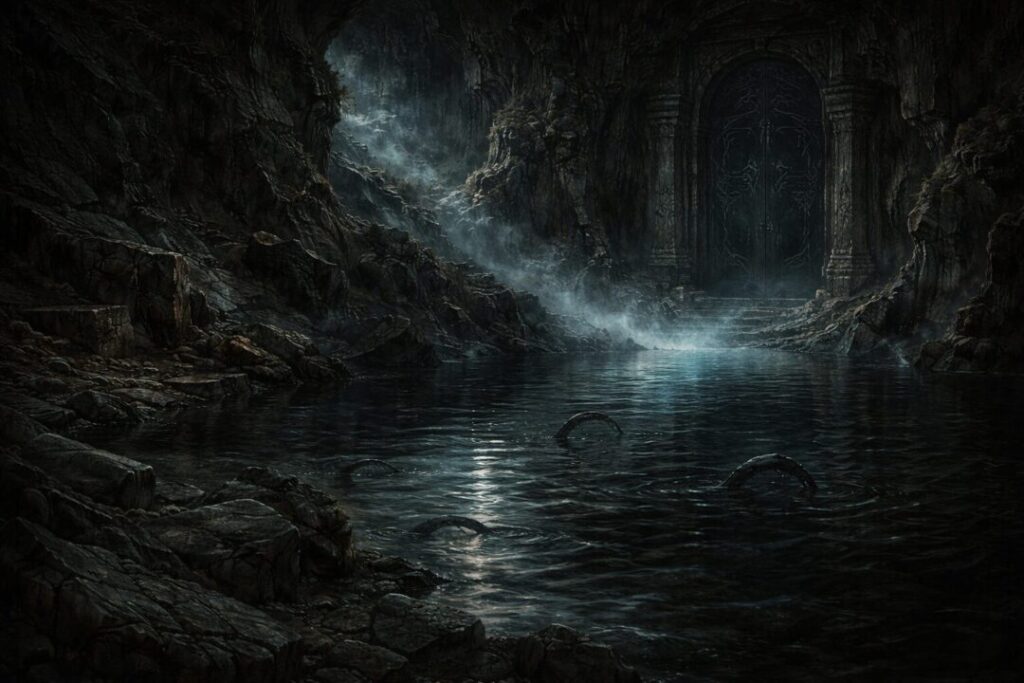
The Fellowship encounters a creature later called the Watcher in the Water: a many-tentacled being lurking in the dark pool before the doors. Tolkien never names its species. He offers no history. Gandalf does not recognize it. Legolas senses something old and hostile, but cannot identify it.
This silence is deliberate.
No canonical text explains where the Watcher came from or how long it has existed. It is not described as an Orc, a corrupted beast, or a servant of any known power. It attacks not with malice or strategy, but with territorial violence.
It guards.
Many readers have interpreted the Watcher as having moved into the area after the fall of Moria, possibly drawn by the abandonment of the city or by the presence of the Balrog within. This interpretation is plausible—but it remains interpretation. Tolkien never confirms it.
What is clear is that the Watcher does not act as part of a wider plan. It does not pursue the Fellowship beyond its waters. It does not follow them into the world.
Its presence reinforces a pattern seen elsewhere in Middle-earth: when great places fall, other things move in—not conquerors, but inhabitants of a different order, filling vacuums left behind by civilization.
The Nameless Things Below the World
The most unsettling reference to what lies beneath Middle-earth comes during Gandalf’s account of his battle with the Balrog.
He speaks of tunnels far below even the deepest delvings of the Dwarves. There, he says, are “nameless things” that gnaw at the roots of the world. He adds, explicitly, that Sauron knows them not.
This passage is brief—and intentionally opaque.
Tolkien never describes these beings.
He never explains their origin.
He never revisits them.
Any attempt to define them as a specific race or creature goes beyond the text.
What can be said, conservatively, is this: Tolkien allows for the existence of beings older than the current structures of power in Middle-earth. They do not belong to Sauron. They do not serve Morgoth in any active sense. They are not aligned with the struggles of the Third Age.
They simply exist, beneath everything else.
This idea—that the world contains layers of reality untouched by its central conflict—is rare in fantasy, but central to Tolkien’s sense of scale. The War of the Ring matters enormously. But it does not encompass all existence.
There are things older than the war.
Older than the Rings.
Older than the ambitions of any Dark Lord.
And they endure regardless of who wins.
A Pattern, Not a Conspiracy
It is tempting to imagine that these awakenings form a coordinated response to Sauron’s growing power. Ancient evils rising as the Dark Lord returns.
But Tolkien does not support this.
There is no evidence that the Balrog was summoned.
No evidence that the Watcher served a master.
No evidence that the nameless things were stirring upward.
What we see instead is a pattern of disturbance.
As Dwarves dig deeper.
As realms expand beyond their foundations.
As ancient places are abandoned, breached, or exhausted.
The deep places are reached.
And when they are reached, something answers—not because it has been called, but because it has been found.
The Third Age is an age of limits. Resources are strained. Knowledge fades. Old boundaries are crossed without full understanding of what lies beyond them.
The world grows thinner.
Why Tolkien Leaves the Depths Unexplained
Tolkien was meticulous in genealogy, language, and history—but he was equally deliberate in his silences.
By refusing to explain what lies beneath Middle-earth, he preserves mystery. The unknown remains unknown, not because it lacks an answer, but because answering it would diminish its weight.
The War of the Ring, immense as it is, does not define the whole of reality. There are older layers of existence that neither Frodo nor Sauron can fully comprehend or control.
This reinforces one of Tolkien’s central ideas: evil is not singular.
Sauron is a great threat—but not the only one.
Power does not flow from one source alone.
History does not move on a single track.
The world is deeper than any single story.
The Uneasy Truth Beneath the Third Age
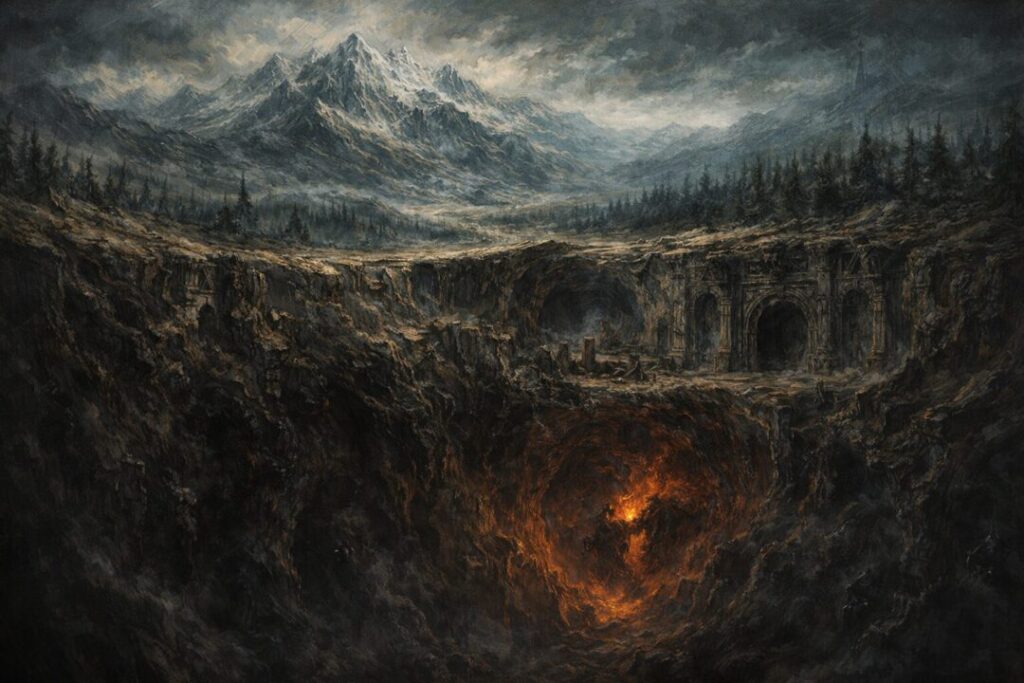
What awoke beneath Middle-earth during the Third Age was not a new darkness.
It was memory.
Buried fire.
Forgotten terror.
Ancient life persisting beneath stone.
The surface world changes. Ages pass. Towers fall. Names are forgotten.
But the deep places remain.
And sometimes—when the world above forgets how old it truly is—those depths remind it.
Sources & Notes
- J.R.R. Tolkien, The Lord of the Rings, Appendix A, III, “Durin’s Folk” — gives the Third Age 1980 awakening of Durin’s Bane after the Dwarves delved too deep for mithril.
- J.R.R. Tolkien, The Silmarillion, “Of the Voyage of Eärendil and the War of Wrath” — notes that some Balrogs escaped the ruin of Angband and hid in deep places of the earth.
- J.R.R. Tolkien, The Lord of the Rings, Book II, Chapter 4, “A Journey in the Dark” — the Watcher in the Water attacks at Moria’s West-gate without a clear origin or allegiance being explained.
- J.R.R. Tolkien, The Lord of the Rings, Book III, Chapter 5, “The White Rider” — Gandalf describes far-below tunnels and the nameless things that gnaw the world, unknown even to Sauron.