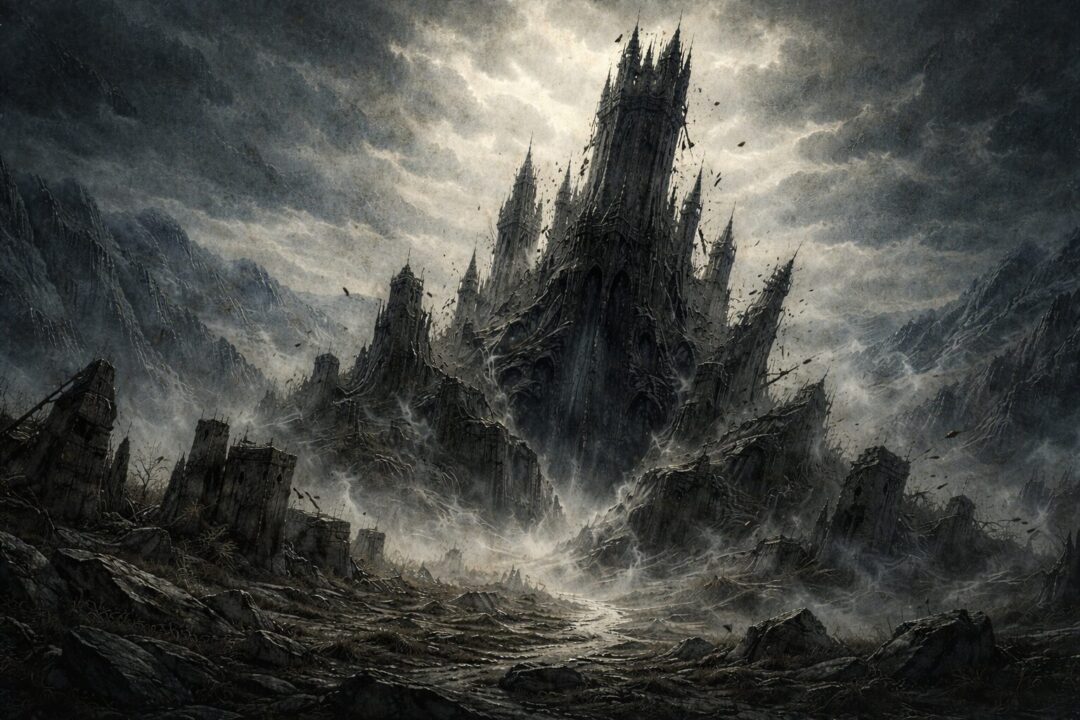
When the One Ring was destroyed and Sauron fell, the Nazgûl vanished with him. Their existence was bound to the Ring, and Tolkien is explicit that when it was unmade, they were destroyed utterly—“passing into the shadows” with no possibility of return.
Yet while the Ringwraiths themselves passed beyond history, the places they ruled did not simply vanish.
Across Middle-earth stood cities, fortresses, and realms shaped by centuries of their presence. These were not ordinary strongholds. They were places molded by fear, prolonged domination, and the influence of beings who existed partly in the unseen world. The Nazgûl did not merely govern territory; they transformed it.
So what happened to those places after the War of the Ring?
The answer, drawn carefully from the texts, is incomplete—and deliberately so. Tolkien does not offer a catalog of restorations or clean resolutions. Instead, he leaves behind silence, abandonment, and ruin, inviting the reader to reflect on what victory does not undo.
The Nazgûl as Rulers, Not Just Servants
Before examining their strongholds, it is important to understand the role the Nazgûl played.
They were not wandering monsters. For much of the Third Age, they acted as Sauron’s chief lieutenants, ruling territory, commanding armies, and enforcing his will. The Witch-king of Angmar ruled a kingdom outright. Others governed regions such as Minas Morgul. Even when unseen, their authority shaped borders, roads, and the fates of cities.
Their dominion was long-lasting. In several cases, it endured for centuries.
When such rulers vanish, the question is not merely who replaces them—but whether replacement is even possible.
Minas Morgul: A City Too Corrupted to Reclaim
Minas Morgul is the clearest and most explicitly described example.
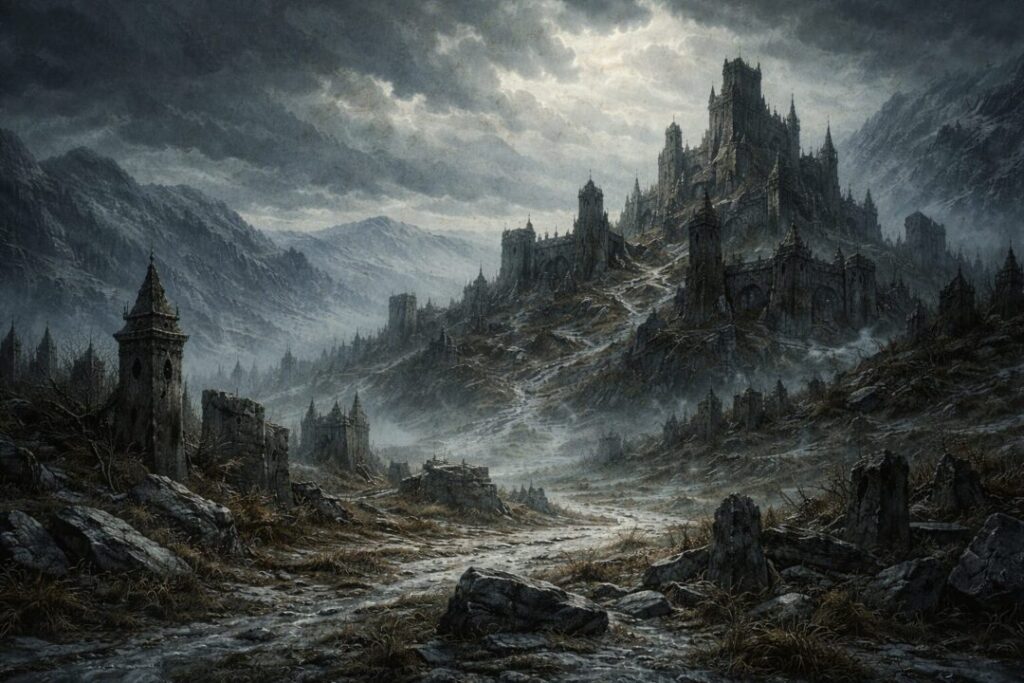
Originally Minas Ithil, a great city of Gondor, it stood as a symbol of watchfulness and beauty. When the Witch-king captured it in the Third Age, the city was transformed into a place of terror. Tolkien’s descriptions are unambiguous: pale corpse-light, foul enchantment, and an atmosphere so dreadful that even hardened warriors feared to approach.
The corruption was not merely political. It was spiritual and environmental. The very stones of the city seemed altered by long occupation.
After the War of the Ring, the Witch-king was destroyed and his armies scattered. And yet Tolkien does not describe Minas Morgul being reclaimed, rebuilt, or resettled.
Instead, The Return of the King tells us that King Elessar ordered the city to be utterly cleansed and that no one would dwell there “for many years.” The phrasing matters. Tolkien does not specify how long. Nor does he describe the outcome.
The implication is restrained but unmistakable: Minas Morgul was not simply dangerous—it was poisoned by history. Its abandonment was not a failure of courage or manpower, but a recognition that some places require time beyond human planning to heal.
Minas Morgul was not conquered back into goodness.
It was left to silence.
Why Tolkien Refuses to Show Its Healing
Notably, Tolkien never narrates the cleansing of Minas Morgul itself. There is no scene of purification, no ritual, no triumphal return of light.
This omission is deliberate.
Throughout The Lord of the Rings, Tolkien avoids depicting the direct “undoing” of long-standing evil. Victory ends dominion, not consequence. Minas Morgul’s fate reinforces this pattern. Evil does not always leave behind neutral ground. Sometimes it leaves scars that cannot be immediately addressed.
By refusing to resolve Minas Morgul on the page, Tolkien allows it to remain what it truly is: a warning.
Angmar: A Realm Already Broken Before the End
Angmar presents a different case.
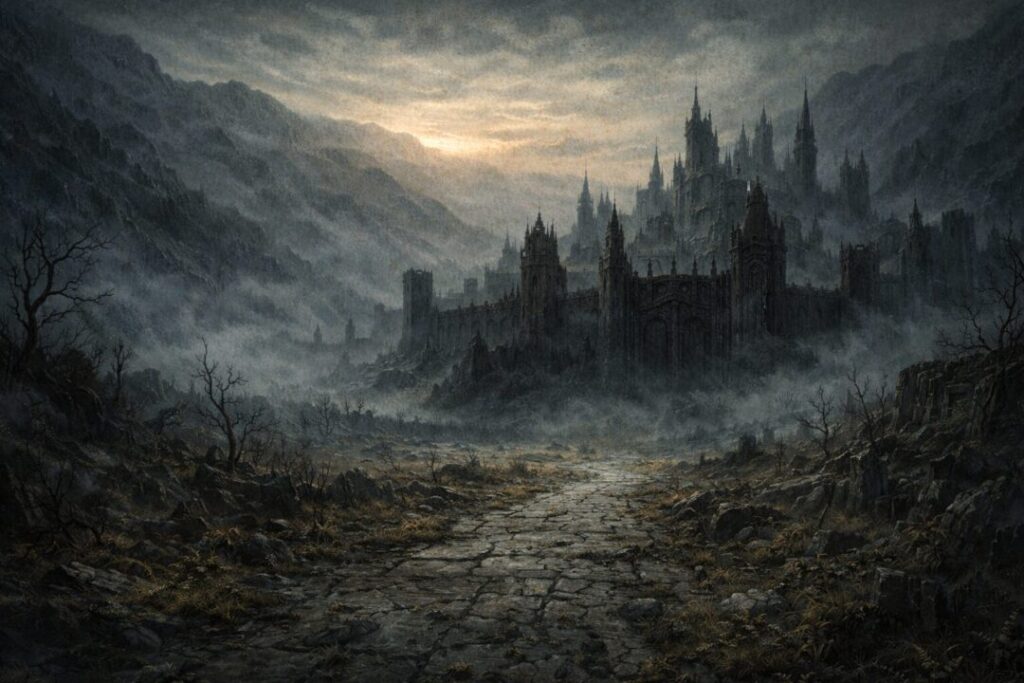
The Witch-king’s northern kingdom fell centuries before the War of the Ring, during the long wars against Arnor. By the time Frodo leaves the Shire, Angmar is already a land of ruins.
Tolkien never describes Angmar as being actively inhabited after its fall. There are no accounts of continued rule, no mention of restoration efforts, and no suggestion that the land ever recovered its former identity.
What remains is memory.
Angmar’s purpose had been singular: the destruction of the northern Dúnedain. Once that purpose was fulfilled—and once the Witch-king departed—the kingdom had no future. Tolkien emphasizes repeatedly that no new power rose there.
Importantly, Tolkien does not claim that Angmar remained cursed or inhabited by supernatural horrors. The dread associated with it appears to be historical rather than active. The land is empty not because it is haunted, but because it is spent.
Angmar was not waiting to be reclaimed.
It was already finished.
Barad-dûr: A Fortress Bound to the Ring
Barad-dûr stands apart from all other strongholds.
Unlike Minas Morgul or Angmar, its existence was fundamentally tied to the One Ring. Tolkien is explicit on this point: the foundations of the Dark Tower were made with the power of the Ring, and without it, they could not endure.
When the Ring was destroyed, Barad-dûr fell completely.
Not ruined.
Not abandoned.
Unmade.
Tolkien’s language is precise. The tower collapses into dust and shadow, erased rather than defeated. There are no ruins left to fear or reclaim. The destruction is total.
This is not symbolic. It is structural. Barad-dûr did not simply belong to Sauron—it depended on him, and through him, on the Ring.
Its disappearance is the clearest example of evil in Middle-earth being undone not by conquest, but by removal of its source.
Why Victory Does Not Mean Restoration
At first glance, one might expect the end of the War of the Ring to usher in widespread rebuilding and renewal.
Tolkien does not write that story.
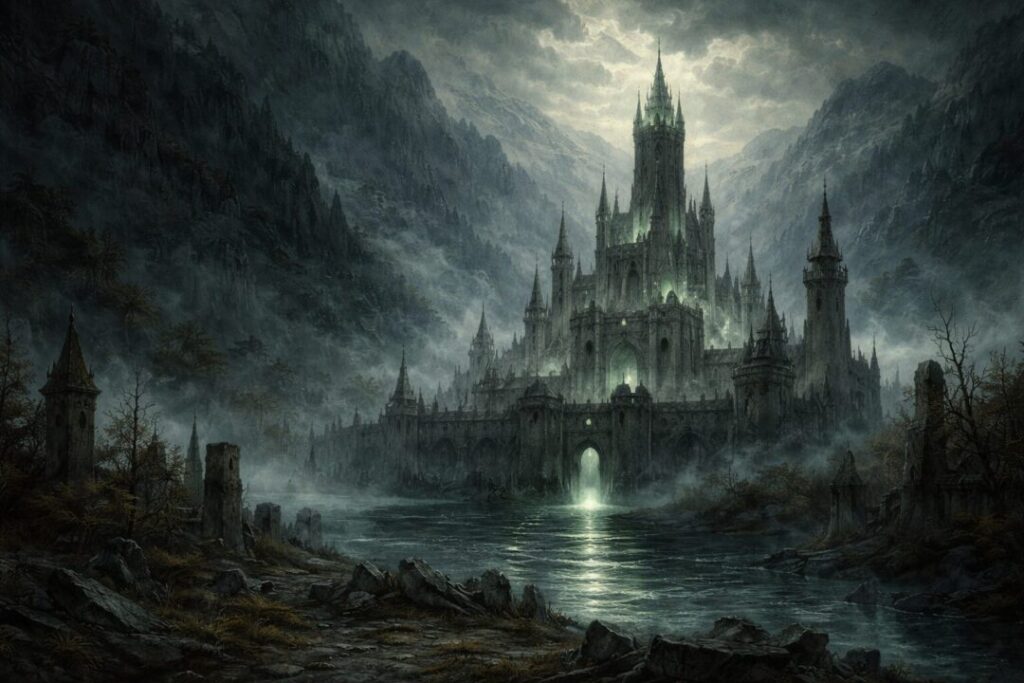
Middle-earth at the end of The Lord of the Rings is not a healed world. It is a wounded one entering a new Age. The Age of Men begins, but it inherits landscapes shaped by loss, decline, and absence.
Some evils are defeated.
Others are outgrown.
Few are reversed.
Minas Morgul’s emptiness reflects this truth. Angmar’s desolation reinforces it. Barad-dûr’s annihilation seals it.
Rather than providing neat closure, Tolkien mirrors real history, where victory often leaves unresolved spaces behind.
Absence as a Deliberate Narrative Choice
It is just as important to note what Tolkien does not say.
He does not describe lingering curses in Minas Morgul.
He does not describe monsters occupying Angmar.
He does not describe campaigns to reclaim the Dark Land.
This restraint matters.
Tolkien avoids sensationalizing aftermath. He allows absence to speak for itself. The Nazgûl are gone, but the marks of their rule remain—some visible, some implied, some left entirely unspoken.
In that silence, Tolkien communicates something essential: evil reshapes the world in ways that victory cannot always repair.
Why This Still Matters
Modern fantasy often rushes to restore everything once the villain is defeated. Ruins become cities again. Darkness lifts cleanly. Balance is fully restored.
Tolkien resists that impulse.
Some doors stay closed.
Some cities stay empty.
Some lands remain warnings rather than prizes.
The Nazgûl’s strongholds were not trophies of victory. They were reminders of what Middle-earth had endured—and what it could never completely undo.
Their silence is not an oversight.
It is part of the cost.
And perhaps that is why Tolkien lets these places fade quietly from the story rather than returning them to glory. Because some evils are best remembered not by what replaces them—but by what is no longer there.
Sources & Notes
- J.R.R. Tolkien, The Lord of the Rings, Book VI, Chapter 3, “Mount Doom” — the Ring’s destruction brings down Barad-dûr and ends the Nazgûl with Sauron’s power.
- J.R.R. Tolkien, The Lord of the Rings, Book VI, Chapter 5, “The Steward and the King” — Aragorn orders Minas Morgul destroyed and left uninhabited for many long years.
- J.R.R. Tolkien, The Lord of the Rings, Appendix A, “The North-kingdom and the Dúnedain” — the Witch-king’s realm of Angmar rises against Arnor and is later overthrown after Fornost.
- J.R.R. Tolkien, The Lord of the Rings, Book II, Chapter 2, “The Council of Elrond” — Barad-dûr’s foundations are described as made with the power of the One Ring.
- J.R.R. Tolkien, The Silmarillion, “Of the Rings of Power and the Third Age” — gives the broader history of the Ringwraiths, Minas Ithil’s fall into Minas Morgul, and Sauron’s servants in the Third Age.