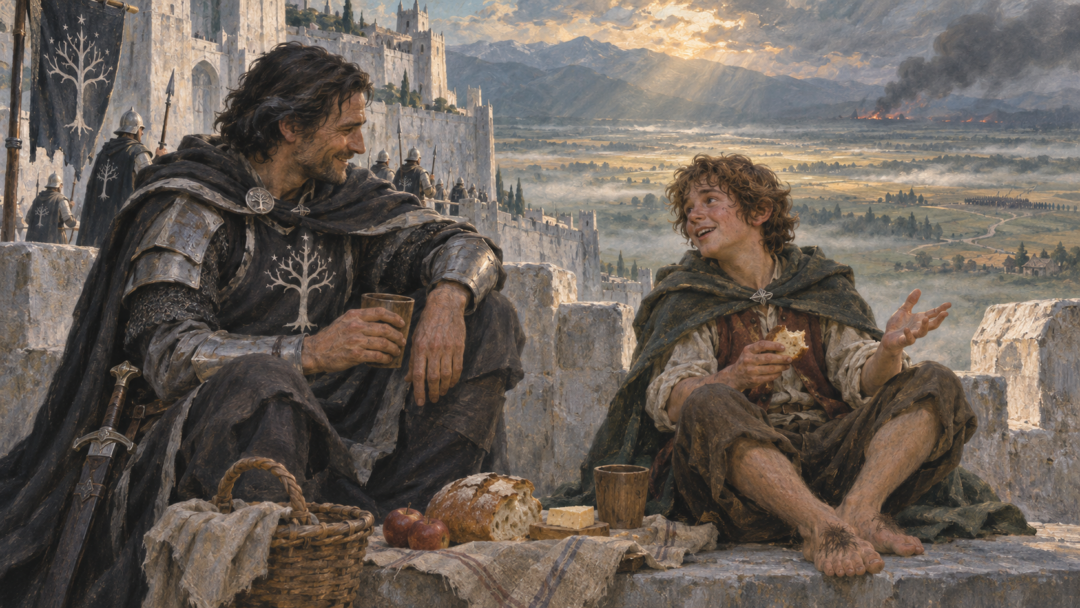
High over Minas Tirith, with war gathering beyond the walls, Pippin wants breakfast. The man assigned to explain his new duties is a soldier in black and silver, curious to meet a halfling and willing to talk. Before the siege, they find time to eat and become friends. It is a quiet pleasure of The Return of the King.
That soldier, Beregond, is an especially strong answer to the question of which Lord of the Rings character the movies waste. Not because his absence ruins Faramir's rescue. The story still reaches that outcome. What disappears is a human thread: the guardsman who welcomes Pippin, makes a desperate decision before help arrives, and has a place in the kingdom that survives the war.
A soldier who makes Minas Tirith feel inhabited
Beregond enters in Book V, Chapter 1, “Minas Tirith,” after Pippin has sworn service to Denethor. He has been sent to teach the newcomer the Citadel's passwords and rules. Their meeting quickly becomes something warmer. Beregond meets someone child-sized whose experiences stretch far beyond the city walls. Their questions work both ways: the hobbit wants to know how the fortress functions, while the soldier wants to understand the strange people called halflings.
Pippin, meanwhile, is not particularly eager to begin with solemn military procedure. He is hungry. Their meal gives the chapter room to wander into talk of Gondor and the wider war. As the book puts it, “They ate and drank; and they talked now of Gondor”. The meal does more than provide comic relief. Pippin encounters the city through someone who lives and works there, rather than solely through its rulers or its monumental history.
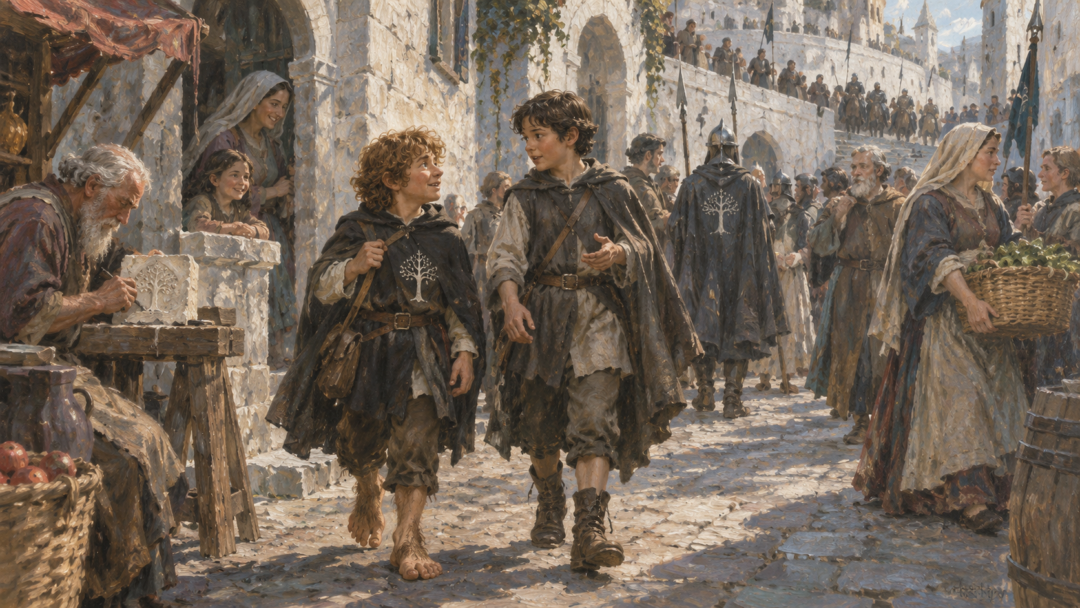
Beregond also introduces another connection. His young son Bergil becomes the hobbit's guide and companion. Together they watch companies from Gondor's outlying regions arrive to defend the city, including the proud force led by Prince Imrahil of Dol Amroth. Bergil recognizes Forlong of Lossarnach, giving Pippin a name and a face to attach to a corner of the realm he has never visited. Each arrival is welcomed, but the defenders wish for more. Through Bergil, public danger gains a child's perspective.
This is a particular loss in adaptation, not a claim that the films contain no ordinary Gondorians. They show soldiers and citizens under attack. What the Beregond-Bergil connection gives the book is continuity between those people and Pippin. His oath to the Steward is a formal bond; his new friendships are personal ones. When events turn terrible, the guardsman is more than scenery.
The warning that changes everything
In Book V, Chapter 4, “The Siege of Gondor,” Faramir returns gravely ill, and Denethor resolves to die with him. Faramir is still alive when the Steward orders him taken to the tombs. Boromir is already dead, and Denethor faces the apparent loss of his remaining son as the enemy closes around the city. Pippin understands the danger and tries to stop what is happening, but cannot command Denethor's servants to disobey. Pippin is close to the crisis, but has no authority over it.
On his way to find Gandalf, Pippin encounters Beregond on duty at the Citadel gate and tells him what Denethor intends. Their earlier meeting now has an unexpected consequence. Pippin knows whom to approach, and Beregond has reason to take his alarm seriously. Neither needs to declare his loyalty. A conversation begun over food and practical advice has become a channel through which urgent news can move.
Beregond is not simply following Pippin's instructions. A guardsman is not free to abandon his post, especially during a siege. Yet he goes toward the Houses of the Dead, where the Steward's command is about to become fatal for Faramir. Pippin searches for Gandalf; Beregond obstructs Denethor's men. Their paths separate because each can do something the other cannot.
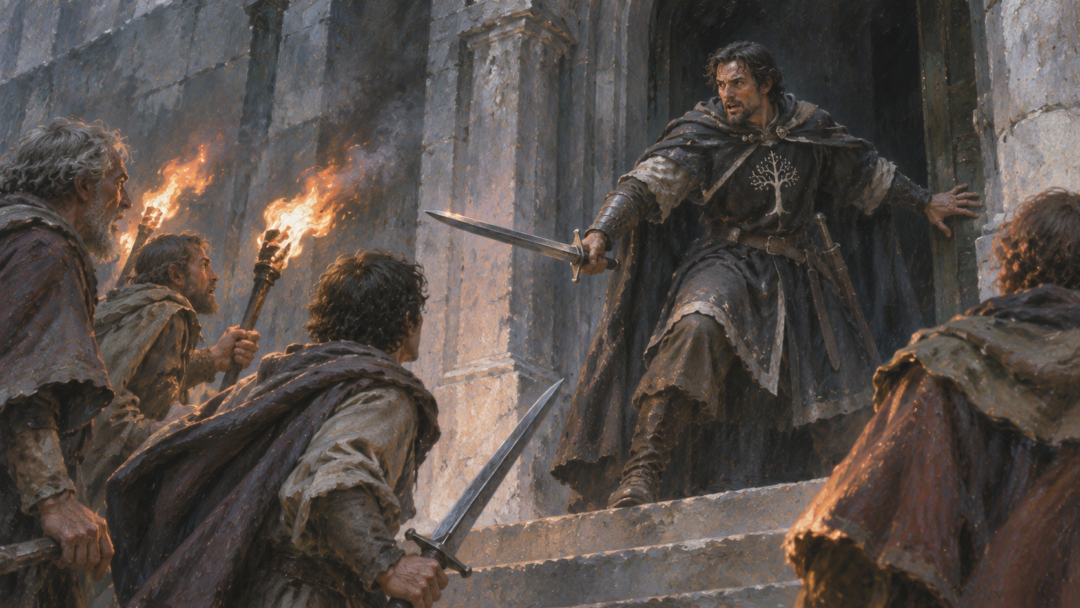
There is no painless version of that intervention. Beregond kills the porter who bars his passage and later kills two of Denethor's servants who try to bring fire to the pyre. Those deaths are not disposable action-scene obstacles. He buys Faramir time but breaks his duty and sheds Gondorian blood. The siege has reached a point where the city's own defenders are fighting one another inside its most solemn precinct.
The man already standing in the doorway
When Gandalf and Pippin reach the House of the Stewards in Book V, Chapter 7, “The Pyre of Denethor,” they do not find an undefended entrance. Denethor's servants have swords and torches, and Beregond is holding the porch against them. He has already acted, at great risk, before the wizard arrives. The ordering matters: an ordinary soldier must hold out until help comes.
Gandalf then enters and lifts Faramir from the funeral pyre before its fuel is lit. The movie can easily blur that detail. Beregond does not lift Faramir from a blaze. He delays the fire; Gandalf removes Faramir. Later, when Denethor approaches Faramir with a knife, Beregond again puts himself between the Steward and his son. He protects Faramir twice.
The scene is frightening partly because Beregond knows the customs and loyalties he is defying. His opponents are not orcs. They serve the same city under a lawful Steward. Beregond must confront the possibility that obedience, in this particular place and hour, will destroy the very person he is trying to protect. His resistance remains costly.
Just as importantly, no one in the book handles the rescue alone. Pippin recognizes the threat and brings word; Beregond stops the torches and holds the passage; Gandalf reaches the tomb and carries Faramir away. Their efforts overlap without becoming interchangeable. The stand is neither Gandalf's power nor Pippin's courage. It is a necessary action available to someone positioned inside Gondor's ordinary system of service, with all the obligations that position entails.
What the movie's rescue changes
The publicly available Return of the King screenplay credited to Fran Walsh, Philippa Boyens, and Peter Jackson, marked “Final Revision — October 2003,” tells this sequence differently. Beregond and Bergil do not appear by name in that text. Pippin remains central to discovering Denethor's plan, but the rescue is concentrated around characters the audience already knows. The screenplay establishes this difference; it does not establish what every film edition or production draft contains.
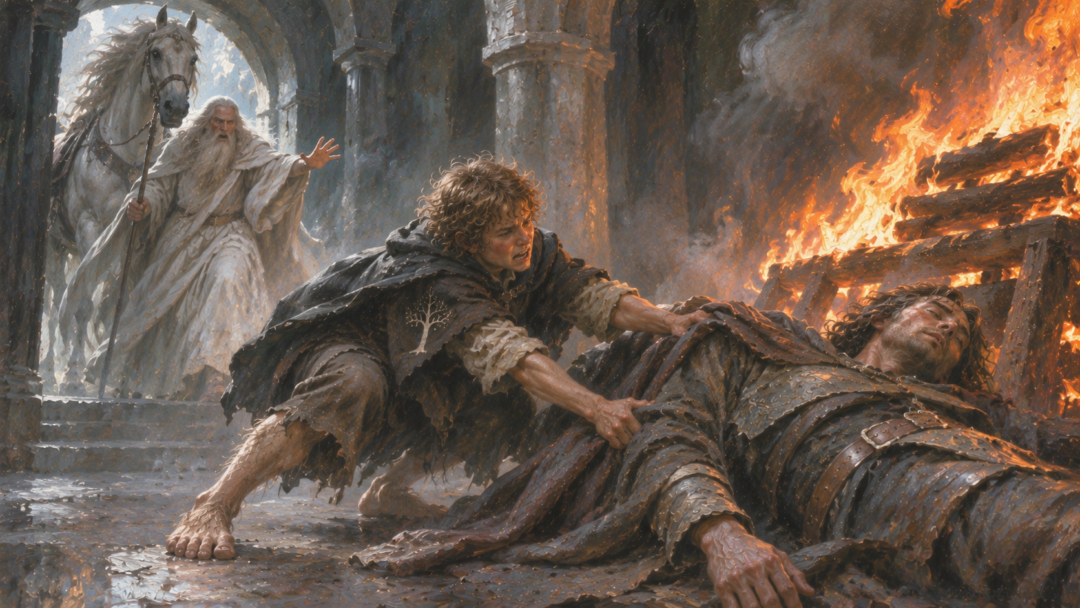
In the screenplay, Gandalf and Pippin enter the tomb on Shadowfax. Denethor hurls a torch, the pyre catches fire, and Pippin leaps down to push Faramir clear of the burning wood. Gandalf rides against Denethor, while Shadowfax also intervenes. Earlier in the same scene, the screenplay has Faramir stir as Denethor pours oil over the pyre, making the danger terrifyingly immediate. The change is larger than simply handing Beregond's deed to Pippin. In the book, Beregond prevents ignition long enough for Gandalf to lift Faramir from the pyre. In the screenplay, Faramir's removal becomes Pippin's desperate act after the fire begins.
The concentration has an advantage on screen. The sequence moves directly from Pippin's dread to a visible rescue in which he has a physical part. Gandalf and Shadowfax provide the force needed to confront Denethor, and the flames make the immediate peril unmistakable. An adaptation must choose what to show. The result here is a tighter chain of danger and response, whether or not that was the explicit reason for omitting Beregond.
But there is a price beyond the missing name. A familiar hero can rescue Faramir without showing that a Gondorian soldier has independently refused to let his lord's despair determine another man's death. The book briefly brings the city's internal life into sharp focus: guards, servants, orders, personal bonds, and resistance to their own command structure. The screenplay preserves the escape while leaving out the man whose earlier hospitality made that conflict feel rooted in an actual community.
Pippin is hardly less courageous on the page. His task there is extraordinarily difficult: he must recognize what Denethor intends, get away, warn Beregond, and find Gandalf while battle consumes the city. The film version chooses a different expression of bravery, visible in a burst of movement and flame. Both have stakes. Only the book, however, connects that moment to the quiet friendship made before the siege reached the gates.
A future that belongs to Gondor
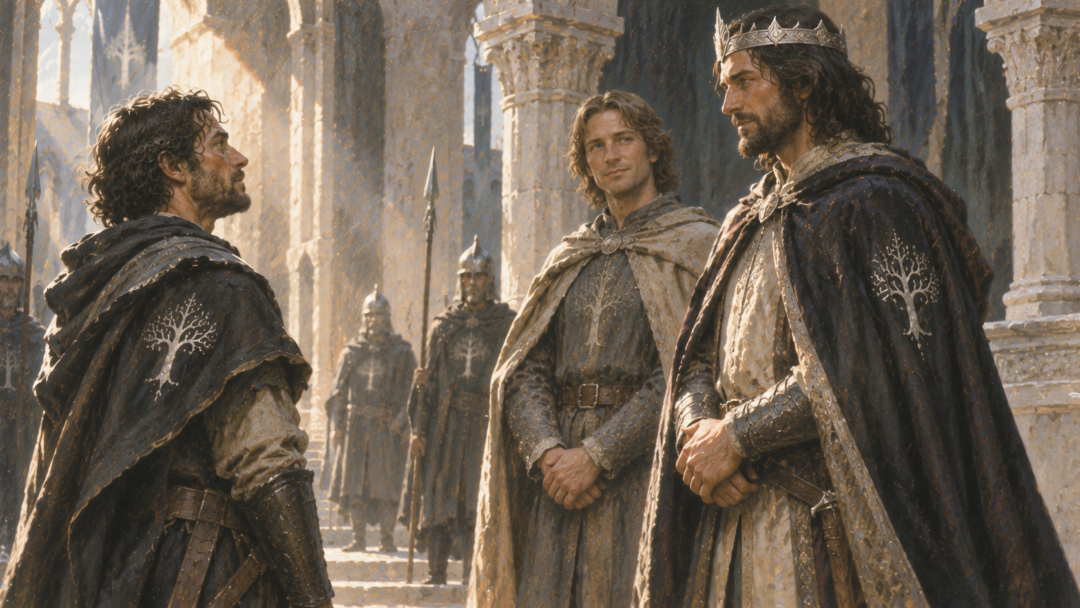
Beregond's story does not finish when Faramir survives. In Book VI, Chapter 5, “The Steward and the King,” Aragorn addresses what the guardsman has done. Beregond must leave the Guard of the Citadel, but he is appointed captain of the White Company, the guard of Faramir as Prince of Ithilien, and is to dwell in Emyn Arnen. The judgment gives his earlier service a future alongside the man he helped save, without pretending the bloodshed never happened.
The ending reaches beyond punishment. Beregond was introduced through a working day and a family connection, not a battlefield triumph. After victory, he still has work, a home, and people to serve. Remembering his son makes this continuation feel less like a ceremonial reward and more like an ordinary family's passage from siege into peace. Gondor's renewal therefore has a scale smaller than the return of a king or the rebuilding of a city. It can be glimpsed in the continued life of one guardsman whose choices were made before anyone knew victory was possible.
There are more flamboyant characters the films leave out, but Beregond offers a particularly revealing absence. His first memorable act is to share time and breakfast with a stranger; his bravest is to stand at a doorway when the torches are coming. The kingdom is saved by famous names, yet the books also remember the man who was there before them.
Sources & Notes
This article is based on close reading and interpretation of Tolkien's published works and related source material where relevant.