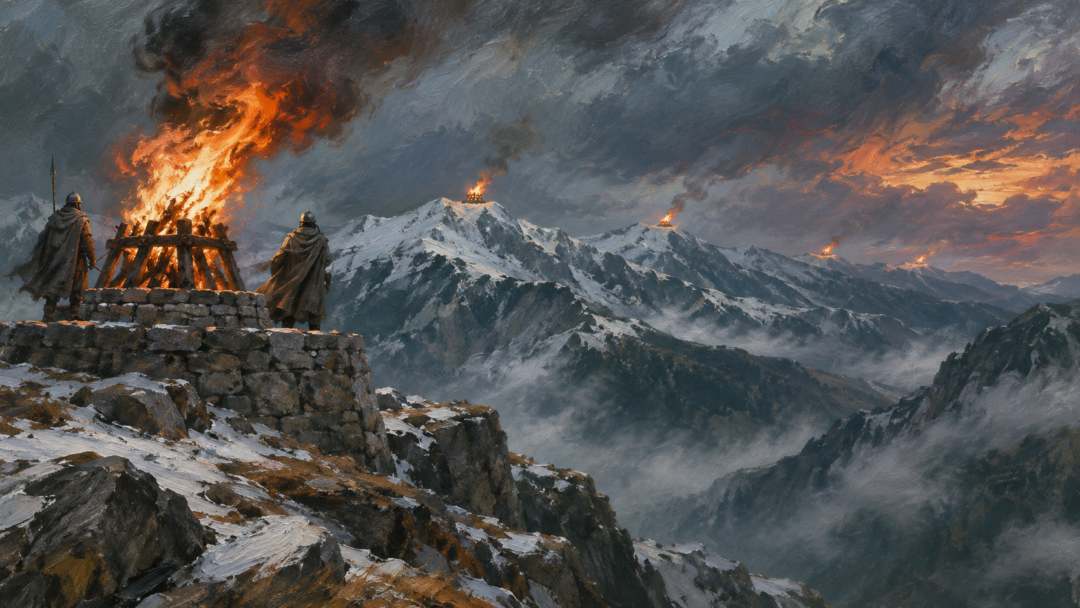
A small figure scrambles above Minas Tirith, past guards who have no idea what he is about to do. Pippin reaches a great stack of wood, sets it alight, and suddenly one flame is answered by another across the White Mountains. Far away, Aragorn sees the message and brings it to Théoden. Gondor's peril has become something we can watch travel from person to person.
It is tempting to call that an improvement on The Lord of the Rings. But improvement needs a narrower meaning here: a clearer sequence of visible action, or an emotional encounter made immediate for a film audience, not a correction of a defective novel. Two changes in The Return of the King make that case particularly well: the lighting of the beacons and Théoden's final exchange with Éowyn. And although Peter Jackson's name stands in the question, the screenplay was credited to Fran Walsh, Philippa Boyens, and Jackson together.
The Beacons Were Burning Before Gandalf Arrived
In Book V, Chapter 1, “Minas Tirith,” Gandalf and Pippin are riding Shadowfax toward Gondor when the warning comes into view. Gandalf announces, “The beacons of Gondor are alight, calling for aid.” The hills already burn. Nobody asks Pippin to climb to a watch station, and there is no suspense about whether the first fire will catch. The sight gives the riders news of a war moving faster than they are. It also tells us that Gondor has begun to act before the wizard reaches its capital.
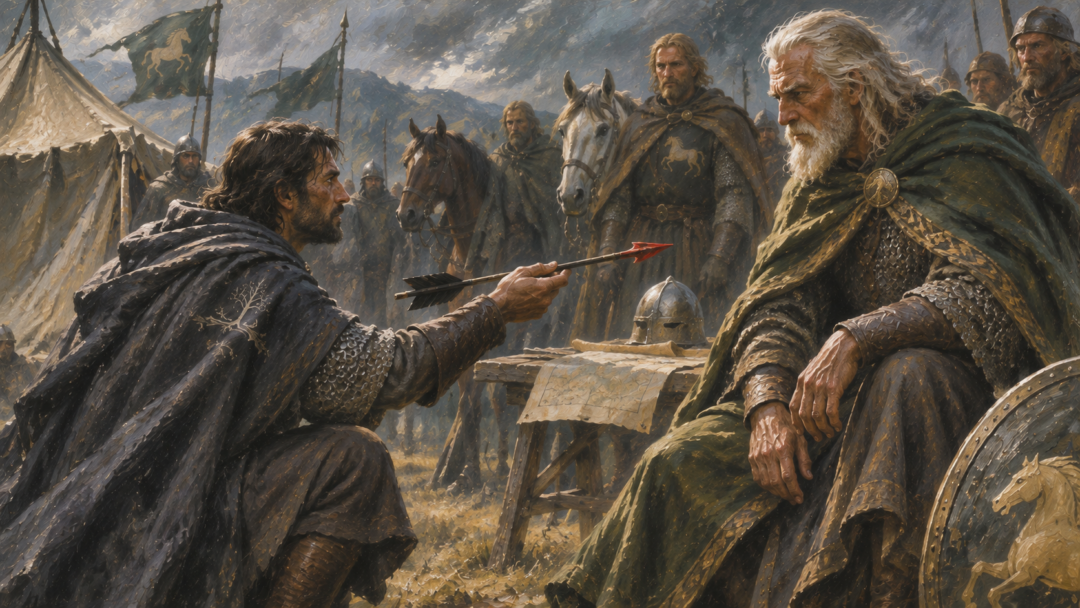
The book does not treat those flames as a substitute for diplomacy. In Chapter 3, “The Muster of Rohan,” Hirgon arrives in Théoden's camp bearing the Red Arrow, a black-feathered shaft with a red-painted point. He kneels and delivers Denethor's urgent request for aid. The object carries the gravity of a formal summons between allies; Hirgon's words convey a particular military predicament. Minas Tirith may soon be surrounded, and Gondor wants Rohan's horsemen to reach it in time. A fire in the distance cannot explain all of that.
Théoden's answer is already taking shape when Hirgon appears. Rohan has survived its own fighting against Saruman, Gandalf has been among its leaders, and a muster for the eastern war is under way. The king understands both the promise of friendship and the practical difficulty of answering it. His riders must gather from a scattered country; he cannot strip every stronghold of defenders. He nevertheless promises to come himself. These are decisions, not an absence of urgency. The novel asks us to appreciate how an alliance functions under pressure.
How the Film Turns a Warning into a Task
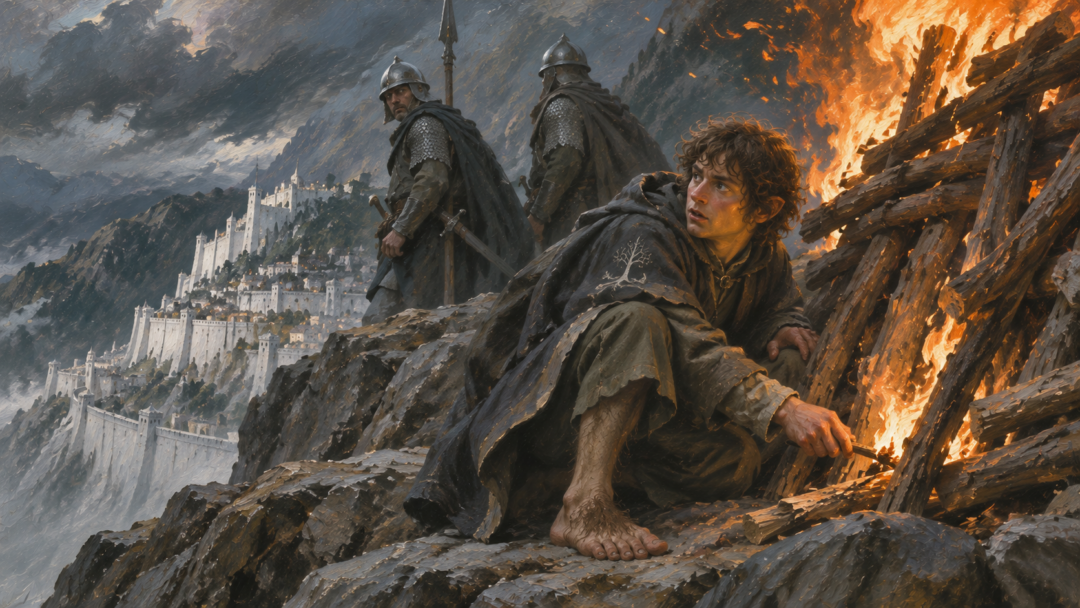
The Final Revision screenplay dated October 2003 gives that pressure a different form. Gandalf privately sets Pippin a job in Minas Tirith. The hobbit climbs the rocky height above the city, hides from the guards stationed by the fuel, pours oil on the wood, and starts the fire. Gandalf waits below for the result. When a more distant beacon answers, the scene has a second small victory: the signal has not merely been sent, but received and passed onward.
The script then takes the message across the mountains, from one fire to the next, until Aragorn spots the light near Edoras. He hurries into the Golden Hall and tells Théoden that Gondor is calling for help. The king orders the Rohirrim to muster. Unlike a report of events already in motion, this arrangement has a beginning, a series of confirmations, and a visible consequence. Every stage answers the question left by the previous one: Will Pippin succeed? Will anyone notice? Will the message reach Rohan? What will its king do?
That progression is especially useful in a story with so many separated characters. Pippin is not a commander and cannot defeat the army approaching Minas Tirith; the script gives him a small, intelligible action that contributes to the larger defense. Gandalf's vigilance makes the next light consequential. Aragorn, miles away, becomes the person who translates a distant signal into an appeal to the king beside him. Each answering fire offers visible proof that the plea has survived another crossing. None of these characters needs to explain an entire communications network for the viewer to understand the result.
The Price Is Paid by Denethor—and by Gondor's Politics
There is a substantial cost. In the book, the warning system is functioning, and Denethor is not a ruler who simply refuses to seek assistance. His messenger travels to Théoden with a request; his city has already made preparations for war. He may be proud, suspicious, and increasingly overwhelmed by despair, but those faults coexist with a formidable administrator's knowledge and actions. Removing the official appeal makes the film's Gondor seem more dependent on Gandalf's initiative than the novel's Gondor actually is.
The screenplay underlines that shift by having Denethor watch the unauthorized beacon with anger. Pippin's success is satisfying partly because it bypasses the Steward. As a short dramatic conflict, that is crisp: the person entrusted with the defense stands in the way, while a hobbit does what must be done. Yet it narrows Denethor. We lose the unsettling combination of strategic competence and spiritual collapse, a man capable of correctly recognizing danger even as his judgment about hope becomes disastrously distorted.
The Red Arrow is a second loss, and not just because it is an evocative object. A network of flames can warn widely and quickly; a rider can describe needs, deliver a formal appeal, and receive an answer shaped by the circumstances. Hirgon's meeting lets Théoden discuss how many men he can assemble, how soon they can ride, and what danger remains at home. His decision emerges from duties that might pull against each other. The film combines warning and request into one clear sign, reducing the space in which those political responsibilities can be heard.
That change also affects our understanding of Rohan. A stirring response to Aragorn's news can look like the instant when Théoden finally chooses whether to help. In the novel, his commitment is already being put into practice, and Hirgon meets a king weighing how to fulfill it. The difference is not courage versus hesitation. It is the difference between a decisive line in a crowded screenplay and the slower business of preparing an allied army. If you prefer the book's treatment, you have a strong reason: the world feels governed by institutions and obligations that endure beyond its heroes.
The Farewell Théoden Never Gives Éowyn in the Book
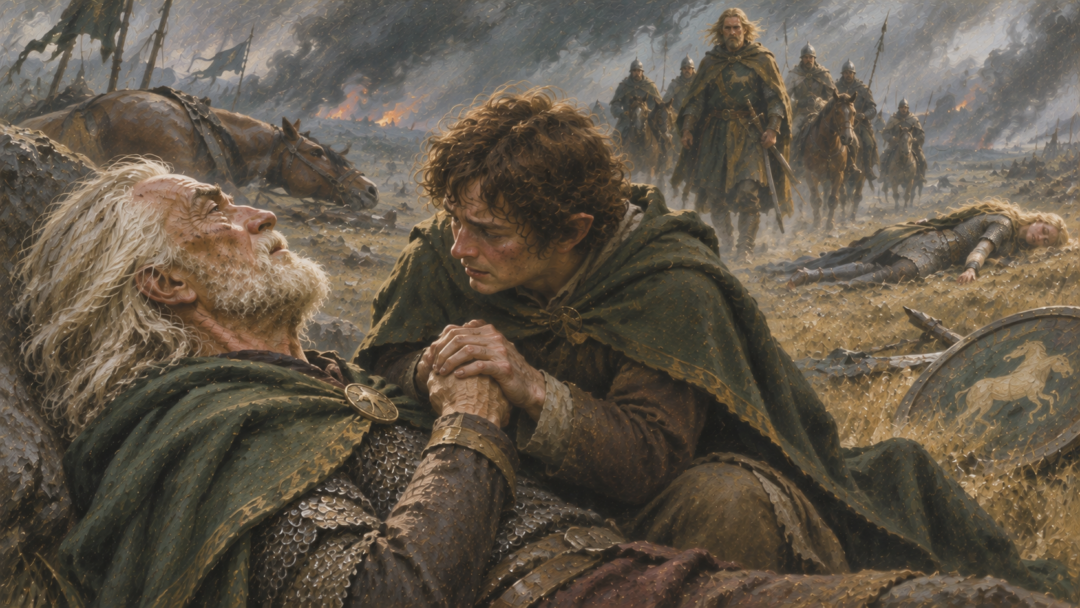
The second change is quieter, though it takes place amid the wreckage of the Pelennor Fields. In Book V, Chapter 6, “The Battle of the Pelennor Fields,” Éowyn and Merry together overcome the Witch-king, but the effort leaves them stricken. Merry finds Théoden fallen where Snowmane has crushed him. He lifts the king's hand to kiss it, and the old man opens his eyes. The person at his side, and the person who hears his last intimate words, is Merry.
That farewell is full of affection. Théoden forgives Merry for disobeying his command, praises the courage behind the disobedience, and imagines a peace they will never share. He will not sit with the hobbit in Meduseld to hear about the Shire's pipe-weed and its lore. He asks to see Éomer, who must succeed him, and hopes to send farewell to Éowyn, whom he loves as more than a niece. When Éomer arrives, the king acknowledges the succession and sends one final message to her.
Then comes the book's piercing restraint: “And so he died, and knew not that Éowyn lay near him.” She is there, but he never learns what she has done or that she has fallen defending him. Merry tries to tell him and is interrupted by the battle's renewed uproar. This is not a tender moment the novel forgot to include. It is tenderness divided among people who cannot complete their conversation. The king dies loved, yet missing the knowledge that might have brought him comfort.
What Changes When Éowyn Reaches His Side
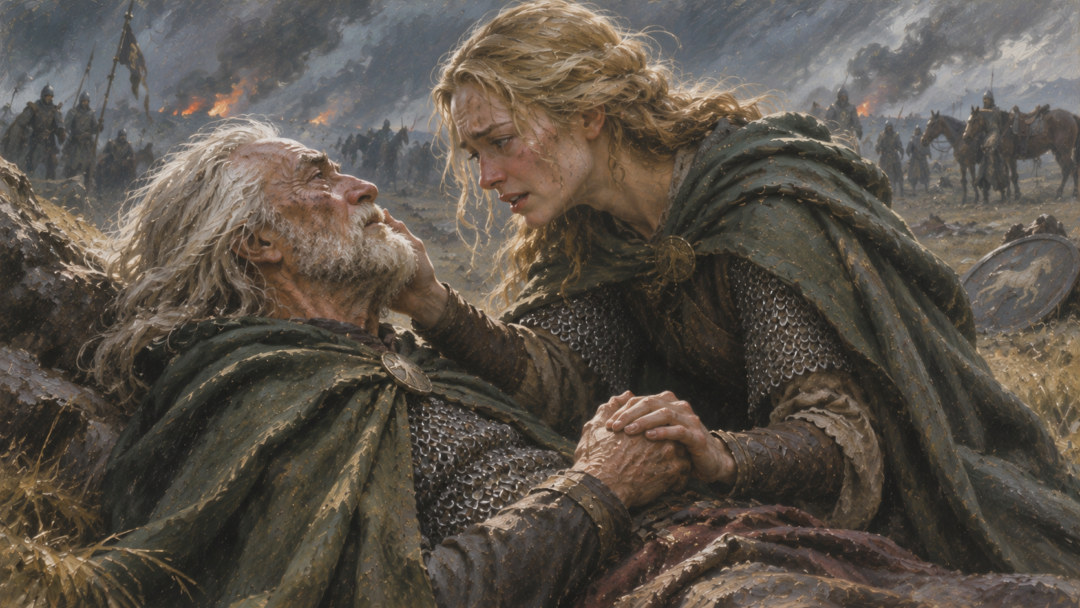
The October 2003 screenplay rearranges that last encounter. Éowyn makes her way to the wounded king. He recognizes her through failing sight; she touches his face, and he holds her hand. She insists that she can save him, while his answer reassures her that she already has. The script retains something of his acceptance of death, including the thought of joining his forefathers without shame. But the farewell is no longer something sent through another person. It is shared between uncle and niece.
That gives Éowyn's battle a personal witness. Her stand against the Witch-king is not only an act the audience knows about; it is recognized by the man she fought to defend. Théoden need not receive a military report or grasp every detail for that recognition to matter. His reassurance meets her frantic wish to save him at precisely the point where she cannot. She has already given him the chance to know she stood beside him when he was helpless. That reassurance does not settle her grief or recovery; it belongs to this one farewell.
But the new meeting displaces Merry. The novel has carefully built his relationship with Théoden through service, kindness, and the king's invitation to share stories at home. Their last words make the hobbit's courage personal rather than merely useful in combat. Taking that conversation away diminishes a small friendship across an enormous difference in rank and experience. The book also allows Théoden to attend to the succession as Éomer arrives, a public duty woven into the private farewell. The screenplay tightens its focus by surrendering those connections.
There is an even sharper counterargument: the book's missed recognition is part of its truth about war. People can be only steps apart and remain unknowable to one another at the very end. Merry hears what Éowyn cannot, Éomer arrives before he understands what has happened to his sister, and Théoden dies without the comfort of seeing her. The film grants a meeting that the novel refuses. Whether that relief feels like an improvement depends on what kind of pain one thinks the scene should preserve.
The most telling difference is a hand. In the novel, Merry lifts the king's; in the screenplay, Éowyn holds it. Neither gesture is empty, and neither person is an interchangeable witness. What the film gains is a farewell answered face to face. What the book keeps is the ache of words carried toward someone close enough to touch, but never reached.
Sources & Notes
This article is based on close reading and interpretation of Tolkien's published works and related source material where relevant.