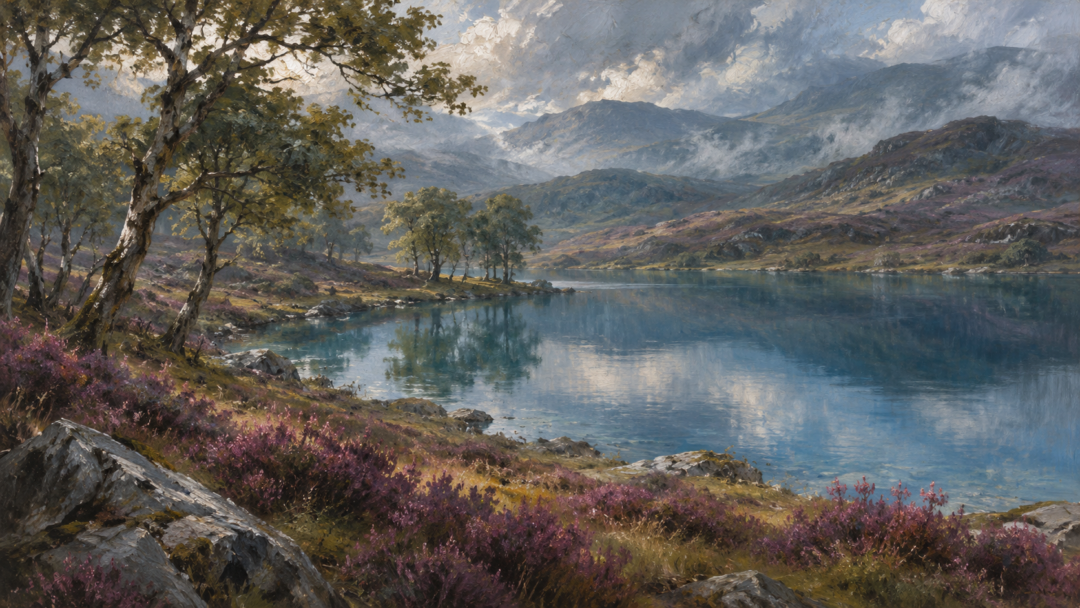
In the highlands of Dorthonion, there is a lake whose blue water reflects the stars. No city stands on its shore. Yet one of Middle-earth’s most haunting farewells, a tradition of sacredness, and the destruction of a desperate band of survivors all lead back to it. The place is Tarn Aeluin, and it is the place I keep returning to beyond the better-known kingdoms and fortresses.
What draws me there is not the promise of a hidden answer. It is the unusual range of memories gathered around one quiet landscape. A love remembered by an Elf, a lake said to have been hallowed by Melian, and a human company betrayed in hiding belong to different episodes. Their closeness on the map is interesting enough without making them one mystery.
A blue lake among the heather
Tarn Aeluin lay in eastern Dorthonion, southwest of Ladros, in the northern country of Beleriand during the First Age. Its setting is surprisingly easy to picture despite the brevity of the description: clear water, wild heather on the surrounding hills, and alder trees beside the shore. Beyond lay difficult forests and lonely highlands. These details establish a recognizable place without supplying a complete local history. Heather is an especially modest detail in a landscape better known through strongholds and campaigns; it lets us imagine a hillside rather than only a map symbol.
Even its name helps keep the scale right. A tarn is a mountain lake, not an inland sea, and the Sindarin Aeluin has been interpreted as referring to blue water. It is a patch of highland made memorable by color and light. During the day its waters were blue; at night they reflected the stars. The place remains recognizably itself in both lights.
Look at Dorthonion in the broader First Age story and the stillness becomes more striking. This was no country permanently removed from war. Morgoth’s assault in the Dagor Bragollach, the Battle of Sudden Flame, shattered the long siege of Angband and transformed the fortunes of its people. Defended lands became perilous, their people driven away or into resistance. Tarn Aeluin remained in that landscape: secluded enough to shelter fugitives for a time, but not beyond the reach of events.
The waters said to have been hallowed
The lake’s oldest-sounding association is also its least explained. Its waters were held in reverence and were said to have been hallowed by Melian, the Maia who became Queen of Doriath. That phrasing matters. It preserves a tradition, not an account of a ceremony or a defined enchantment. The story gives the lake a sacred reputation while leaving the experience behind that reputation largely unknown.
Melian is hardly an incidental name in the history of Beleriand. Her power is associated with the Girdle of Melian, the protection surrounding Doriath. Knowing that can make it tempting to imagine a similar magical boundary at Tarn Aeluin, or to ask why such a boundary did not prevent the violence that came later. But the account of the lake supplies no comparable defensive rule. Reverence is not invulnerability.
I prefer the less mechanical reading. We are not told what those who revered it believed they knew. The certainty belongs to its reputation, not to a system of spells. That leaves room for a more recognizably Middle-earth kind of sorrow: a beautiful place can remain beautiful even when people are not safe within it. Its waters need not lose their clarity for the world around them to become dark.
An evening remembered by Aegnor
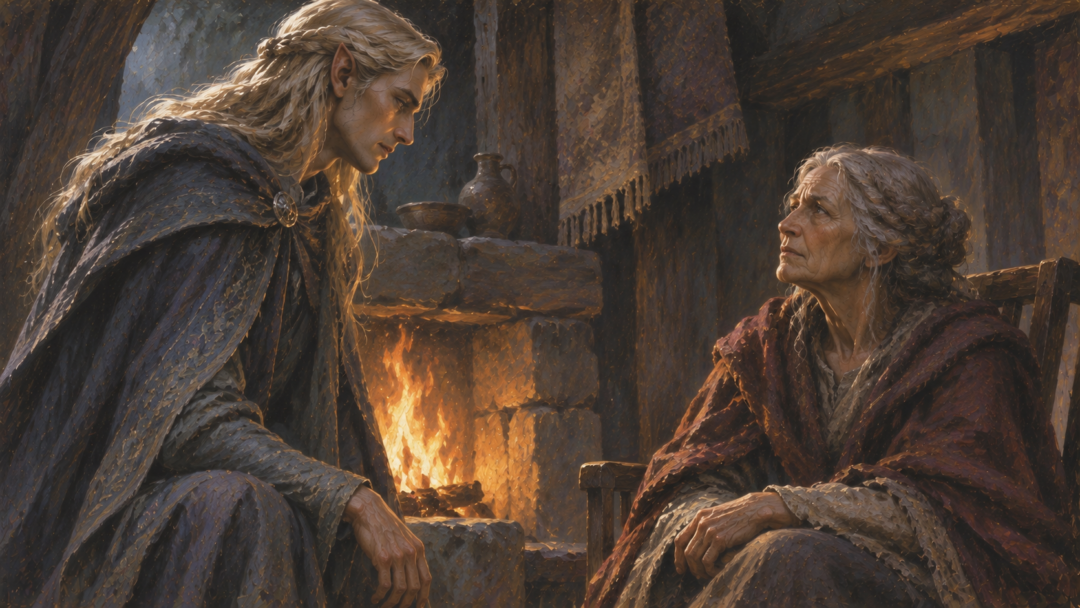
The lake becomes intensely personal in Athrabeth Finrod ah Andreth, the conversation preserved in Morgoth’s Ring. Finrod speaks with Andreth, a mortal woman now older, about matters that divide the lives and hopes of Men and Elves. Andreth is a wise-woman of the House of Bëor, fully capable of challenging her Elven visitor. Gradually their discussion exposes an intimate wound: she loved Finrod’s brother Aegnor, and he loved her, but they did not make a life together. The philosophy suddenly has a personal cost.
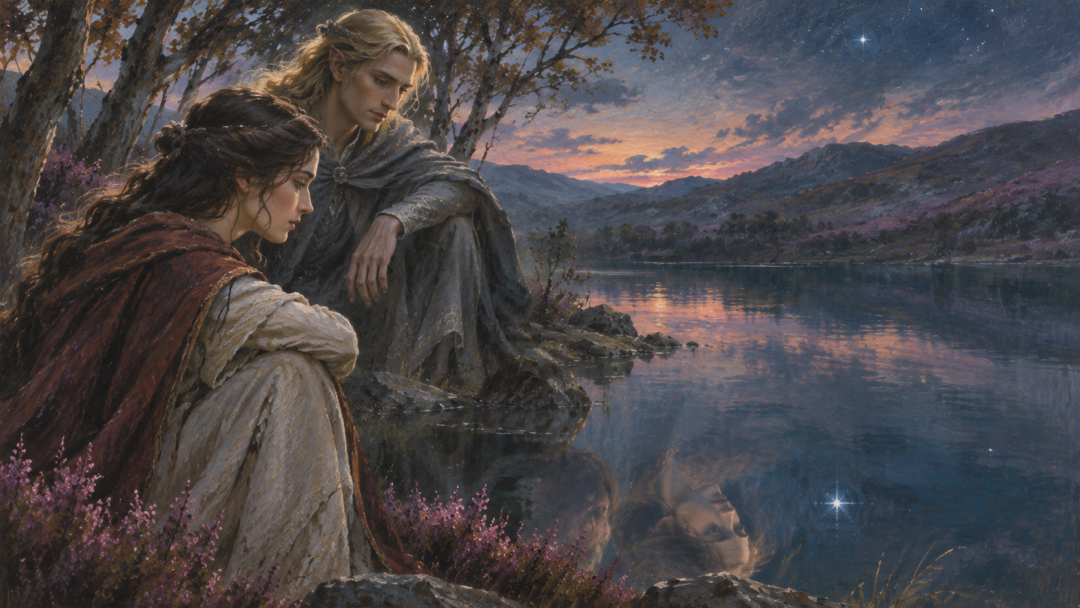
Finrod recalls the young Andreth as Aegnor knew her, including their last evening beside the water of Aeluin. In his account, Aegnor saw her face reflected there, with a star seeming to rest in her hair. It is a precise image for such a sparsely described place. The reflection is not evidence that this was the instant he first fell in love. The dialogue presents it as an image he would remember after their separation.
Aegnor’s decision belongs to the troubled circumstances of his age. He would not abandon his people while war threatened their lands, and Finrod explains that the Eldar did not enter marriage in such times. He also describes Aegnor’s fear of the sorrow that unequal lifespans would bring. Finrod says Aegnor would not take another bride for her sake. None of this makes the choice painless, or converts a refusal into a happy ending. The encounter survived in memory, although the relationship could not continue.
Finrod offers this remembrance as a kind of consolation. Elves, he tells Andreth, dwell deeply in memory; Aegnor will retain the image of her youth rather than watch it fade into age. It sounds tender until we consider who is hearing it. Andreth is living the years that Aegnor will not share. She cannot live within that unfinished moment. Her changing body and her continued grief give the remembered reflection a painful second side.
She also asks, in effect, where her own memories will go when she dies. Finrod cannot give her the same assurance he offers about an Elven memory enduring. Her unanswered question changes the lake scene. Aegnor’s star-lit image is not false; it is incomplete. Tarn Aeluin is where someone was beautifully remembered, and where another person’s loss becomes especially difficult to soften.
The refuge of Barahir’s outlaws
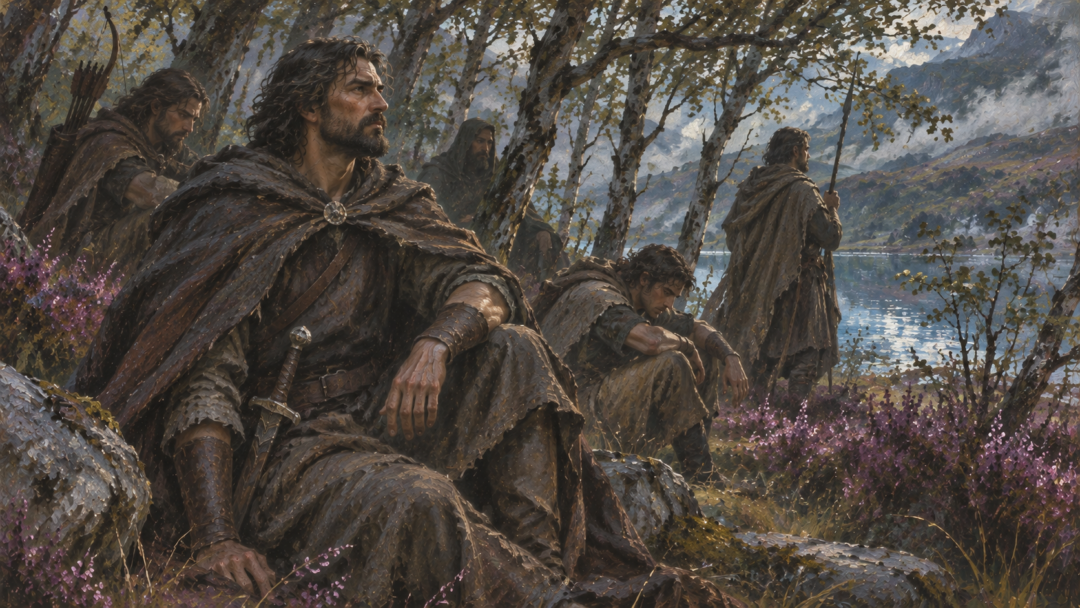
Another strand of the story brings the lake into a harsher chapter. After the Dagor Bragollach, Barahir and a dwindling group of loyal men resisted Morgoth’s occupation of Dorthonion. Barahir had saved Finrod in the battle and received his ring, but that honor could not secure his homeland. As the resistance was hunted and reduced, the company eventually took refuge in the wild country around Tarn Aeluin.
This is a very different use of a quiet shore. The story gives no account of shelters, meals, or watches at their camp. Such details remain imaginings. What the geography does establish is the need for concealment. Its remoteness offered a possible refuge to men with almost nowhere else to go.
Their secrecy was undone through Gorlim, one of Barahir’s companions. Gorlim hoped his missing wife Eilinel might still be alive. Sauron exploited that hope with a deceptive appearance of her, then captured Gorlim and persuaded him to reveal the hiding place in exchange for a promise of reunion. The promise was a trap. Eilinel was already dead, and Gorlim was killed after betraying the company, before the Orcs reached the lake. Their refuge was exposed through an enemy’s knowledge of human grief.
Orcs attacked the hiding place before dawn and killed Barahir and the companions present. Beren, Barahir’s son, survived because he had been sent away on an errand to watch the Enemy. In a dream, Beren saw carrion birds beside a mere and received a warning involving Gorlim, but he returned too late. No special power of the lake protected Beren. His absence, and the terrible timing of his return, account for his survival.
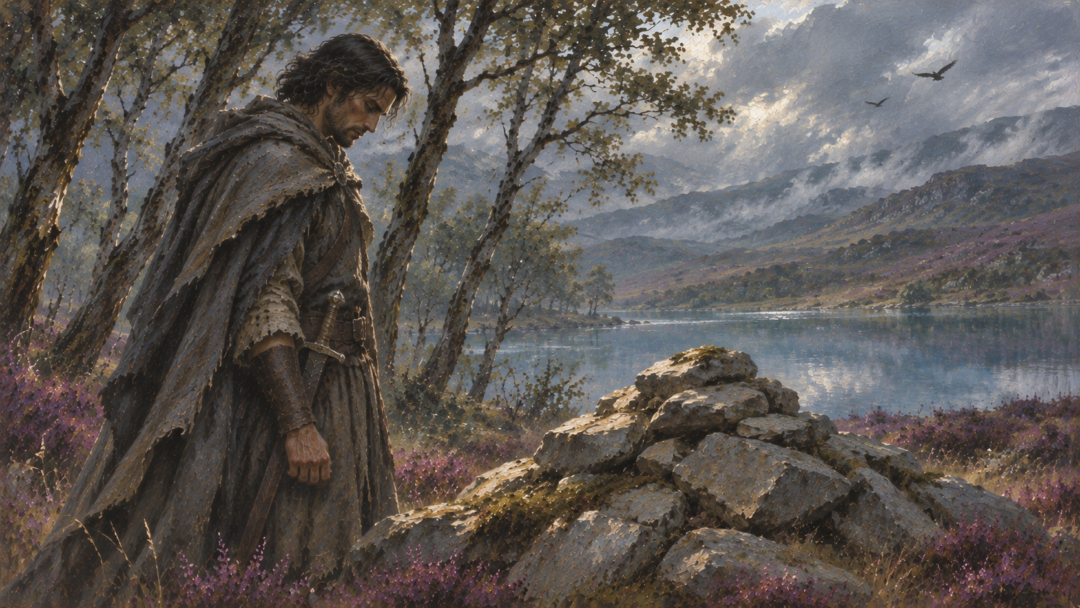
Beren found the aftermath beside the water, with carrion birds in the trees. He buried his father and raised a cairn, then pursued the attackers and recovered Barahir’s ring from their captain elsewhere. The cairn is the detail that stays with me. A hidden refuge had become a burial place, and the son who would go on to meet Lúthien first had to mark what was lost here. The changed landscape needs no embellishment.
Different stories, one shore
Some connections stretch beyond the lakeshore. Andreth was Barahir’s aunt, joining the remembered romance and the later outlaw story through family as well as location. Melian, whose name belongs to the lake’s reported sanctity, was Lúthien’s mother. Finrod, who described the evening of Aegnor and Andreth, was also the lord whose ring passed to Barahir and ultimately to Beren. And Beren’s later story would draw both Finrod and Lúthien into its course. These relationships place the lake near several major threads of the First Age, without making it their cause.
The episodes also belong to different moments. Andreth and Aegnor’s remembered evening came before the ruin of Dorthonion; Barahir’s company sought shelter after the northern defenses collapsed. The landscape changed around the lake, even if its brief descriptions hardly change at all. No scene returns Andreth to the shore in the later years. The two stories can occupy the same map without their characters having to encounter one another there.
That is the strange fascination of Tarn Aeluin. It receives just enough description to become a place, and just enough human and Elven sorrow to remain in the imagination. Beyond the heather and the alders, the stories leave much of its shore unvisited. I think of the still water after Beren has gone, reflecting the same stars that once appeared beside Andreth’s face, with no one left there to tell the lake what either memory means.
Sources & Notes
This article is based on close reading and interpretation of Tolkien's published works and related source material where relevant.