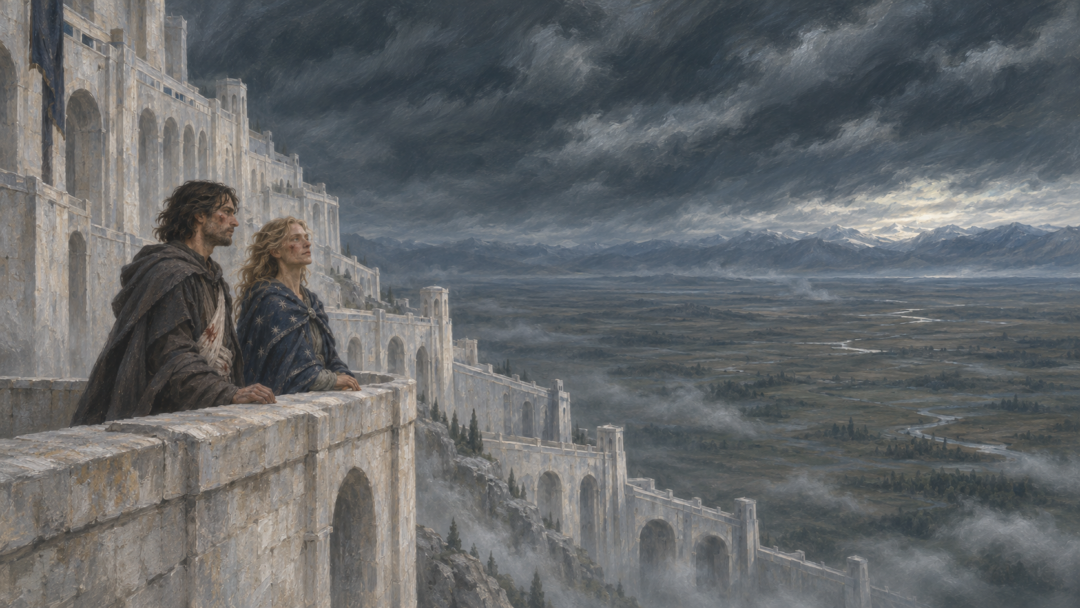
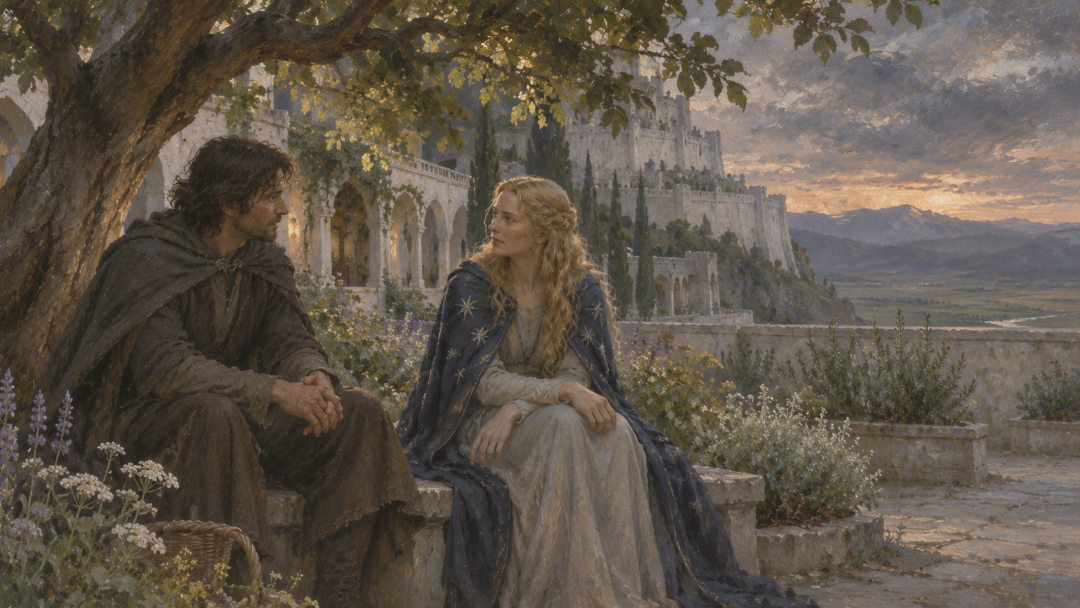
On the walls of Minas Tirith, Faramir and Éowyn look east. Somewhere beyond the mountains, the Captains of the West have gone toward the Black Gate; neither of the two people watching knows whether they will return. Éowyn wears a blue mantle worked with silver stars. The besieged city has survived, but another darkness may be coming. It hardly looks like the setting for a love story.
Yet that is precisely where one develops. The answer is partly a matter of time: the war contains waiting, healing, travelling and fearing news, not just battles. It is also a matter of what love means. A new attachment, a promise already made, and the care that keeps another person alive demand very different kinds of attention.
The hours between the battles
In The Steward and the King, the story turns back from the triumph on the battlefield to the people left behind in Minas Tirith. Faramir has survived a grave wound and the Black Breath; Éowyn has been hurt fighting the Witch-king and remains under the healers' care. The Pelennor Fields have been won, but the war is not over. The main army has gone east, leaving these two unable to join it, however much they might wish otherwise.
Éowyn does wish otherwise. She asks to leave the Houses of Healing and ride after the army, and she resents being confined when her brother is facing the enemy. Faramir, who is himself recovering, does not offer an escape from the healers' orders. Instead he tells her, "You and I, we must endure with patience the hours of waiting." They are not neglecting their duty by remaining in the garden; their circumstances permit little else.
Faramir can, however, do something about her immediate misery. Éowyn wants to look east, toward the fate of her people and the war, and her room offers no such view. He arranges for her to be able to walk in the garden and look in that direction. He also asks whether she might sometimes walk or talk with him. It is a small invitation, with the freedom to accept or refuse, made inside a place that is still treating wounded people.
They meet, walk and stand together over successive days, sometimes speaking and sometimes silent. By the time they watch the great darkness rise from the east, affection has begun to take root alongside their fear. They do not yet understand the sight before them. Then the Shadow breaks, light returns, and the city rejoices before messengers have fully explained why. Their growing closeness belongs to the uncertain days before that release, not only to the peace afterward.
Éowyn still has a choice to make
What makes this relationship interesting is that the two are not waiting for the same thing. Faramir has been drawn to Éowyn's courage and beauty, but he also sees her sorrow. Éowyn, meanwhile, has lost Théoden, endured the terror of the Witch-king and survived a battle in which she had expected death. She has wished for Aragorn's love and for a place in great deeds. Being alive, even after victory, does not instantly tell her what sort of life she wants.
Faramir's first concern for her includes pity, but the later conversation makes an essential distinction. When Éowyn fears that his affection is merely compassion for someone wounded and unhappy, he makes clear that he loves her for herself, not because she needs rescuing. Just as importantly, he does not decide her answer for her. The frank declaration and their decision to marry come after the Shadow has broken, when the immediate dread of defeat has passed and they can speak more plainly about what they want.
Éowyn's answer also reaches beyond Faramir. She turns away from seeking death and renown through battle and speaks of becoming a healer, of loving things that grow. This is a change in how she imagines her own future, not proof that a romance has magically cured her wounds or grief. The Houses of Healing, her time to recover, and her own decision all matter. The love story works because she is able to choose life with another person, rather than being handed to him as a reward for surviving the war.
Arwen's love did not begin on the battlefield
Faramir and Éowyn discover an attachment amid the crisis. Aragorn and Arwen show the opposite possibility: a commitment that has already lasted for years before the decisive battles begin. Appendix A tells of their earlier meetings and their betrothal in Lothlórien, long before the Fellowship sets out from Rivendell. Aragorn's journey to the throne is entangled with that promise, but the love itself is not an unexpected interruption to his march against Mordor.
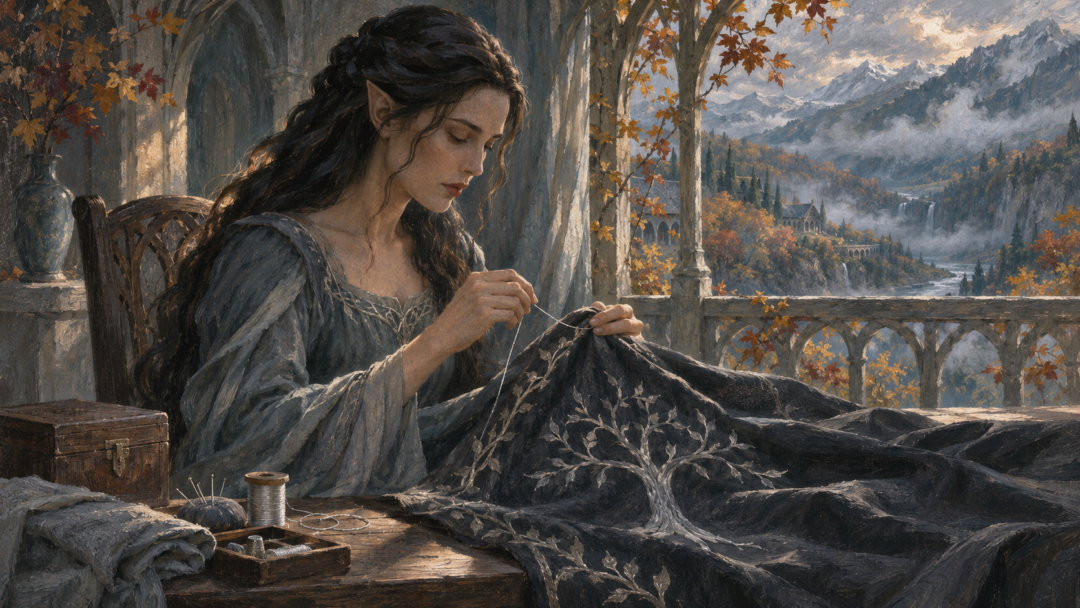
In The Passing of the Grey Company, Halbarad brings Aragorn a gift and message from Arwen. The gift is a standard she has made in secret over a long period. Her message speaks of time growing short and of their hope either reaching fulfillment or ending. A piece of patient work, completed before its moment of use, has entered the war with the man for whom it was made. The scene makes room for Arwen's own effort without pretending she is riding beside the armies.
Arwen need not know every danger ahead or predict the battle's outcome. The future remains uncertain. Aragorn does not have to find a spare afternoon to begin courting someone while he leads his company. What he carries is the knowledge of an existing bond and the possibility that the world he hopes to share with Arwen may be lost. Love takes no time away from the journey at that moment; it helps explain what is at stake in reaching its end.
When there is no time to stop, Sam keeps caring
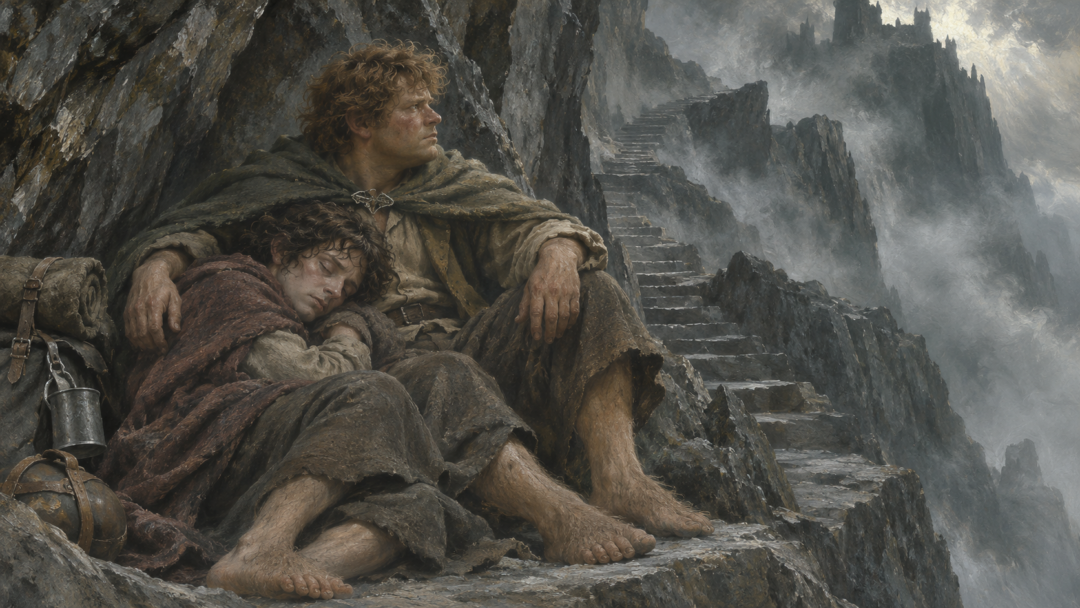
Far from Minas Tirith, Frodo and Sam have even less leisure. Their road into Mordor is measured in exhaustion, hunger, thirst and the need to avoid discovery. Yet one of the most tender scenes occurs on the Stairs of Cirith Ungol, before they enter Shelob's lair. Sam persuades Frodo to rest and keeps watch as Frodo sleeps with his head in Sam's lap. There is no pause in the larger danger. Rest is simply necessary if they are to face the next stretch of road.
It resembles the ordinary care of someone sitting beside an exhausted friend, but says more than any grand speech. Sam does not step outside the quest to show affection. Supporting Frodo's sleep is part of making the quest possible. On a journey where courage alone cannot keep tired legs moving, attending to another person's frailty is as practical as finding water or watching for enemies.
After Shelob attacks, the scene becomes terrible rather than restful. Sam fights the spider, cuts Frodo free and tries desperately to find signs of life. Believing Frodo dead, he composes his body, folds his hands upon his breast and wraps him in a cloak. He grieves before taking the Ring, because he understands that the task may still have to be completed. His care for Frodo and his responsibility to the quest pull painfully against each other, not because either is frivolous, but because both are real.
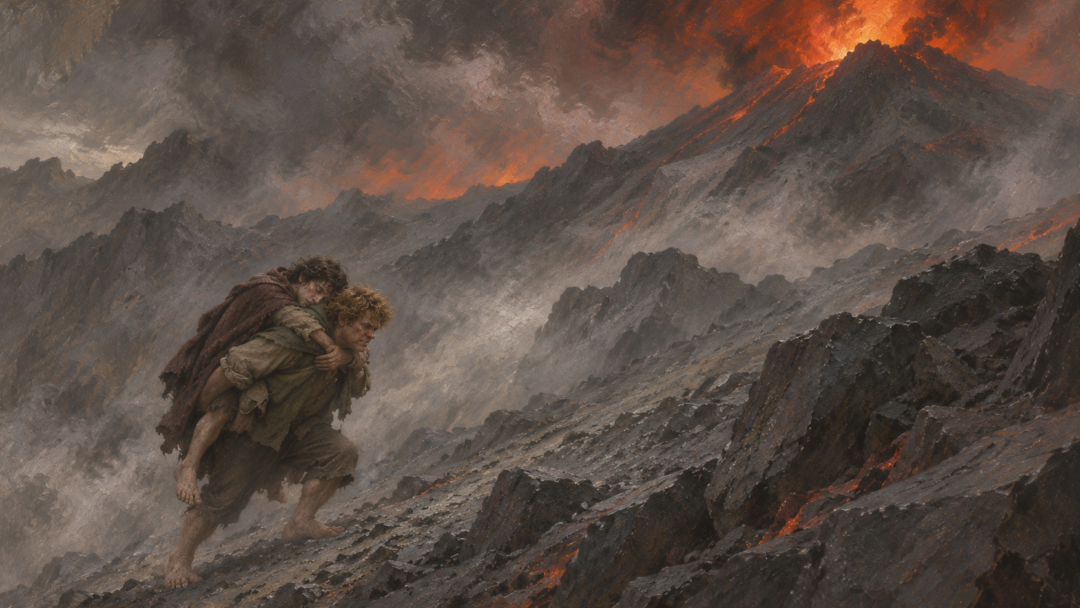
Only later does Sam overhear Orcs revealing that Frodo is alive, stunned by Shelob's poison. He turns back to rescue him from the Tower of Cirith Ungol. On the slopes of Mount Doom, when Frodo can scarcely move, Sam finally lifts him onto his back and carries him uphill. Sam cannot bear the Ring's burden in Frodo's place, but he can bear Frodo. Love here becomes an act of physical labor undertaken while the final task remains unfinished.
The people waiting in the Shire
Sam's devotion to Frodo is not his only attachment. In Mordor he thinks of Bywater, of his father and sister, and of Rosie Cotton and her family. These names arrive when the Shire seems impossibly far away, with little reason to expect he will see it again. Remembering them is not a detour into idle romance. It gives a human scale to everything that might be destroyed: recognizable faces, familiar places, the ordinary business of coming home.
Rosie is not presented as someone Sam suddenly falls in love with because danger makes him sentimental. His thoughts point back to a life that existed before the quest, while the later story gives that affection a future. After returning to the Shire and helping free it from the ruffians, Sam marries Rosie. That ending matters because it takes his longing out of imagination and places it among the everyday acts of living, repairing and making a home.
None of this requires us to treat Sam's loyalty to Frodo and his love for Rosie as interchangeable. Nor does his tenderness toward Frodo require a single verdict about how every reader must label their bond. The story gives us the actual gestures: a sleeping head supported, a body tended, a friend carried. It also gives us the names Sam hopes to see again. Different forms of love can exist in the same life, even under the same terrible pressure, without cancelling one another.
On the slopes of Mount Doom, Sam cannot see the Shire, or know whether Rosie and his family will ever hear his voice again. All he can see is the broken ground ahead and Frodo, too exhausted to climb it. The future he longs for is beyond his reach, but his friend is not. So he bends, takes Frodo on his back, and climbs.
Sources & Notes
This article is based on close reading and interpretation of Tolkien's published works and related source material where relevant.