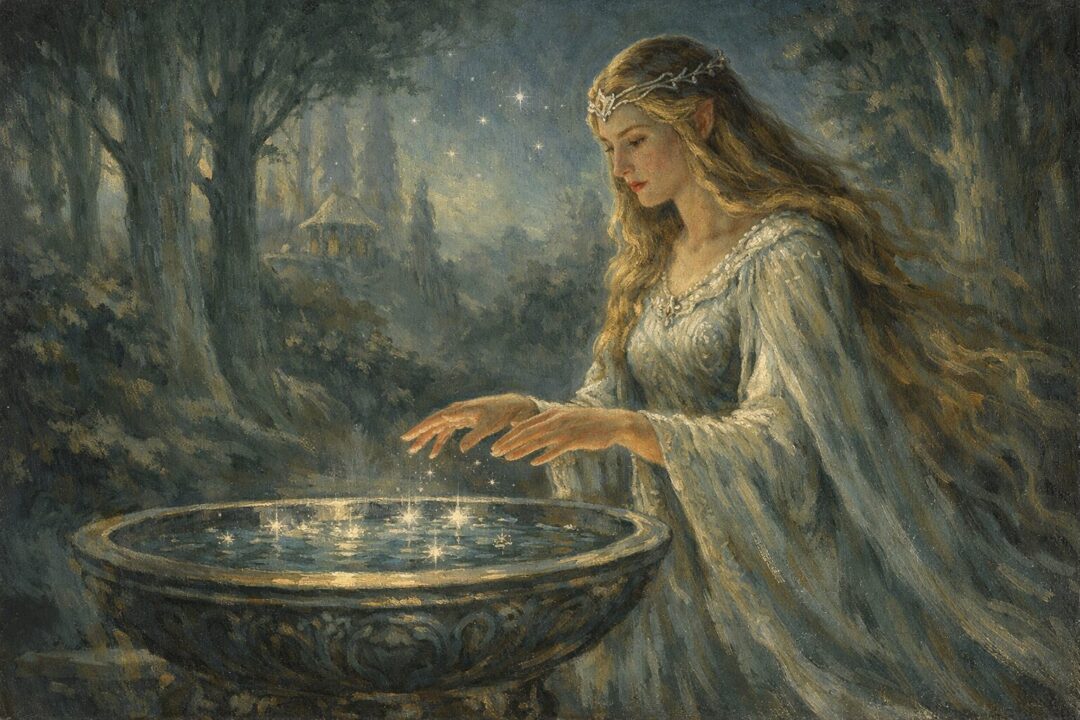
Galadriel is one of the oldest and most powerful beings who appears directly in The Lord of the Rings. She is a survivor of the First Age, a ruler of one of the last great Elven realms in Middle-earth, and a bearer of Nenya, one of the Three Rings of the Elves.
By the time of the War of the Ring, Galadriel has already outlasted kingdoms, cataclysms, and many of the powers that once shaped the world. She has lived through the fall of Beleriand, the defeat of Morgoth, the long diminishing of the Elves, and the slow return of shadow under Sauron.
She is not inexperienced.
She is not untested.
She is not naïve.
And yet, when the One Ring is offered to her, Galadriel recoils.
Not because she doubts its power.
Not because she fears Sauron’s retaliation.
But because she understands herself too well.
This moment—quiet, contained within a single chapter, and easily passed over—is one of the most revealing passages in the entire legendarium. In it, Tolkien distills one of his central moral insights: that the greatest danger does not always come from the enemy outside, but from the power that aligns too closely with our own desires.
Galadriel’s Long Memory of Power
To understand Galadriel’s fear, we must first understand her history.
Galadriel is not a passive figure shaped only by wisdom gained in later years. In The Silmarillion, she is described as proud, strong-willed, and ambitious in her youth. She is one of the leaders of the Noldor who leave Valinor during the great rebellion, though notably not as a follower of Fëanor.
Her motives are carefully distinguished in Tolkien’s later writings. Galadriel does not swear the Oath. She does not participate in the Kinslaying. But she does desire independence, dominion, and the opportunity to rule realms of her own in Middle-earth.
This distinction matters.
Galadriel’s ambition is never cruel—but it is real. She wants to shape the world rather than simply inhabit it. Over time, that desire becomes tempered by suffering, loss, and long reflection, but it is never erased.
By the Third Age, Galadriel’s strength has been refined into wisdom, restraint, and foresight. Yet the underlying impulse—to order, preserve, and protect—is still present. Lothlórien itself stands as evidence of this. Through the power of Nenya, her realm is preserved against decay, held in a state of suspended time, resistant to the slow wearing-down that afflicts the rest of Middle-earth.
Her power is not destructive.
It is preservative.
And that is precisely what makes it dangerous.

The Ring Does Not Offer Galadriel Destruction—It Offers Fulfillment
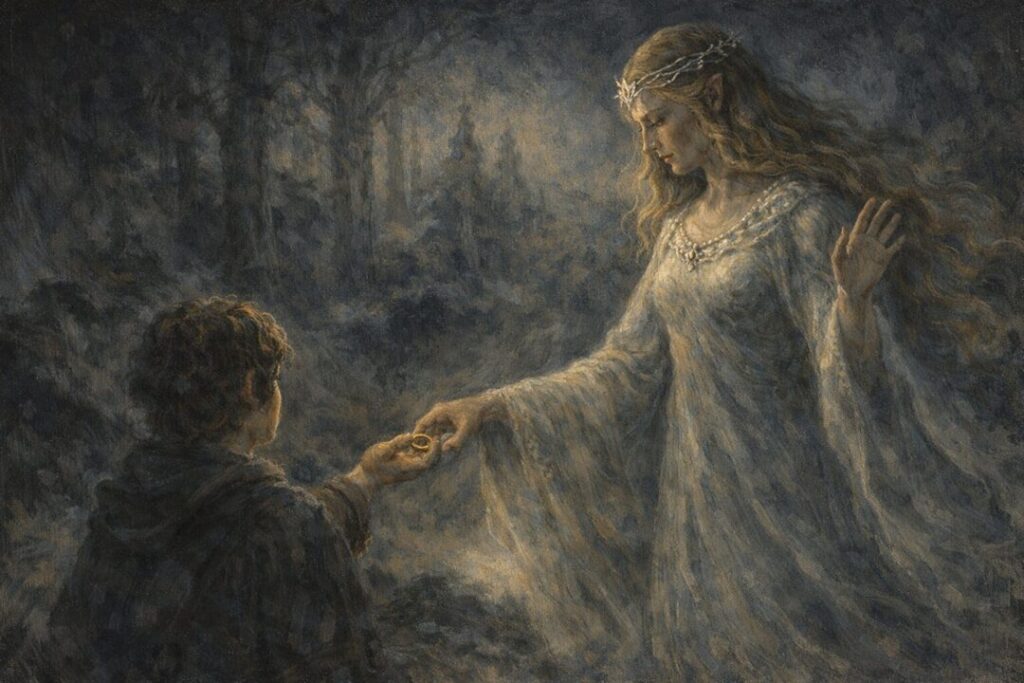
When Frodo offers Galadriel the One Ring, her reaction is immediate and overwhelming. She does not ask for time to consider. She does not weigh arguments. Instead, she sees—instantly and vividly—what accepting the Ring would mean.
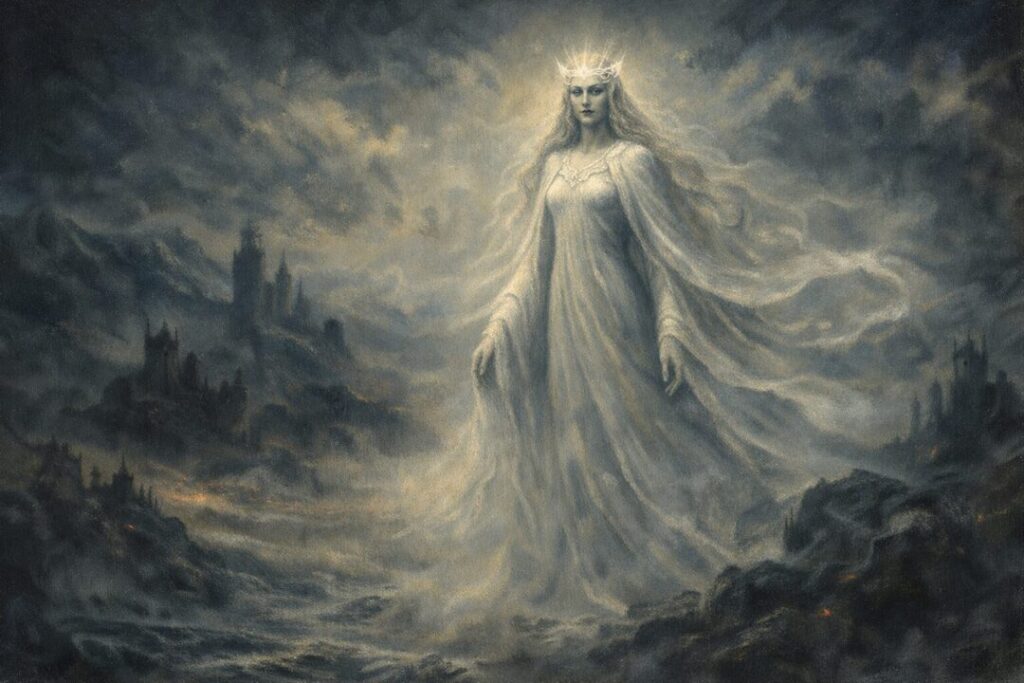
She speaks of becoming a Queen:
Beautiful and terrible.
Loved and feared.
As great as the foundations of the earth.
This is not a fantasy of chaos or cruelty. It is a vision of order, clarity, and strength. Importantly, Tolkien never states outright that Galadriel could defeat Sauron in direct combat. That question is left deliberately unanswered. What isimplied, however, is that her victory would not come through brute force.
It would come through replacement.
She would not destroy Sauron’s system of domination.
She would inherit it.
This is not later fan interpretation imposed on the text. It aligns with how the Ring consistently operates throughout the story. The Ring does not corrupt by imposing alien desires. It magnifies what is already present.
For Boromir, it amplifies his desperation to defend Gondor.
For Saruman, it intensifies his love of order, efficiency, and control.
For Galadriel, it would magnify her desire to heal the world by ruling it.
That is the temptation.
And that is the fear.
Power Used for Good Is Still Power
Galadriel understands something many others do not: that power exercised with the best intentions can still erase freedom.
A world ruled by her would likely be beautiful. It would be orderly. Many forms of suffering would end. But it would not be a world of choice. It would be a world shaped according to a single will—even a wise one.
Tolkien never explicitly spells this out in philosophical terms. But the structure of The Lord of the Rings supports this reading. The Ring always offers solutions. It promises efficiency, clarity, and decisive action. That is its trap.
Evil in Middle-earth is not limited to brutality or malice. Sometimes it arrives as certainty.
Galadriel fears becoming a tyrant who would never believe herself to be one.
“I Shall Diminish, and Go Into the West”
Galadriel’s refusal of the Ring is often described as an act of humility, but that word does not fully capture what is happening.
She does not say she is unworthy.
She does not say she lacks the strength to wield it.
She says she will diminish.
This is a conscious acceptance of loss.
By refusing the Ring, Galadriel accepts that Lothlórien will fade. The power that has preserved it will fail. The Elves will pass from Middle-earth. And her long project of preservation—her attempt to hold beauty against time—must come to an end.
This is not merely a moral choice.
It is an existential one.
She chooses a future in which the world is no longer shaped according to her will, even benevolently. She accepts becoming irrelevant to the next age of history.
This is a sharper sacrifice than death.
It is the surrender of authority.
Galadriel’s Fear Is Moral, Not Tactical
Sauron is a known quantity to Galadriel. She has encountered his kind before, under other names and in other ages. He represents domination through fear, coercion, and force.
But Galadriel understands a subtler danger: domination through goodness.
A ruler who knows better.
A queen who always chooses what is “best.”
A world where harmony replaces freedom.
Tolkien never explicitly states that this would be Galadriel’s outcome—but the internal logic of the Ring supports it. The Ring cannot be used without imposing the bearer’s will upon others. Even when used for good, it ultimately reduces the world to a single perspective.
Galadriel fears not corruption in the sense of becoming cruel—but corruption in the sense of becoming absolute.
Why Galadriel Succeeds Where Others Fail
Unlike many characters tempted by the Ring, Galadriel does not imagine she could use it briefly. She does not believe she could set it aside later. She understands that taking the Ring would be a point of no return.
This self-knowledge is what saves her.
In this, she mirrors Gandalf, who refuses the Ring outright, and contrasts sharply with Saruman, who believes he can master it. Elrond, too, never attempts to wield it, understanding that some powers cannot be touched without consequence.
The truly wise do not flirt with ultimate authority.
They step away from it.
Galadriel’s test is quieter than Frodo’s—but no less absolute. Frodo carries the Ring and fails at the end. Galadriel refuses it entirely, knowing exactly what she is refusing.
The Greatest Victory of the Third Age
Galadriel’s refusal of the Ring is not a side moment. It is one of the central moral victories of the entire Third Age.
No battle is won.
No enemy is slain.
No banner is raised.
And yet, the future of Middle-earth is preserved.
Because Galadriel understands that the greatest threat was never Sauron alone—but the temptation to defeat him by becoming something equally final.
In the end, the thing Galadriel fears most is not the Dark Lord.
It is the certainty that, if she claimed the Ring, she would rule with perfect intention—and irreversible authority.
And that is the most dangerous power of all.
Sources & Notes
- J.R.R. Tolkien, The Lord of the Rings, Book II, Chapter 7, “The Mirror of Galadriel” — Frodo offers Galadriel the One Ring, and her “beautiful and terrible” queen-vision makes the moral danger explicit.
- J.R.R. Tolkien, Unfinished Tales, “The History of Galadriel and Celeborn” — gives the later tradition of Galadriel’s pride, independence, and desire for a realm of her own in Middle-earth.
- J.R.R. Tolkien, The Silmarillion, “Of the Rings of Power and the Third Age” — explains the Three Elven Rings, their preservative power, and their dependence on the fate of the One Ring.
- J.R.R. Tolkien, The Lord of the Rings, Book II, Chapter 2, “The Council of Elrond” — Gandalf’s refusal of the Ring frames the same danger: power taken for good would become a power too great and terrible.
- J.R.R. Tolkien, Letter 131 — Tolkien describes Sauron’s will toward order, control, and domination, useful context for why replacing him through the Ring would not defeat the Ring’s logic.