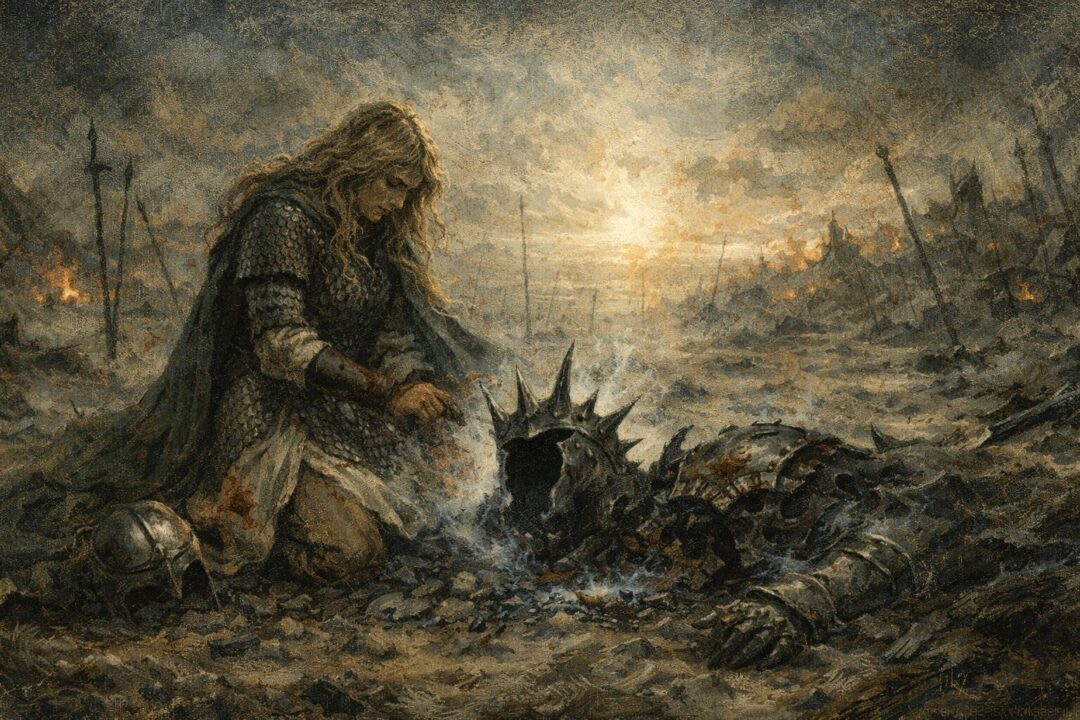
Few lines in The Lord of the Rings are quoted as often—or misunderstood as deeply—as the Witch-king’s declaration on the Pelennor Fields:
“No living man may hinder me.”
To many readers, this sounds like absolute immunity. An unbreakable rule. A supernatural condition that renders the Lord of the Nazgûl untouchable by human hands.
It is often treated as though the Witch-king carries a spell that makes him invincible to men—an iron law of the world that can only be bypassed through clever wording or technicalities.
But Tolkien never writes it that way.
The Witch-king is not protected by a magical shield that renders him immortal. He is bound instead by a prophecy, spoken long before the War of the Ring—and prophecies in Middle-earth do not function like rules in a game.
They do not prevent actions.
They do not enforce outcomes.
They do not remove agency.
They describe what will happen, not what cannot.
To understand how Éowyn is able to kill the Witch-king of Angmar, we must look carefully at three things:
- What the prophecy actually says
- What happens to the Witch-king on the Pelennor Fields
- Why Tolkien stages this moment the way he does
Only when all three are held together does the scene reveal its full meaning.
The Prophecy: What Was Actually Foretold
The prophecy that defines the Witch-king’s fate originates centuries before the events of The Lord of the Rings, during the long wars between Angmar and the northern Dúnedain.
After the Witch-king challenges Eärnur, the last King of Gondor, and then retreats, Glorfindel speaks the words that later echo across the Pelennor:
“Far off yet is his doom, and not by the hand of man will he fall.”
This line is often paraphrased—both in casual discussion and popular retellings—as “no man can kill him.”
But that paraphrase is inaccurate.
The prophecy does not say the Witch-king cannot be slain.
It does not say he is invulnerable.
It does not say he will never fall in battle.
It only specifies by whom he will not fall.
That distinction is essential.
Tolkien’s prophecies are descriptive, not preventative. They do not place enchantments on characters. They do not grant protection. They simply reveal outcomes that will come to pass through the unfolding of history, choice, courage, and error.
In this sense, the prophecy does not make the Witch-king safe.
It merely tells us how he will eventually be undone.
Misunderstanding the Witch-king’s Confidence
By the time of the War of the Ring, the Witch-king has existed for centuries as a servant of Sauron. He has faced kings, warriors, and champions of Men—and none have slain him.
His confidence is therefore grounded in experience.
When he declares that no living man may hinder him, he is not invoking magic. He is expressing certainty—certainty shaped by prophecy, reinforced by centuries of survival, and hardened by contempt.
This matters, because it reveals the nature of his error.
The Witch-king does not believe he is immortal.
He believes he understands the limits of his fate.
And he is wrong.
The Battle of the Pelennor Fields: What Actually Happens
At the Battle of the Pelennor Fields, the Witch-king confronts King Théoden of Rohan and fulfills much of what the prophecy implies. He breaks the king, strikes him down, and scatters his guard.
In that moment, he stands unopposed.
No warrior of Gondor or Rohan dares face him.
The terror he inspires is overwhelming.
His presence bends the battlefield around him.
But the Witch-king does not fall to Éowyn alone.
This point is often overlooked—and it is crucial.
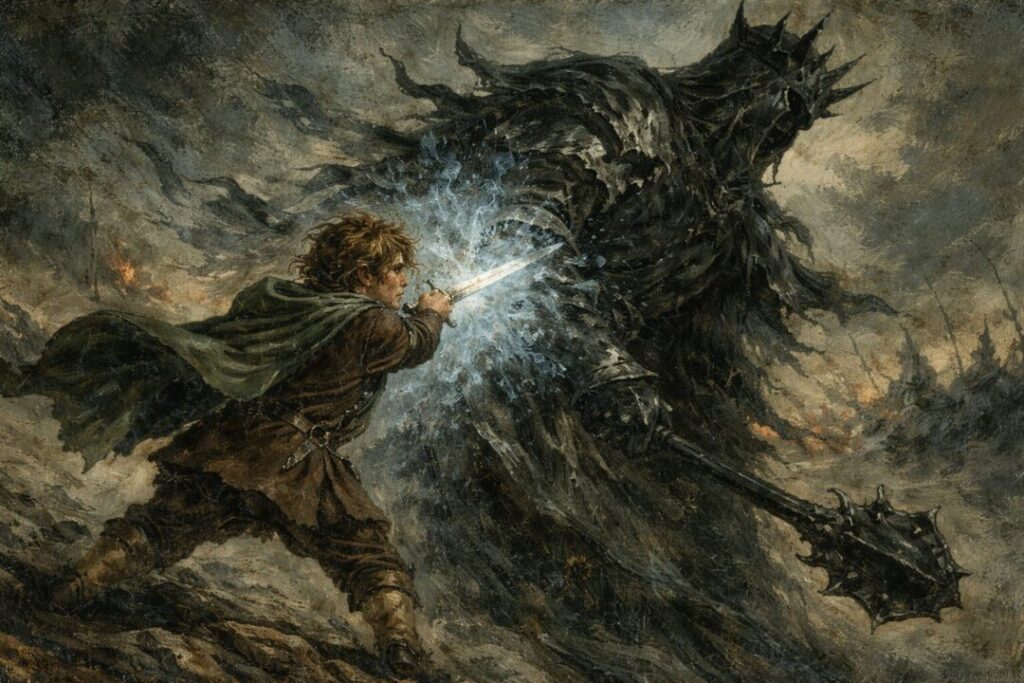
Before Éowyn strikes the final blow, the Witch-king is wounded by Meriadoc Brandybuck, who creeps behind him and stabs him with a blade taken from the Barrow-downs.
These blades are not ordinary weapons. The text explicitly tells us they were forged long ago by the Dúnedain of Arnor, specifically for war against Angmar. They are described as carrying spells laid upon them for the undoing of the Witch-king’s sorcery.
When Merry strikes, Tolkien writes that the blade “broke the spell that knit his unseen sinews to his will.”
This is not a minor wound.
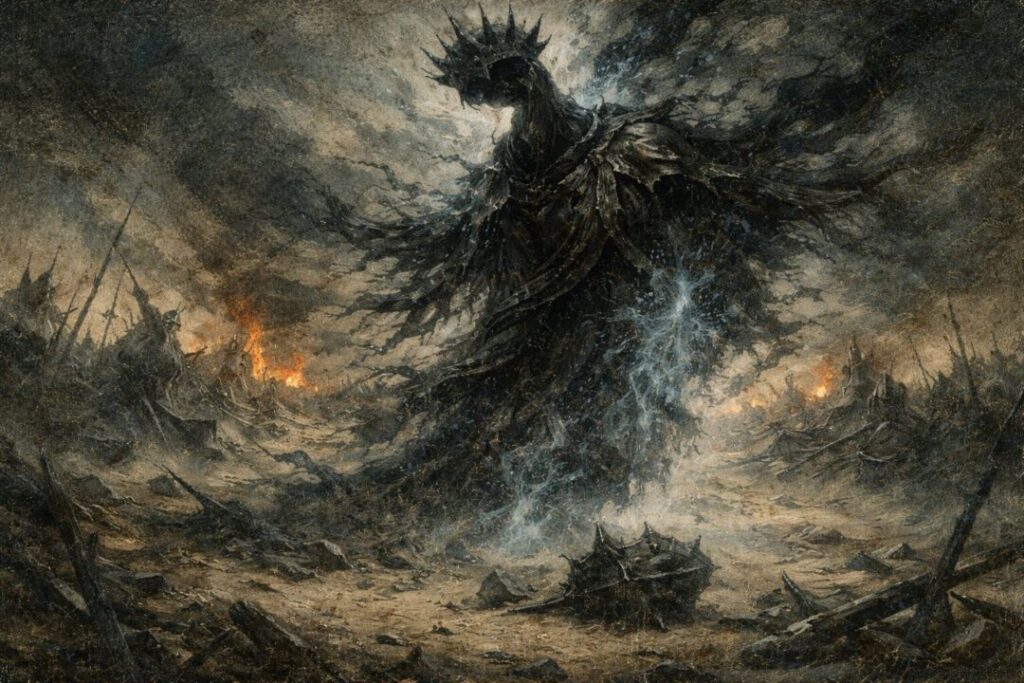
It is the unraveling of the magic that sustains the Witch-king’s form.
Only after this does Éowyn strike—and when she does, the Witch-king is no longer whole.
This sequence matters profoundly.
Without Merry’s blow, the text strongly implies that Éowyn’s sword alone would not have sufficed. The Witch-king is not simply stabbed to death; he is unmade, undone through a convergence of history, ancient craftsmanship, and courage from the least expected hands.
Why Éowyn Is Not a “Loophole”
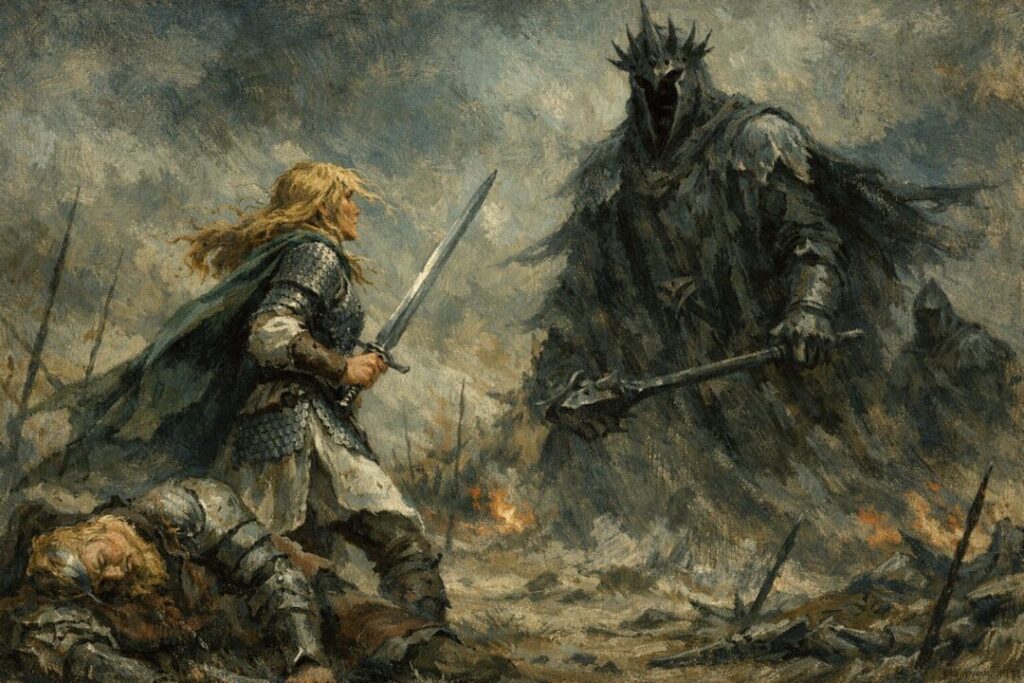
A common modern interpretation treats Éowyn’s victory as clever wordplay: she is not a man, therefore the prophecy fails.
But Tolkien’s writing does not support this reading.
Éowyn does not announce her gender in order to negate magic.
She does not exploit a technicality.
She does not “solve” the prophecy.
She reveals herself after she has already chosen to stand and fight.
Her declaration—“I am no man”—is not a spell or a trick. It is a statement of identity, defiance, and truth spoken to an enemy who has already underestimated her.
The Witch-king’s error is not believing the prophecy.
His error is believing the prophecy makes him safe.
Fate Without Fatalism: Tolkien’s Deeper Pattern
Throughout Middle-earth, fate and free will coexist in tension.
Prophecies come true not because characters obey them, but because they act according to who they are.
The Witch-king is undone by:
- His certainty
- His contempt for the small and the overlooked
- His inability to imagine resistance from those he dismisses
Éowyn is able to face him because she has already accepted death. She does not seek glory or renown. She seeks meaning in a world that has denied her agency and honor.
Merry acts not because of prophecy, but loyalty—love for his king and horror at what he sees before him.
None of them are forced into this moment.
None of them are puppets of fate.
And that is precisely why the prophecy is fulfilled.
Why This Moment Is Central to Tolkien’s World
The death of the Witch-king is not about cleverness.
It is not about exploiting rules.
It is not about gender as a trick or a twist.
It is about one of Tolkien’s most persistent truths:
Evil collapses when it assumes the world will obey its expectations.
The Witch-king expects kings and warriors.
He expects strength measured in armies and lineage.
He expects fear.
He does not expect a shieldmaiden who refuses to stand aside.
He does not expect a Hobbit who strikes from the shadows.
And that blind spot—more than any sword—destroys him.
Why This Still Resonates
Modern fantasy often treats prophecy as a puzzle to be solved or subverted.
Tolkien treats prophecy as a shadow cast by choices yet to be made.
Éowyn does not defeat the Witch-king because of prophecy.
She defeats him because she steps forward when everyone else falls back.
And the prophecy, quietly and without spectacle, comes true.
Not as a loophole.
Not as a trick.
But as history, fulfilled.
Sources & Notes
- J.R.R. Tolkien, The Lord of the Rings, Appendix A, ‘Annals of the Kings and Rulers’ — Glorfindel’s prophecy after the fall of Angmar that the Witch-king’s doom was far off and ‘not by the hand of man.’
- J.R.R. Tolkien, The Lord of the Rings, Book V, Chapter 6, ‘The Battle of the Pelennor Fields’ — the Witch-king’s challenge, Éowyn’s ‘I am no man,’ and her final stroke.
- J.R.R. Tolkien, The Lord of the Rings, Book V, Chapter 6, ‘The Battle of the Pelennor Fields’ — Merry’s Barrow-blade is identified as a weapon made against Angmar and as breaking the spell that bound the Witch-king’s unseen sinews.
- J.R.R. Tolkien, The Lord of the Rings, Book I, Chapter 8, ‘Fog on the Barrow-downs’ — the origin of the Barrow-blades that later become crucial in the Witch-king’s fall.
- J.R.R. Tolkien, The Lord of the Rings, Book V, Chapter 8, ‘The Houses of Healing’ — Éowyn and Merry’s wounds after confronting the Nazgûl, underlining the peril and cost of the victory.