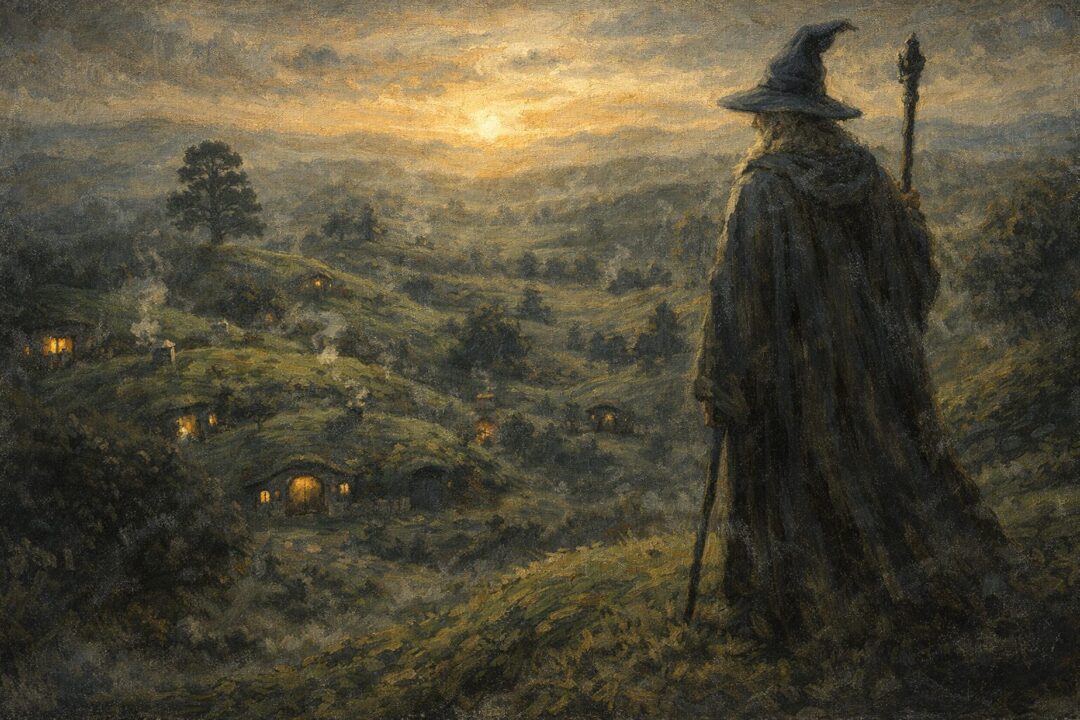
When The Hobbit begins, Bilbo Baggins appears to be the least suitable candidate for adventure in all of Middle-earth.
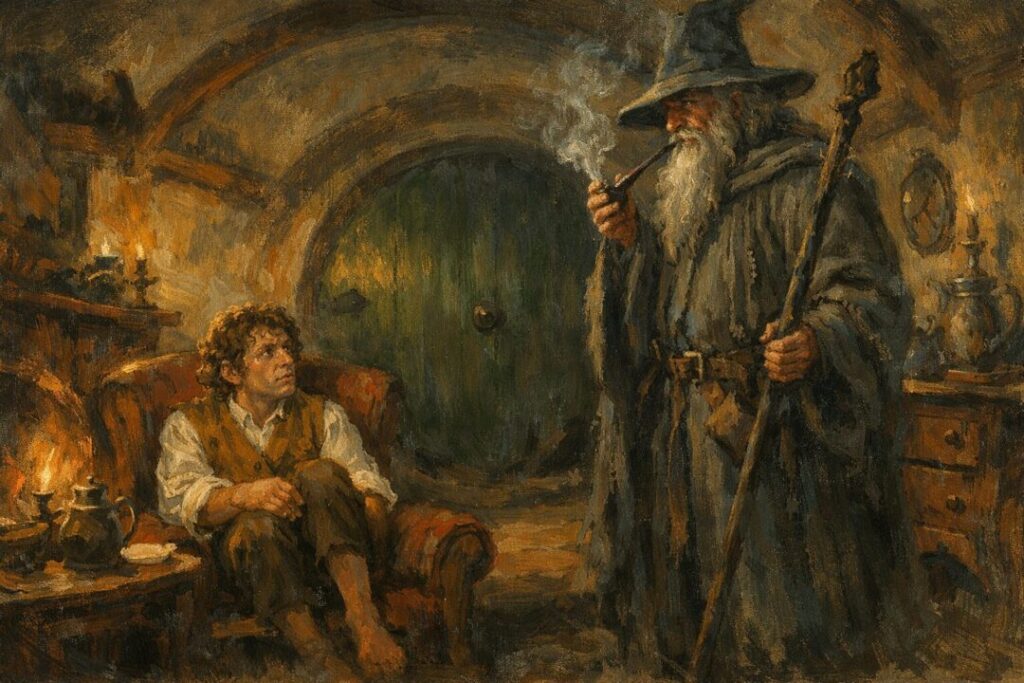
He is sheltered, comfortable, and deeply resistant to anything that disrupts routine. His life in Bag End is defined by predictability: regular meals, polished brass buttons, and a fierce commitment to respectability. Even Gandalf’s arrival is treated not as an invitation, but as an intrusion. Bilbo does not dream of danger or glory. He actively avoids them.
From a practical standpoint, nothing about Bilbo suggests usefulness to a company of Dwarves attempting to reclaim a mountain guarded by a dragon.
And yet, Gandalf insists.
Not only does he insist—he quietly arranges events so that Bilbo Baggins becomes central to the Quest of Erebor. This decision is not impulsive, nor is it presented as simple chance. Years later, Gandalf himself reflects that choosing Bilbo was one of the most consequential—and uncertain—choices he ever made.
To understand why, we must first understand what Gandalf was actually trying to accomplish.
Gandalf’s Long View of Middle-earth
By the time of The Hobbit, Gandalf is far more than a wandering conjurer who enjoys fireworks and riddles. He is already deeply concerned with the slow re-emergence of Sauron’s power and the fragile balance of the North. This concern is not explicit in the children’s tale itself, but it is clarified later in Unfinished Tales, where Gandalf explains the wider context behind the Quest of Erebor.
Smaug’s occupation of the Lonely Mountain was not merely a Dwarvish tragedy. It was a strategic danger. A dragon of Smaug’s strength, left unchallenged, could have become a devastating weapon if drawn into alliance with the Shadow. Gandalf explicitly states that preventing this outcome was one of his primary motivations.
This context matters.
The Quest of Erebor was never only about recovering gold or restoring a lost kingdom. It was about preventing the balance of power from tipping irrevocably toward darkness. Gandalf was acting decades before the War of the Ring, working quietly, indirectly, and often without certainty.
And for that kind of work, Gandalf did not need a hero in the conventional sense.
He needed someone unexpected.
Why Not a Warrior?
If Gandalf’s goal had been to confront Smaug by force, Bilbo would have been an absurd choice. No reading of The Hobbit suggests that Gandalf believed a small company could slay the dragon outright. Dragons are not defeated through bravery alone, and Gandalf was fully aware of Smaug’s strength.
Instead, Gandalf required subtlety.
In The Hobbit, Gandalf makes an explicit observation about Hobbits that often goes unnoticed. He describes them as tougher than they appear—capable of enduring hardship, fear, and deprivation longer than expected. More importantly, they are slow to dominate others and slow to be dominated themselves.
These traits are not spectacular. They do not impress kings or generals. But they are rare.
Bilbo embodies them almost unconsciously.
He does not seek control.
He does not desire mastery.
He does not crave glory or conquest.
In Middle-earth, these absences are strengths.
The Importance of Moral Resilience
Bilbo’s most important moments in The Hobbit are not scenes of combat.
They are moments of restraint.
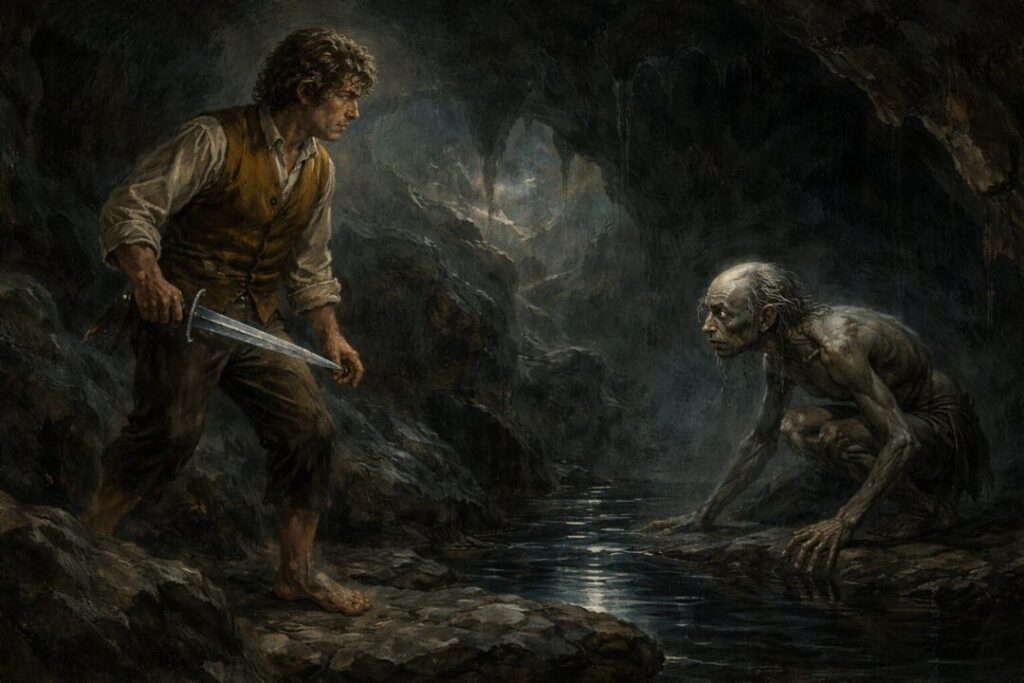
When Bilbo encounters Gollum beneath the Misty Mountains, he gains the opportunity to kill him. He is armed. He is afraid. He has every rational excuse to strike. And yet he does not. The text is explicit: Bilbo is moved by pity, not strategy.
This act is not presented as inevitable. It is a choice.
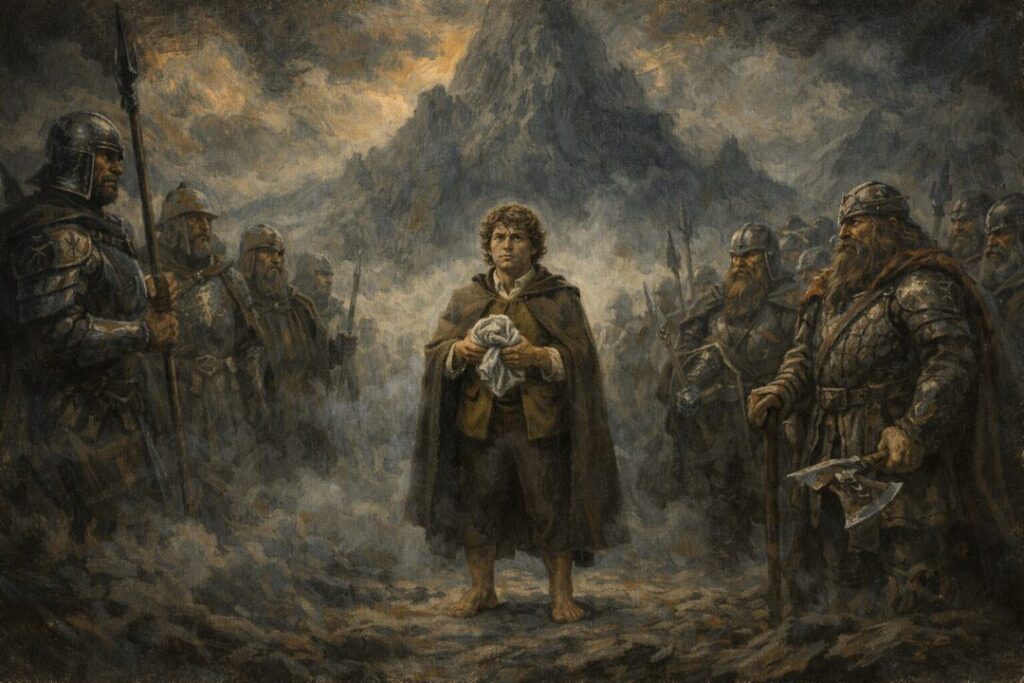
Later, at the climax of the story, Bilbo gives up the Arkenstone—an act that directly undermines his own allies—in order to prevent war. Again, this is not a clever trick or a calculated gamble. It is a moral decision rooted in restraint and foresight.
Even Bilbo’s use of the Ring is marked by limitation. Though he employs it to escape danger, he does not attempt to dominate others with it, nor does he cling to it as a source of power.
The texts never claim that Hobbits are immune to corruption. Gandalf himself later warns that no one is completely safe from the Ring. But Hobbits are slower to desire domination, and that slowness matters.
Gandalf could not have known how Bilbo would act in every moment. But the possibility of mercy mattered more than certainty of strength.
Throughout Middle-earth’s history, it is mercy—not power—that changes outcomes.
Tookishness and Choice
Bilbo is not an average Hobbit, and Gandalf is fully aware of this.
Gandalf explicitly references Bilbo’s Tookish heritage. His mother, Belladonna Took, came from a family known for restlessness, curiosity, and occasional adventure. But just as important is the fact that Bilbo has suppressed that side of himself.
This tension is crucial.
Bilbo is capable of courage—but not addicted to it. His bravery must be chosen, not indulged. That makes his growth meaningful rather than reckless. He does not rush toward danger. He steps into it reluctantly, learns from it, and carries its weight afterward.
This also makes Bilbo unpredictable—not only to enemies, but to himself.
Predictability is dangerous in Middle-earth. Power is watched. Greatness draws attention. But small choices made by unlikely people often go unseen.
Not Destiny, but Risk
One of the most important things Tolkien never states is that Gandalf knew Bilbo would succeed.
In fact, Gandalf openly admits uncertainty. His confidence is not based on prophecy, but on judgment. He observed Bilbo for years. He understood the Shire. He believed that Hobbits, though underestimated, possessed moral resilience unmatched by many greater peoples.
But belief is not certainty.
This distinction matters.
Bilbo is not chosen because fate demands it.
He is chosen because Gandalf is willing to risk hope on someone overlooked.
That risk pays off—not because Bilbo is flawless, but because he grows.
A Pattern That Continues
Bilbo’s selection establishes a pattern that defines the entire legendarium.
Later, Frodo will be chosen not for strength, but for endurance. Sam will succeed not through power, but through loyalty. Time and again, Middle-earth turns on the actions of those who seem insignificant by the standards of kings and warriors.
The Ring is not destroyed by force.
Evil is not overcome by domination.
Victory emerges through humility, mercy, and perseverance.
Bilbo is the first clear proof of this principle.
Why This Choice Still Matters
Many modern stories equate importance with power. Characters matter because they are strong, skilled, or exceptional.
Middle-earth does the opposite.
Gandalf chooses Bilbo not because he is extraordinary—but because he is ordinary, and therefore capable of extraordinary moral choice. His smallness allows him to move where power cannot. His reluctance allows him to resist where ambition would fail.
Without Bilbo, Gollum would die beneath the mountains.
Without that mercy, the Ring would never reach Mount Doom.
And without that destruction, all victories would ultimately collapse.
Gandalf did not choose a hero in the traditional sense.
He chose a Hobbit.
And that choice quietly shaped the fate of Middle-earth.
Sources & Notes
- J.R.R. Tolkien, Unfinished Tales, “The Quest of Erebor” — Gandalf’s later explanation that Smaug and the North were strategic concerns behind Thorin’s quest.
- J.R.R. Tolkien, The Hobbit, Chapter 1, “An Unexpected Party” — Gandalf’s knowledge of Bilbo’s Tookish side and his decision to attach him to Thorin’s company.
- J.R.R. Tolkien, The Hobbit, Chapter 5, “Riddles in the Dark” — Bilbo’s pity and refusal to kill Gollum when he has the chance.
- J.R.R. Tolkien, The Hobbit, Chapter 16, “A Thief in the Night” — Bilbo’s surrender of the Arkenstone as an attempt to prevent war.
- J.R.R. Tolkien, The Lord of the Rings, Book I, Chapter 2, “The Shadow of the Past” — Gandalf’s account of Bilbo’s pity and its later importance in the fate of the Ring.