When the War of the Ring ends, Middle-earth enters a time of healing.
The Dark Lord is overthrown. The great Shadow is lifted. The kings of Men return, and the age of Elves quietly begins to close. On the surface, the world appears restored.
And then—almost unnoticed—Bilbo Baggins leaves it.
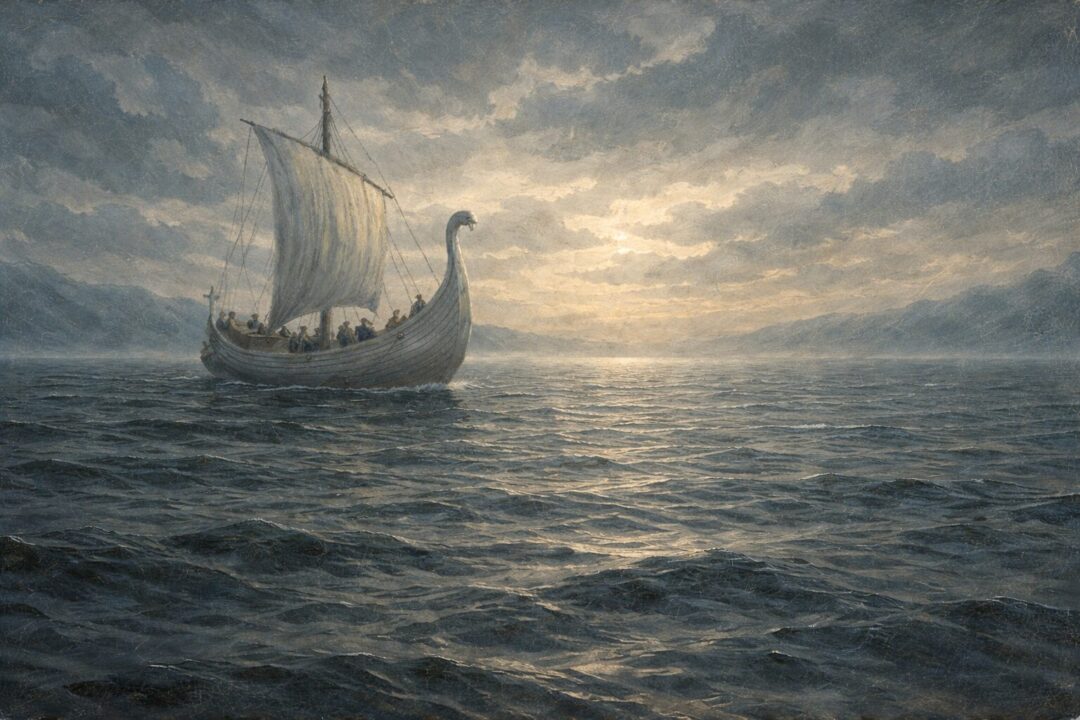
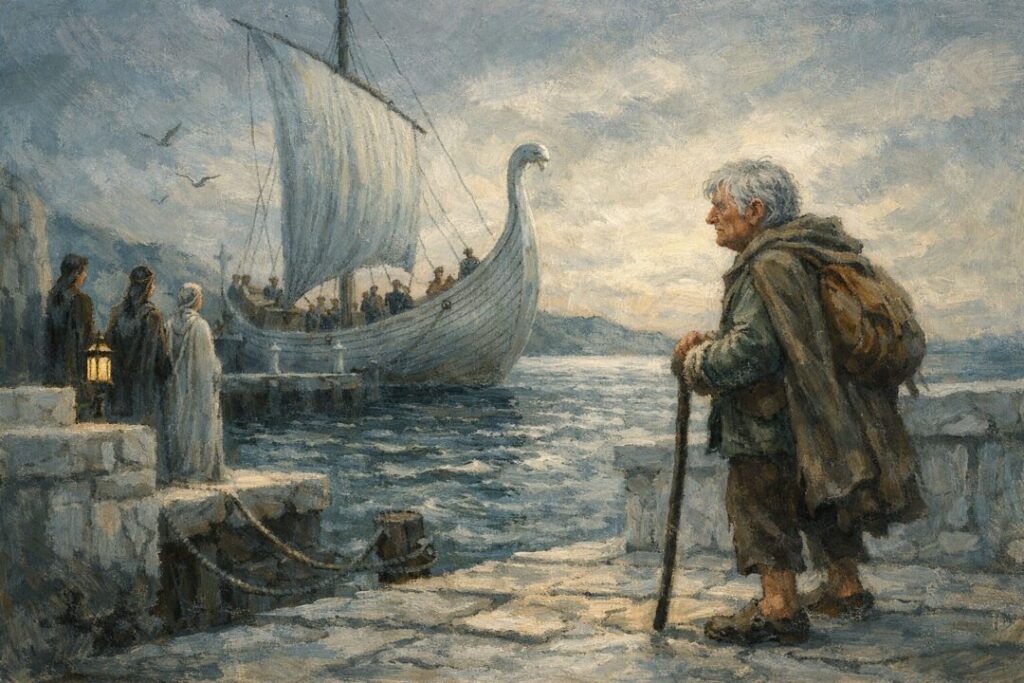
At the Grey Havens, far from the celebrations in Minas Tirith or the quiet joy of the Shire, Bilbo boards a white ship. He does so alongside Frodo, Gandalf, Elrond, and Galadriel, and sails west across the Sea.
The moment is brief. The narration is restrained. No explanation is offered.
There is no speech justifying the decision. No ceremony marking its importance. For a character who once stood at the center of an adventure that reshaped Middle-earth, Bilbo’s final departure is almost understated.
Yet this scene raises one of the most persistent questions in the legendarium:
Why was Bilbo allowed to go to the Undying Lands at all?
The Undying Lands Are Not Heaven
Before any explanation can begin, a common misunderstanding must be addressed.
The Undying Lands are not a place where mortals become immortal.
This idea is widespread but incorrect. Mortality, in Tolkien’s world, is fundamental and irreversible. Death is not a curse to be lifted or a flaw to be corrected—it is part of the natural order of created beings who are not Elves.
Sailing West does not change this.
Bilbo will still die.
What makes the Undying Lands “undying” is not that all who dwell there live forever, but that the land itself is unmarred by decay in the same way as Middle-earth. Time passes differently there. The burdens of weariness, grief, and spiritual exhaustion are eased—but not erased.
For mortals, the West does not grant escape from death. It grants something quieter.
Rest.
A chance for healing that Middle-earth, by the end of the Third Age, can no longer provide.
Bilbo as a Ring-bearer
Bilbo’s journey west cannot be understood apart from one defining fact:
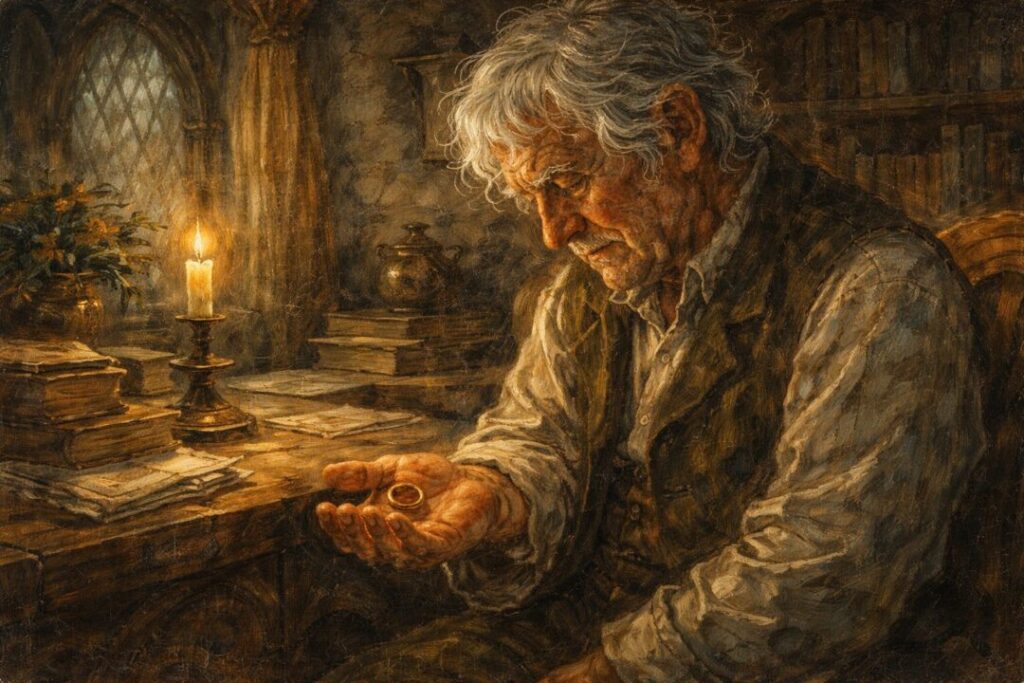
He bore the One Ring.
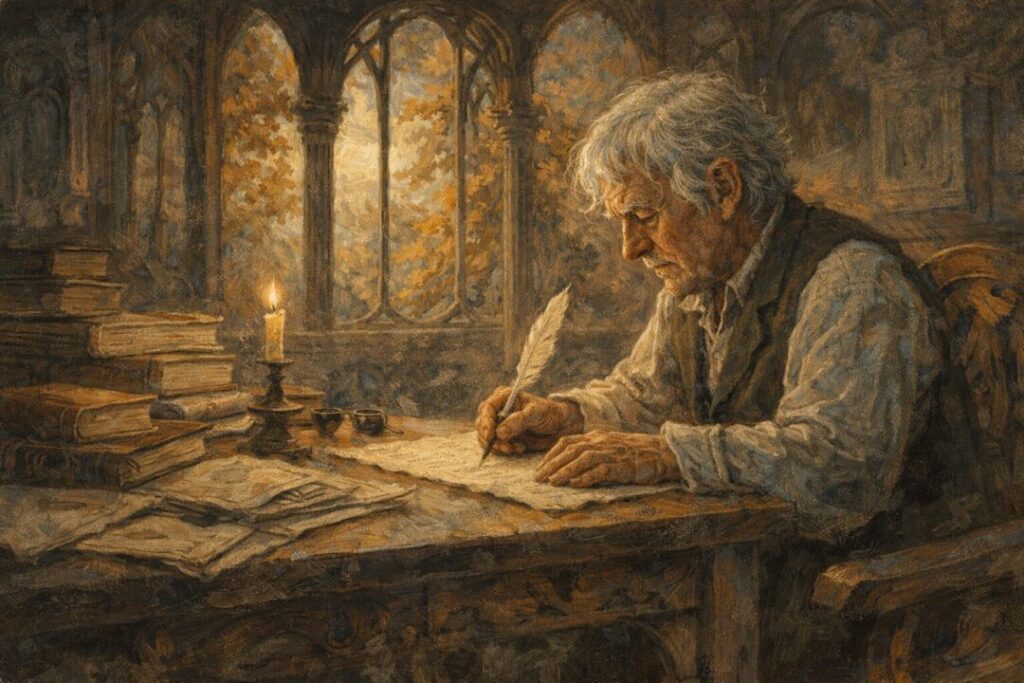
For sixty years, the Ring remained in Bilbo’s keeping. Unlike later bearers, he did not seek it, did not understand its true nature, and never attempted to wield it for domination. Yet the Ring worked upon him all the same.
It stretched his life beyond its natural span.
It bound itself to him, subtly and persistently.
And it left marks that did not vanish when it was surrendered.
This is crucial.
Bilbo’s resistance to the Ring is real—but resistance does not mean immunity. Tolkien repeatedly emphasizes that evil leaves scars even when it is opposed. Not all damage appears as corruption or madness. Some wounds manifest as exhaustion, fading, and an unshakable weariness of the world.
By the time Bilbo leaves the Shire, the Ring is long gone. But its influence has already shaped his life in ways that cannot be undone.
Bilbo is not broken.
He is not enslaved.
But he is worn thin.
The Cost of Endurance
Bilbo’s age is often treated as a curiosity or even a joke within the story. He is very old for a Hobbit, yet remarkably preserved for much of his life.
But this preservation is not benign.
When the Ring is finally destroyed, Bilbo’s true age asserts itself almost at once. He becomes forgetful. He sleeps often. He begins to fade, not dramatically, but gently—like something that has been held together by effort for too long.
This is not presented as punishment.
It is presented as cost.
Bilbo endured something no Hobbit was meant to endure. He lived in proximity to a power designed to dominate wills far greater than his own, and he did so without becoming cruel or grasping. That endurance matters—but it does not come without consequence.
The Undying Lands are not offered to erase that cost.
They are offered because the cost has already been paid.
Why Middle-earth Was No Longer Enough
By the time Bilbo leaves, Middle-earth itself is changing.
The Elves are departing.
The great Rings have lost their power.
Magic, as it once existed, is fading from the world.
The Fourth Age is an age of Men—of order, law, and ordinary time. It is a good age, but it is narrower than what came before.
For someone like Bilbo, this narrowing carries a quiet pain.
He has walked in Rivendell.
He has spoken with Elves who remember the Elder Days.
He has seen a dragon and stood in the presence of something ancient and terrible.
The texts never state directly that Bilbo no longer belongs in Middle-earth—but they strongly imply that the world has become too small for the shape his life has taken.
Not because he is greater than it.
But because he has been stretched beyond it.
Frodo’s Parallel Journey
Bilbo’s story is not unique.
Frodo, too, cannot remain whole in Middle-earth after the Ring’s destruction. Though the Shire is healed, Frodo is not. His wounds—physical, spiritual, and psychological—persist long after victory is achieved.
The Morgul wound never fully fades.
Shelob’s sting leaves its mark.
The weight of the Ring lingers even after it is gone.
This parallel is deliberate.
The Undying Lands are offered not as a reward for heroism, but as a remedy for damage that cannot otherwise be healed.
In this sense, Bilbo and Frodo’s passage westward is not triumphal—it is compassionate.
Who Granted This Permission?
The narrative does not describe a formal decree. There is no scene in which authority is invoked or permission announced.
Yet the structure of the world makes the source of approval clear.
Only the Valar possess authority over who may dwell in Aman. Mortals do not simply arrive there by chance or personal choice.
Bilbo’s passage westward occurs under the guardianship of Gandalf—himself a Maia acting under their authority—and in the company of the greatest Eldar remaining in Middle-earth. The implication is unmistakable: this journey is permitted, and it is intentional.
But it is also exceptional.
This is not a door opened for all.
It is not a reward that can be earned.
It is not a precedent.
Only Ring-bearers are granted this grace.
Only those who bore the burden without seeking mastery.
And even then, what is offered is not transformation—but peace.
Bilbo’s Ending Is Not Triumphant
Bilbo does not sail West in glory.
He is not restored to youth.
He is not exalted above others.
He does not escape his fate.
He is small.
He is tired.
He is nearing the end of his natural life.
The texts suggest that in the Undying Lands he finds peace—but not endless joy, and not an escape from mortality. His final years are eased, not extended. The road becomes gentler, but it still ends.
This restraint is essential.
Bilbo’s story does not conclude with elevation.
It concludes with release.
A Story About Mercy, Not Power
Bilbo’s journey west reflects one of the deepest moral patterns in the legendarium.
Bilbo spared Gollum.
Bilbo surrendered the Ring willingly.
Bilbo never sought dominion.
These acts were small. Quiet. Often misunderstood.
Yet they shaped the fate of the world.
When the long cost of endurance finally becomes too great, mercy is shown to Bilbo in return—not loudly, not dramatically, but completely.
The Undying Lands are not a prize.
They are a kindness.
Why This Moment Matters
Bilbo’s departure reminds us of something Tolkien never allows us to forget:
Victory does not erase damage.
Good choices can still wound.
Endurance has a cost.
Sometimes the bravest ending is not to stay—but to let go.
Bilbo Baggins does not go West because he is extraordinary.
He goes because he carried something no one should have had to carry—and carried it as gently as he could.
And in the moral universe of Middle-earth, that is enough.
Sources & Notes
- J.R.R. Tolkien, The Lord of the Rings, Book VI, Chapter 9, “The Grey Havens” — shows Bilbo sailing from the Havens with Frodo, Gandalf, Elrond, and Galadriel as the Ring-bearers depart Middle-earth.
- J.R.R. Tolkien, The Lord of the Rings, Book I, Chapter 1, “A Long-expected Party” — Bilbo’s long possession of the Ring has preserved him unnaturally, yet leaves him feeling “thin” and ready to leave the Shire.
- J.R.R. Tolkien, The Lord of the Rings, Book I, Chapter 2, “The Shadow of the Past” — Gandalf explains the Ring’s effect on Bilbo’s longevity and the moral importance of his pity for Gollum.
- J.R.R. Tolkien, The Lord of the Rings, Book II, Chapter 1, “Many Meetings” — Rivendell reveals Bilbo after surrendering the Ring: aged, sleepy, and still drawn into the burden’s aftermath.
- J.R.R. Tolkien, The Letters of J.R.R. Tolkien, Letter 246 — Tolkien explains Frodo’s passage West as a special grace for a Ring-bearer’s healing, with Bilbo included in the same exceptional mercy, not made immortal.