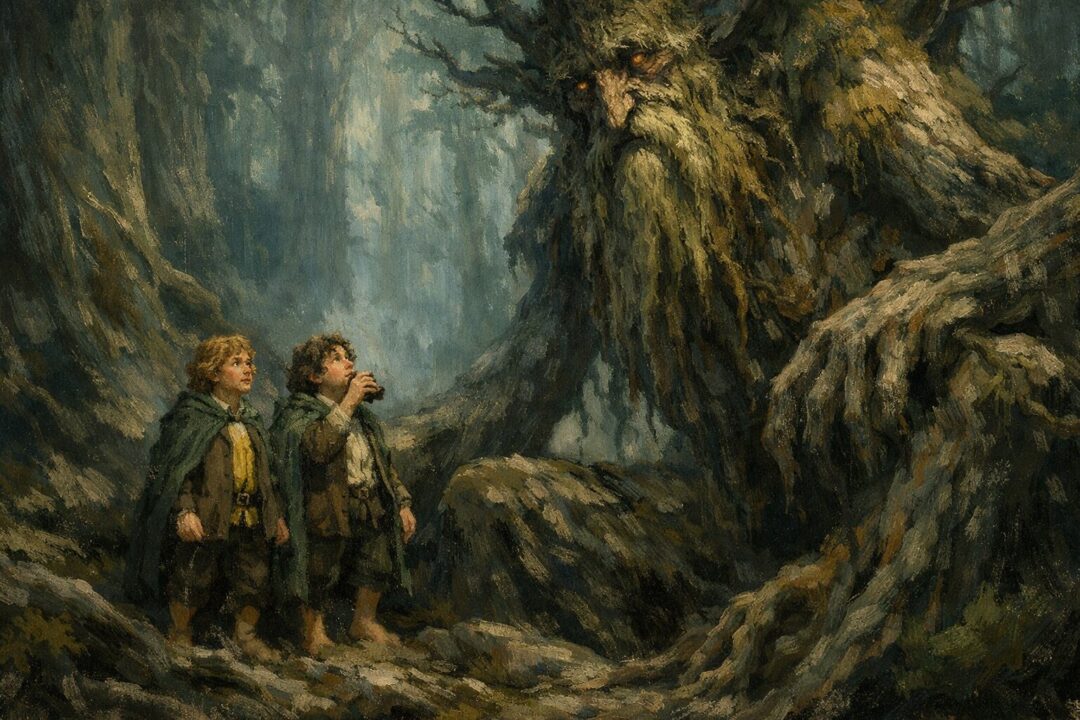
Among the many subtle changes that occur by the end of The Lord of the Rings, one stands out for how quietly it is stated — and how deliberately it is framed.
Peregrin Took grows taller.
Not symbolically.
Not metaphorically.
Physically.
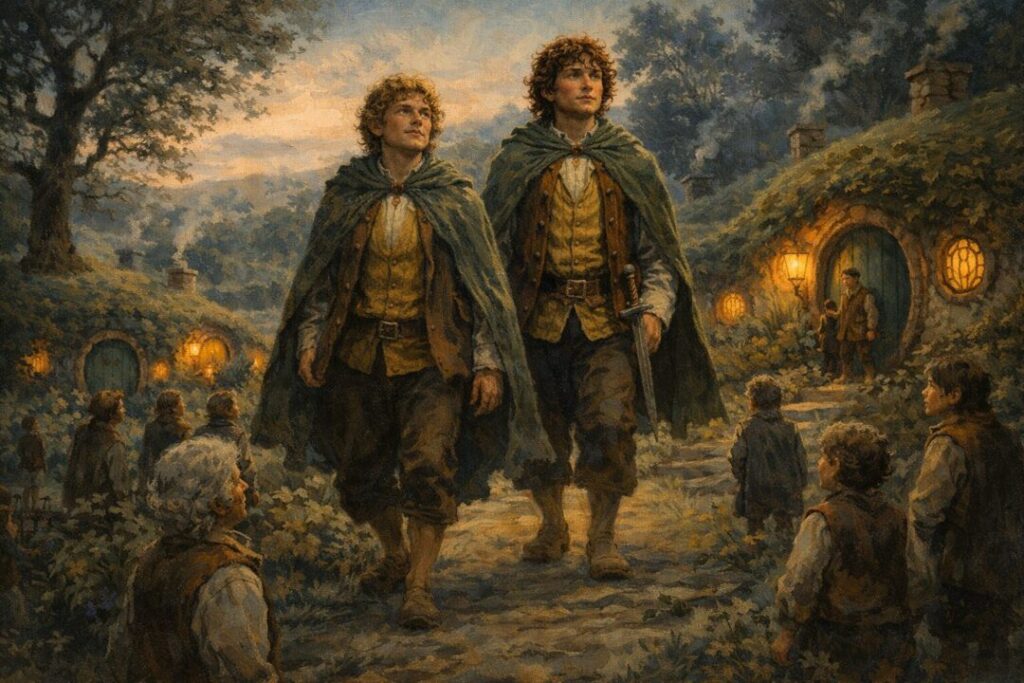
When the Hobbits return to the Shire after the fall of Sauron, Tolkien makes a point of telling us that both Pippin and Meriadoc Brandybuck are unusually tall by Hobbit standards. Merry becomes the tallest Hobbit recorded in Shire history, and Pippin is only slightly shorter.
It is a brief detail, easy to miss amid the restoration of the Shire and the emotional closure of the story. But Tolkien does not include it casually. He does not often describe physical change without purpose — and when he does, it usually signals something deeper at work.
So why does Pippin grow taller?
Tolkien Does Not Waste Words
Tolkien’s narrative style is economical when it comes to bodily description. Characters do not gradually “level up” or change appearance unless it serves a thematic or historical function. When height, age, or physical presence is mentioned, it tends to matter.
This makes Pippin’s growth stand out.
It is not necessary for the plot.
It does not resolve a conflict.
It is not used to grant him advantage.
And yet Tolkien deliberately draws attention to it.
The explanation, as with many things in Middle-earth, exists on two levels: a clear textual cause, and a quieter thematic meaning.
The Canonical Cause: Ent-draughts
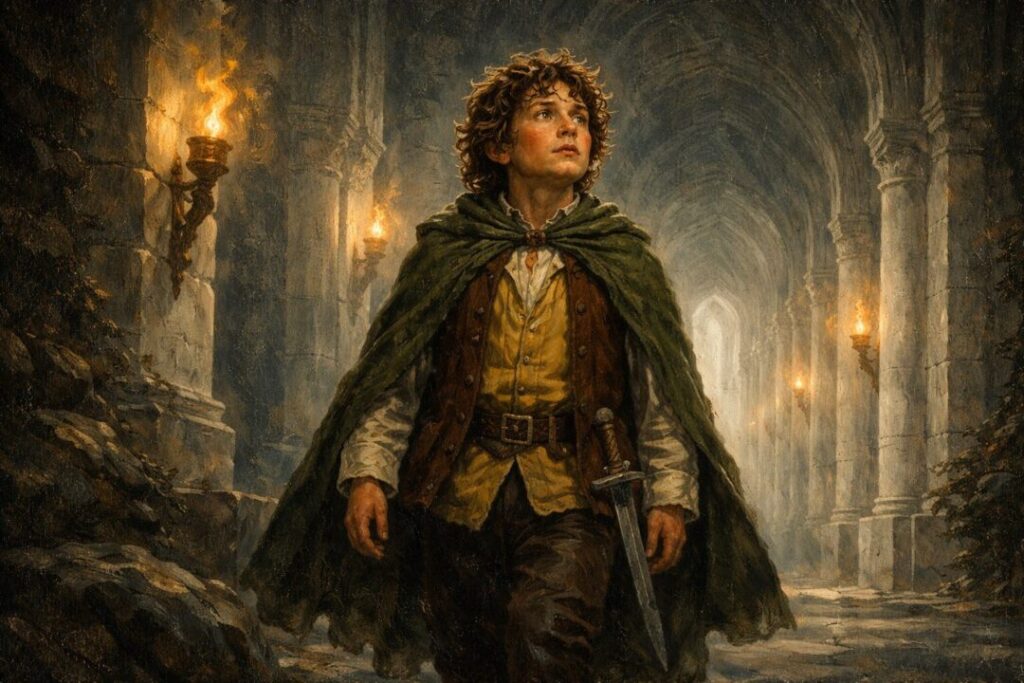
The only explicit cause Tolkien gives for Pippin’s increased height is the Ent-draughts he consumes in Fangorn Forest.
After Merry and Pippin escape from the Orcs, they encounter Treebeard, who brings them into Fangorn Forest and provides them with a drink made from water enriched by the Ents.
The text is intentionally vague about its nature.
The draught causes the Hobbits to sleep deeply. When they wake, they feel refreshed, clearer in thought, and physically stronger. Over time, Treebeard remarks that they appear to be growing.
This is crucial: Tolkien never describes the Ent-draughts as a magical potion designed to alter Hobbits. They are not presented as transformative in the way many fantasy elixirs are.
Instead, they are described almost agriculturally — as nourishment.
The Ents themselves are shepherds of trees. They are beings defined by patience, slowness, and natural growth measured in years and centuries. Everything about them resists haste or artificial change.
Their draughts reflect this philosophy.
They do not force growth.
They encourage it.
Treebeard explicitly suggests that Merry and Pippin are growing “according to their kind.” That phrase matters. Tolkien is careful not to imply that Hobbits are being reshaped into something else.
Growth, Not Transformation
At no point does Tolkien suggest that Ent-draughts grant abilities beyond Hobbit nature.
Merry and Pippin do not become stronger than Men.
They do not gain supernatural endurance.
They do not live longer lives.
They remain Hobbits — simply larger ones.
This fits Tolkien’s broader approach to power in Middle-earth. What is often called “magic” is rarely flashy or abrupt. Change tends to be slow, organic, and rooted in nature rather than spectacle.
The Ent-draughts are not an exception to this rule. They are a perfect expression of it.
They allow the Hobbits to reach a fuller physical potential — nothing more, and nothing less.
Why Only Merry and Pippin?
This naturally raises another question.
If Ent-draughts encourage growth, why don’t other Hobbits experience the same change?
The answer is straightforward and entirely textual.
Only Merry and Pippin drink them.
Frodo Baggins and Samwise Gamgee never enter Fangorn Forest. They never meet Treebeard, and they never consume Ent-draughts. Tolkien gives no indication that such substances exist elsewhere or that the effect could be replicated.
There is no spreading “Ent magic.”
No lingering influence beyond Fangorn.
No suggestion of similar growth occurring later.
This is a single, specific encounter with a specific consequence — and Tolkien keeps it contained.
The Timing Matters
Just as important as why Pippin grows is when the growth is emphasized.
Tolkien does not highlight Pippin’s increased stature immediately after Fangorn. The change is only fully noted after the War of the Ring is over, when the Hobbits return home.
By then, Pippin is no longer the impulsive youngest member of the Fellowship.
Consider what he has endured:
• Capture and transport by Orcs
• Exposure to the palantír and direct confrontation with Sauron’s will
• Service to Gondor and loyalty to Denethor
• Participation in the Battle of the Black Gate
By the time he comes back to the Shire, Pippin has looked directly at death and chosen duty anyway.
The physical growth does not precede this transformation. It follows it.
Outer Growth Reflecting Inner Change
This is where Tolkien’s deeper intent becomes visible.
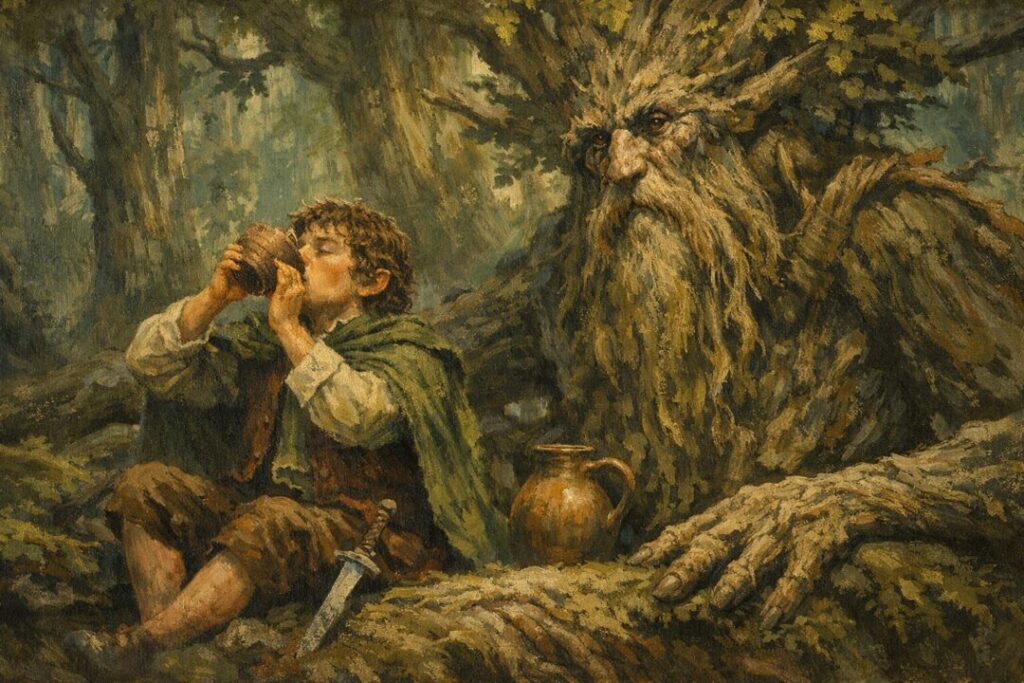
Pippin’s increased height is not presented as the cause of his maturity, but as a quiet reflection of it. The inner change comes first — courage, restraint, responsibility — and the body follows.
This is a recurring pattern in Tolkien’s legendarium. Physical form and spiritual condition are closely linked, though rarely in simplistic ways.
Pippin grows taller because he has grown inwardly.
Not in ambition.
Not in pride.
But in steadiness.
By the time the Hobbits confront Sharkey’s forces in the Shire, Pippin naturally takes on leadership. He does not seek authority, but others recognize it in him.
His stature mirrors his presence.
Not a Reward, Not a Power-Up
It is important to be clear about what this growth is not.
It is not a reward for bravery.
It is not a power-up earned through suffering.
It is not framed as something inherently superior.
Tolkien never suggests that being taller makes Pippin better.
Hobbits, as a people, are deliberately small. Their strength lies in resilience, humility, and endurance — not physical dominance. The Shire itself embodies this philosophy, standing apart from the great kingdoms and their obsession with size, lineage, and power.
Pippin grows taller, but he does not outgrow the Shire.
He remains deeply Hobbit in values, loyalties, and temperament.
Why Tolkien Included This Detail at All
So why mention Pippin’s height at the end of the story?
Because Tolkien is marking a threshold.
Merry and Pippin have crossed out of the sheltered world of the Shire and into the ancient, perilous history of Middle-earth. They have walked in forests older than kingdoms, spoken with beings who remember the First Age, and survived a war that reshaped the world.
They return home changed — but not unrecognizable.
Their bodies bear a quiet mark of passage.
Not a scar.
Not a title.
Not a crown.
Just growth.
It is Tolkien’s understated way of saying that such journeys leave traces, even when peace returns.
A Final Thought
Pippin does not grow taller because he becomes more important in the world.
He grows taller because he becomes more fully himself.
And Tolkien leaves it there — trusting the reader to notice, to reflect, and to understand without explanation.
In a story where the greatest victories are won quietly, even growth itself does not need to shout.
Sources & Notes
- J.R.R. Tolkien, The Lord of the Rings, Prologue, “Concerning Hobbits” — notes that Merry and Pippin later surpassed Bandobras Took’s famous height, pointing ahead to the Ent-draught effect.
- J.R.R. Tolkien, The Lord of the Rings, Book III, Chapter 4, “Treebeard” — Treebeard gives Merry and Pippin the Ent-draughts in Fangorn and begins the textual chain for their unusual growth.
- J.R.R. Tolkien, The Lord of the Rings, Book III, Chapter 9, “Flotsam and Jetsam” — Merry and Pippin describe the draughts and the noticeable physical change after their time with the Ents.
- J.R.R. Tolkien, The Lord of the Rings, Book VI, Chapter 8, “The Scouring of the Shire” — the returned hobbits, especially Merry and Pippin, appear changed and take active leadership at home.
- J.R.R. Tolkien, The Lord of the Rings, Book V, Chapter 1, “Minas Tirith” — Pippin’s service to Denethor and Gondor supports the article’s reading of outward growth beside inward maturity.