There is a particular kind of disappearance in Middle-earth that does not feel like death.
It is quieter than that.
It is the way a people can remain alive—numerous, even—yet slip outside the frame of the stories most often told. Not erased by catastrophe, but bypassed by chroniclers. Not ended, but unrecorded.
That is the peculiar fate of the Avari.
They are named in the earliest days, at the first great turning of Elven history. And then, for long stretches, they are scarcely mentioned again.
The refusal that creates a people
The Avari do not begin as a “tribe” with a distinctive culture, a heraldry, and a famous king.
They begin as an answer.
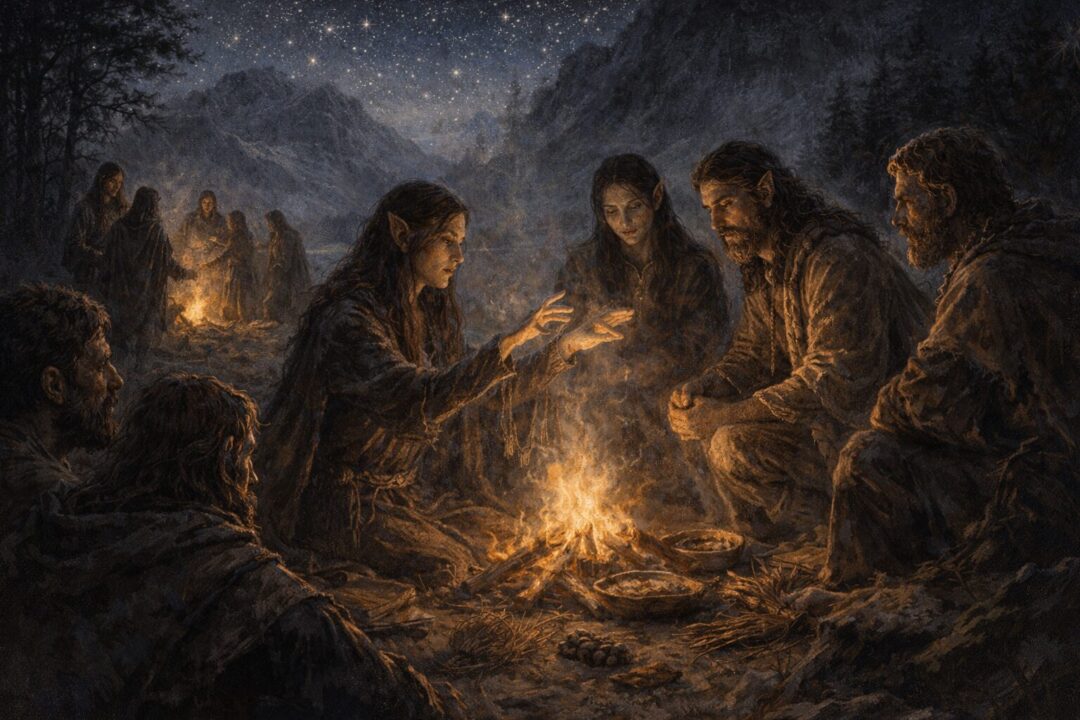
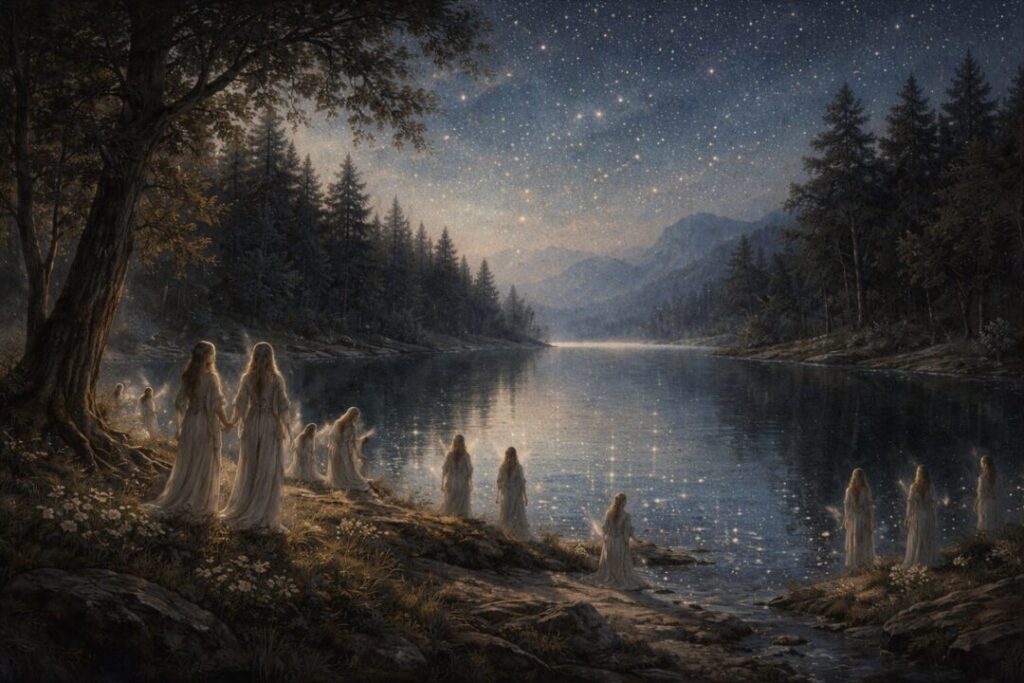
After the Elves awaken beside Cuiviénen, they live under stars in a world without the Sun and Moon. In the later accounts of the Awakening, the starlight is not decoration: it is environment, identity, and first memory.
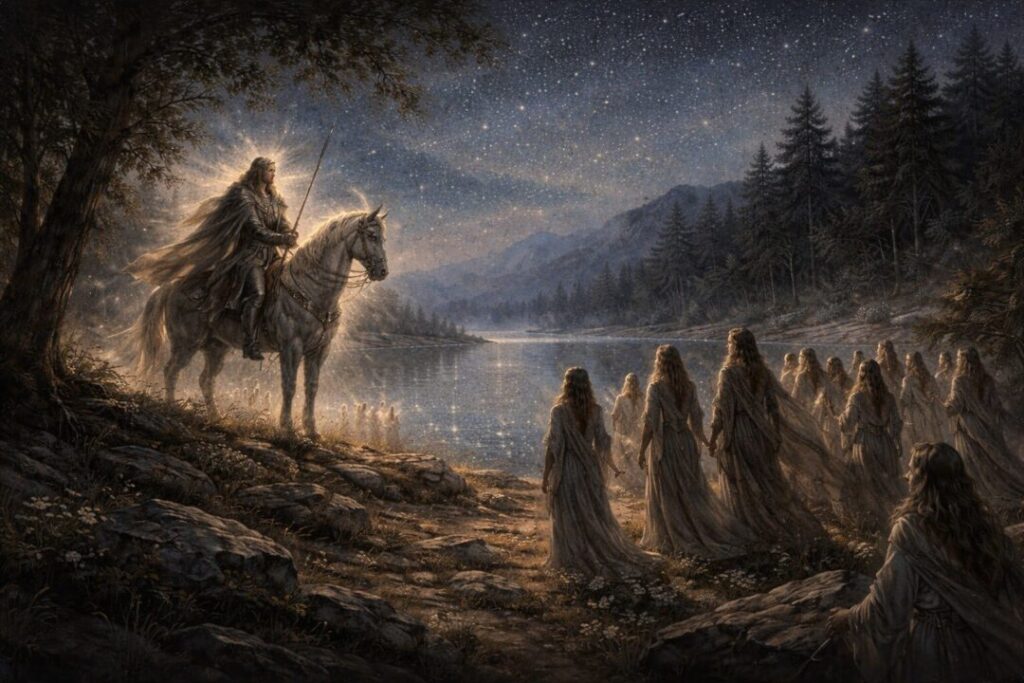
When Oromë discovers them and the summons to journey West is debated, the texts define the outcome with blunt simplicity: those who depart are remembered as the Eldar; those who refuse are called the Avari, “the Unwilling”.
Crucially, the defining description of the Avari is not a moral condemnation. The passage does not say they are evil, foolish, or corrupt. It says they refused—because they preferred starlight and the wide spaces of Middle-earth to the rumour of the Trees.
That sentence matters because it anchors everything we can responsibly claim about them:
- Their defining act is refusal of the Great Journey.
- Their expressed preference is for Middle-earth as it is: starlit, wide, and immediate.
- After that, their history is described in broad strokes, not in a detailed narrative.
What “Avari” means—and what it does not
The Avari are often lumped together with every Elf who did not live in Aman. That can produce confusion.
One helpful boundary is the category often translated as “Elves of the Darkness” (Moriquendi): Elves who never reached Aman or saw the Light of the Trees. This category includes not only the Avari, but also other groups who began the westward movement and did not complete it.
So “Avari” is not simply “Elves who never saw the Trees”.
It is specifically: Elves who refused the summons and did not set out on the Great Journey in the first place.
That distinction matters for any attempt to answer “what became of them”, because it prevents a common error: treating every woodland Elf of later Ages as secretly Avari. The texts do indicate mingling in certain regions (more on that below), but they never give us permission to flatten every later Elvish community into the Avari category.
The few direct traces the texts give us
If you are looking for a single paragraph that says, “and the Avari went here, founded this realm, fought this war, and finally vanished in this way,” you will not find it.
What you will find is something subtler: a chain of brief, scattered statements that suggest movement, contact, and gradual blending—alongside vast silence.
The Silmarillion’s own summary is broad: after the refusal, many Avari “spread gradually throughout the wide lands of Middle-earth.” That is not a legend of a kingdom. It is a description of dispersal.
Later linguistic and ethnographic notes (preserved in published collections) add a few sharper glimpses:
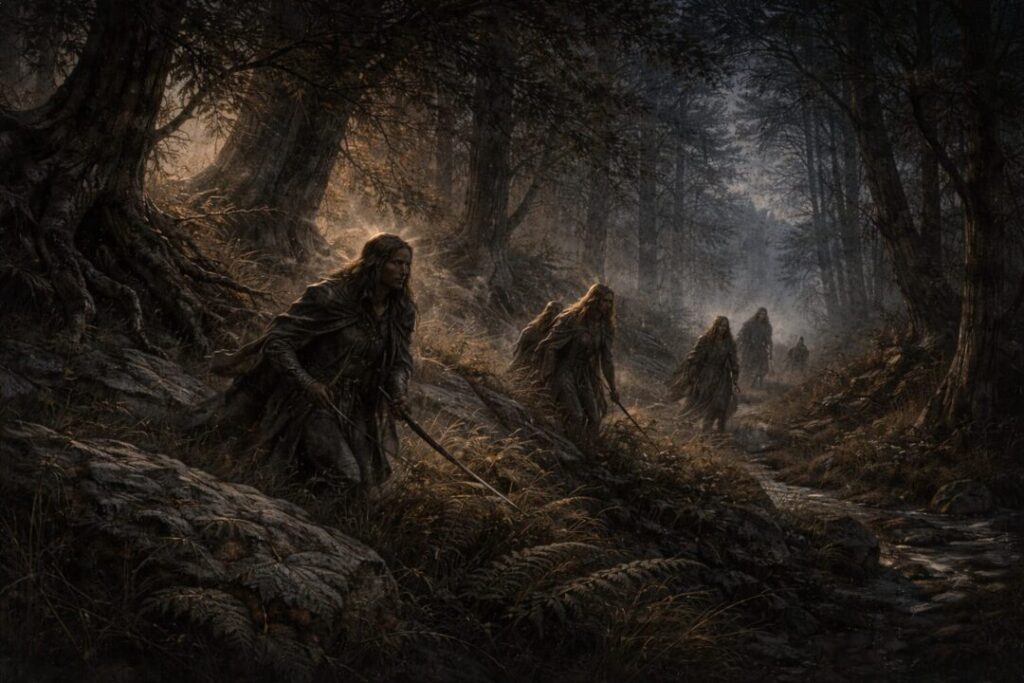
Some Avari wandered westward over time; some mingled with the Nandor in the Vales of Anduin; others entered Eriador; and some are described as coming into Beleriand “in small and secret groups… from the South,” remaining largely isolated from other Elves there.
Notice what the pattern suggests (and this is an inference, not an explicit statement): the Avari are more visible at the edges of other peoples’ stories than in stories of their own. We usually meet them as “those who were there earlier,” “those encountered in passing,” or “those whose speech left a trace.”
Even the language evidence reinforces this impression.
The Avari as a linguistic shadow
There is an arresting line preserved in a discussion of Avarin: an early note about the language appendix says (paraphrasing the sense) that the Avari and their many secret tongues “do not concern” that book. In other words: even when the narrative turns to languages, the Avari remain peripheral and under-recorded.
What is preserved is tiny but telling.
The only certain Avarin forms that survive in the published materials are not poems, not place-names, not inscriptions. They are six self-designations—forms descended from the ancient Elvish word for “the People” (kwendī): Kindi, Cuind, Hwenti, Windan, Kinn-lai, Penni.
And the note attached to them is revealing: the Avari continued to call themselves “the People,” while reportedly regarding those who went away as deserters.
Even without adding anything that is not in the texts, this tells you something profound about the Avari’s “fate”:
They do not vanish because they lack identity.
They vanish because their identity remains local, diverse, and scattered—“widely sundered” tongues rather than a single prestigious standard speech that dominates later records.
The first Elves that Men met
One of the most important (and easiest to miss) implications about the Avari is this:
They may have mattered enormously to the earliest history of Men, long before the famous Elf-lords of Beleriand become central to the tales.
As the Edain migrate westward from their awakening in the East, the texts indicate that during their wanderings they encountered Dark Elves and adopted “many words and devices” that influenced their language; they had met Dwarves and Avari in the East and taken some of their speech.
This does not mean the Avari founded Mannish civilisation, or “uplifted” Men into greatness (the texts do not say that). But it does mean the Avari are positioned as an early contact point—Elves in the East who interacted with Men before the well-documented friendships of later centuries.
This is one of the clearest answers Middle-earth gives to the question “what became of them?”:
Some part of what “became of” the Avari is that they became part of the background from which later peoples emerge—especially in language, and perhaps in early cultural contact (as far as we can responsibly infer from the language-focused passages).
The Avari and the peril of the early world
No honest account of the Avari’s fate can ignore why the summons mattered.
The world east of the West is dangerous in the early ages: shadows, lies, and the threat of seizure.
Even in the stories of the Great Journey itself, there are references to fear of a dark Rider and to Elves lost when they fled or hid.
In later reflection, the origins of Orcs become a debated matter among loremasters; one strand of tradition associates Orcs with Elves who were taken, imprisoned, and corrupted, and at least one early suspicion among Elves is that the Orcs might be Avari who had become “evil and savage in the wild.” This is presented as an in-world belief and uncertainty—not as a settled fact.
For the Avari specifically, this contributes to a sober, lore-grounded picture:
- They remain in regions where the Shadow’s reach is earlier and more direct.
- Their dispersal means they do not present a single fortified “front” like later kingdoms.
- They are therefore plausibly more exposed to loss, capture, and gradual diminishment—though the texts do not quantify this or narrate it as a single tragedy.
Did they “spread out”? Yes—then they slip beyond the map
So: did they spread out?
Yes, in the most literal sense: the texts describe dispersal across the wide lands of Middle-earth, and later notes add westward wandering, mingling in the Vales of Anduin, movement into Eriador, and small secret entries into Beleriand from the South.
But what happened after that?
Here the most responsible answer is: we are not told in narrative form.
We are given, instead, a late linguistic note that by the late Third Age no Avari were to be found west of Misty Mountains.
That single line does not say the Avari are extinct. It does not say they all migrated eastward. It does not say they all faded.
It says: by the late Third Age, in the West (the part of Middle-earth whose histories we most often inherit), you would not find them as a distinct, recognisable people.
From that, two careful inferences are possible (and must be labelled as inference):
First, some Avari may have become indistinguishable from neighbouring Elvish peoples in the regions east of the mountains where mingling is explicitly mentioned. If a people “often became merged together,” their disappearance from later, west-focused records becomes understandable without requiring annihilation.
Second, if Avari communities endured in large numbers into later Ages, the likeliest place for them to endure as Avari would be in lands outside the western narrative’s attention—farther East (and potentially South) than the main theatres of the stories. This is not stated as fact anywhere in the primary narratives; it is simply the most conservative way to account for the combination of “they spread widely” plus “none were found in the western regions late in the Third Age.”
And that returns us to the core truth about the Avari:
Their fate is not “a secret history we haven’t decoded.”
Their fate is that Middle-earth is wide, and the chronicles we inherit are narrow.
The Avari live at the meeting point of those two realities—named clearly at the beginning, then swallowed by distance, dispersal, and time.
Sources & Notes
- J.R.R. Tolkien, The Silmarillion, “Of the Coming of the Elves and the Captivity of Melkor” — gives the Awakening at Cuiviénen, Oromë’s summons, the sundering into Eldar and Avari, and the Avari’s refusal of the Great Journey.
- J.R.R. Tolkien, The Silmarillion, “Of the Coming of the Elves and the Captivity of Melkor” — notes that many Avari gradually spread throughout the wide lands of Middle-earth after the first refusal.
- J.R.R. Tolkien, The War of the Jewels, “Quendi and Eldar” — Tolkien’s linguistic and ethnographic notes on Avarin names, scattered Avari groups, westward wanderings, and mingling with other Elvish peoples.
- J.R.R. Tolkien, The Peoples of Middle-earth, “Of Dwarves and Men” — background for early contacts in the East, including the influence of Avari and Dwarves on early Mannish speech and culture.
- J.R.R. Tolkien, The Silmarillion, “Of the Coming of Men into the West” — shows Men arriving in Beleriand after earlier eastern wanderings and meetings with Dark Elves, a context for Avarin contact before the famous Elf-friendships.
- J.R.R. Tolkien, Morgoth’s Ring, “Myths Transformed” — for Tolkien’s later uncertainty and debate over Orc origins, useful when treating Avari/Orc connections as tradition and speculation rather than settled fact.