One of the most haunting disappearances in the Númenor story is not a murder, not a battlefield death, and not a fall from a tower.
It is a departure.
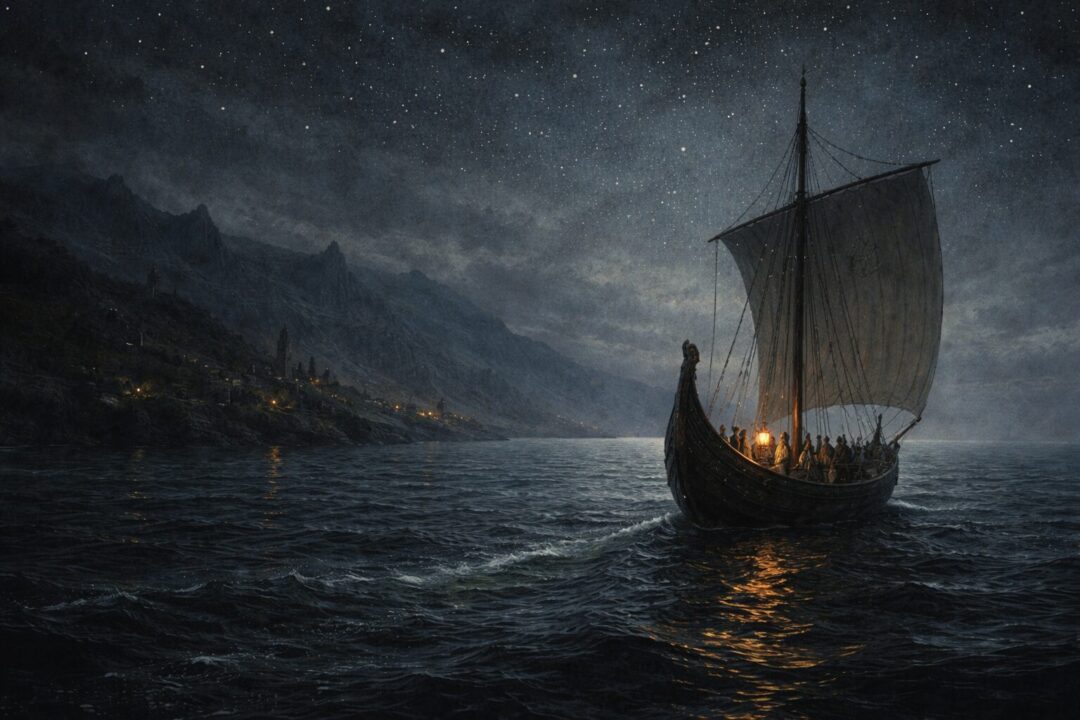
Amandil—father of Elendil, last Lord of Andúnië—sets sail at night in a small ship, takes three companions, and is never heard from again “by word or sign.” The text adds something even colder: there is “no tale or guess” of what became of them.
That single sentence creates the question that readers keep returning to:
Did Amandil reach Valinor?
The answer, if we are strict with what is written, is that the texts refuse to tell us. But the refusal itself is meaningful. It is not an accident of missing notes; it is part of the moral and mythic shape of Númenor’s ending.
What follows is a conservative, lore-accurate map of the problem: what can be said as fact, what must remain unknown, and what interpretations the text allows without pretending to confirm them.
Amandil is not the King
Many summaries accidentally elevate Amandil into the kingship. The primary narrative does not. Amandil’s identity is bound to a different role: he is the last Lord of Andúnië, a leading figure among the Faithful, and the father of Elendil.
This matters because the Númenor tragedy is not only the downfall of rulers. It is the collapse of a whole people’s relationship with the West—especially their growing resentment toward mortality.
The King at the end is Ar-Pharazôn, and it is his pride and power that culminate in the open breaking of the Ban and the assault upon Aman.
Amandil stands in the story as a counterpoint: not a wielder of royal authority, but a man who tries one last appeal when authority has become hostile to the very idea of appeal.
What Amandil actually does in the text
The most valuable thing the canon gives us is that Amandil’s plan is presented in direct speech.
He tells Elendil that his departure must be hidden: “It must not become known.” He will prepare in secret, sail into the east “whither daily the ships depart,” then “go about… back into the west” and seek what he may find.
He also gives practical instructions: Elendil should prepare ships, load what matters most, and lie ready in the haven of Rómenna, claiming (as cover) that they may later follow him east. He tells Elendil to seek out the Faithful in secret and let them choose exile rather than participation in the King’s war.
This is not a romantic quest. It is a measured plan: concealment, misdirection, readiness.
Then the chronicler’s voice takes over with a summary that is deliberately spare:
Amandil sets sail at night in a small ship, takes three servants “dear to his heart,” and is never again heard of “by word or sign.” Nor is there any tale or guess of their fate.
So: we know the method, and we know the silence. We do not know the end.
The Ban and the danger of the West
To understand why the story treats Amandil’s act as so grave, the Ban of the Valar has to be held in mind.
In summary, the Ban is described as a prohibition laid upon Númenórean mariners: they are not to sail so far west from their island that they can no longer see its coasts. The purpose is explicitly moral and psychological: to prevent the longing for the immortality of the Undying Lands from becoming a consuming temptation. Some accounts observe that the eastern edge of Tol Eressëa could at times be visible from Númenor—yet they were forbidden to go there, or to any part of Aman.
In that light, Amandil’s voyage is striking because it is not motivated (in the text) by the desire to seize immortality. His words are those of secrecy, fear, and last resort—seeking what he may find, and implicitly seeking help or mercy from the Powers rather than theft of their land.
Reputable references even note a technical irony: strictly speaking, Amandil’s secret voyage can be seen as an earlier breach of the Ban, long before Ar-Pharazôn breaks it publicly with an armament.
But “earlier breach” is not the same as “same sin.” The texts keep Amandil’s motive distinct from the mass delusion that the Undying Lands can be taken like a fortress.
The narrator’s warning about “a second embassy”
This is where the question becomes sharp.
The story openly invites comparison with Eärendil. Amandil himself references the idea of “sign” and implies he cannot expect the same outcome.
Then the narrator delivers a judgement-like aside:
“Men could not a second time be saved by any such embassy, and for the treason of Númenor there was no easy absolving.”
This does not explicitly say Amandil fails to reach the West. It does not say he is rejected. It does not say he dies.
But it does something just as important: it blocks the reader from treating Amandil as a repeat of Eärendil with a predictable success. It frames Númenor’s situation as beyond an easy replay of the First Age rescue pattern.
In other words: even if Amandil’s intent is noble, the story warns the reader not to expect a clean absolution.

The one line that keeps the mystery alive
And then, almost immediately, the text complicates the warning with a sentence that preserves uncertainty on purpose.
Paraphrased without sharpening it beyond its wording, the chronicle says: whether or not Amandil came indeed to Valinor and Manwë listened to his prayer, Elendil and his sons and their people were spared from the ruin “by grace of the Valar.”
This is not confirmation. The structure matters:
- It explicitly admits the possibility (“whether or no…”).
- It explicitly refuses to settle it.
- It still attributes the Faithful’s survival to grace.
So, canon gives us two anchors at once:
The rescue is gracious.
Amandil’s arrival is unknown.
That is why the mystery persists: the text itself holds the door open without walking through it.
So what happened to Amandil? What can we responsibly say?
The only fully lore-safe answer is: we do not know.
Still, the canon context lets us state what possibilities are consistent with the world as described.
It is consistent (interpretation) that Amandil simply perished in the attempt, with no witness and no record, which matches the text’s insistence that there is no tale or guess.
It is consistent (interpretation) that he was turned aside, ensnared, or otherwise prevented—because the West is not open sea in the ordinary sense. In the elder cosmology, the Valar set defensive barriers such as the Enchanted Isles, described as perilous and as ensnaring unpermitted mariners. Again, this does not prove Amandil’s end; it establishes that “reaching Aman” is not simply a matter of sailing longer.
It is also text-permitted (interpretation) that Amandil reached the West and that his plea was heard—because the chronicler explicitly frames that as an open question and places it beside the statement that the Faithful were spared “by grace.” But the text never assigns a cause-and-effect chain that says: “because Amandil arrived, therefore the Valar spared the Faithful.” That stronger claim would exceed the narrator’s wording.
What the narrative does not allow us to do is replace its silence with a confident ending.
There is no canonical scene of Amandil arriving.
There is no canonical judgement pronounced upon him.
There is only the pattern of Númenor: the moment for repentance comes late, and grace—when it appears—does not erase consequences.
Why the silence matters
Amandil’s fate is unknown, but his function in the story is clear.
He embodies a kind of Middle-earth heroism that is easy to miss: the act that is not rewarded with a visible outcome, not commemorated with a monument, and not even completed with a certainty.
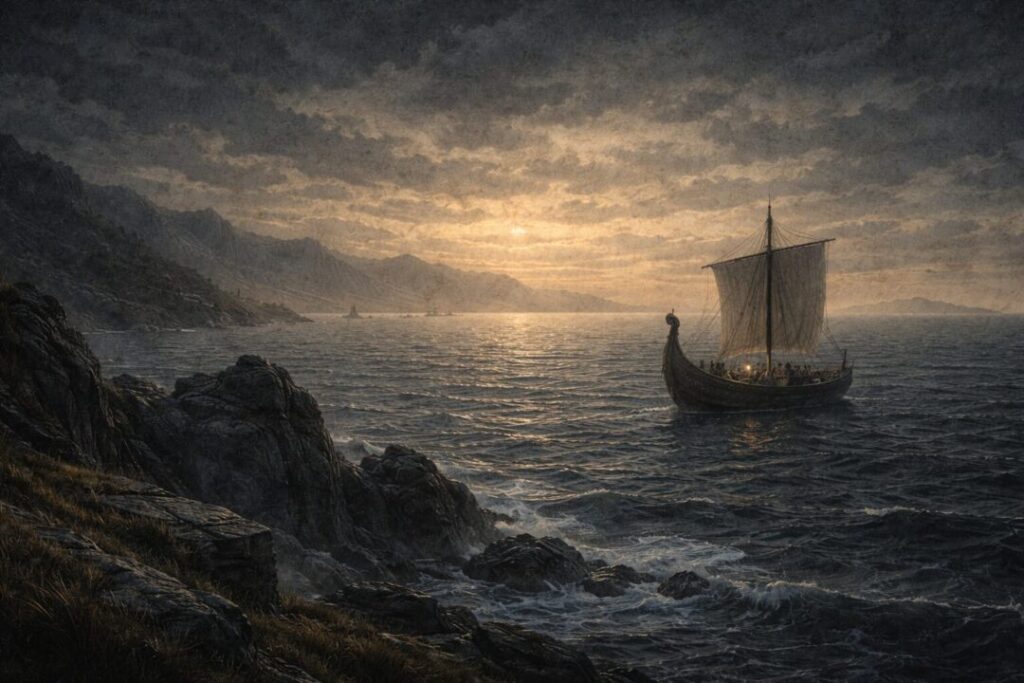
He sails into the West when the West has become, for his people, the centre of obsession and rebellion. Yet his purpose is not to take. It is to plead—and to warn his son to be ready for the end of the world they have known.
And the text answers our desire for closure with a stark denial:
No word.
No sign.
No tale.
That is not a gap to be patched. It is part of the tragedy.
Because Númenor’s fall is not only about what is destroyed in a single day. It is also about what disappears unrecorded: the last attempts to turn back, made too late to save the world that is ending.
Did Amandil reach Valinor?
The canon leaves us with a more unsettling question:
If the noblest voyage ends in silence, what does that tell us about the kind of hope Númenor still had left?
Sources & Notes
- J.R.R. Tolkien, The Silmarillion, “Akallabêth” — Amandil’s counsel to Elendil, his secret westward voyage, and the statement that no tale or guess tells his fate.
- J.R.R. Tolkien, The Silmarillion, “Akallabêth” — the Ban of the Valar, Ar-Pharazôn’s invasion of Aman, and the sparing of Elendil’s people by grace of the Valar.
- J.R.R. Tolkien, The Silmarillion, “Of the Voyage of Eärendil and the War of Wrath” — the earlier successful embassy to the Valar that Amandil’s attempt deliberately echoes but cannot simply repeat.
- J.R.R. Tolkien, The Silmarillion, “Of the Sun and Moon and the Hiding of Valinor” — the hiding of Aman and the Enchanted Isles as context for why an unauthorized voyage west was not ordinary seamanship.
- J.R.R. Tolkien, The Letters of J.R.R. Tolkien, Letter 131 — Tolkien’s own overview of Númenor’s corruption, the Ban, and the final rebellion against the Valar.