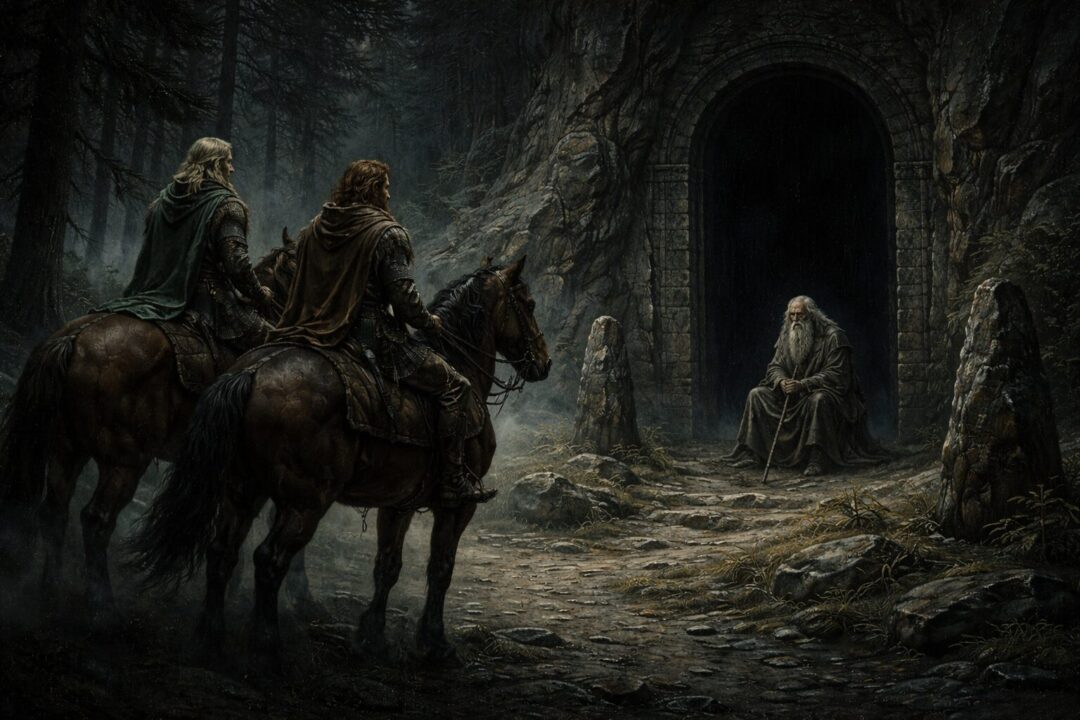
The Door under Dwimorberg is one of those details that reads like pure atmosphere—until you notice how deliberately it is framed.
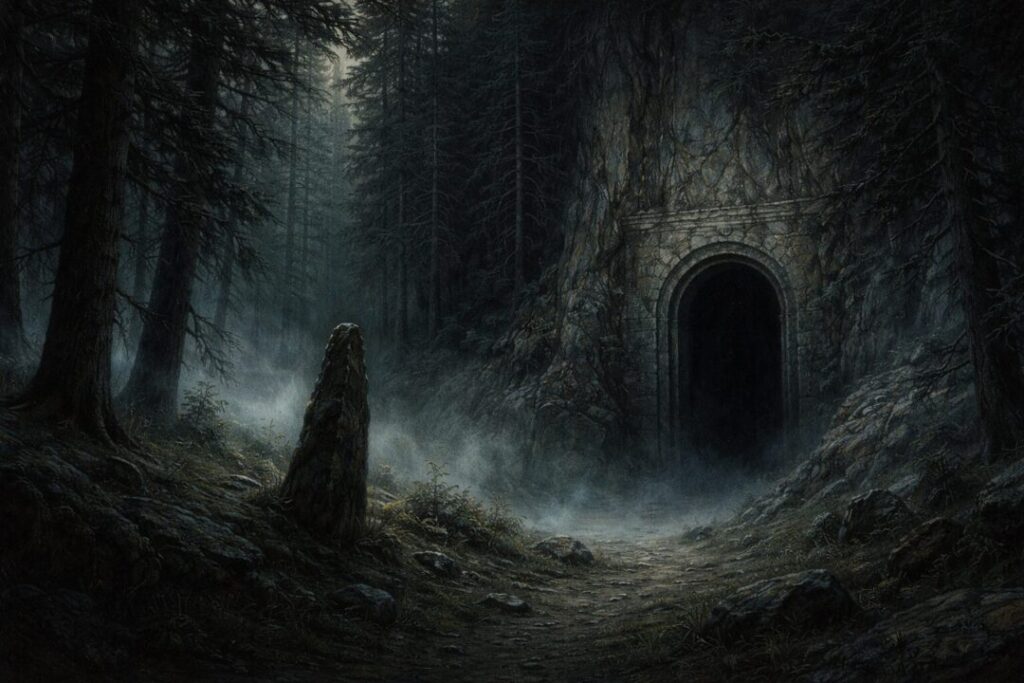
It is not merely a gap in rock. It is approached with ceremony: ancient standing-stones, a black wood, a glen that ends in a sudden stone wall. And then the threshold itself, with carvings still visible but no longer legible—“signs and figures” above a wide arch, blurred by time and shadow.
Even the characters in the story treat it as a problem, not a landmark.
In the Rohirrim’s remembered lore, Théoden describes it as a “secret way” beneath the mountain to “some forgotten end”, a path whose secrets have gone untested since Baldor—heir of the Mark—passed within and was never seen again.
That alone is enough to spark the fan-question: who built it?
Was it Gondor? The Dwarves? Some nameless older folk?
The remarkable thing is that the text gives an answer—but it does so in the most unsettling way possible: not as exposition, but as a warning spoken by someone who dies mid-riddle.
The one line that points to the builders
When Brego and Baldor first come upon the doorway, they find a figure seated before it—an ancient “old man”, so withered and still that he seems almost part of the stone.
And this figure speaks the closest thing the legendarium offers to a builder’s attribution:
“It was made by those who are Dead, and the Dead keep it, until the time comes.”
If you are looking for a clean, named architect—“the masons of Gondor built it in year X”—you will not find one.
What you do find is a statement that identifies the makers by their fate: “those who are Dead.”
In context, that is not a generic phrase for “dead people.” The entire tradition around Dwimorberg is bound up with the Dead Men: the Men of the Mountains who swore allegiance to Isildur at the Stone of Erech, broke that oath, and were cursed to find no rest until it was fulfilled.
The lore sources summarise this group consistently:
- They were originally known as the Men of the Mountains.
- Before the foundation of Gondor, they had a history of serving (and worshipping) Sauron in the Dark Years.
- When summoned by Isildur to fight against Sauron, they refused, and Isildur pronounced the curse that bound their unquiet dead to the mountains.
So, who built the Door under Dwimorberg?
The only direct textual pointer is: the Men of the Mountains themselves—later known as the Dead Men—made it.
It is worth being precise about what is certain, and what is not.
The statement “made by those who are Dead” fairly grounds authorship.
But the texts do not give a construction date, a named craftsman, or a step-by-step account of how the door was cut and set into the rock. The “how” remains largely atmospheric: carvings, stone, and fear “like a grey vapour” flowing outward.
If you want to infer when it was made, the safest phrasing is cautious:
Because the door is said to be made by the Dead Men, it must have been built when they still possessed bodies and tools—before their lingering became purely spectral. The narrative does not date that moment, but it implies the door’s origins lie in the period when the Men of the Mountains still lived in (and shaped) the White Mountains.
Secondary references sometimes go further—placing its construction in the Second Age or proposing an earlier “dark temple” purpose—but that is interpretation built on later notes and inference, not an explicit statement in the main narrative.
The door inside the mountain that makes the mystery worse
Many readers focus so hard on the outer arch that they miss the more disturbing detail: the Paths contain another shut door.
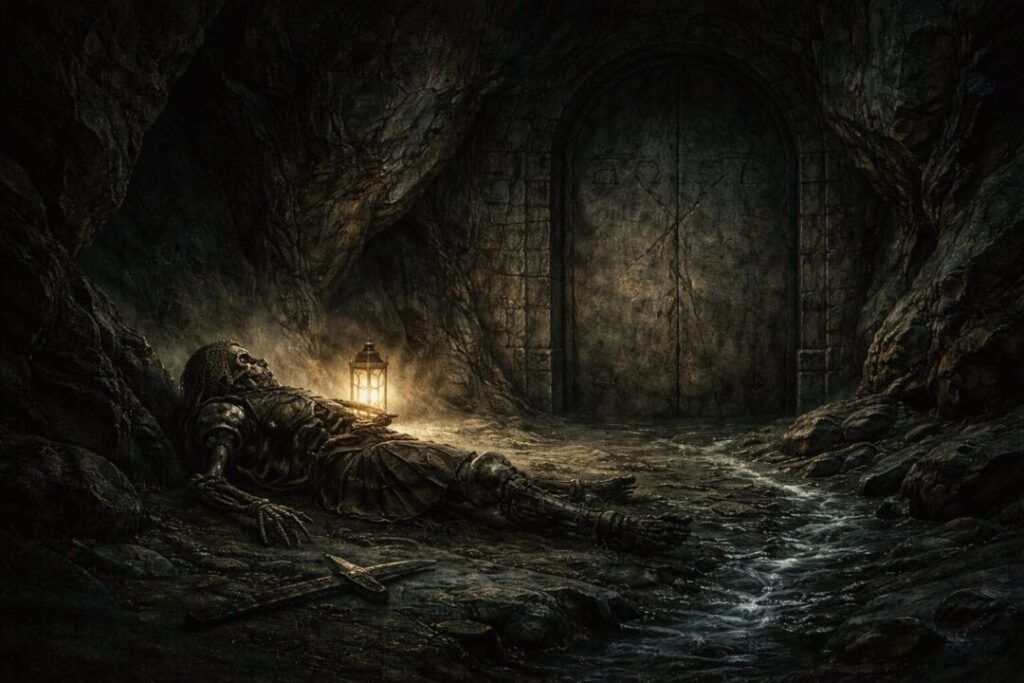
The passage is not presented as a straight tunnel with a single entrance and exit. Within it lies a great empty space in darkness, and there the company finds a skeleton—described in lore references as richly garbed, with a golden helm—lying before a stone door “shut fast”, with a broken sword nearby and a hand still clawing at the cracks.
This is widely taken (and supported by the Rohirrim’s own tale of Baldor’s vow and disappearance) to be Baldor’s end—though it is worth noting a subtlety: the published narrative does not pause to name the corpse in the moment; the identification is carried by context, appendices, and later editorial discussion.
So now the mystery splits into two:
- The outer door: the Gate to the Paths.
- The inner door: a shut stone barrier within the passage.
The first question is “who built the entrance?” The text’s answer is already eerie: it was made by the Dead Men, and they keep it.
The second question is harder: what is the inner door, and why is it shut?
Here we reach one of the few places where a late explanatory note presses into the darkness—not as absolute certainty, but as informed probability.
A note preserved through The Lord of the Rings: A Reader’s Companion (as reproduced in reputable lore summaries) suggests that the “special horror” of the closed door before Baldor’s skeleton is “probably” because it opened into an “evil temple hall”.
The same note proposes a grim reconstruction of Baldor’s death: that the door was shut against him, and that enemies who had followed him came up silently, broke his legs, and left him to die unable to find any way out.
Two things matter here for lore accuracy:
- This is not presented as a definite “this is what happened” in the main story; it is framed as “probably” in the note.
- It nonetheless provides the most textually grounded explanation we have for why a second door exists at all: it implies that at least part of the under-mountain complex included constructed halls set apart—something more like a sealed chamber than a public roadway.
That is the hinge-point where the usual fan-guess (“it’s just a haunted tunnel”) becomes insufficient.
Because if an “evil temple hall” lies behind an inner shut door, then the Door under Dwimorberg is not merely guarding a passage.
It is guarding access to a place with a moral history.
And the line “made by those who are Dead” begins to read less like trivia and more like indictment: the makers were not neutral masons. They were a people whose story includes allegiance, betrayal, and the long consequences of an oath.
What “until the time comes” implies
The second half of the old man’s warning is as important as the first:
The Dead keep the door “until the time comes.”
The tale treats that “time” not as a vague future, but as something bound to prophecy, inheritance, and the resolution of a broken oath.
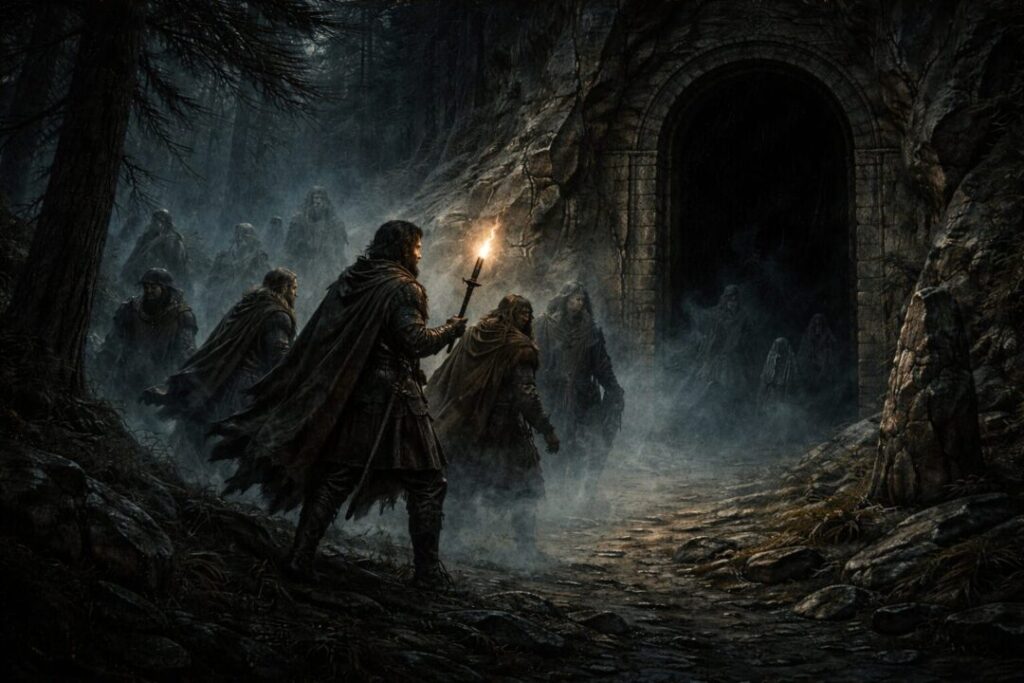
The lore surrounding the Dead Men includes the expectation that they will be summoned again by the heir of the one they swore to—Isildur’s heir. A prophecy attributed to Malbeth the Seer speaks of an hour when “the oathbreakers” will awaken and the heir will pass the door to the Paths of the Dead.
In the War of the Ring, that is precisely the role taken by Aragorn: he enters by the Door, calls the Dead, and commands them to come to the Stone of Erech and fulfil their oath—after which he releases them from their unquiet.
This matters for the builder question because it tells you what kind of object the Door is.
It is not framed as a normal gate that could be opened by any determined traveller. It is a threshold whose accessibility is tied to moral authority and timing: the Dead “keep” it, and it opens in the context of the heir’s need and summons.
So the most lore-faithful answer to “who built it?” is also the most thematically consistent one:
The Door under Dwimorberg is presented as the work of the Men who became the Dead Men—and it remains, in a sense, under their custody until the story demands its resolution.
And the deeper you follow the textual hints, the less the Door feels like set-dressing.
It becomes a relic of a people’s dark past—one that still has power over the living, not through spells or flashing magic, but through an older Tolkienian force: the binding weight of an oath, and the long shadow cast by breaking it.
Sources & Notes
- J.R.R. Tolkien, The Lord of the Rings, Book V, Chapter 2, “The Passing of the Grey Company” — gives the Door under Dwimorberg, the old man’s warning that it was “made by those who are Dead,” Aragorn’s passage, and the summoning of the oathbreakers.
- J.R.R. Tolkien, The Lord of the Rings, Appendix A, “The House of Eorl” — preserves the Rohirrim tradition of Brego, Baldor’s rash vow, and Baldor’s disappearance through the forbidden Door.
- J.R.R. Tolkien, The Lord of the Rings, Book V, Chapter 2, “The Passing of the Grey Company” — also contains Malbeth’s prophecy and the link between the Door, Isildur’s heir, Erech, and the unfulfilled oath.
- J.R.R. Tolkien, The Lord of the Rings, Appendix A, “Gondor and the Heirs of Anárion” — gives the wider history of Isildur, the Stone of Erech, and the oathbreakers’ place in the early South-kingdom tradition.
- Wayne G. Hammond and Christina Scull, The Lord of the Rings: A Reader’s Companion, notes to “The Passing of the Grey Company” — discusses Tolkien’s late note on the inner closed door and the probable “evil temple hall,” useful as commentary rather than direct canon.