There is a moment in The Return of the King that feels like stepping into a folk tale.
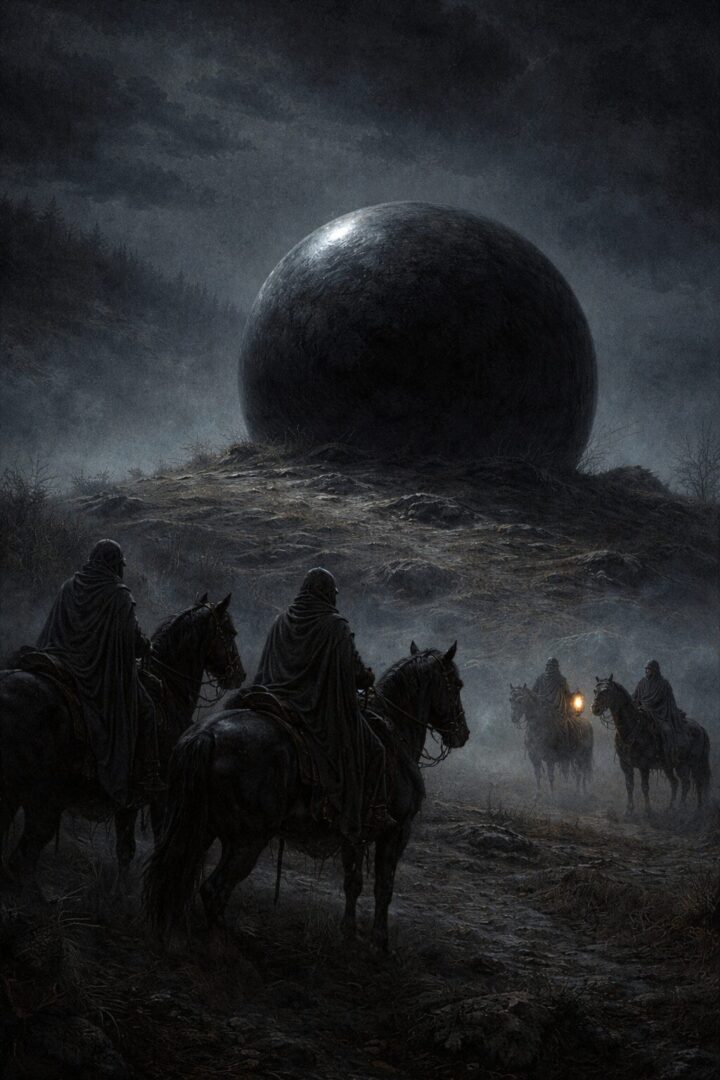
The Company rides hard through a frightened land. Lights go out as they pass. Doors are barred. People cry out a name like a warning: “The King of the Dead!”
And then, just before midnight, they come to a hill that no one nearby will approach.
On its summit sits something that does not resemble the ruins of a city, or a cairn, or any monument that “belongs” to the landscape of Gondor.
It is simply a black globe.
Half buried. Smooth. The height of a man.
The Stone of Erech is one of those objects in Middle-earth that arrives as if it has always been there—without explanation, without origin-story, without craftsmanship on display. It is not “beautiful” in the way a work of Elvish making is beautiful. It is not obviously useful. It is not even clearly worked.
Yet the narrative treats it as heavy with meaning.
So heavy, in fact, that it becomes the place where an oath is taken—and where the consequences of breaking that oath last until the War of the Ring.
That alone would make it memorable.
But the Stone also carries a second, quieter provocation—one sentence, delivered like a scrap of remembered history:
It “had been brought out of the ruin of Númenor and there set by Isildur at his landing.”
How?
The text never supplies a logistical answer. There is no scene of loading it, no account of hauling it, no explanation of what it is made from, or why it was worth saving.
And because the book is careful with its wording, even the claim of origin arrives hedged in tradition rather than certainty: it was brought “it was said” from Númenor by Isildur.
The best we can do, if we are being strict with the lore, is to follow the clues that are present—and let the silences remain silences.
What the text actually says about the Stone’s origins
The narrative gives two competing explanations that circulate among the people of the region.
Some believe the Stone “had fallen from the sky.”
That belief is immediately presented as local speculation. It is the kind of explanation people invent for an object that seems alien: too smooth, too dark, too unlike the surrounding rock.
Then the book offers an alternative tradition, held by those who still remember “the lore of Westernesse”: the Stone came from Númenor and was set on the hill by Isildur at his landing.
When Aragorn speaks of it earlier, he is even more cautious: “a black stone that was brought, it was said, from Númenor by Isildur.”
Between these two passages, three grounded conclusions become possible:
The Stone is not treated as a natural feature of the hill; it is treated as something placed there.
Its Númenórean origin is presented as remembered lore, not demonstrated fact in the scene.
Whatever its origin, by the time Gondor is being formed it is already functioning as the physical site of a binding oath.
That last point is crucial, because it tells us why the Stone matters narratively, even if we never learn its “engineering” story.
Why “brought out of the ruin” is the heart of the puzzle
The phrase “brought out of the ruin of Númenor” sounds straightforward until you remember what Númenor’s ruin was.
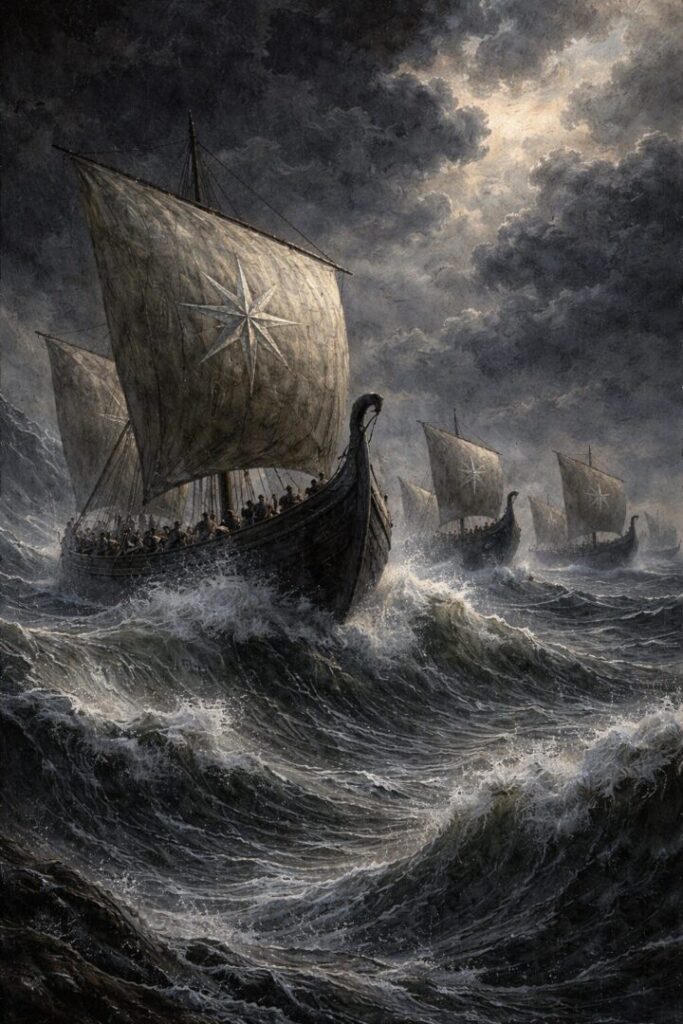
In Appendix A, the Downfall is described plainly: Númenor was “thrown down and swallowed in the Sea,” and the last leaders of the Faithful—Elendil and his sons—escaped with nine ships, carried by “a great storm” and cast upon the shores of Middle-earth.
Once Númenor is swallowed, there is no coastline to revisit, no quarry to return to, no harbour to load cargo from. The physical place is gone.
So “brought out of the ruin” cannot reasonably mean that someone sailed back later and recovered a globe of stone from the seabed. The text never suggests anything like that, and the nature of the Downfall as described makes such a recovery implausible as a literal reading.
A more conservative reading is therefore implied by the wording itself:
“Brought out of the ruin” can mean “carried away in the moment of catastrophe”—taken out of Númenor’s fate as the ruin fell, not taken from a ruined landscape after the fact.
That is still an interpretation, but it is an interpretation guided by the text’s own constraints.
In other words: if the Stone truly came from Númenor, then it almost certainly had to be already on a ship (or being moved to one) when the Downfall struck.
And that forces the question into a narrower, more interesting form:
If precious space on a fleeing ship was limited—limited enough that only nine ships carried the last leaders of the Faithful—why was this black globe worth taking at all?
The book does not answer that directly. But it does give us something else that is surprisingly relevant.
It tells us what Númenórean ships were capable of carrying.
What the lore tells us about Númenórean ships and cargo
When people imagine Númenórean ships, they often picture elegance: tall masts, proud prows, white sails. But the texts also stress something practical.
In Unfinished Tales, Númenórean seafaring is described in terms of scale and capacity: their ships “became ever larger and of greater draught,” able to make far voyages “carrying many men and great cargoes.”
This matters for the Stone of Erech question because it establishes a baseline:
The idea of transporting a single enormous object by ship is not inherently out of character for Númenórean capability. The lore explicitly allows for large vessels that bear heavy loads across long distances.
The texts do not say such ships carried monoliths. They do not say the Stone was ever used as ballast. They do not describe cranes, rollers, or specialised hauling tools.
But they do confirm that Númenórean shipping was not confined to small craft and light cargo.
That is as far as we can go without inventing details.
A conservative reconstruction of the Stone’s journey
If we keep ourselves strictly bound to what is stated and what is implied by necessity, the most conservative reconstruction looks like this:
The Stone is already in Númenor during its final era, and it is considered significant enough—by someone, at some level—that it is taken aboard a ship.
It survives the catastrophe that destroys Númenor, because it is not in the land when the land is swallowed. Whether it was loaded minutes before flight or stored aboard long in advance is not stated.
It reaches Middle-earth in the same broad historical movement that brings the Númenórean realms in exile into being, associated in the narrative with Isildur’s “landing.”
It is moved inland to the Hill of Erech and set there before the oath of the King of the Mountains is sworn upon it, “in the beginning of the realm of Gondor.”
Everything beyond this is logistical detail that the text leaves unrecorded: where exactly Isildur landed, what route was taken, what manpower or engineering was used to haul the Stone from shore to hilltop.
It is tempting to reach for “magic” here, because the Stone is described as “unearthly.”
But that word describes appearance, not mechanism. The book gives us no suggestion of spells, levitation, or supernatural transport. When the supernatural arrives in the Erech sequence, it arrives through an oath and a curse—not through the physical movement of stone.
So if there is a Middle-earth answer to the transport question, it is not “magic did it.”
It is: the texts deliberately do not say—except to imply that Númenórean capacity and urgency made it possible.
The “magic” of Erech is not in the stone
The Stone of Erech functions like a focal point for a moral law the legendarium treats as real: oaths bind, and breaking them has consequences.
The book places three moments around the Stone:
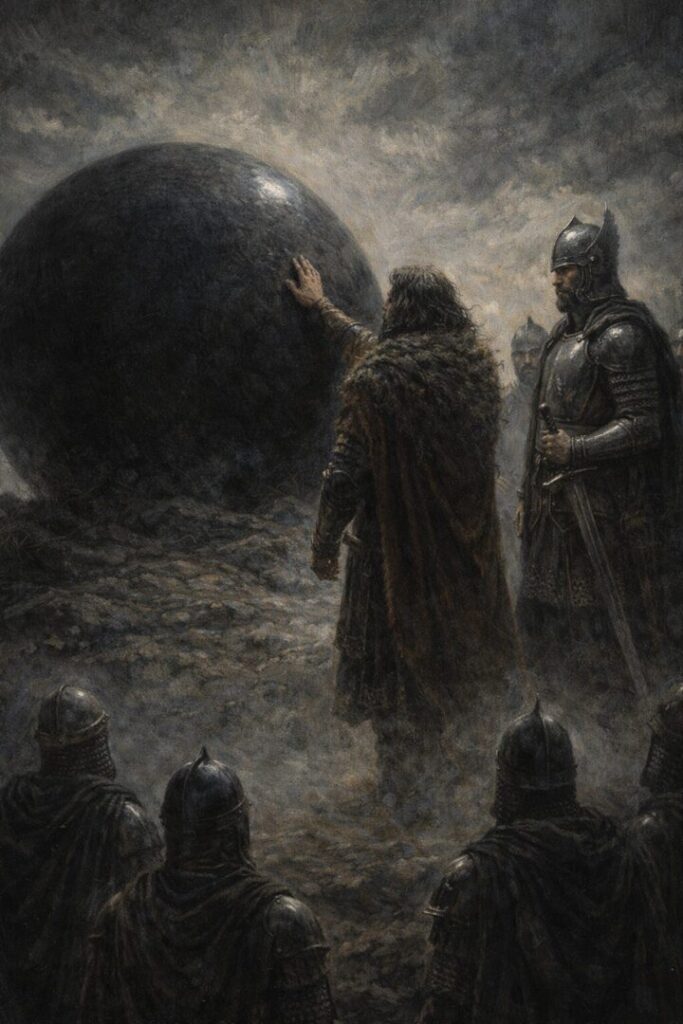
The oath: the King of the Mountains swears allegiance to Isildur upon the stone.
The betrayal and curse: when summoned to fight against Sauron, the Men of the Mountains refuse, and Isildur declares a curse that they will “rest never” until their oath is fulfilled.
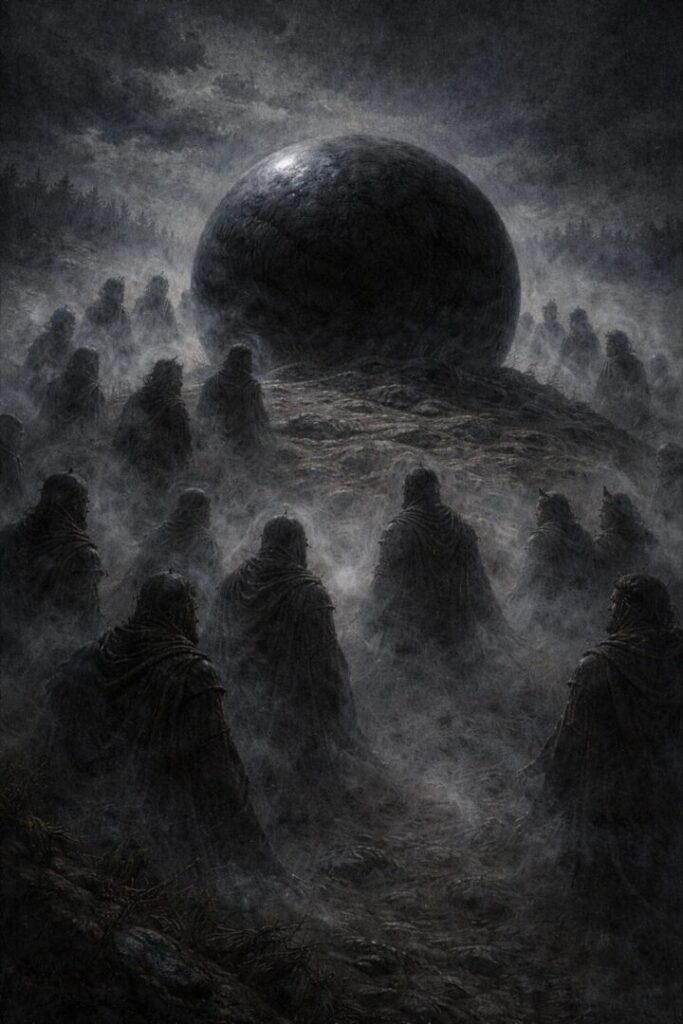
The reckoning: in the War of the Ring, Aragorn comes to the Stone in the dead of night, a horn is blown, answering horns are heard “as if … in deep caves,” and the oathbreakers respond that they have come “to fulfil our oath and have peace.”
In that sequence, the Stone does not act. It does not glow, speak, or move.
It stands.
It witnesses.
And the land around it remembers.
Even the people of the valley treat it less like an object and more like a boundary-marker for dread: they will not dwell near it; they say it is a trysting-place of the Shadow-men; they imagine whispering shapes gathering around it in times of fear.
That folk-belief is not framed as “correct” in a literal sense, but it is framed as understandable—because the curse has made the Hill of Erech a place where terror lingers.
So the Stone’s true “power” is not that it is enchanted.
Its power is that it is the physical anchor for a vow that outlasts kingdoms.
What remains a mystery on purpose
If you came looking for a definitive mechanical answer—how many men hauled it, what roads they used, whether it rolled on timber or rode in a ship’s hold—the canon does not provide it.
In one sense, that absence is frustrating.
In another sense, it is consistent with how the story treats the Stone. The narrative is not interested in the Stone as engineering. It is interested in the Stone as evidence: a tangible remnant that turns an oath into something you can stand beside in the dark.
And that returns us to the smallest phrase in the whole discussion, the one that quietly controls everything:
“It was said.”
The book itself signals that the Stone’s Númenórean origin is a matter of remembered lore—an inherited explanation that competes with local superstition.
That framing does not mean the tradition is false.
It means the story is content for the Stone to remain what it feels like in the scene: a relic from a lost world, inexplicable in its particulars, undeniable in its effect.
So how was it brought from Númenor to Middle-earth?
The strict answer is: the texts do not tell us how.
The lore-grounded answer is: they tell us only enough to make one conclusion difficult to escape—if it truly came from Númenor, it had to leave in the hour of ruin, carried east by the same seaborne survival that founded the realms in exile.
And perhaps that is the point.
The Stone of Erech is not there to prove what men can move.
It is there to prove what men cannot outrun.
Sources & Notes
- J.R.R. Tolkien, The Lord of the Rings, Book V, Chapter 2, “The Passing of the Grey Company” — describes the black Stone of Erech, the traditions about its origin, Isildur setting it at his landing, and the oath sworn there by the King of the Mountains.
- J.R.R. Tolkien, The Lord of the Rings, Appendix A, “Gondor and the Heirs of Anárion” — places Isildur and Anárion in the founding of the South-kingdom after the Downfall, the historical setting for Erech and the oathbreakers.
- J.R.R. Tolkien, The Silmarillion, “Akallabêth” — recounts Númenor’s drowning, the escape of Elendil and his sons in nine ships, and the storm-driven arrival of the Faithful in Middle-earth.
- J.R.R. Tolkien, Unfinished Tales, “A Description of the Island of Númenor” — gives the relevant background for Númenórean seafaring, shipbuilding, and the scale of voyages before the Downfall.