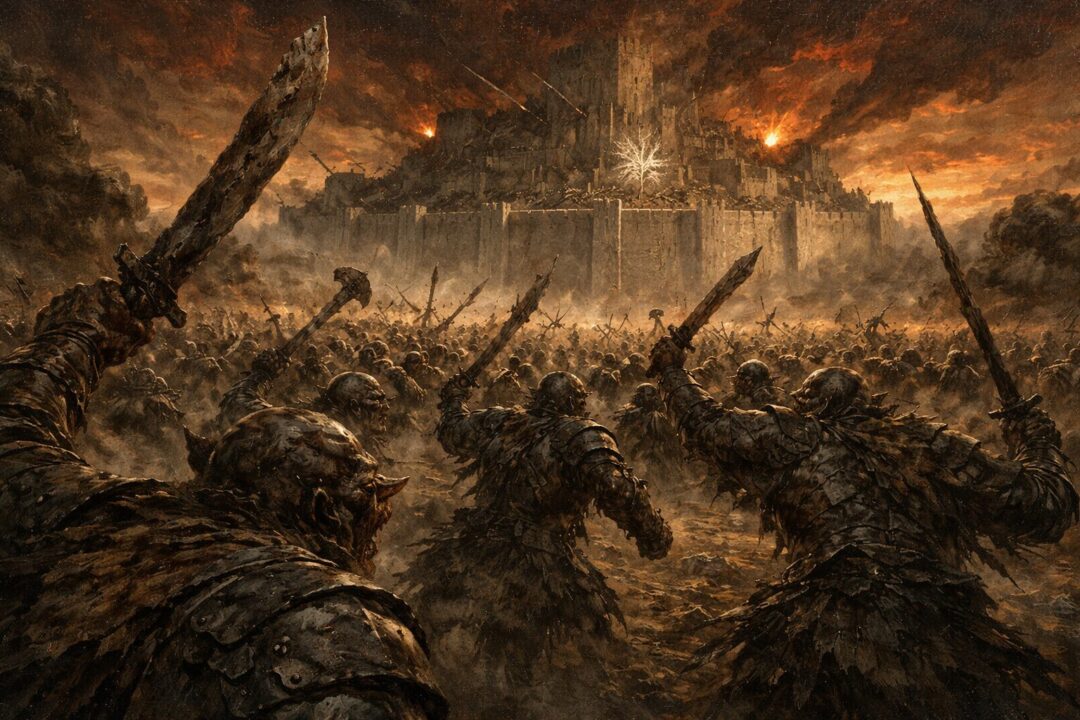
“You must dig swift and deep, if you wish to hide from Orcs.” In Tolkien’s world, orcs are relentless hunters, and this warning from Legolas illustrates the fear they inspire. But how would they describe the War of the Ring? The Orcs’ perspective is nearly invisible in the books, yet hints in the lore allow us to imagine it – always keeping lore-accuracy and Tolkien’s vision at the core.
Born of Morgoth’s Mockery
All versions of Tolkien’s mythology agree on one thing: orcs were not born naturally. As The Silmarillion explains, Morgoth bred the “hideous race of the Orcs in envy and mockery of the Elves”. In other words, evil twisted life that already existed – Orcs were corrupted from Elves (or, in later revisions, from Elves and Men) rather than beings created out of nothing. This corruption was profound: “deep in their dark hearts the Orcs loathed the Master whom they served in fear, the maker only of their misery”. Even at their creation, Orcs bore a torment: they hated Morgoth (and later Sauron) even as they obeyed him. This one line suggests a tragic reality – Orcs are victims of evil as much as instruments of it.
Tolkien implies that Orcs had lives and wills. They “had life and multiplied after the manner of the Children of Ilúvatar”, meaning they grew and had children like Elves and Men. The phrase “if they are to live at all, they have to live like other living creatures” (as Frodo says) hints at this too. The Dark Lords could not create life; they only corrupted it. Thus an Orc on the battlefield in T.A. 3019 is a living, thinking creature – however tortured and evil – not just a mindless beast.
Life Under the Dark Eye
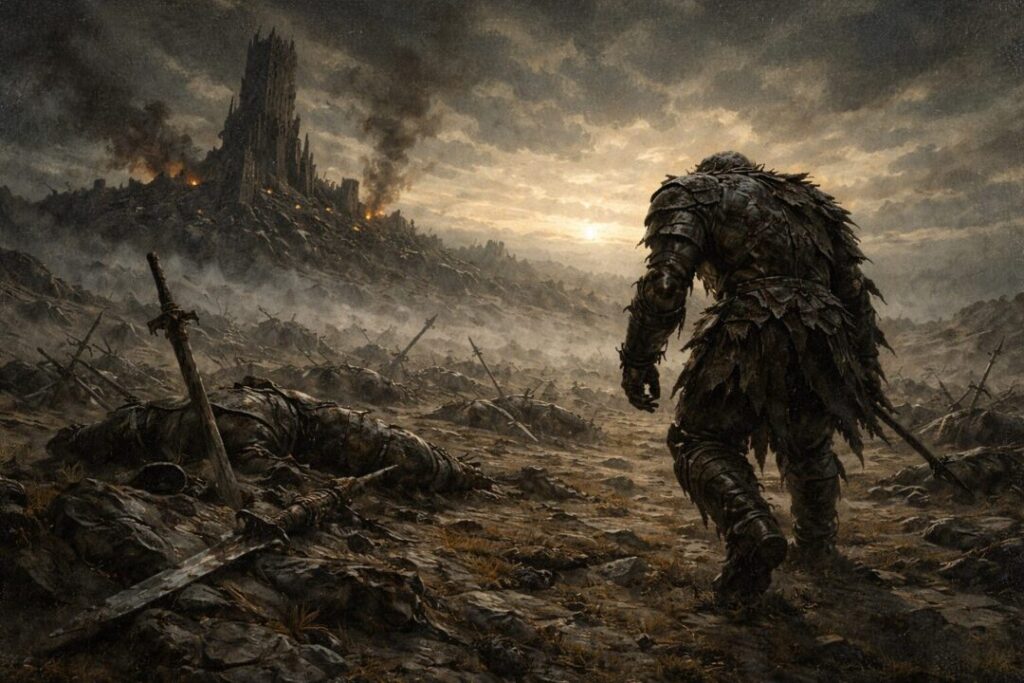
By the Third Age, orcs were the backbone of Sauron’s armies. Tolkien notes that in Mordor and Dol Guldur, and even serving Saruman, Orcs were everywhere during the War. But the Orcs’ world was one of fear, cruelty, and chaos. As The Peoples of Middle-earth (a posthumously published collection) states: “Orcs were pitiless and took pleasure in all kinds of cruel and wicked acts”. They delighted in slaughter, savagely battling enemies with no mercy. Yet that same source adds a crucial point: many orcs were cowardly and far less formidable than Men or Elves. They were effective only in overwhelming numbers or under threat.
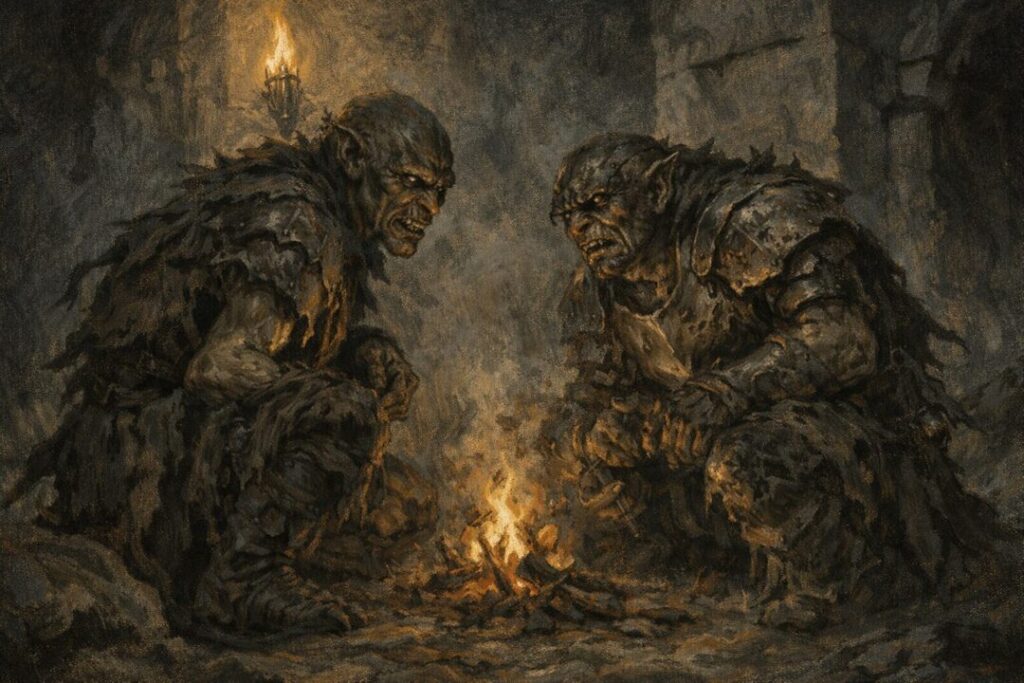
Their internal society was fractious. Without a Dark Lord’s grip, Orcs often turned on each other. Tolkien explains that Orcs “often disobey[ed] their commands or fight amongst themselves”. Even experienced captains like Gorbag and Shagrat were quick to argue and even murder one another over spoils. In one notable scene (only summarized in Tolkien’s narratives), these two Orc captains quarrel fiercely when they find a Hobbit’s treasure: Gorbag tries to take Frodo’s mithril coat and is stabbed by Shagrat in return. This brawl among officers reveals something telling: greed and survival often outweighed duty for an Orc.
Yet despite their cruelty, Orcs had to obey the Dark Lords or face death. Tolkien notes that under Sauron “Orcs were so completely dominated by his will that they would die for him on command without hesitation.” Sauron exploited every tribe’s petty hatreds, uniting them by hatred of Men and Elves. In other words, Sauron didn’t create loyalty – he forced it. An Orc grunt might hate the Elves, but what it truly feared was the whip and fire of Mordor if it disobeyed.
Food and environment were constant struggles. Orcs were perpetually hungry and filthy; they drank tainted water and ate raw meat or carrion. Tolkien’s writings imply they were “always hungry” and even turned on their own wounded comrades for scraps. This harsh life bred cunning: they became excellent trackers and ambushers. Elves understood this well, as Legolas warned: Orcs will hunt any trace, any scent, unless you hide completely. For an Orc in the night, smelling the smoke of an enemy camp or the scent of an Elven horse is a blazing beacon of prey to kill.
What did they know of the Ring? To an Orc, the One Ring was a rumor among many. Sauron’s command — “Bring the Halfling alive! The Halfling alive!” — was their mission. But the Ring’s true history and power were far beyond their understanding. When Sam overheard Gorbag and Shagrat in Cirith Ungol, they never mentioned Mordor’s plans for the Ring; they argued over a mithril coat and referred to Frodo as “a precious bit of cargo”. That single word precious is ironic – to Sam it meant something of ultimate value, but to the Orcs it was just a descriptor for a prisoner. This scene (drawn from Tolkien’s narrative) shows Orcs treating Frodo as a commodity, not a hero or a threat.
Into Battle, Under Sauron’s Command
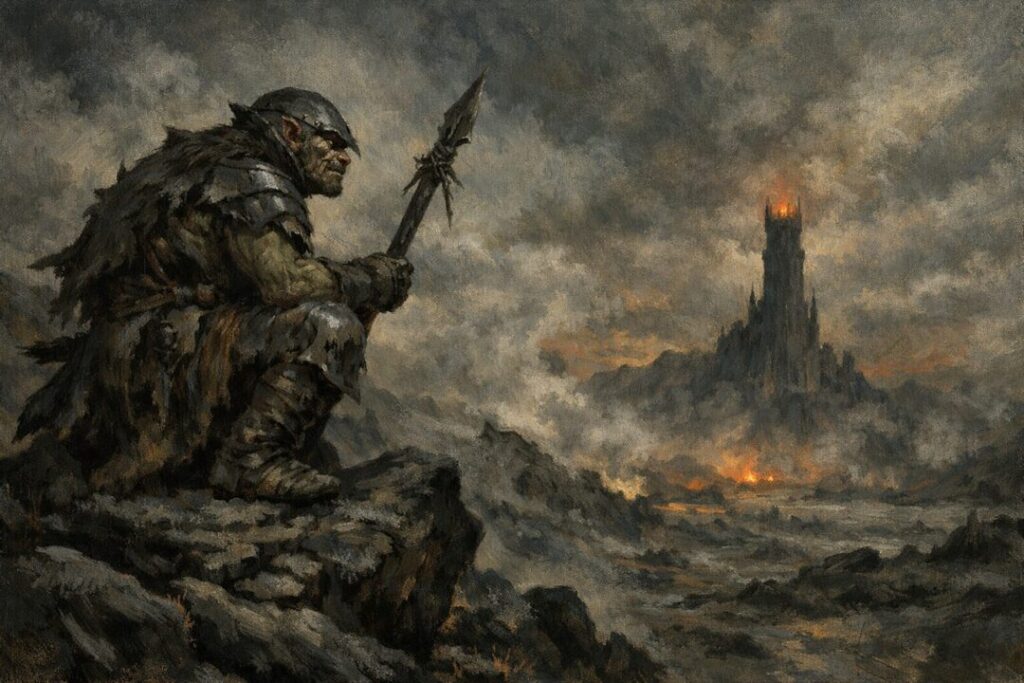
Imagine a dark dawn in Mordor: black rocks and sulfur in the air, armies of Orcs lining the slopes of Mount Doom. A single orc soldier, gazing east, sees the sky glow with war. Riders in white (Aragorn’s host) crest the land beyond the Black Gate. Through Orc eyes, this is terrifying: legions of Men who fight with honor and know courage in daylight, a place where Orcs always fled. The orc on watch may not grasp who Aragorn is, but senses the tide has turned. He doesn’t celebrate, only wonders if he’s next to fall.
In the fields of Pelennor, Orcs ran loose. They heard the Witch-king’s scream as Éowyn struck him down — a sound of doom. These Orcs might think only: “Our Nazgûl is dying; now nothing will stop the cavalry!” Doubt and panic would spread. Tolkien tells us Saruman’s Uruk-hai (and surely Sauron’s Orcs) “were bred for war”, but no living creature is meant to endure the slaughter of such battles. After Pelennor, Orc armies were broken: at Hornburg by the horses, at Minas Tirith by fire. Many orcs died or fled, too terrified even to fight or regroup.
When Sam and Frodo were carried off to Cirith Ungol, orc enemies tramped past other fronts. In Mordor, the final events unfolded – the Drop of the Dark Tower. At midnight, the Ring was destroyed. Although orc minds would not understand the magical chain-reaction, they would feel it. Tolkien describes Barad-dûr’s walls crumbling in a thunder-clap and the Eye exploding. An Orc tower-guard might have seen the Dark Tower shudder and blink out, then the morning star rising bright for the first time. In that confusion, command collapsed. Sauron was dead; their dread master’s voice silenced.
Aftermath: The Scattered Survivors
With Sauron defeated, Tolkien says the Orc armies were destroyed or scattered. They had no orders now – only instinct to survive. Some Orcs, especially those deep in Mordor, tried to flee west or hide in caverns. Others in the north (like the remnants of Bolg’s brood) hid in mountains. But life for an Orc became even bleaker: free men and elves hunted them like vermin. By the Fourth Age, Orcs in places like Moria were entirely expelled. Any that remained had to assimilate or go deep underground.
Tolkien never gives Orcs a new master after Sauron. Their story quietly ends. This is telling: they are not pardoned or uplifted. The wizard Gandalf explicitly says Eru (God) will judge Orcs, but practically none are shown mercy in the saga. Frodo muses that even though Morgoth “ruined and twisted” them, they cannot easily be “set free.” In that sense, Orc lives in the End of the Third Age are bleak and unheroic: far from victory or redemption, only aimless ruin.
Why the Orc Perspective Matters
Retelling the War of the Ring from Orc eyes isn’t just a gimmick: it highlights a deeper truth. Tolkien’s legendarium suggests that victory and heroism do not erase the wounds of evil. Orcs were born of cruelty, but they felt fear, pain, and hatred too. Some lines hint at that tragic angle: Orcs “loathe[d] the Master”, showing a spark of self-awareness. They are far from simple monsters; they are, in Tolkien’s own moral universe, pitiable victims of the most dreadful deformity.
By imagining an Orc’s viewpoint, we see the cost of the War on all sides. The Ring’s destruction means freedom for Elves and Men, but for an Orc soldier it means nothing but darkness and loss. In the silence after Sauron’s fall, their world is gone – and Tolkien doesn’t write a single happy ending for them. If Orcs had stories, they would be ones of despair, not triumph.
This other side of the story reminds us: Tolkien never allowed evil to be shallow. If Orcs speak at all, their words might ask: “What have we truly won?” In their case, victory was annihilation, and the “beast” within them was slain, not redeemed. Viewing the War through Orc eyes may reveal only emptiness – but that emptiness is a powerful part of the legendarium’s moral fabric.
Sources & Notes
- J.R.R. Tolkien, The Silmarillion, "Of the Coming of the Elves and the Captivity of Melkor" — on Morgoth breeding Orcs in envy and mockery of the Elves.
- J.R.R. Tolkien, The Lord of the Rings, Book IV, Chapter 5, "The Window on the West" — Frodo's warning that Orcs must live like other living creatures, since the Enemy cannot create life.
- J.R.R. Tolkien, The Lord of the Rings, Book VI, Chapter 1, "The Tower of Cirith Ungol" — Gorbag and Shagrat's quarrel, the mithril coat, and Orcish greed and fear around Frodo as prisoner.
- J.R.R. Tolkien, The Lord of the Rings, Book VI, Chapter 2, "The Land of Shadow" — Sam and Frodo overhear Mordor Orcs, showing hunger, harsh discipline, desertion, and forced service.
- J.R.R. Tolkien, The Lord of the Rings, Book VI, Chapter 4, "The Field of Cormallen" — Sauron's fall leaves his hosts leaderless, with many creatures scattering or destroying themselves.
- J.R.R. Tolkien, Letter 131 — Tolkien's account of Sauron's rule through domination and tyranny, useful context for Orc obedience under the Dark Lord.