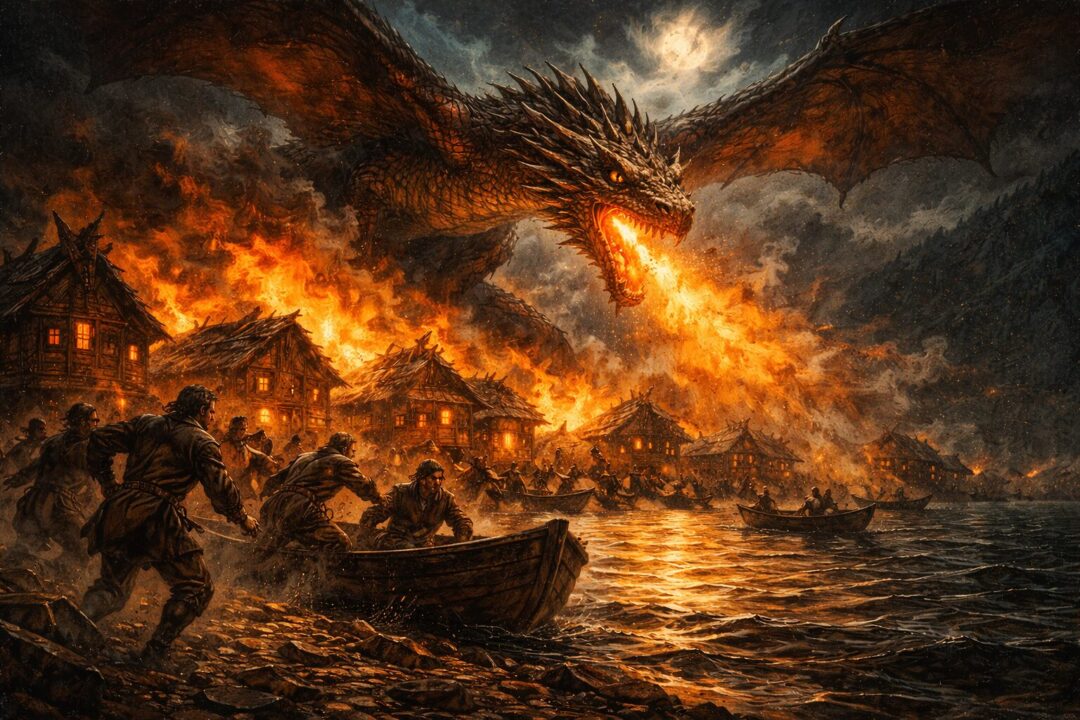
In The Hobbit, Bilbo Baggins slips from Smaug’s treasure-hall by the narrowest of margins.
He is invisible.
He is trembling.
He is alive.
But imagine the moment bending another way.
Imagine the dragon’s head turning a fraction sooner.
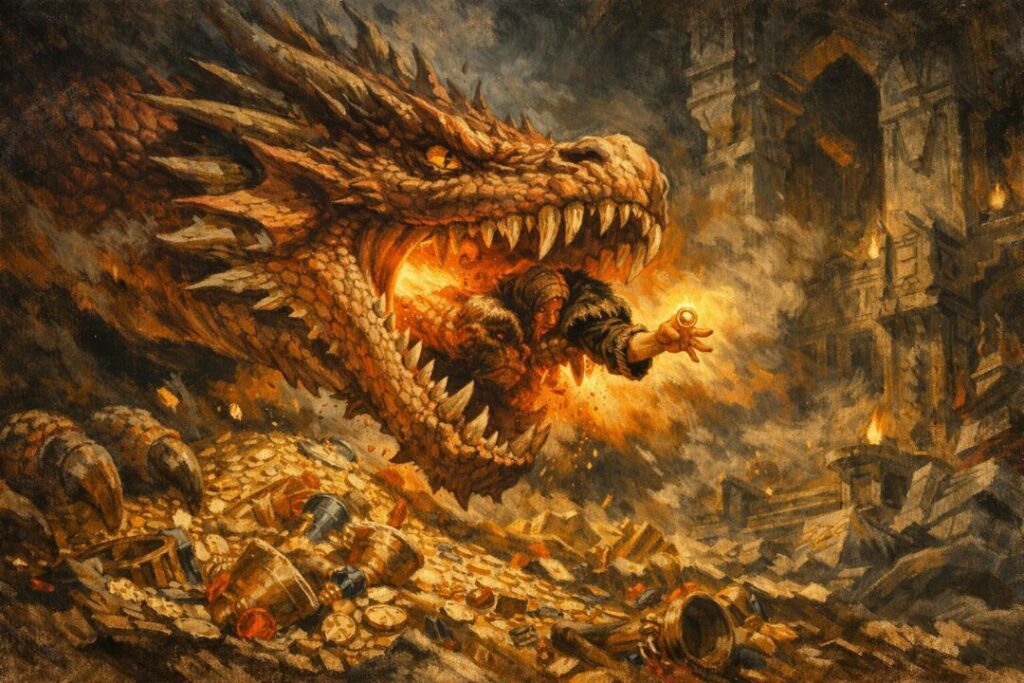
Imagine vast jaws closing in fire and shadow.
Imagine Bilbo Baggins swallowed whole — along with the One Ring.
The scene never happens. The text never allows it.
But the question lingers:
What would have become of the Ring if Smaug had devoured it?
The Ring Cannot Be Destroyed by Dragon-Fire
Before speculation begins, one truth must be established.
The One Ring cannot be destroyed by dragon-fire.
At the Council of Elrond, Gandalf makes this clear: though dragon-fire could consume some of the lesser Rings of Power, “there is not now any dragon left on earth in which the old fire is hot enough, nor was there ever any dragon… who could have harmed the One Ring.”
Only the fires of Orodruin — the Cracks of Doom — where it was forged, can unmake it.
This is not metaphor.
It is law within the structure of Middle-earth.
So if Smaug had swallowed Bilbo and the Ring, the Ring would remain intact.
It would not melt.
It would not crack.
It would endure.
Dragons and the Rings of Power
The texts tell us something else.
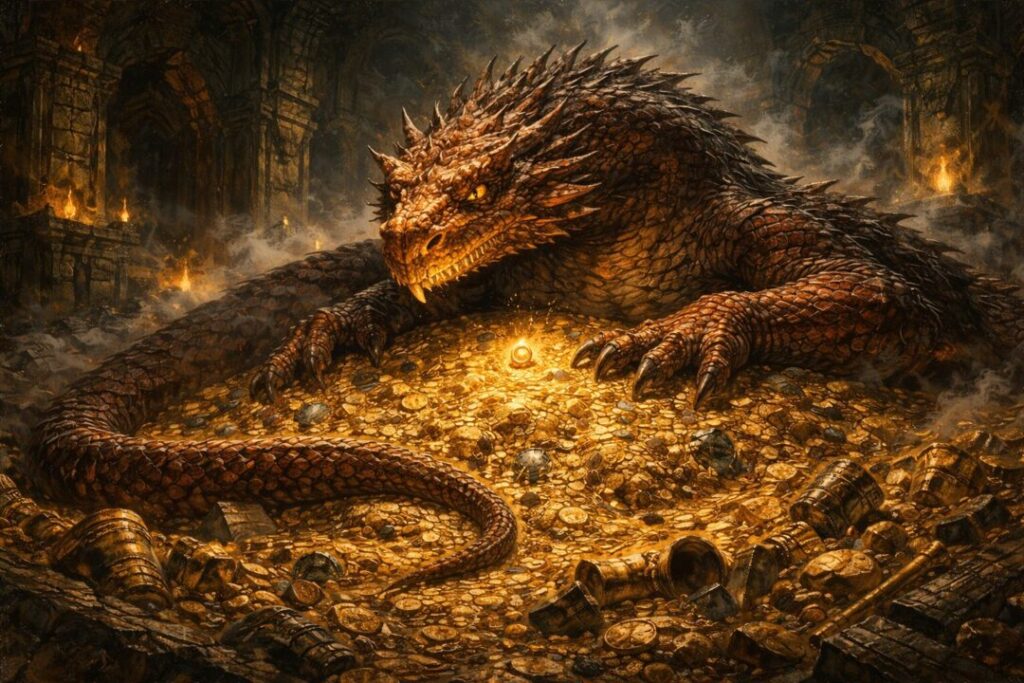
Of the Seven Rings given to the Dwarves, some were “consumed in fire,” devoured by dragons in their hoards. Others Sauron reclaimed.
But the One Ring is different.
It was not made by Elves.
It was not shaped by shared craft.
It was forged by Sauron alone, and into it he placed much of his own power.
Dragons have destroyed treasure before.
They have never destroyed this.
Smaug, for all his cunning and intelligence, is not described as a ring-wearer, nor as a being who seeks subtle domination. His nature is simpler and older: pride, greed, destruction, possessiveness.
If he swallowed the Ring, it would likely lie within his hoard — or within his body — as merely another golden thing.
And yet the Ring is not passive.
The Will of the Ring
The One Ring has a will.
It abandons Gollum.
It slips from Isildur’s finger.
It works always to return to its maker.
If Smaug possessed it — knowingly or not — the Ring’s influence would still exist.
But here the texts grow silent.
We are never shown a dragon under the Ring’s influence.
We are never told how such a creature would respond.
Would Smaug feel a pull toward Mordor?
Would Sauron sense something stirring in the North?
The canon gives no direct answer.
What we can say with confidence is this:
The Ring does not grant arbitrary new powers. It enhances domination and bends the will toward Sauron’s design. Smaug already dominates by terror. He already hoards. He already burns.
It is entirely possible the Ring would do little more than deepen what was already there.
Smaug would not become a new Dark Lord.
He would remain a dragon — unknowingly carrying the instrument of Sauron’s return.
The Immediate Consequence: Erebor Remains Under Shadow
Bilbo’s survival is not incidental.
Without Bilbo:
- Smaug’s weak point is never revealed to Bard.
- Thorin’s quest collapses.
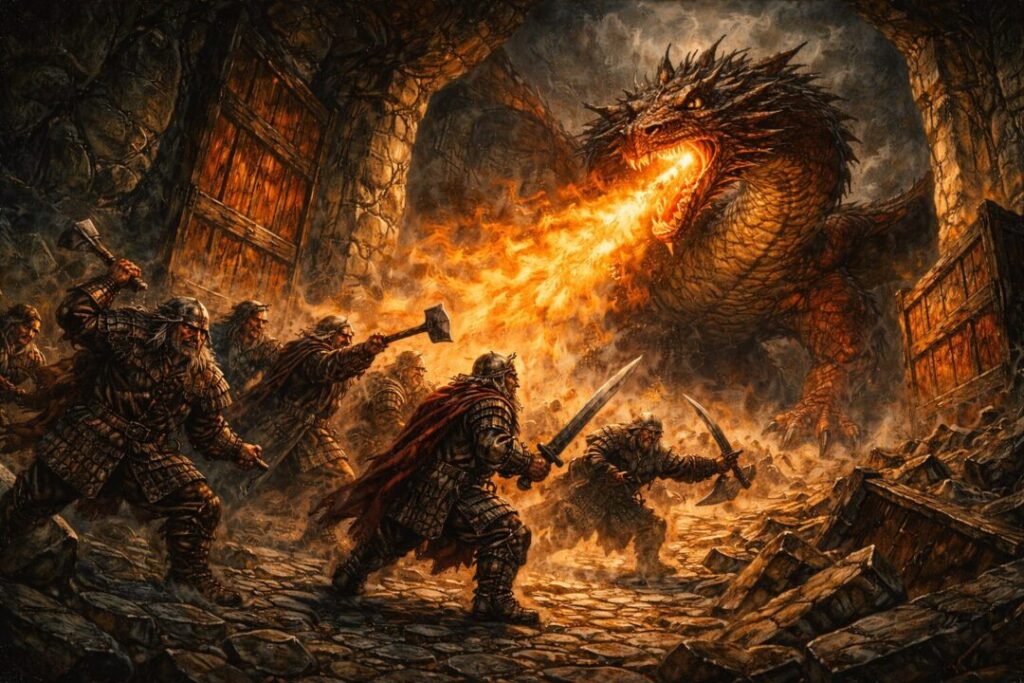
- Erebor remains occupied.
- Dale remains broken.
- The North stays under dragon-shadow.
Bard slays Smaug only after learning of the bare patch beneath his left breast — knowledge Bilbo brings from within the Mountain.
Without that knowledge, Smaug may well have survived the attack on Lake-town.
And if Smaug survives, the Ring remains hidden.
Not in Mordor.
Not in the Shire.
But buried beneath a mountain of gold.
What of Sauron?
At the time of The Hobbit, Sauron is not yet openly returned to Mordor. He is gathering strength after the White Council drives him from Dol Guldur.
In the canonical timeline, Sauron later learns that a hobbit from the Shire possesses a Ring of significance. That knowledge begins the long hunt.
But if Bilbo dies in Erebor?
There is no hobbit to question.
No name whispered under torture.
No Shire to search.
The Ring’s presence in the North might remain unknown.
Unless — and this is speculation — Sauron sensed it through other means.
The texts never confirm that Sauron can detect the Ring’s physical location unless it is claimed or used. When Frodo wears it at Amon Hen, Sauron becomes aware. When it lies idle, he does not.
If the Ring lies buried beneath Smaug’s treasure, unused and unworn, Sauron may remain ignorant.
The fate of the world might hinge on a dragon’s digestion.
If Smaug Dies Later
Dragons are long-lived, but not immortal.
If Smaug eventually fell — whether by age, by war, or by some later hero — the Ring would re-emerge.
Found by whom?
A dwarf reclaiming Erebor?
A plunderer?
An Orc?
A Man of Dale?
The Ring changes hands through chance and weakness. That pattern repeats across ages.
But one thing remains certain:
Whoever found it would face the same truth declared at the Council of Elrond:
The Ring cannot be used for good.
It must be destroyed.
And its destruction would still require Mount Doom.
Could the West Have Survived?
Here lies the darker implication.
Bilbo’s survival sets in motion:
- The restoration of Erebor.
- The alliance of Dwarves, Elves, and Men at the Battle of Five Armies.
- The strengthening of the North.
- The eventual resistance to Sauron’s forces during the War of the Ring.
If Smaug survives longer, the North remains weakened.
When Sauron later sends armies against Dale and Erebor, there may be no strong kingdom to resist him.
The War of the Ring is not fought only in Gondor.
It is fought everywhere.
Bilbo’s escape is one of the first dominoes.
Remove it, and the board changes.
The Ring in a Dragon’s Belly
There is something strangely fitting about the image.
The greatest instrument of domination in the world — swallowed by a creature of pure greed.
Power devoured by appetite.
And yet, in Tolkien’s moral architecture, evil does not consume evil into nothingness.
It persists.
It waits.
It works.
The Ring would not be neutralized by being eaten.
It would endure until it found another hand.
Why This “What If” Matters
This alternate path never happens.
But imagining it reveals something essential about the actual story.
The destruction of the Ring depends not on might — not on armies, not on dragons, not on kings.
It depends on:
- A hobbit slipping unseen through darkness.
- A dragon’s weak spot noticed.
- A choice to spare Gollum.
- A refusal to wield power for domination.
If Smaug had swallowed Bilbo, the path to Mount Doom might have closed before it began.
But the story we are given insists on something quieter:
History turns on small survivals.
Bilbo’s escape is not a footnote.
It is a hinge.
And in that hinge lies the fragile thread on which all Middle-earth hangs.
The Ring was never undone by fire alone.
It was undone by mercy — carried, step by step, by someone small enough not to desire it.
If Smaug had devoured Bilbo, the Ring would still have endured.
But hope might not have.
And that is the true weight of the question.
Sources & Notes
- J.R.R. Tolkien, The Lord of the Rings, Book II, Chapter 2, “The Council of Elrond” — Gandalf states that no dragon-fire, not even Ancalagon’s, could have harmed the One Ring; only the fire where it was made can unmake it.
- J.R.R. Tolkien, The Lord of the Rings, Book I, Chapter 2, “The Shadow of the Past” — explains the Ring’s survival, its abandonment of Gollum, and its tendency to move toward its maker through chance and weakness.
- J.R.R. Tolkien, The Hobbit, Chapter 12, “Inside Information” — Bilbo’s riddling talk with Smaug reveals the dragon’s pride, greed, keen suspicion, and the bare patch in his jeweled armour.
- J.R.R. Tolkien, The Hobbit, Chapter 14, “Fire and Water” — Bard learns of Smaug’s weak spot through the thrush and kills him, showing how Bilbo’s discovery becomes decisive for Erebor and Lake-town.
- J.R.R. Tolkien, Unfinished Tales, “The Quest of Erebor” — Gandalf’s later account stresses the danger of Smaug remaining in the North and potentially serving Sauron’s designs during the coming war.