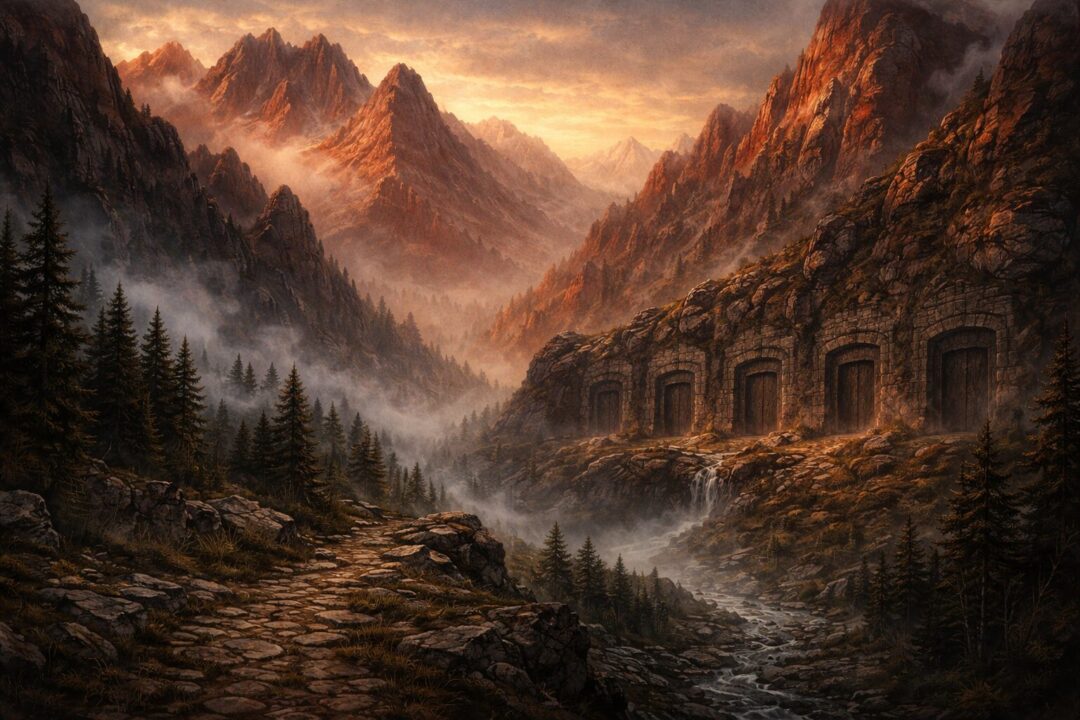
The “Eastern Dwarves” sound like a fan invention.
A hidden civilization beyond the maps.
A secret House lost in shadow.
An eighth clan no one speaks of.
But the idea does not begin with speculation.
It begins in the Appendices.
And what they quietly reveal is far more consequential than most readers realize.
Seven Houses — But Only One We Truly Know
The Dwarves were created as Seven Fathers, each laid to rest in different places of Middle-earth. From these Fathers came the Seven Houses.
This is stated plainly in The Silmarillion and repeated in Appendix A of The Lord of the Rings.
Yet when readers think of Dwarves, they almost always think of one line: the Longbeards—Durin’s Folk.
Durin awakened at Mount Gundabad in the north. His people founded Khazad-dûm (later Moria), and in later ages established Erebor and the Iron Hills.
Their history fills pages.
But Appendix A adds something easy to overlook: of the Seven Houses, only three are said to have had mansions in the western regions known to the Elves and Men of Beleriand and later Middle-earth.
Four Houses remained in the East.
The text does not give us their city names.
It does not describe their kings.
It does not map their mountains.
It simply states their existence.
That restraint is important.
Because it tells us this is not a forgotten draft idea. It is part of the structure of the world.
Where Was “The East”?
When the texts speak of “the East,” they do not mean merely the lands east of the Misty Mountains.
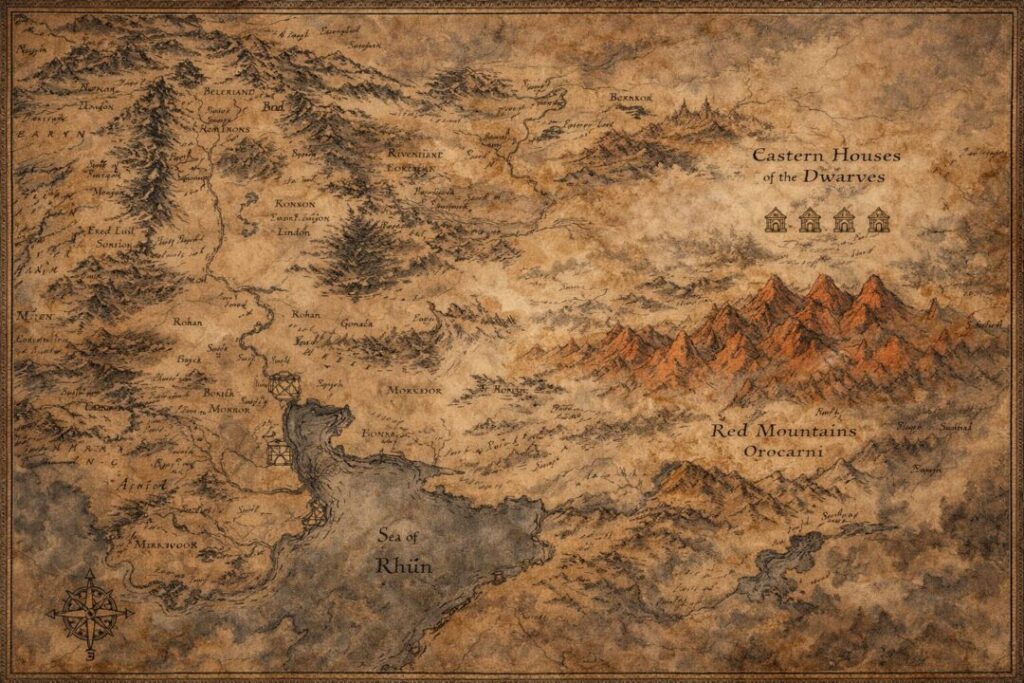
They mean lands far beyond the Sea of Rhûn.
The Dwarves were said to have been laid in sleep at various points across Middle-earth. Durin’s awakening in the northwestern regions is described in detail. But the others are not localized in the same way.
The implication—carefully stated—is that the remaining Fathers awakened in distant mountain ranges in the eastern regions of the world.
The texts do not name those mountains.
They do not confirm whether they lay near Orocarni (the Red Mountains), though later notes outside the main narrative tradition associate eastern Dwarf-houses with those ranges. Because this detail appears in late writings, it should be treated as supported but not narratively elaborated.
What is not speculative is this: most Dwarves did not live in the West.
The Dwarves we see are a minority branch.
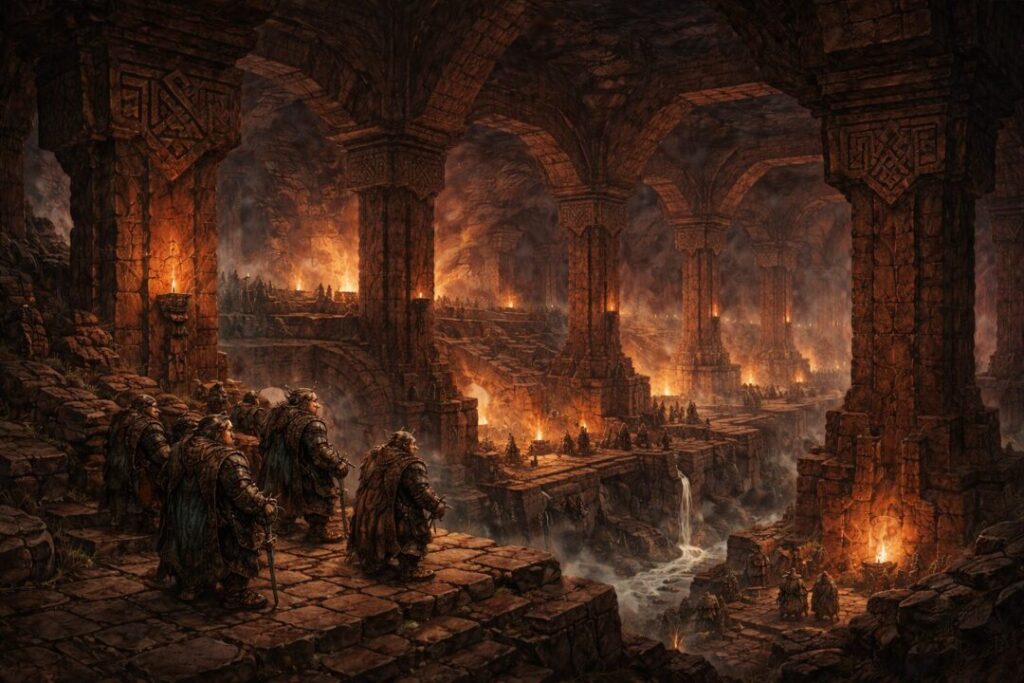
The War of the Ring Was Not Only Western
One of the clearest canonical references to the Eastern Dwarves appears in Appendix B, in the chronology of the War of the Ring.
In the year 3019 of the Third Age, while the Siege of Gondor takes place, another note appears:
Sauron stirred up Easterlings and attacked Dale and Erebor.
The Battle of Dale was fought. King Brand of Dale fell. King Dáin II Ironfoot was slain before the gates of Erebor.
The Dwarves and Men of Dale then withstood a siege inside the Lonely Mountain until news came of Sauron’s fall.
That is the western edge of the eastern war.
But Sauron’s influence did not end there.
Appendix A explicitly states that Sauron sought to win over the Dwarves of the East to his service.
It adds that some resisted him.
It does not claim that all were corrupted. It does not say they were conquered.
But it confirms that diplomatic and military pressure extended beyond Erebor.
This matters.
Because it means the War of the Ring was not geographically isolated to Gondor, Rohan, and the Shire.
It was continental.
The Eastern Dwarves were part of that unseen resistance.
Why We Know So Little
There is a temptation to fill the silence.
To imagine vast eastern kingdoms.
To invent eastern Dwarf-lords.
To describe lost cities of red stone beneath unknown peaks.
But the texts do not do this.
And the restraint appears deliberate.
The narrative perspective of The Lord of the Rings is western. It follows the line of Númenórean kingdoms, the Elves of Lindon and Rivendell, and Durin’s Folk.
The Eastern Houses simply do not intersect directly with the Ring-bearer’s path.
So they remain peripheral—not because they are unimportant, but because the story is not about them.
This pattern appears elsewhere in the legendarium. Entire civilizations exist at the edges of the map with only brief mentions. Their absence from the central narrative does not negate their reality.
In fact, it enlarges the world.
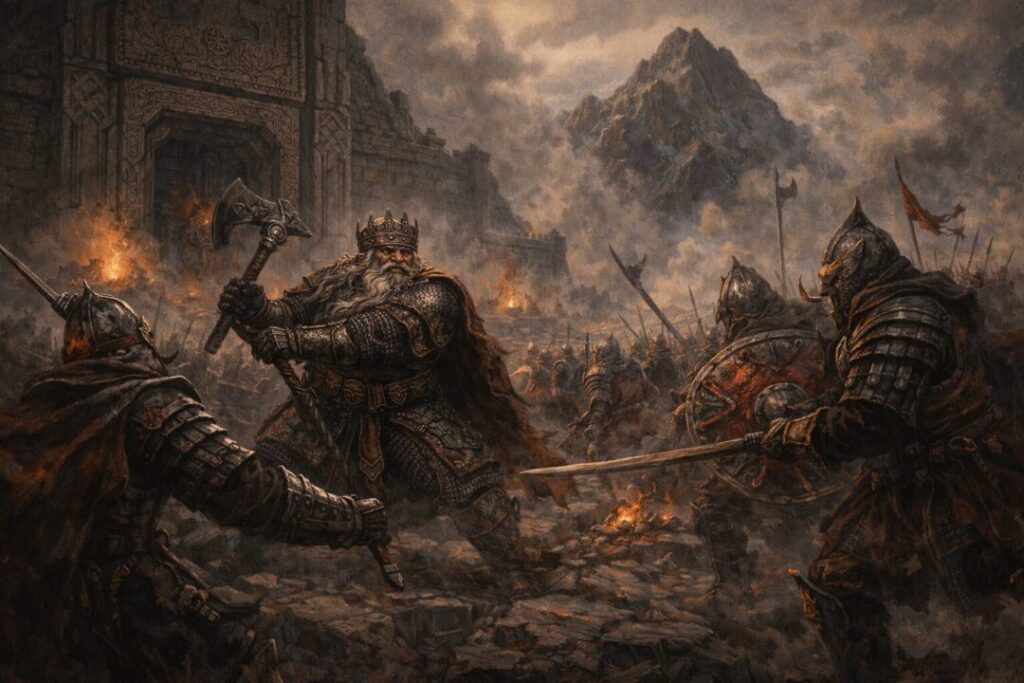
Were the Eastern Dwarves Different?
Canon does not describe cultural differences among the Houses in detail.
The Dwarves are consistently portrayed as sharing core traits: endurance, secrecy, craftsmanship, resistance to domination, and a guarded relationship with other peoples.
There is no textual basis for claiming the Eastern Houses were physically different, morally distinct, or culturally alien compared to Durin’s Folk.
Any such claim would be speculation.
What we can say confidently is this: all Seven Houses descended from one of the Seven Fathers. All were part of the same created people. All shared the fundamental Dwarvish nature described in The Silmarillion and Appendix A.
The differences between Houses are historical and geographic—not racial or mythic.
Did Any Eastern Dwarves Come West?
The texts record migrations between Dwarf realms in various ages. After the fall of Khazad-dûm in the Third Age, Durin’s Folk became scattered. Some went to the Iron Hills. Some to Erebor.
But there is no explicit statement that entire Eastern Houses migrated westward.
It remains possible that individuals traveled, traded, or intermarried between Houses. Dwarves are said to have maintained relations between their mansions.
However, no narrative episode confirms a mass relocation of one of the four Eastern Houses into the western lands of the story.
Again, the silence is careful.
The Eastern Dwarves remain where they began—in the East.
The Scale of Middle-earth
The existence of the Eastern Houses changes something subtle but profound.
It reminds us that the Dwarves we know are not the whole people.
Durin’s line is central to the narrative because it intersects with Elves and Men of the West. But structurally, it is one branch among seven.
That means that during the First, Second, and Third Ages, while Beleriand rose and fell, while Númenor drowned, while Gondor declined—vast regions of Middle-earth continued beyond the horizon of the main story.
Dwarven cities may have risen and fallen there.
Wars may have been fought against Sauron’s eastern dominions long before his assault on Minas Tirith.
The texts do not narrate these events.
But they confirm the peoples were there.
And they confirm Sauron sought to dominate them.
So Who Were the “Eastern Dwarves”?
Stripped of embellishment, the answer is simple.
They were four of the Seven Houses of the Dwarves, whose mansions lay in the eastern regions of Middle-earth.
They were not a secret race.
They were not a lost eighth House.
They were not an invention of later adaptation.
They are part of the core cosmology of the Dwarves.
Their anonymity is not evidence of absence.
It is evidence of scale.
Middle-earth is larger than the road from the Shire to Mordor.
And the War of the Ring was fought on more fronts than the ones we walk beside Frodo.
The Eastern Dwarves stand as a reminder of that.
Not mysterious.
Not legendary in the sense of forgotten myth.
But deliberately distant—anchored in the structure of the world, even if never brought fully into the light.
Sources & Notes
- J.R.R. Tolkien, The Silmarillion, “Of Aulë and Yavanna” — establishes the Seven Fathers of the Dwarves and their sleeping places, the deep background behind the Seven Houses.
- J.R.R. Tolkien, The Lord of the Rings, Appendix A, “Durin’s Folk” — gives Durin’s awakening at Gundabad, the centrality of the Longbeards, and the wider Seven-House framework beyond Durin’s line.
- J.R.R. Tolkien, The Peoples of Middle-earth, “Of Dwarves and Men” — names the Dwarf-houses and places the four less-narrated houses in the eastern regions, while treating them as part of the same Dwarvish people.
- J.R.R. Tolkien, The Lord of the Rings, Appendix B, “The Tale of Years” — records the Battle of Dale and the siege of Erebor during the War of the Ring, showing that Sauron’s war extended into the North and East.
- J.R.R. Tolkien, The Lord of the Rings, Appendix A, “Durin’s Folk” — Sauron’s embassy to Dáin and the Dwarves’ refusal of his bargain provide direct context for Dwarvish resistance and pressure beyond the main southern campaign.