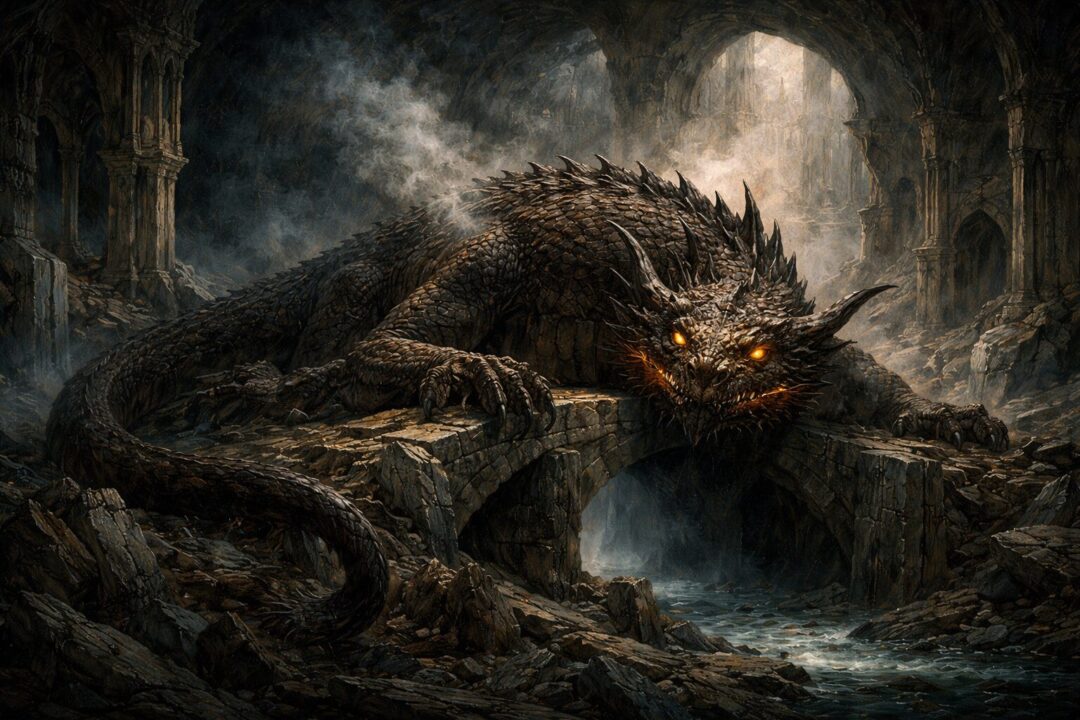
There is a line in The Silmarillion that feels almost unbearable once you notice it.
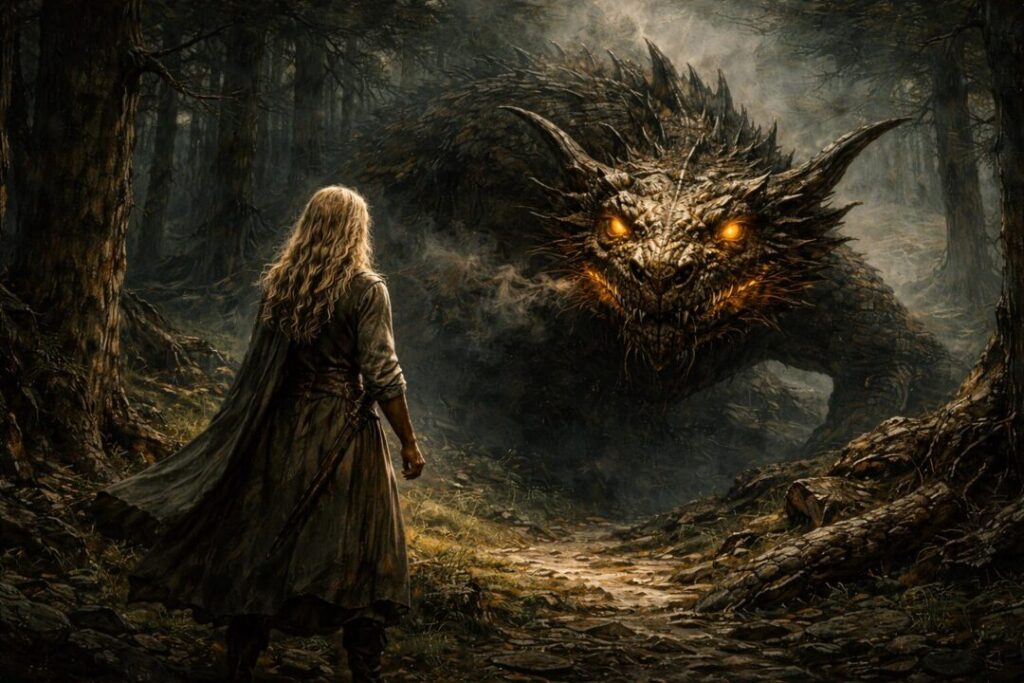
Niënor stands before Glaurung in the woods of Brethil. The dragon fixes his gaze upon her and casts a spell of forgetfulness. Her past dissolves. Her name is gone. Her memory of kin, of home, of sorrow—erased.
And then he directs her.
He tells her to seek Túrin.
The result is catastrophe. But the question lingers:
How did Glaurung know they would meet?
Was it prophecy?
Was it fate?
Or something else entirely?
To answer that, we need to look carefully at what the texts actually say about dragons—and about doom.
What the Text Shows
When Niënor confronts Glaurung after the fall of Nargothrond, she defies him. She calls him liar and slave of Morgoth.
The dragon responds not with physical violence, but with words and sight.
His eyes are repeatedly described as instruments of power. Earlier, before Nargothrond, Túrin had stood before Glaurung and was held fast by the dragon’s gaze, unable to move. The text describes him as rooted, his will overcome, while Glaurung spoke into his mind.
This is not presented as foresight.
It is domination.
Glaurung reads fear. He reads pride. He reads guilt. And he exploits them with precision.
In Brethil, he does the same to Niënor. He commands her memory to depart. He tells her to forget her name. And then he sends her wandering.
He does not say, “You will meet Túrin.”
He ensures that she will.
That distinction matters.
Do Dragons Possess Foresight?
The primary texts do not describe Glaurung as prophetic.
There is no statement that he sees the future in the manner of Mandos or Ulmo. Unlike certain figures whose foresight is explicitly named, Glaurung’s power is always described in terms of cunning, malice, and enchantment.
He is called the Father of Dragons, the first of the Urulóki—fire-drakes of Morgoth. His greatest weapon is not flame.
It is speech.
In Nargothrond, he convinces Túrin to abandon Finduilas by carefully selecting truths twisted into despair. He reveals information—but he arranges it to break resolve.
This is a creature who understands psychology.
If Glaurung had true prophetic sight, the texts do not confirm it. What they repeatedly confirm is his ability to perceive weakness and drive events toward ruin.
Fate and the Doom of Túrin
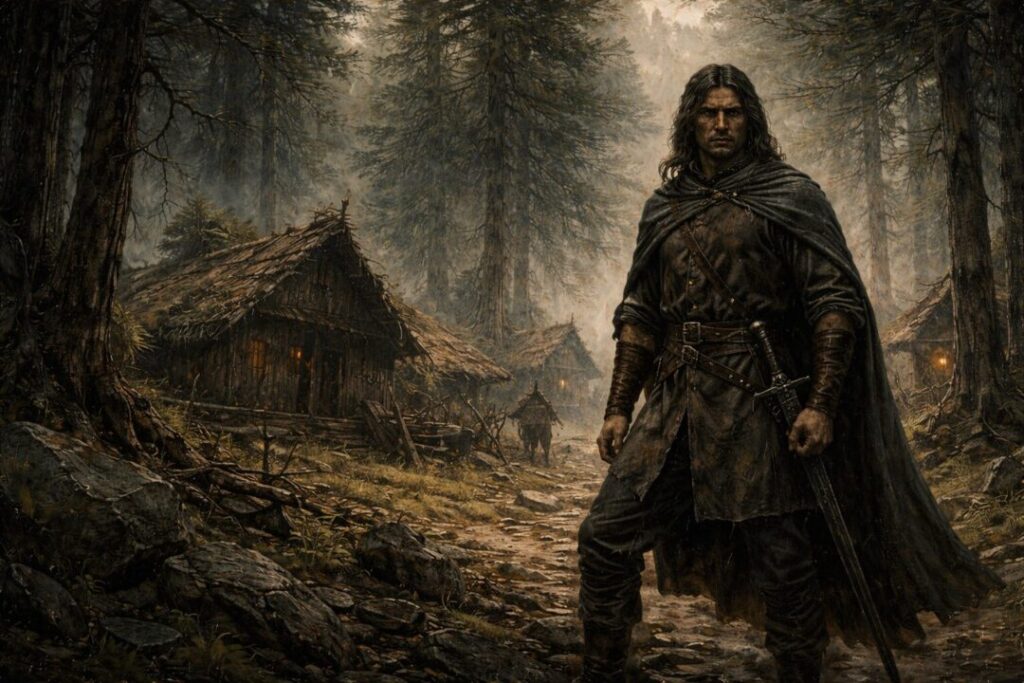
Túrin’s life is marked from the beginning by what is called the Doom of Húrin.
After Húrin defies Morgoth in the Nirnaeth Arnoediad, Morgoth curses him and his kin. He declares that wherever they go, evil shall arise; their counsels shall be turned to fear; hope shall wither.
This is not subtle.
But the curse is also not mechanical. Morgoth does not control Túrin like a puppet. Rather, he claims dominion over the outcomes of their choices.
Again and again, Túrin acts freely—and disastrously.
He slays Beleg in confusion.
He persuades Orodreth to abandon secrecy.
He refuses Ulmo’s indirect counsel delivered through Finduilas.
The pattern is consistent: pride, isolation, and tragic misjudgment.
The texts present doom not as the removal of free will, but as a narrowing of paths.
When Glaurung sends Niënor toward Brethil, he does so into a world already shaped by that curse. Túrin is already there. He has already taken a new name. He has already sought obscurity among the Woodmen of Haleth’s people.
The dragon does not need prophecy.
He needs probability.
The Geography of Tragedy
Brethil is not random.
After the fall of Nargothrond, Túrin flees north and eventually settles in the Forest of Brethil. Niënor, under Glaurung’s spell, wanders from the same ruined city into the surrounding lands.
The proximity is real.
The narrative does not describe impossible distances or miraculous convergence. It describes two displaced figures moving within the same region of western Beleriand.
Glaurung, lying in Nargothrond, knows where Túrin was last seen. He knows Túrin’s pride. He knows his tendency to stand against danger rather than flee from it.
Sending Niënor wandering toward Brethil is not mystical foresight.
It is calculated cruelty.
Did Glaurung Understand the Curse?
This is where interpretation enters.
The text does not explicitly state that Glaurung is aware of the full terms of Morgoth’s curse on Húrin’s house. However, as one of Morgoth’s greatest servants, he is certainly aligned with that purpose.
Whether he knows every detail is unstated.
But he does not need to.
The curse ensures that sorrow follows the family. Glaurung merely accelerates it.
If anything, his action demonstrates how doom in Middle-earth often works: not as an unstoppable prophecy, but as a pattern that malevolent wills can exploit.
Was It Predestined?
This is the hardest question.
The legendarium does contain true foresight. Mandos speaks prophecies that unfold across ages. Ulmo’s warnings sometimes prove exact. There is a structure of providence that guides history toward ultimate ends.
But Túrin’s story feels different.
It is intensely human.
He is not described as unable to choose otherwise. In fact, the tragedy deepens precisely because he might have chosen differently at several points.
If Glaurung possessed absolute foresight, the texts do not say so. What they show instead is a being of immense cunning who understands how to trap flawed people within their own tendencies.
Niënor, stripped of memory, seeks kindness.
Túrin, seeking redemption, offers protection.
Neither recognizes the truth until it is too late.
Glaurung does not need to see the future.
He only needs to know them.
The Moment of Revelation
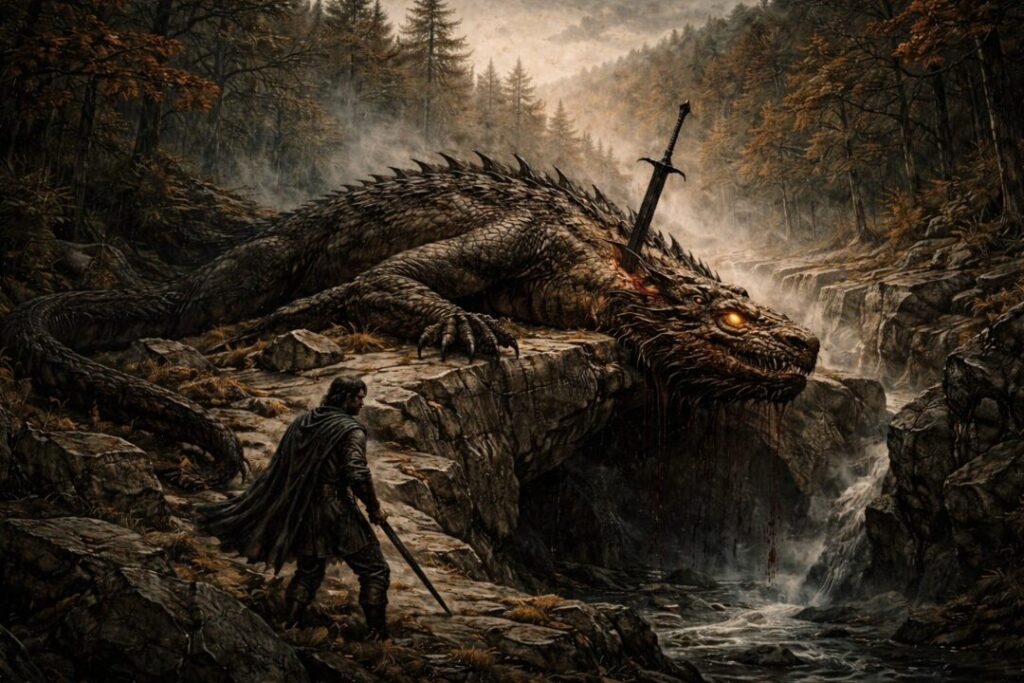
When Glaurung is finally slain by Túrin at Cabed-en-Aras, his last act is not silence.
With his dying breath, he restores Niënor’s memory.
This final cruelty confirms something essential.
He is not revealing a predestined script. He is delivering knowledge at the moment it will hurt most.
If he had truly foreseen every step, he would not need this final gesture.
He ensures that the truth arrives at the precise point of destruction.
And then he dies.
Fate, Freedom, and Tragedy
The meeting of Túrin and Niënor feels inevitable because the narrative is shaped by doom.
But inevitability in Middle-earth is rarely mechanical.
It is the convergence of:
• A curse laid upon a family
• A dragon skilled in manipulation
• A proud man fleeing his past
• A woman robbed of her memory
Glaurung did not have to glimpse the future.
He simply set the pieces where they were most likely to collide.
And in a world where pride and sorrow already bent the path, that was enough.
So was it predestined?
The texts never say.
What they show instead is something perhaps more unsettling: that evil in Middle-earth often succeeds not by foreseeing destiny—
but by understanding weakness.
And in Túrin’s case, that understanding was fatal.
Sources & Notes
- J.R.R. Tolkien, The Silmarillion, “Of Túrin Turambar” — Glaurung holds Túrin with his gaze at Nargothrond, later enchants Niënor, sends her away nameless, and reveals the truth at his death.
- J.R.R. Tolkien, The Children of Húrin, “The Fall of Nargothrond” and “The Journey of Morwen and Niënor to Nargothrond” — fuller narrative of Glaurung’s manipulation of Túrin and Niënor after Nargothrond.
- J.R.R. Tolkien, The Silmarillion, “Of the Fifth Battle: Nirnaeth Arnoediad” — Morgoth’s curse on Húrin and his kin, the doom under which Túrin’s story unfolds.
- J.R.R. Tolkien, Unfinished Tales, “Narn i Hîn Húrin” — expanded tradition behind the Túrin story, including the doom, Túrin’s movements, and the Brethil setting.