Helm’s Deep is often remembered as a story of rescue.
But in the text of The Two Towers, it reads first as a story of collapse.
The Rohirrim are driven back. The Deeping Wall is breached by blasting fire. Théoden’s men are forced into the Hornburg. The defenders are exhausted long before the sun rises.
And by dawn, Saruman’s army holds the field.
That matters.
Because when we ask what might have happened if the Uruk-hai had fortified Helm’s Deep instead of breaking, we must begin with what the text actually shows.
The Position at Dawn
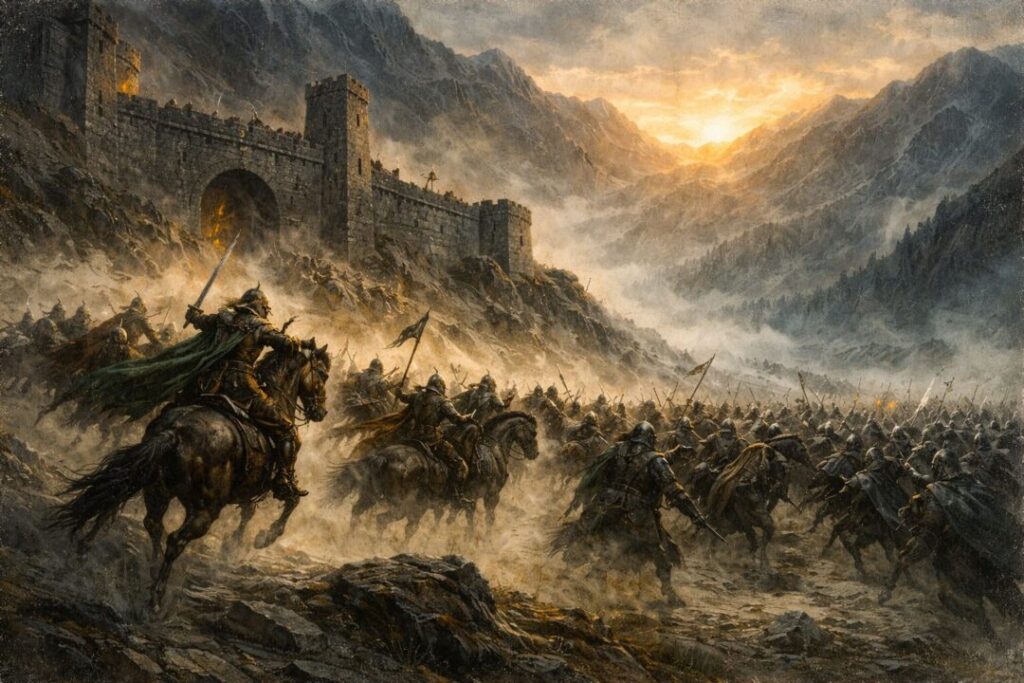
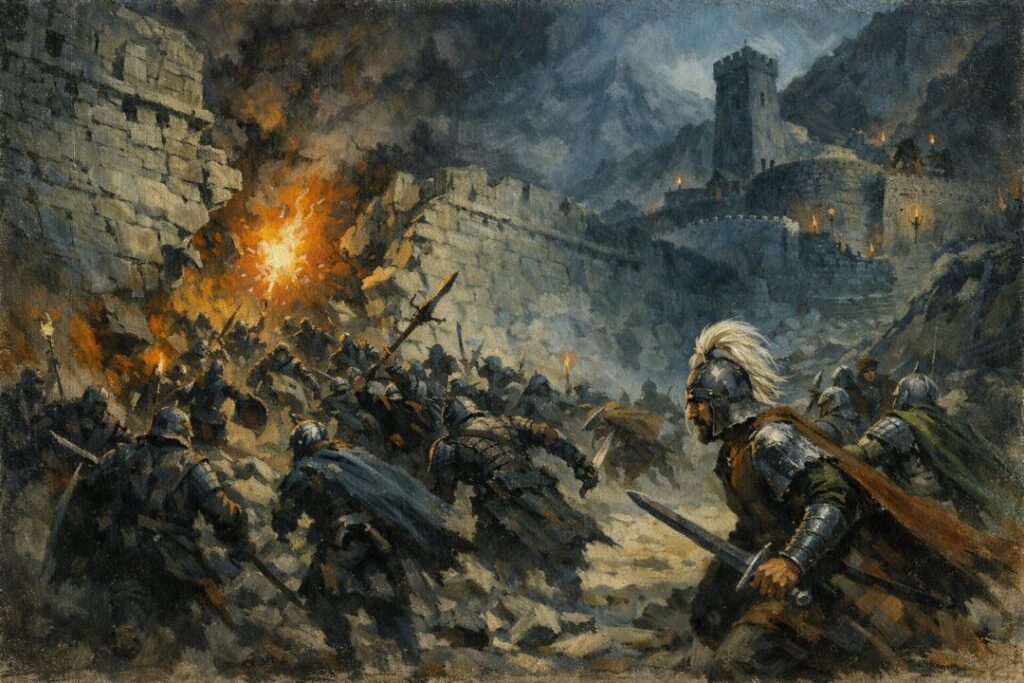
During the night assault, the Uruk-hai and Dunlendings press relentlessly. They bring scaling ladders. They use explosive fire to shatter the Deeping Wall. They pour through the breach in significant numbers.
The defenders retreat step by step.
By the time the sky begins to pale, Théoden has withdrawn to the Hornburg itself. Aragorn, Éomer, and the king prepare for a final sortie—not because they are winning, but because they are cornered.
The Deeping Wall is lost.
The Coomb is filled with enemies.
Saruman’s forces hold numerical superiority.
There is no textual suggestion that the Rohirrim were about to reclaim the field without outside intervention.
What the Uruk-hai Do Not Do
This is where the question begins.
The narrative does not describe Saruman’s army digging trenches. It does not mention defensive barricades constructed after the breach. There is no indication of scouting lines placed to monitor the valley’s approaches.
Instead, when Théoden leads his sudden charge at dawn, the Uruk-hai are surprised by its ferocity.
Then another shock follows.
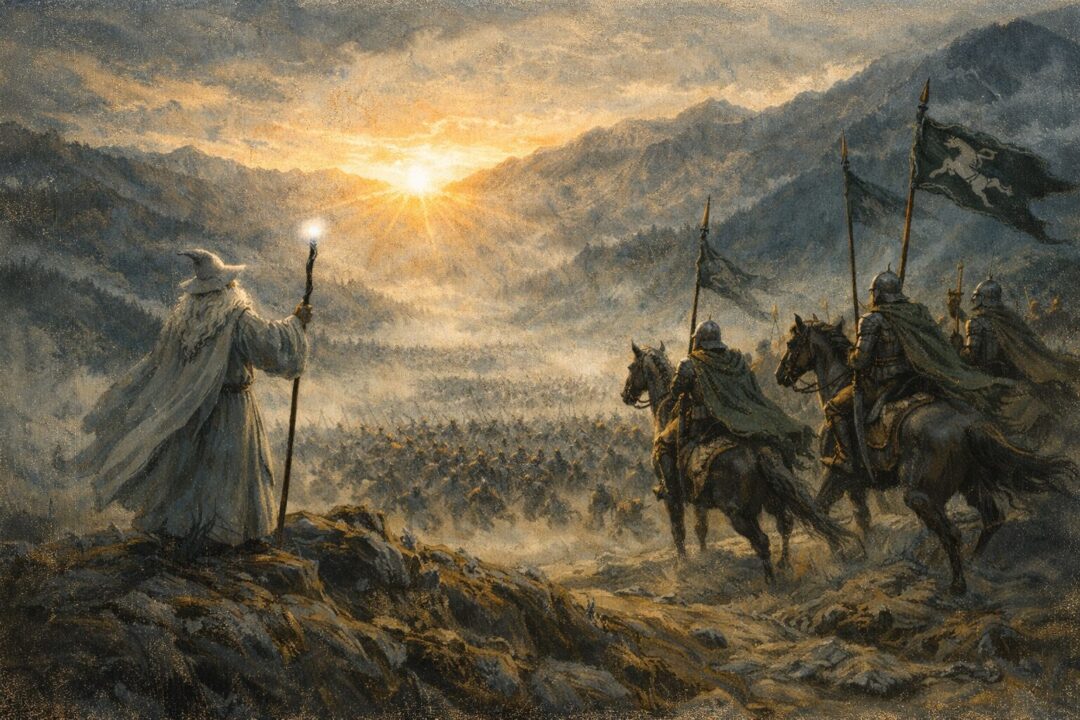
Gandalf appears on the ridge with Erkenbrand and fresh riders from the Westfold. The sunlight breaks over the valley behind them.
The text describes fear spreading among Saruman’s host. They begin to waver. Then they are driven toward the mysterious wood that had crept into the valley overnight—the Huorns.
From there, their destruction is swift.
What we do not see is a disciplined fallback or a coordinated defensive stand.
And this absence is striking.
Were the Uruk-hai Capable of Holding?
The Uruk-hai are not ordinary Orcs.
In The Lord of the Rings, they are described as larger, stronger, and able to endure sunlight. They are disciplined enough to march long distances, coordinate siege efforts, and execute complex assaults involving explosives.
They obey orders.
They chant in unison.
They maintain formation through the long night battle.
There is no textual evidence that they lacked the capacity for fortification. Siege warfare implies the opposite: they understood preparation and structure.
So why did they break?
The text gives two clear pressures.
First: unexpected counterattack. Théoden’s sortie from the Hornburg is sudden and forceful.
Second: reinforcement at sunrise. Gandalf’s arrival with Erkenbrand changes the visible balance of power at the exact moment morale is already strained.
And then there is the third element.
The Huorns
The valley behind the Uruk-hai does not remain open.
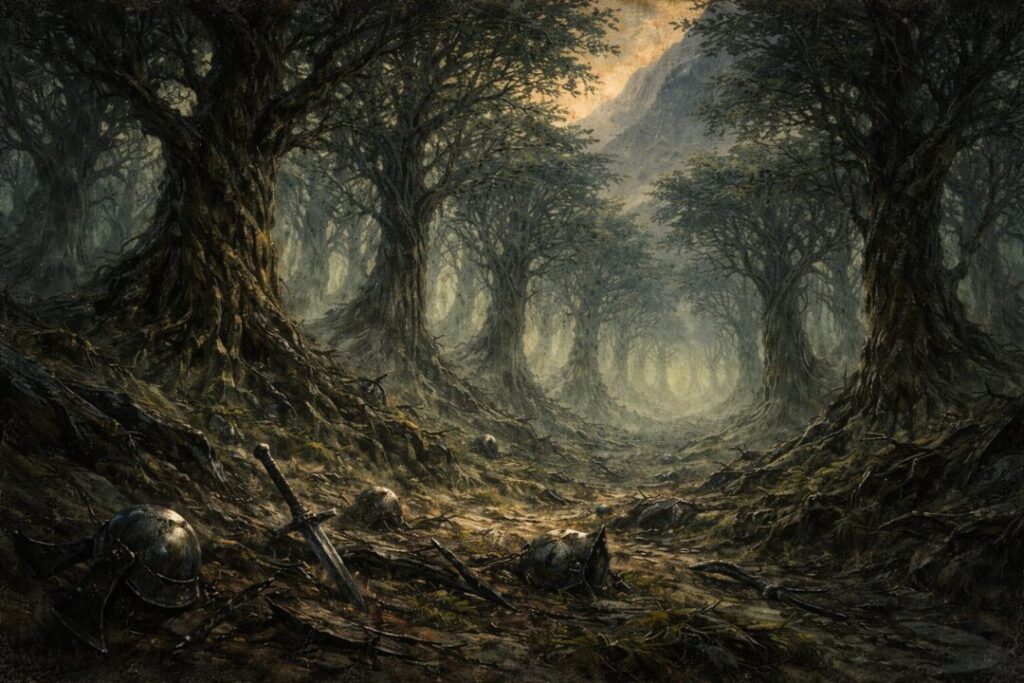
Overnight, the Huorns move from Fangorn Forest into the Deeping Coomb. When the army of Isengard attempts retreat, they find the forest blocking escape.
The text does not describe this in strategic language—but the effect is clear. The Uruk-hai are compressed between counterattacks and an unknown, encroaching force.
Fear spreads.
It is at this point that cohesion dissolves.
The Counterfactual: Fortified Dawn
Now we may cautiously imagine.
If the Uruk-hai had consolidated their breach at first light—if they had entrenched behind the shattered Deeping Wall, established shielded positions at the causeway, and deployed scouts toward the western ridge—several outcomes shift.
Théoden’s sortie would have met braced defenses instead of disordered ranks.
Gandalf’s charge, though dramatic, would have struck prepared lines rather than shaken troops.
And most importantly: a controlled withdrawal might have been possible before the Huorns fully sealed the valley.
It is important to say clearly: this is speculation.
The text does not state that such entrenchments were attempted and failed. It simply does not mention them.
But given the demonstrated discipline of the Uruk-hai earlier that night, their rapid collapse at dawn suggests morale—not capacity—was decisive.
The Role of Timing
Helm’s Deep turns on minutes.
Gandalf promises to return at first light on the fifth day. He does so precisely.
If Saruman’s forces had maintained cohesion even slightly longer, the Rohirrim inside the Hornburg might have been overwhelmed before reinforcements arrived.
There is no indication that the defenders had reserves.
Aragorn himself speaks as though their situation is nearly hopeless.
The arrival of Erkenbrand’s riders is not vast in scale. It is decisive because of timing and morale.
A prepared defensive line could have blunted that effect.
The Limits of Speculation
We must not overstate the case.
The Huorns represent a force beyond conventional warfare. Once they encircle the valley, retreat becomes perilous regardless of discipline.
And the psychological shock of sunlight, reinforcement, and sudden countercharge may have broken even a fortified army.
The text portrays the Uruk-hai as fierce—but not immune to fear.
Still, what the narrative quietly reveals is this:
Helm’s Deep is not won by overwhelming superiority.
It is won at the edge of collapse.
A Narrow Victory
The Rohirrim survive because of three converging events:
- Théoden’s desperate dawn charge
- Gandalf’s precisely timed return
- The intervention of the Huorns
Remove or delay any one of these, and the outcome becomes uncertain.
Saruman’s army did not lack strength.
It lacked resilience at the critical moment.
And that distinction matters.
Because it shows that Helm’s Deep was not inevitable triumph—it was a fragile intersection of courage, timing, and fear.
Had the Uruk-hai entrenched, regrouped, and held formation through sunrise, the battle may not have ended in the valley.
It may have ended at the Hornburg’s gates.
And that possibility makes the victory far more precarious—and far more remarkable—than it first appears.