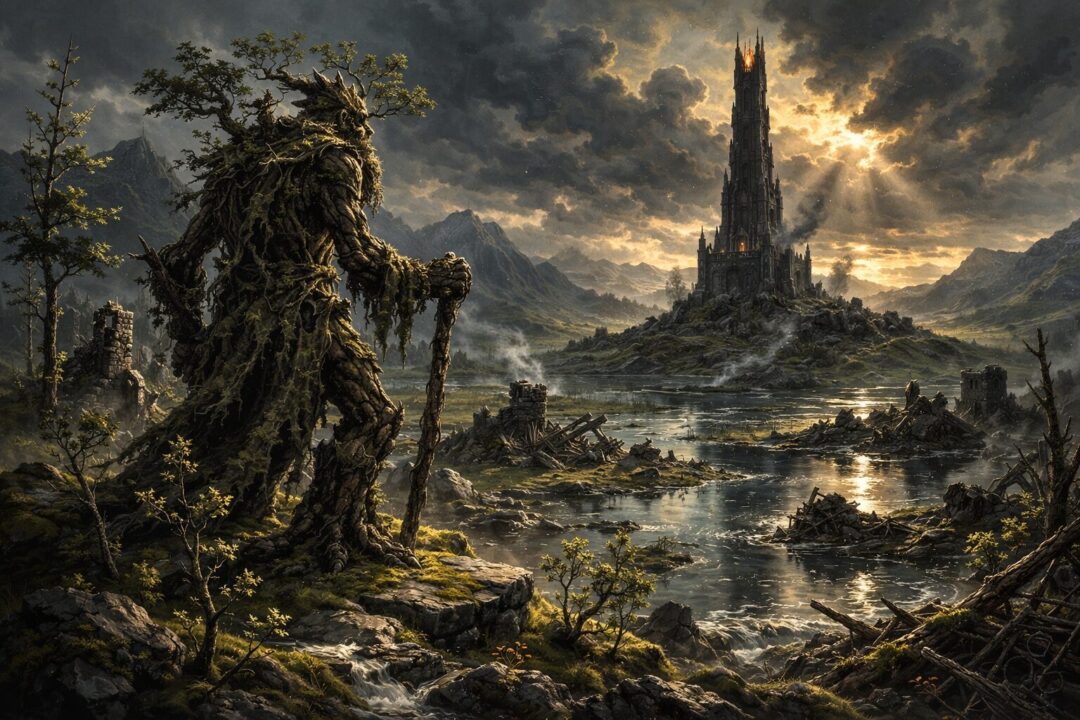
Orthanc is one of the rare places in The Lord of the Rings where the story pauses long enough to let victory feel complicated.
Isengard has been broken. The engines and forges that powered Saruman’s war are ruined. The ring-wall is smashed, the valley is flooded, and the tower stands isolated—untaken, unburned, but suddenly small against what has happened around it.
And then Saruman speaks.
That detail matters, because Saruman’s last weapon is not an army. It is persuasion. Gandalf warns the others before they approach: Saruman is cornered, and “a wild beast cornered is not safe to approach,” and above all they must “Beware of his voice!”
So when the parley finally comes, the central conflict is not steel on stone.
It is whether Saruman can still bend the will of the victors.
And this is where the “mistake” question begins—because what happens at Orthanc is not simply punishment. It is restraint.
The offer people forget
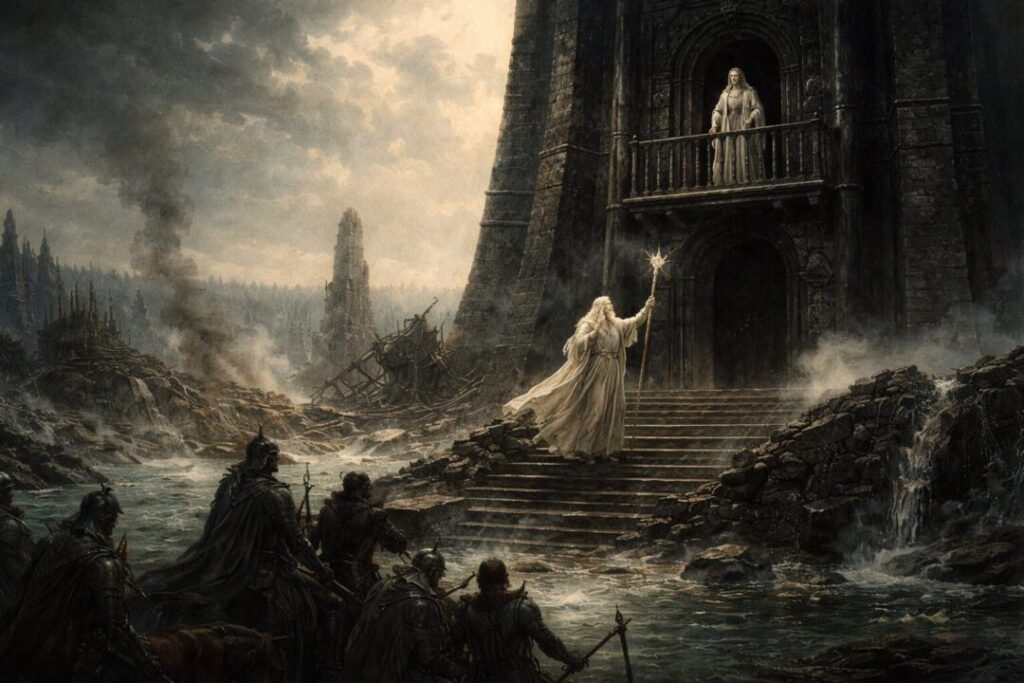
Gandalf does not arrive at Orthanc only to pronounce judgement. He tries something else first: he gives Saruman a last chance.
The line is blunt and unmistakable: “I am giving you a last chance. You can leave Orthanc, free — if you choose.”
This is not naïveté. It is deliberate. Gandalf is fully aware Saruman is treacherous (“The treacherous are ever distrustful”), and he makes clear he does not intend to kill or harm him.
Saruman immediately probes for traps. What does “free” mean? What are the conditions?
And Gandalf answers with the terms that show this is not indulgence: Saruman must surrender the Key of Orthanc and his staff as pledges of good conduct—things to be returned only “if you merit them.”
Saruman refuses.
He rages. He mocks. He tries to regain dominance through humiliation.
So Gandalf ends the conversation in a way that is both merciful and absolute. He commands Saruman back, declares him “a fool, Saruman, and yet pitiable,” and then says the sentence that seals the fall: “Saruman, your staff is broken.”
Saruman is not executed.
He is cast down.
That distinction is the heart of the debate.
Gandalf’s own explanation
If the text left the moment there, readers would still argue. But Tolkien includes something unusually clarifying: Gandalf tells the others why he tried.
He admits it plainly: his reasons were “some merciful and some less so.”
The “less so” matters. Gandalf is not only showing pity. He is also stripping Saruman of his last illusion: he is showing Saruman that the power of his voice is waning, and that he cannot remain both tyrant and counsellor.
But then Gandalf says something even more provocative:
He gave Saruman “a last choice and a fair one: to renounce both Mordor and his private schemes, and make amends by helping us in our need.”
And he adds: “Great service he could have rendered.”
That line doesn’t “redeem” Saruman. It does something subtler.
It shows that Gandalf believed Saruman still had agency. Still had the ability, however narrow, to choose a different end.
So the mercy at Orthanc is not sentimental. It is moral: it insists Saruman must be the author of his own refusal.
Saruman chooses to withhold help. Saruman chooses to cling to Orthanc. Saruman chooses command over service.
And then Gandalf leaves him to that choice.
Why not kill him anyway?
Because the text repeatedly treats killing as a threshold.
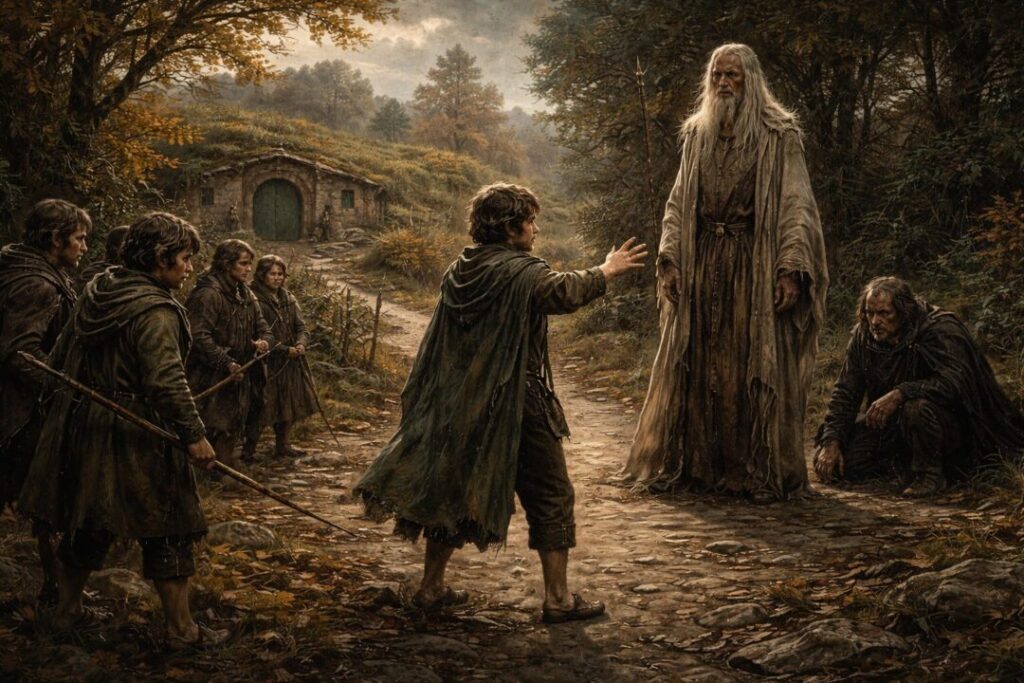
Even when Saruman later threatens and boasts, Frodo calls out the reality: Saruman has “lost all power, save his voice that can still daunt you and deceive you, if you let it.”
That’s not an argument that Saruman is harmless.
It’s an argument that the real danger is not physical strength. It is corruption—the ability to twist others into becoming what they hate.
That is why Gandalf’s restraint is not just about sparing Saruman.
It is also about sparing the victors from being shaped by vengeance.
The text makes this explicit in the Shire, but the logic begins at Orthanc.
The prison that becomes a release
After the parley, Saruman remains trapped in the tower, and Treebeard vows he will not be allowed beyond the rock “without my leave.”
For a time, Orthanc becomes a cage.
But later, after the Ring is destroyed and journeys are ending, the narrative quietly reveals something that many readers miss on a first pass:
Treebeard let Saruman go.
When Gandalf returns north, Treebeard admits Saruman grew “very weary at last,” and Gandalf suspects Saruman persuaded even Treebeard by finding “the soft spot in your heart.”
Gandalf calls Saruman “this snake,” and says he likely still had “one tooth left”: “the poison of his voice.”
This is important for the “mistake” question, because it shows Orthanc was not a permanent solution. The mercy was not only in not killing Saruman—it was also in allowing the possibility, however misguided, that he might leave, diminish, and fade.
And Saruman does exactly that.
But he does not fade quietly.
The cost of sparing him: the Shire
Saruman’s final movement is not toward another fortress. It is toward something small.
The Shire.
There, the story reaches its sharpest moral edge. The war has ended; the King is crowned; the great captains have returned. And yet the Hobbits come home to a land bruised by petty tyranny.
When Saruman is confronted, the hobbits cry for his death—“Kill him!”—and Saruman answers with the last echo of his old power: whoever strikes him “shall be accursed,” and if his blood stains the Shire it will “wither and never again be healed.”
Frodo refuses.
“I will not have him slain,” he says, because “it is useless to meet revenge with revenge: it will heal nothing.”
And he refuses again, even when Saruman tries to stab him: “Do not kill him even now… I would still spare him, in the hope that he may find it.”
This is the key: the text frames Frodo’s mercy not as blindness, but as growth.
Saruman recognizes it too, in his own twisted way, telling Frodo: “You have grown, Halfling.”
So was it a mistake?
If you measure only by outcomes, you could argue yes: Saruman’s survival allows the Scouring of the Shire to happen at all.
But the text forces a harder reading.
Because the Scouring is not merely an extra disaster. It is the place where the Hobbits prove what the Quest did to them. They do not simply win the Shire back by force. They are tested on what kind of victors they will be.
And in that test, Saruman is almost irrelevant.
The real question becomes: will the Shire be healed by cruelty—or by something else?
Saruman’s end, and what it reveals
After Frodo spares him, Saruman turns to leave. And then the smallest figure in the scene becomes the instrument of judgement.
Wormtongue snaps.
He rises, draws a hidden knife, and cuts Saruman’s throat.
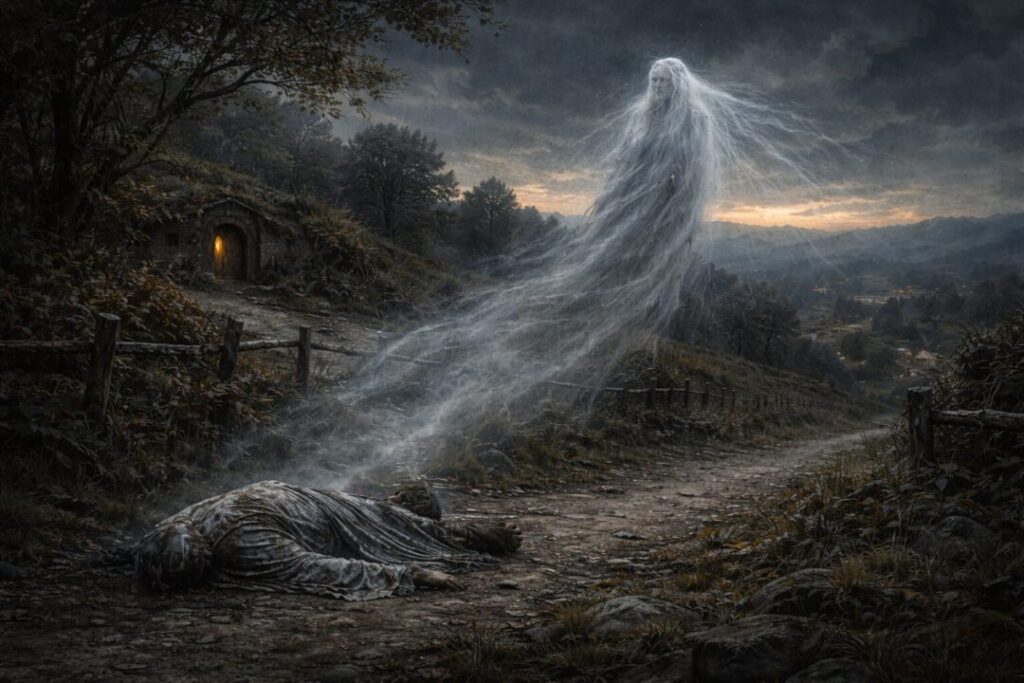
And what follows is one of the most haunting images in The Return of the King:
A grey mist gathers above Saruman’s body, “like smoke,” looming as a “pale shrouded figure.” It wavers, looking West—but a cold wind comes out of the West, and the figure bends away and dissolves.
The text does not turn this into a courtroom. It does not give speeches about cosmic justice.
It gives an image: a spirit turned away, unable to return.
And it happens without the heroes becoming executioners.
So… was the mercy wrong?
Orthanc presents mercy as a risk. The Shire proves it.
Sparing Saruman does not prevent harm. It does not “fix” him. It allows him space to do what he will do—smaller, meaner, more desperate things.
But the text also shows what mercy prevents:
It prevents Gandalf, Théoden’s riders, or the Hobbits from stepping over a line that would stain their victory. It forces Saruman’s fall to be complete: not slain as a great enemy in a great duel, but reduced to bitterness, dependence, and finally killed by the servant he degraded.
And that ending matters, because it answers the question in a way that feels almost like a trap:
If Saruman had been killed at Orthanc, he would have died still looking like a power.
By being spared, he is revealed.
He becomes what he truly is when stripped of armies and walls: a voice that can wound, a will that cannot repent, and a pride that keeps shrinking until it has nowhere left to go.
So the “mistake” is not simply that Saruman lived long enough to hurt the Shire.
The deeper danger is what killing him would have done to the people who had already survived Mordor.
In the end, the text doesn’t ask whether Saruman deserved mercy.
It asks what kind of world the victors are trying to build—when the war is over, and the towers have already fallen.
Sources & Notes
- J.R.R. Tolkien, The Lord of the Rings, Book III, Chapter 10, “The Voice of Saruman” — gives Gandalf’s warning about Saruman’s voice, the parley at Orthanc, the rejected “last chance,” and the breaking of Saruman’s staff.
- J.R.R. Tolkien, The Lord of the Rings, Book VI, Chapter 6, “Many Partings” — has Treebeard admit he let Saruman leave Orthanc, while Gandalf notes the lingering danger of “the poison of his voice.”
- J.R.R. Tolkien, The Lord of the Rings, Book VI, Chapter 8, “The Scouring of the Shire” — shows Saruman’s petty rule in the Shire and the hobbits’ recovery of their homeland after the War.
- J.R.R. Tolkien, The Lord of the Rings, Book VI, Chapter 8, “The Scouring of the Shire” — gives Frodo’s refusal to answer revenge with revenge, his sparing of Saruman after the knife-stroke, and Wormtongue’s killing of Saruman.
- J.R.R. Tolkien, The Lord of the Rings, Book VI, Chapter 8, “The Scouring of the Shire” — describes Saruman’s spirit looking West and being blown away, grounding the article’s reading of judgement without execution by the heroes.