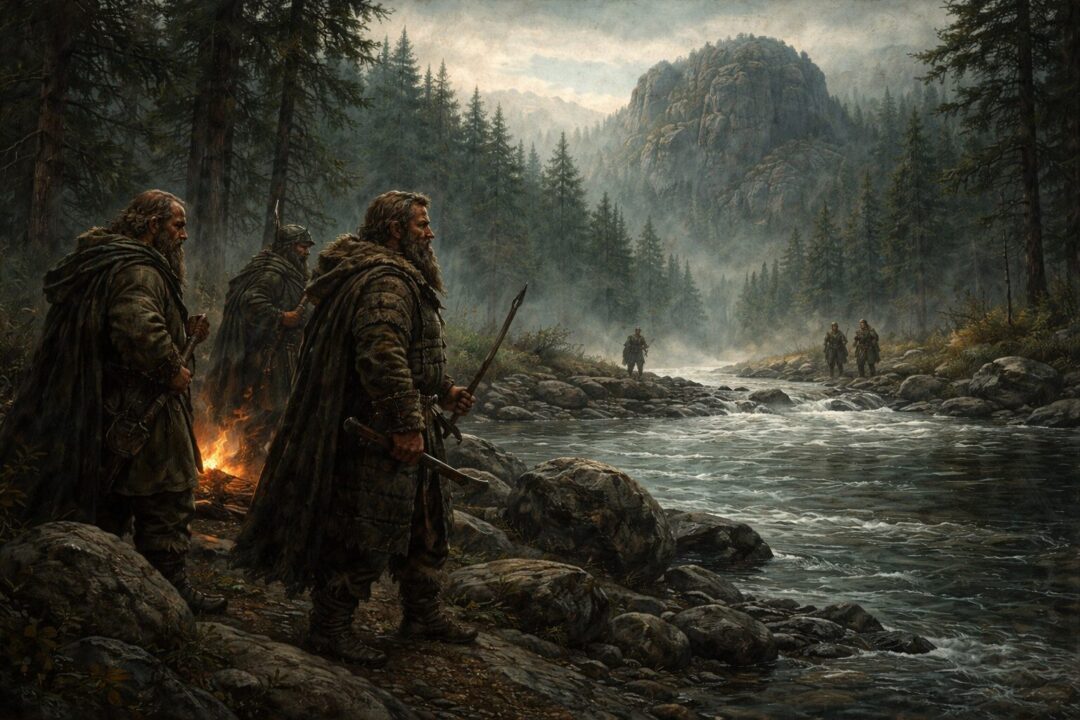
Beorn feels like the kind of answer Middle-earth forgot to use.
In The Hobbit, he is introduced like a local legend that turns out to be real: a grim, dangerous host with a house full of animals, a man of enormous strength who can take the shape of a great bear. Gandalf treats him carefully—like someone you do not command, only persuade.
And then, when the story needs a sudden, decisive violence, Beorn appears again: at the Battle of Five Armies, breaking the line and slaying Bolg.
So it is natural to ask what readers always ask in wars:
Where was he later?
And more pointedly: why didn’t Gandalf go to recruit him when the War of the Ring began?
The canon gives an answer. But it gives it in the way it often does: not with a scene, but with a few lines placed far apart—one inside the story, one outside it.
And when you put them together, the question changes shape.
Because the truth is not simply “Beorn wasn’t recruited.”
The truth is: Beorn’s time as a recruit had already passed.
And the role his people played in the War of the Ring was not the role most readers are looking for.
Beorn is not “on the board” in 3018
The most direct statement about Beorn’s status during the years of The Lord of the Rings comes not as a dramatic note in the narrative, but as a plain clarification preserved in Tolkien’s published letters.
In Letters, No. 144 (25 April 1954), Tolkien answers a reader question about Beorn by stating that Beorn is dead by the time of the War of the Ring, noting that Beorn appeared in The Hobbit in T.A. 2940, while The Lord of the Rings is set in 3018–3019.
That single fact immediately changes the “why didn’t Gandalf recruit him?” angle.
If Beorn is already dead, Gandalf cannot go north and “use” him like a hidden weapon. There is no missing scene because the character is no longer present.
But this does not mean Beorn’s people are absent.
It means the question needs to be reframed:
If Beorn is gone, what happened to the Beornings?
And did Gandalf have any relationship to them in the war?
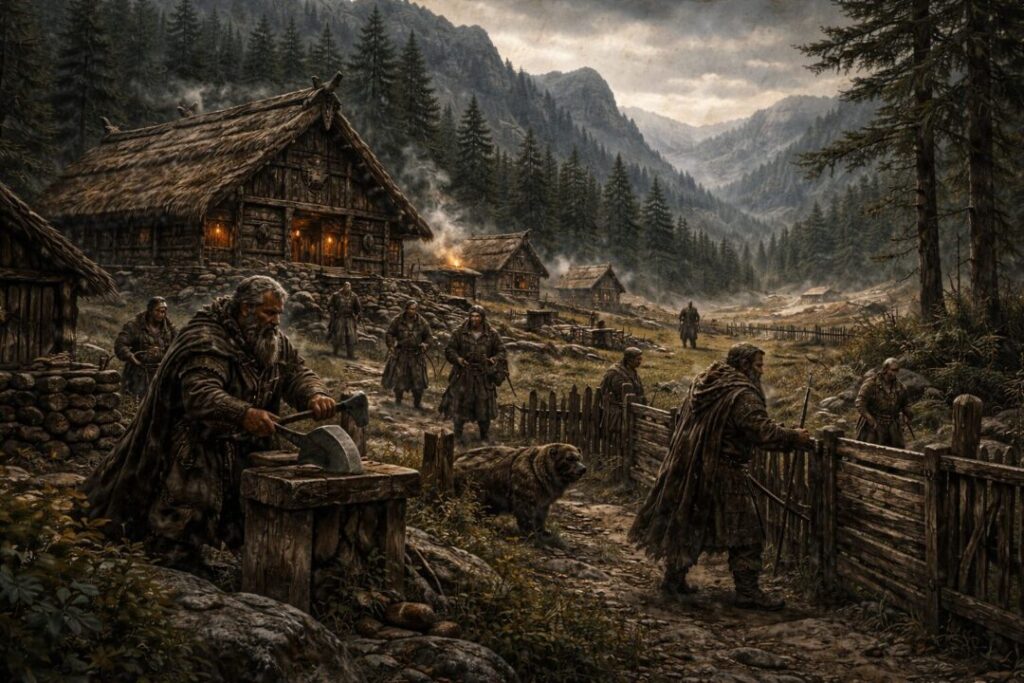
The Beornings are still there—and they matter to the roads
The first quiet clue appears in Rivendell, during the Council of Elrond.
Glóin, speaking of the dangers of travel and the changing world, mentions the northern crossings and the mountain routes. He refers to the Beornings as “valiant men” who “keep open the High Pass and the Ford of Carrock,” adding that their tolls are high.
It is an easy line to skim. It sounds like travel talk.
But it tells you something strategic: there are only a few workable ways through those lands, and someone is actively holding them against Orcs and wolves and the slow collapse of safety.
In other words, even without Beorn himself, the Beorning people are still performing a function that resembles a kind of war:
Not a march to Minas Tirith.
Not a host on the Pelennor.
But the stubborn maintenance of passages—routes that connect North and West, Eriador and Rhovanion.
That matters because Gandalf’s war is never only about armies.
It is about movement: messengers, refugees, hidden journeys, trade-lines that prevent regions from becoming isolated and starving.
If the High Pass and the Ford of Carrock fail, the North becomes harder to reach, and the Misty Mountains become a sealed wall.
So the Beornings are not “unused.”
They are doing something quieter: keeping the world stitched together.
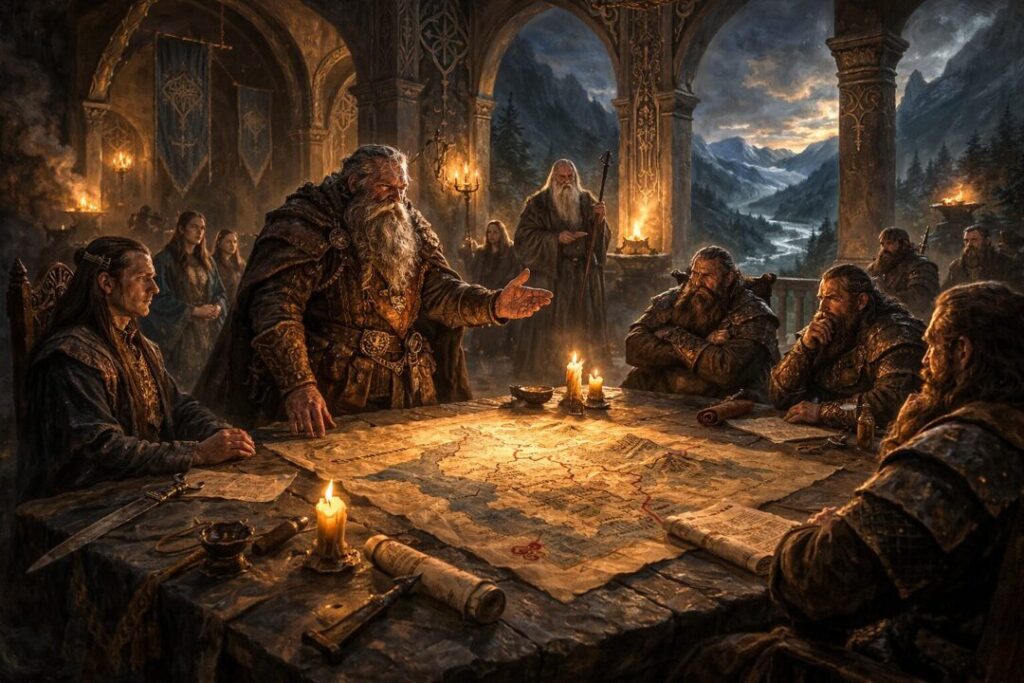
The North is fighting its own War of the Ring
The second piece is the one most “where were they?” questions ignore:
The War of the Ring is not fought only in Gondor and Rohan.
The Appendices make clear that the same days that bring siege and battle in the South also bring assaults in the North and East—most famously the attacks on Dale and Erebor, and the assaults out of Dol Guldur against the Woodland Realm and Lórien.
When people ask why certain allies were not sent south, the answer is often brutally simple:
they were already fighting.
This is where the Beornings belong in the larger picture.
The texts do not give a long Beorning campaign narrative. We do not get named captains or detailed scenes the way we do in Rohan. But the canon does show that the North was under pressure during the war, and that survival there was not automatic.
In that context, the Beornings’ role as guardians of crossings and keepers of routes stops looking like a footnote and starts looking like a front line.
If you imagine Sauron’s war as a single spear aimed at Minas Tirith, you will always ask why everyone wasn’t sent to the tip.
But the war is also a net.
Hold the crossings.
Break the roads.
Cut the regions apart.
Let fear and winter do what armies cannot.
In that kind of war, a people like the Beornings are not an “extra.”
They are one of the things preventing the North from going dark.
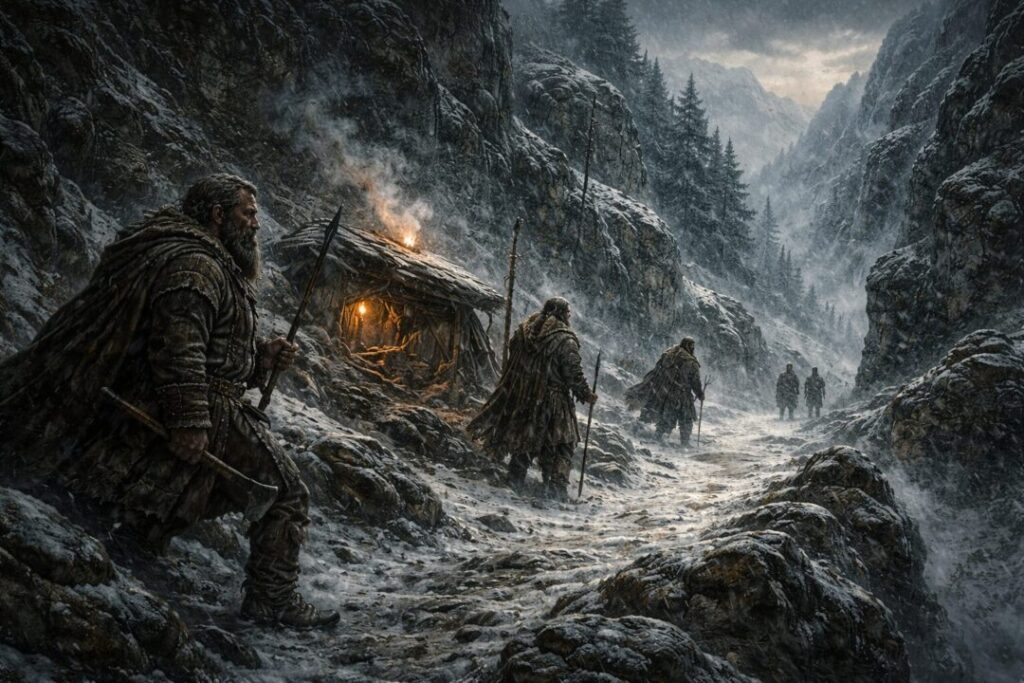
Why Gandalf doesn’t “recruit” them the way people expect
Even setting Beorn’s death aside, the idea of Gandalf recruiting Beorn like a general collecting units misunderstands what Beorn is in the texts.
Beorn is not a vassal. He does not appear as part of a kingdom with formal obligations. Gandalf approaches him in The Hobbit cautiously, as someone who may help—or may kill you—depending on how you enter his house and how honest you are.
That tone matters.
It suggests Beorn’s aid is not something you can simply requisition when the world catches fire.
And it explains why the later story treats the Beornings differently: not as a summoned force, but as a local power already embedded in their own responsibilities.
Interpretation (clearly labeled)
It is reasonable to interpret Gandalf’s strategy as one of distributed resistance rather than centralization. He does not gather every strength into one place. He tries to keep multiple lines from breaking at once: Shire, Bree, Rivendell, the Gap of Rohan, Rohan itself, Gondor, and the northern regions.
On that reading, the Beornings are not “forgotten.”
They are exactly where they would be most valuable: guarding the living seams between lands.
But this is interpretation, not a direct authorial statement. The canon simply shows the Beornings holding crossings and the North being attacked; it does not give us a scene of Gandalf assigning them a mission.
The sharper answer is the simplest one
So, why didn’t Gandalf ever try to recruit Beorn for the War of the Ring?
Because Beorn does not live into the War of the Ring, according to Tolkien’s own clarification in Letters.
And because the Beornings—his descendants and people—are not written as a dramatic “late-game ally,” but as a steady northern presence: valiant men keeping routes open in dangerous country, doing the kind of work that rarely becomes a chapter title.
Beorn’s story is shaped like many northern stories in Middle-earth.
A great figure rises in a local crisis.
He turns the tide once, violently.
Then time passes, and the world moves on.
When the next war comes—the last war of the Third Age—the tale does not resurrect him for spectacle.
It leaves him where many real strengths are left in this legendarium:
In a name remembered.
In a people still holding ground.
In a road that remains open when it “should” have closed.
And if you want the most unsettling part, it is this:
The War of the Ring has so many theaters that the main narrative can afford to glance away from some of them.
Which means a great deal of fighting—especially in the North—happens almost out of sight.
Beorn is not the ally who failed to arrive.
He is the reminder that Middle-earth has defenders whose victory is simply that they kept the world passable… long enough for the Ring to be destroyed.
Sources & Notes
- J.R.R. Tolkien, The Letters of J.R.R. Tolkien, Letter 144 — Tolkien notes that Beorn was dead by the time of the War of the Ring, placing his Hobbit appearance generations earlier.
- J.R.R. Tolkien, The Lord of the Rings, Book II, Chapter 2, “The Council of Elrond” — Glóin describes the Beornings as valiant men who keep open the High Pass and the Ford of Carrock, though they charge high tolls.
- J.R.R. Tolkien, The Hobbit, Chapter 7, “Queer Lodgings,” and Chapter 18, “The Return Journey” — Beorn is presented as a powerful, independent skin-changer whose aid cannot simply be commanded.
- J.R.R. Tolkien, The Lord of the Rings, Appendix B, “The Tale of Years: The Great Years” — the War of the Ring includes northern attacks on Dale, Erebor, Lórien, and the Woodland Realm, showing why local defenders mattered far from Minas Tirith.