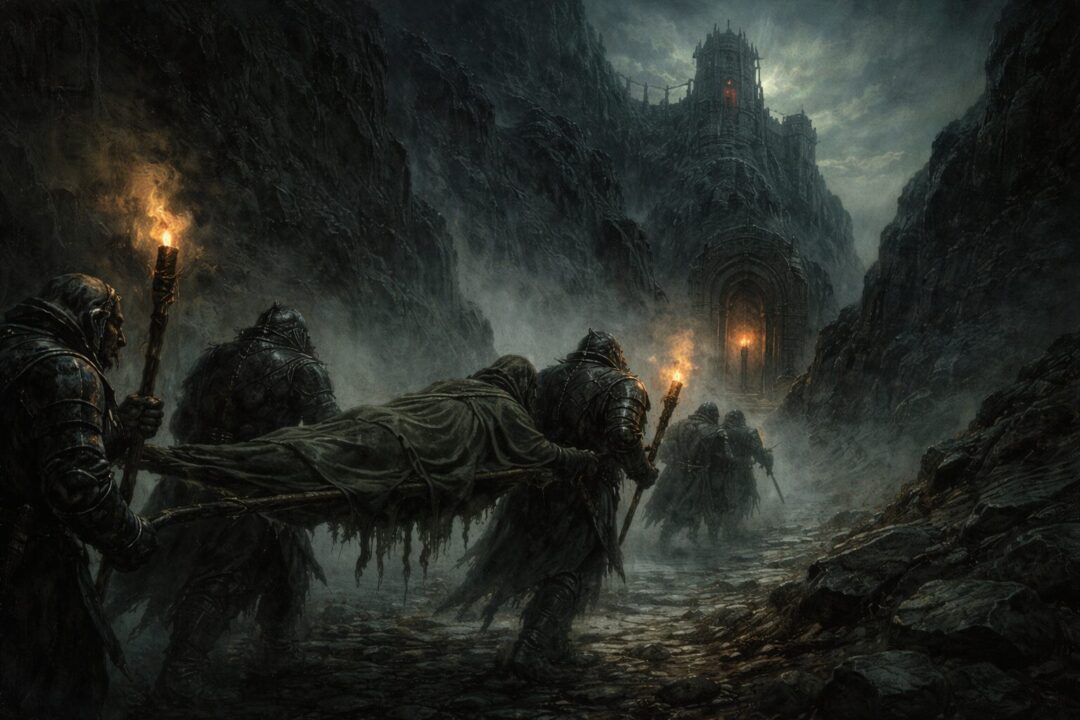
Denethor’s end is one of the most uncomfortable scenes in The Return of the King because it isn’t the fall of a fool. It is the collapse of someone intelligent enough to understand the stakes—someone strong enough to resist domination—yet still driven into despair.
Most readers remember the palantír as the cause.
But the text invites a more precise question: what, exactly, pushed Denethor over the edge?
And there is one possibility, never stated outright, that fits the timing with eerie neatness:
Denethor may have seen evidence—direct or indirect—of Frodo’s capture.
We must be careful from the start: Tolkien never explicitly says, “Denethor saw Frodo in the Stone.” Any claim stronger than that goes beyond the page.
But the timeline, Denethor’s own words, and what we know about the palantíri make the question worth asking—and they let us narrow what is possible, what is unlikely, and what remains only interpretation.
The pressure point: March 13
Appendix B’s “Tale of Years” places several decisive events on March 13, 3019: Frodo is captured by the Orcs of Cirith Ungol, and Faramir is wounded in the retreat to Minas Tirith.
Those are not merely parallel plot threads. They are the two human fulcrums of the war:
- The Steward’s last son is carried back nearly dead.
- The Ring-bearer is taken at the very gate of Mordor.
Then the Siege tightens. Denethor withdraws further from command. Gandalf effectively takes on the direction of the defense while Denethor clings to the one thing he believes still gives him leverage: the Stone.
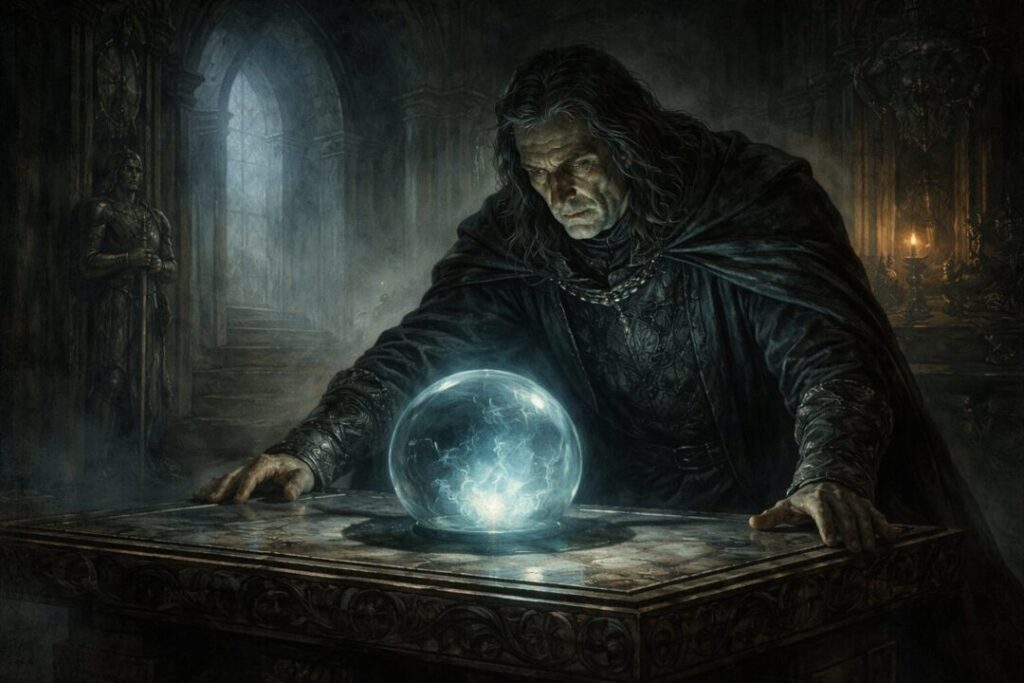
Tolkien Gateway summarizes that Denethor had long used the Anor-stone in secret to gain knowledge, and that Sauron—using the Ithil-stone—eventually perceived and contested him.
That matters because it establishes two key points:
- Denethor is not naïve about the palantír.
- Sauron is not ignorant of Denethor’s use.
So if Denethor looked on the night of March 13, the “conversation” was not one-sided.
What the palantír can and cannot do
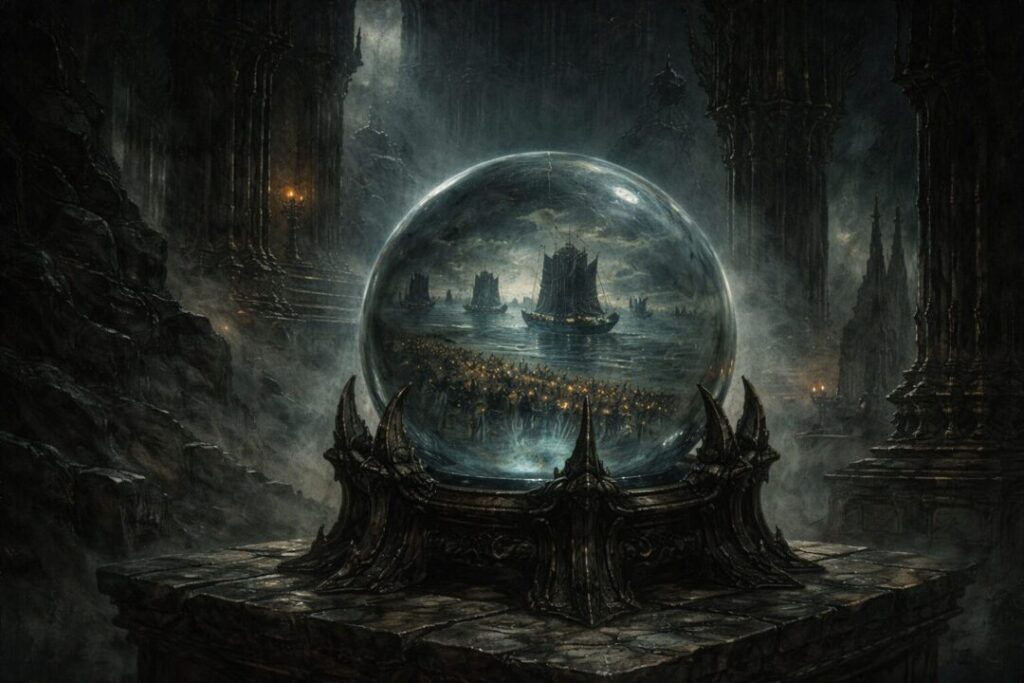
A palantír does not function like a storyteller. It is not a magical cinema designed to provide context, names, or explanations.
The lore emphasizes limits that matter here:
- The Stones are used to see afar and to communicate mind-to-mind.
- A strong user can direct the gaze, but it is taxing, and “chance” still affects what one’s gaze falls upon.
- Crucially for any “Frodo in the dark” theory: the Stones require light to see anything.
- And in the broader tradition around Denethor’s downfall, Sauron’s deception is consistently framed as selective truth—showing real things in a way that drives a false conclusion.
So the most lore-consistent mechanism is not “the palantír lies,” but:
the palantír shows something true, and the viewer supplies the doom.
That is exactly the kind of trap Denethor is vulnerable to—because he is proud enough to trust his own interpretations, and desperate enough to accept the worst if it fits what he fears.
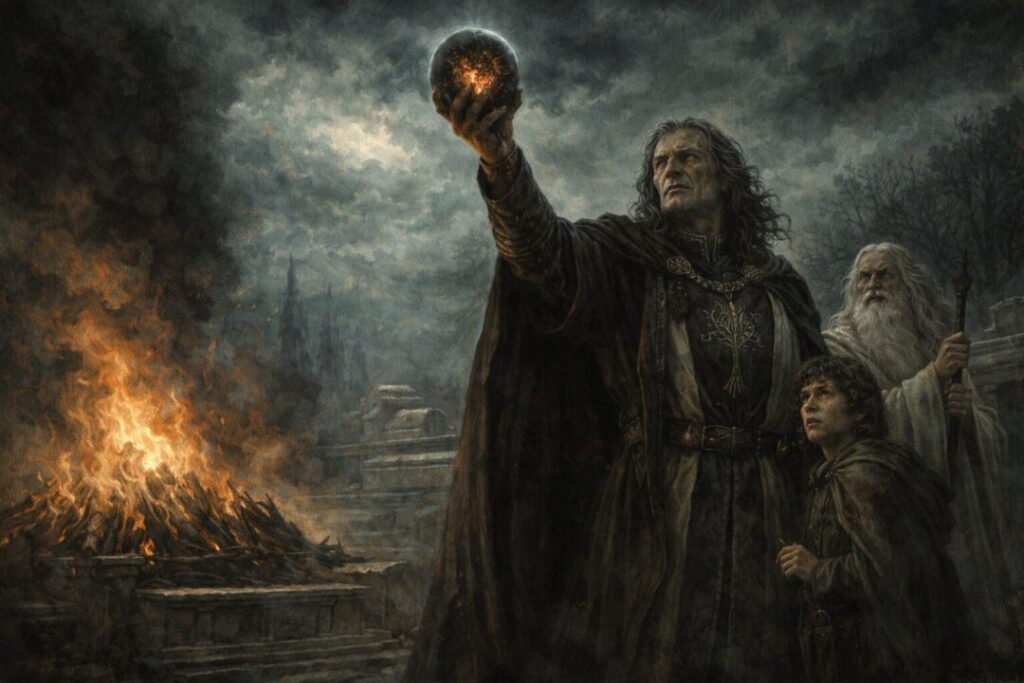
Denethor’s own words: “The Enemy has found it”
The strongest textual hook for the Frodo question is Denethor’s language in The Pyre of Denethor.
When Pippin speaks of hope—especially hope for Frodo—Denethor replies:
“The fool’s hope has failed. The Enemy has found it, and now his power waxes…”
Denethor does not say “found us.” He does not say “found a weakness.” He says “found it.”
In the context of the war, “it” can only reasonably mean the Ring—or the Ring-bearer as the key to the Ring’s fate.
But here is where accuracy matters:
Denethor cannot know, as a fact, that Sauron possesses the Ring—because Sauron does not.
So Denethor is either:
- making a deduction from military realities alone, or
- reacting to something he believes he has seen, or
- reacting to something Sauron has maneuvered him into concluding.
The palantír is not necessary for Denethor to despair. But it is the most direct reason the text gives for why Denethor’s despair is so absolute—so certain.
Did Denethor see Frodo himself?
Here we must separate three different claims:
Claim A: Denethor saw Frodo clearly, identified him, and understood the capture.
This is not stated in the text. It should be treated as speculation.
Even if Denethor saw a “small figure,” recognizing Frodo at distance is not guaranteed, and the palantír does not label images.
Claim B: Denethor saw something that strongly implied the capture of the Ring-bearer.
This is possible, and it fits what the Stones are used for: distant sight, selected truth, dreadful inference.
If Denethor had learned from Faramir that a Halfling went toward Cirith Ungol (which Denethor essentially extracts in their confrontation), then Denethor might reasonably try to cast his gaze toward that pass—especially during the hours when he feels the city’s fate tightening.
He would not need to see “Frodo’s face.” He would only need to see a captive carried under guard near the very threshold of Mordor.
Claim C: Denethor saw evidence adjacent to Frodo that caused the same conclusion.
This is, in some ways, the most lore-faithful option.
Because Frodo’s capture happens at Cirith Ungol—an Orc-held tower in a war zone—there are other “true images” that could produce Denethor’s statement:
- increased movement and mustering around the pass,
- Orcs carrying spoils, prisoners, or tokens,
- signals of success near Mordor’s western borders.
Any of these, shown without context, could press Denethor into the exact conclusion he voices: the Quest has failed.
Why Denethor wouldn’t tell Gandalf plainly
If Denethor believed he had seen the Ring-bearer taken, why does he not say, “Frodo has been captured”?
The text offers a simple answer: Denethor’s conflict with Gandalf is not only strategic—it is existential.
Denethor does not merely reject Gandalf’s plan. He rejects Gandalf’s right to be the one who “knows.” That is why he says:
“Nay, I have seen more than thou knowest…”
He positions himself as the one with superior sight, superior realism, superior authority.
So he speaks in absolutes (“The Enemy has found it”) rather than in shared particulars. Naming Frodo directly would be a kind of admission: that Gandalf’s hope had a real shape, a real person, a real fragile thread.
Denethor will not grant that thread dignity. He will only announce its severing.
And if the Stone showed him something that looked like severing, Denethor would rather burn than reopen the argument.
The most responsible conclusion
So—did Denethor ever see Frodo’s capture in the palantír?
The conservative, text-faithful answer is: we are not told.
But the lore allows a narrower statement that remains grounded:
- Denethor used the Anor-stone and gained knowledge from it.
- Denethor reached a point where he believed the Enemy had “found it.”
- The critical day when Denethor’s despair hardens aligns with the day Frodo is captured.
- The palantíri are capable of showing true images in ways that drive catastrophic inference.
From there, the “Frodo angle” becomes a disciplined interpretation:
Denethor may not have seen Frodo’s face—but he may have seen enough truth, at the worst possible moment, to believe the Ring-bearer had been taken.
And that possibility recasts Denethor’s final hours.
Not as the tantrum of a collapsing ruler.
But as the death-spiral of a man who thinks he has watched the last light go out—through a Stone that never needed to lie to destroy him.
Sources & Notes
- J.R.R. Tolkien, The Lord of the Rings, Appendix B, “The Tale of Years” — dates Frodo’s capture at Cirith Ungol and Faramir’s wounding to 13 March 3019.
- J.R.R. Tolkien, The Lord of the Rings, Book V, Chapter 4, “The Siege of Gondor” — shows Denethor’s secret use of the Anor-stone and his despair under Sauron’s pressure.
- J.R.R. Tolkien, The Lord of the Rings, Book V, Chapter 7, “The Pyre of Denethor” — gives Denethor’s claim that “The Enemy has found it” and his final rejection of Gandalf’s hope.
- J.R.R. Tolkien, Unfinished Tales, “The Palantíri” — explains the Seeing-stones’ powers, limits, need for light, and vulnerability to domination by a stronger will.
- J.R.R. Tolkien, The Lord of the Rings, Book IV, Chapter 5, “The Window on the West” — gives Faramir’s encounter with Frodo and Sam, a plausible route for Denethor to suspect the Ring-bearer’s path toward Mordor.