The end of the War of the Ring does not end the world’s long unmaking.
It only changes who notices it.
Some peoples leave in ships. Some are written into new histories. Some win kingdoms and keep them.
And some—like the Ents—simply keep standing.
They are still there after the Ring is unmade. They are still strong enough to break stone and turn a fortress into a garden. They still speak in the old, slow way. They still remember forests that once reached from one horizon to another.
But the text makes one thing increasingly hard to avoid:
The Ents do not “finish” in a single moment.
They thin out. They grow still. They become harder to find.
Their fate is one of Middle-earth’s clearest examples of the slow-fading peoples—the ones who don’t get a clean exit, only a long quiet after.
A victory that looks like regrowth
When Aragorn’s company rides to Isengard in the chapter “Many Partings,” they expect ruins.
Instead they find work.
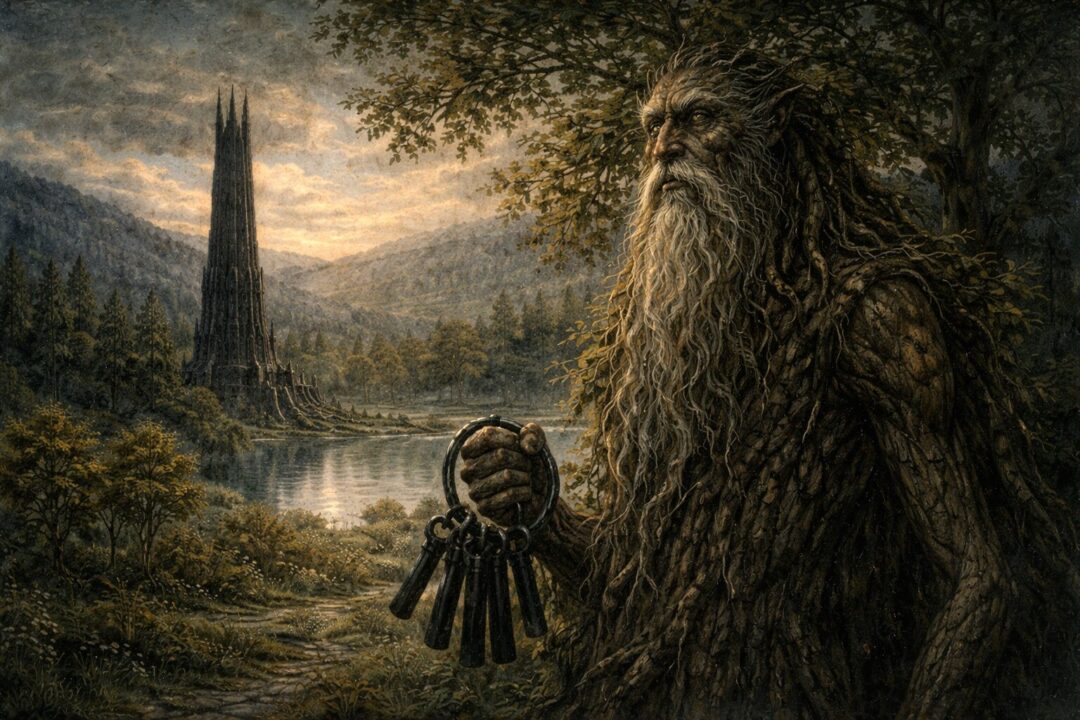
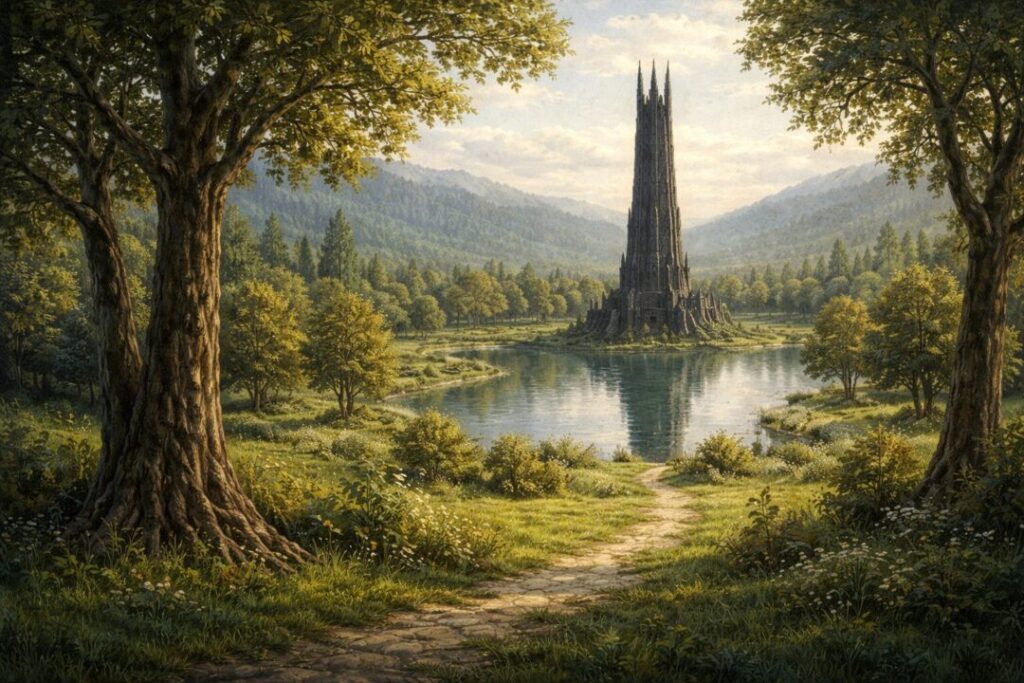
The stone-circle is thrown down. The enclosed land is remade into a garden filled with orchards and trees, with running water. Orthanc still rises—tall, impregnable, mirrored in a lake—but everything around it has been re-set toward life.
Treebeard greets them with a new name: “Welcome to the Treegarth of Orthanc!”
It matters that this is where we see the Ents after the war.
They do not build a city. They do not claim a throne. They do not write a new law.
They re-plant.
And the King recognizes what that means.
Aragorn formally gives the valley to the Ents: “I will give to Ents all this valley to do with as they will,” with only one condition—that they keep watch upon Orthanc and allow none to enter without his leave.
So, in the immediate aftermath, the Ents gain something real: space, safety, and royal acknowledgement.
But almost at once the text lets a different truth surface.
“Forests may grow… But not Ents.”
Aragorn’s farewell sounds generous. He points west and remembers older days: when the Ents once walked beyond the mountains, when there was room to spread again.
Treebeard answers with a sentence that is both simple and final:
“Forests may grow… Woods may spread. But not Ents. There are no Entings.”
This is the hinge of the whole question.
Because it tells you what “after the Ring” really means for the Ents.
The war removed an enemy. It opened roads. It even restored land.
But it did not restore the one thing the Ents lack: continuation.
Treebeard’s words do not describe a sudden extinction. They describe a limit.
If there are no Entings, then the number of Ents can only move in one direction over time—downward—whether by death, by weariness, or by the other slow change the text keeps pointing toward.
The Ents were already dwindling before the war
Long before Isengard becomes a garden, Treebeard tells Merry and Pippin something that frames the Ents as a people already in decline.
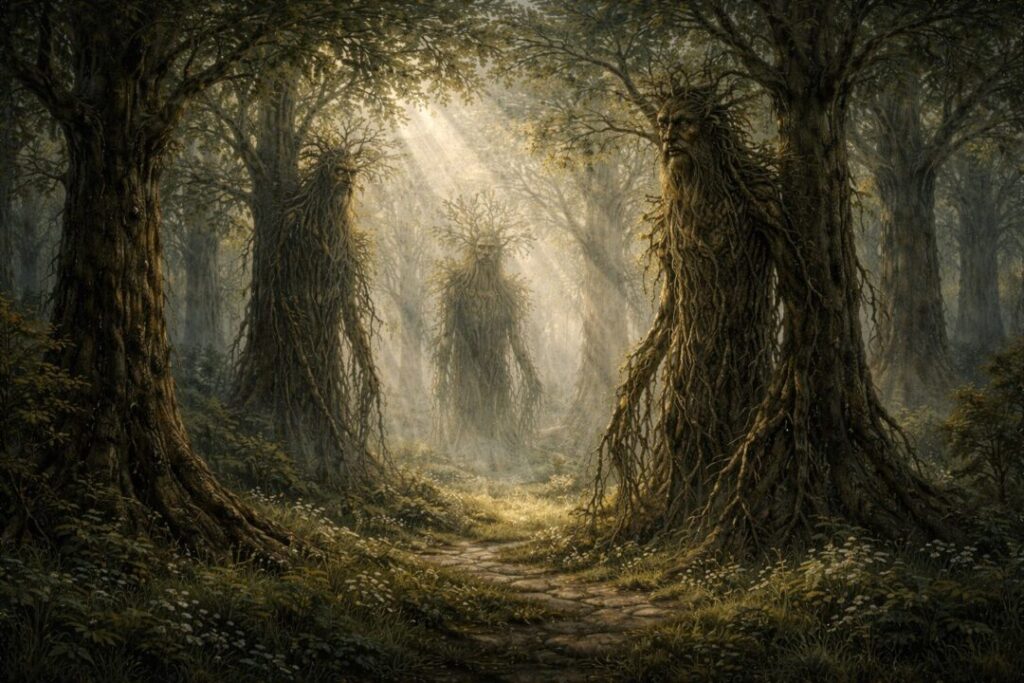
Some are still “true Ents,” he says, but many are “growing sleepy, going tree-ish.”
That phrase is easy to pass over because it’s spoken in the middle of a lively conversation.
But it is one of the most important clues we get about Entish “ending.”
Treebeard describes a spectrum:
- trees that are just trees,
- trees that are half-awake,
- and Ents who are becoming more like trees again.
Some of his kin, he says, now look just like trees and speak only in whispers, needing “something great” to rouse them.
In other words: the Ents are not only few in number. Some are also slipping out of the category “people,” back toward the category “forest.”
So when the Ring is destroyed, it does not start the fading.
It simply makes the fading easier to miss—because the world’s attention moves elsewhere.
Watchwood and Treegarth: what the Ents can still do
Treebeard’s answer to Saruman is one of the last great public acts of the Ents.
They tear down Isengard. They flood its pits. They undo a machine with water, stone, and patient force.
But after that, their power expresses itself as restoration and guarding.
In The Two Towers, Treebeard speaks of what will come next: trees returning to live there—old trees, wild trees—and the naming of the new wood as “Watchwood.”
The name is quietly revealing.
It does not mean “conquest-wood.”
It means a wood that keeps watch.
That fits exactly with the condition Aragorn later lays down in “Many Partings”: the Ents keep the valley, and they keep guard on Orthanc.
So, if you ask what the Ents do after the Ring is destroyed, the text answers clearly:
They restore Isengard into a living place.
They maintain a guarded realm—the Treegarth.
They watch.
But if you ask what becomes of them, the answer is harder, because it is not a single event.
It is a long, quiet trajectory.
“There are too many Men there in these days.”
After Treebeard’s “Forests may grow… but not Ents,” Aragorn offers a second hope: perhaps now the search eastward may be easier, because lands long closed will lie open again.
Treebeard refuses—not with anger, but with a realism that feels older than politics.
He says the distance is great, and then adds the line that quietly defines the Fourth Age:
“There are too many Men there in these days.”
This is the Ents’ isolation in one sentence.
Not “Men are evil.”
Not “Men will hunt us.”
Just: they are too many.
It’s a statement about density, borders, and the shape of the world to come. The Age of Men is not merely a calendar change. It is the condition that makes the old peoples harder to sustain.
And it helps explain why the Ents’ end is not a dramatic fall.
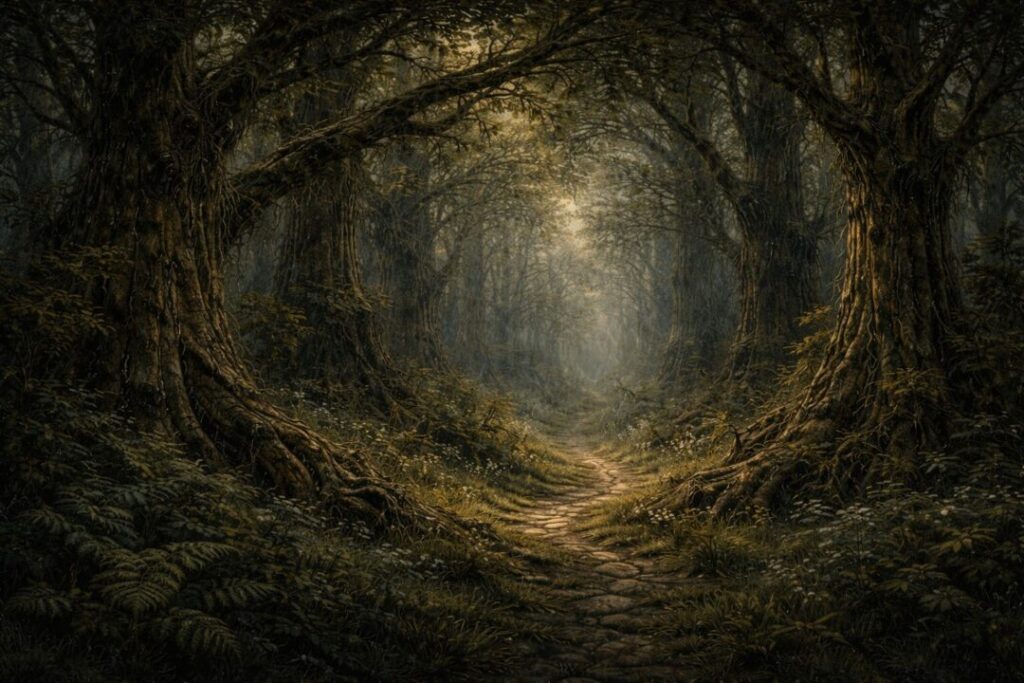
It is retreat into the remaining wild places—until those places themselves become harder to name on human maps.
The farewell that sounds like an ending of meetings
When the Company departs, Treebeard bows to Celeborn and Galadriel and speaks a line that reads like an elegy for long friendships between very old kinds:
He says it is sad they meet only “thus at the ending,” and then:
“For the world is changing… I do not think we shall meet again.”
Whether you read that as certainty or sorrow, the direction is the same.
The world is moving into a mode where Ents and Elves do not cross paths.
Not because they hate each other.
Because the conditions that made such meetings possible—shared woods, shared borders, shared time—are passing away.
So what became of the remaining Ents?
If we restrict ourselves to what the text supports, the answer comes in layers:
1) They remained active immediately after the war.
They restored Isengard into the Treegarth of Orthanc and established the Watchwood.
2) They did not recover as a people.
Treebeard states plainly that there are no Entings, and that forests may spread but Ents will not.
3) They continued the slow change already underway.
Treebeard describes many Ents becoming “tree-ish,” growing sleepy, speaking only in whispers.
4) Their world became increasingly separated from the human one.
Treebeard explicitly names the problem: too many Men.
Put together, the most conservative reading is this:
After the Ring’s destruction, the Ents likely persisted for some time—guarding Orthanc, tending their reclaimed valley, remaining in Fangorn—but they dwindled in number and in “wakefulness,” becoming less encountered by later peoples.
That is not a cinematic ending.
It is something more Middle-earth is quietly built to do:
To let ancient wonders become stories not because they were disproven—
but because fewer and fewer living voices are left to point at the trees and say, that one used to walk.
And if you want the sharpest proof that this is how the ending works, you can find it in Treebeard’s own logic:
He does not say, “We will be slain.”
He says, “We will not increase.”
Which means their ending is not a last stand.
It is time—doing what time does in the Dominion of Men.
Sources & Notes
- J.R.R. Tolkien, The Lord of the Rings, Book VI, Chapter 6, “Many Partings” — Treebeard welcomes the company to the Treegarth of Orthanc; Aragorn grants the valley to the Ents, and Treebeard answers that forests may grow but “not Ents,” because there are no Entings.
- J.R.R. Tolkien, The Lord of the Rings, Book III, Chapter 4, “Treebeard” — Treebeard explains the loss of the Entwives, the absence of Entings, and the slow dwindling of Ents as some grow sleepy and tree-ish.
- J.R.R. Tolkien, The Lord of the Rings, Book III, Chapter 9, “Flotsam and Jetsam” — Merry and Pippin describe Isengard after the Ents’ assault, with the pits flooded and Saruman’s machinery broken.
- J.R.R. Tolkien, The Lord of the Rings, Book VI, Chapter 5, “The Steward and the King” — confirms the transition into the Dominion of Men, the larger Fourth Age context in which Treebeard expects fewer meetings with the older peoples.
- J.R.R. Tolkien, The Lord of the Rings, Appendix B, “The Tale of Years” — records the beginning of the Fourth Age after the War of the Ring, framing the Ents’ survival as a lingering, fading presence rather than a narrated extinction.