Some Middle-earth turning points announce themselves with horns and banners.
Others happen in the grass.
Éomer’s first appearance in The Two Towers is not in a throne-room, not on a battlefield at the end of a chapter, but out on the open plains—where a Marshal of the Mark meets three strangers who have no horses, no food, and almost no hope of catching what they pursue.
It’s one of those scenes that feels like connective tissue: necessary for motion, not meaning.
And yet it is also the place where a “small disobedience” becomes visible.
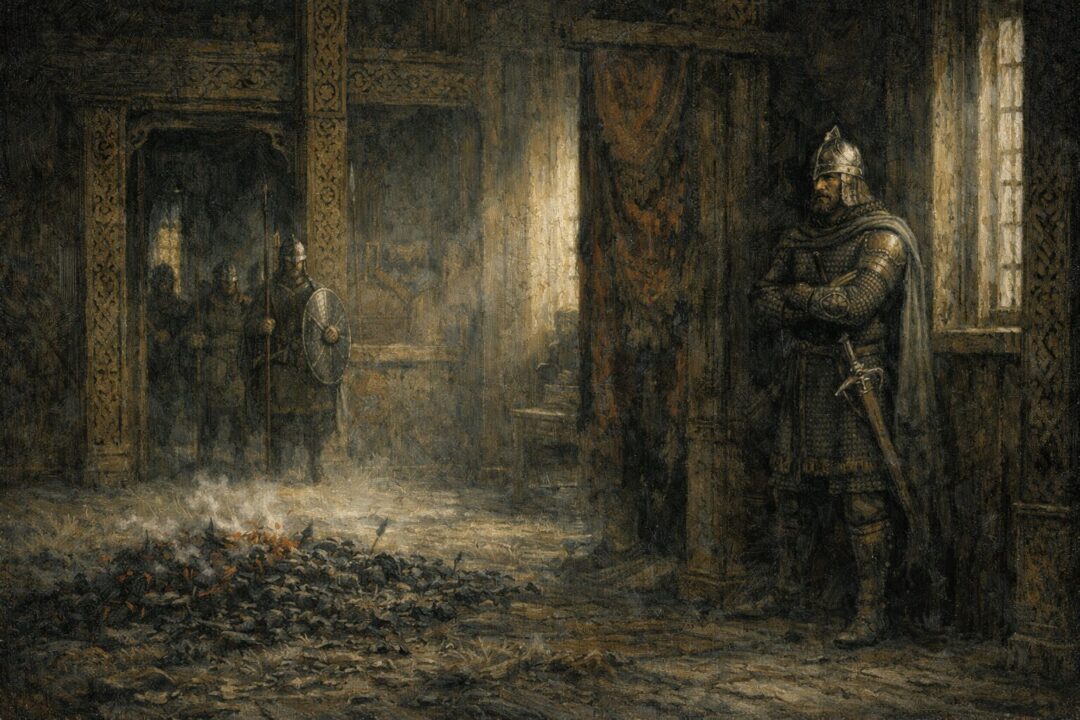
Because Éomer is not riding in a calm, well-ordered kingdom. He is riding in the Rohan where Théoden’s strength has been bent by long counsel, where Gríma Wormtongue’s voice has narrowed what is permitted, and where bold riders are treated as a problem to be managed. In that context, Éomer’s ride against the Orc-company is not just vigorous patrolling—it is action taken in a house that has begun to fear action.
When Aragorn’s company meets him in “The Riders of Rohan,” Éomer is already in a precarious position. In the same stretch of narrative that follows, we learn he is accused on his return to Edoras and imprisoned—partly for the very things tied to that ride and his defiance of Gríma’s influence. The text does not frame him as a rebel against Théoden’s true will; it frames him as a loyal man operating under a distorted rule.
That distinction matters for this “what if.”
Because the counterfactual is not simply: What if Éomer were less brave?
It is: What if Éomer were perfectly obedient inside a sickened court?
If Éomer never disobeys, does the Quest fail—not loudly, but quietly—through missing junctions?
To answer carefully, we have to keep our feet on what the text actually puts in his hands.
The first hinge: the Orc-company at the edge of Fangorn
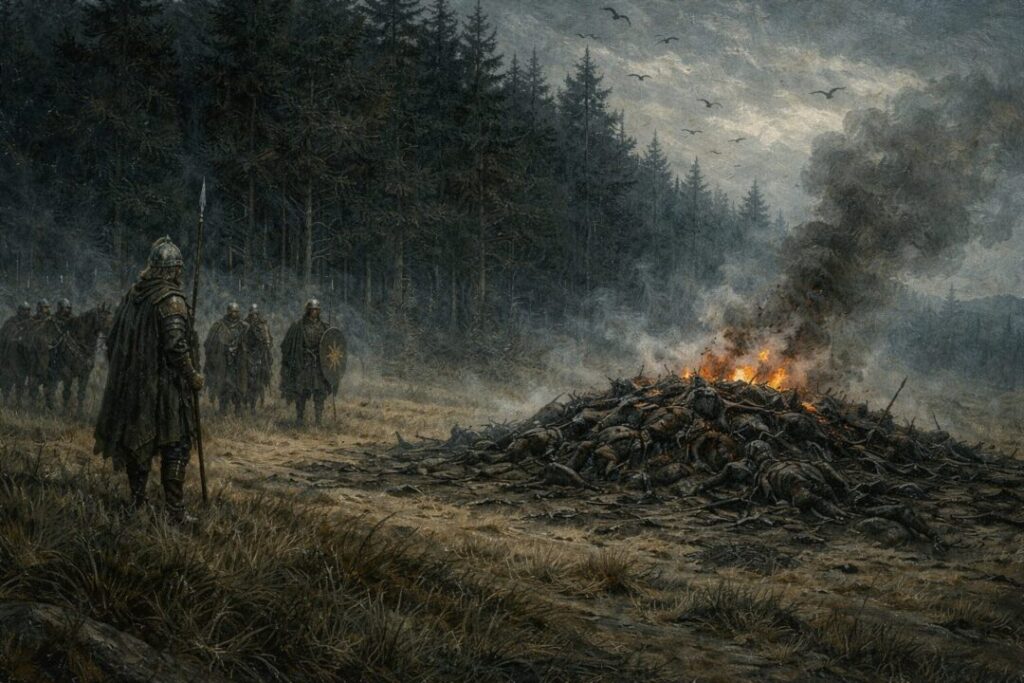
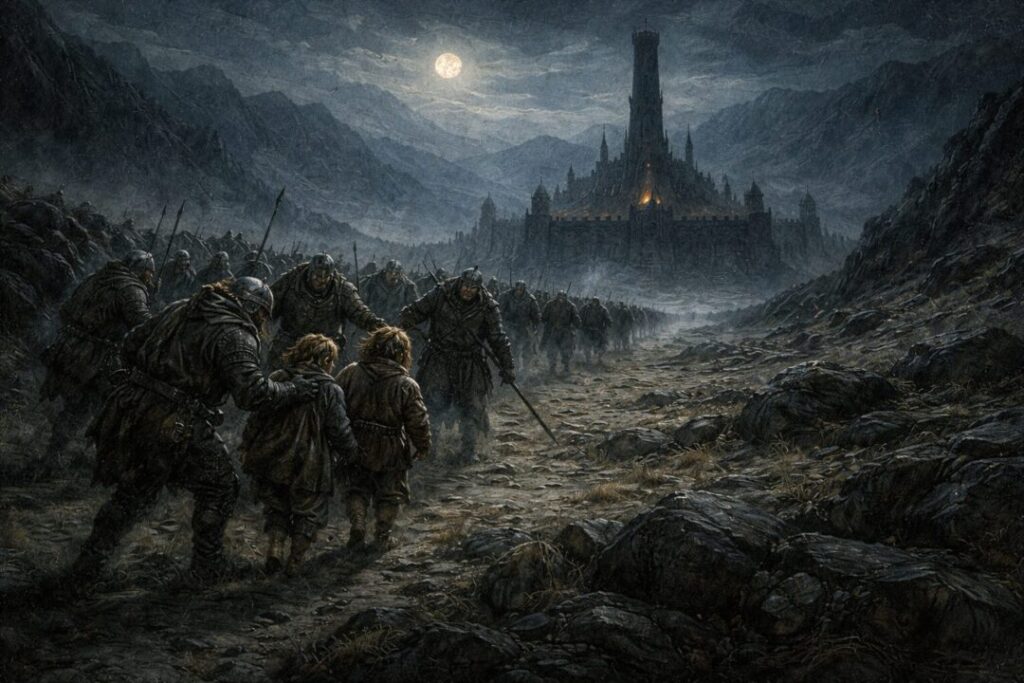
In The Two Towers, the Orcs carrying Merry and Pippin do not reach Isengard.
They are overtaken and destroyed by Rohirrim near the borders of Fangorn. That is not an optional flourish; it is the violent interruption that makes the next chain possible.
Merry and Pippin escape in the confusion, fleeing into Fangorn. They meet Treebeard. They learn what kind of being they have stumbled into. And from that meeting grows the Entmoot and the march on Isengard.
We should be conservative in phrasing what follows—because Tolkien does not give us a timetable that says “if X, then Ents never move.” But the narrative does show a simple dependency: without the Rohirrim attack at that place and time, the hobbits are far less likely to enter Fangorn alive and free.
So if Éomer never rides out, one plausible consequence is grimly straightforward:
- The Orc-company may get closer to Isengard with its captives than it ever does in the book.
- Merry and Pippin may never have the chance to escape into Fangorn at all.
We cannot claim with certainty that they would arrive at Isengard—war is full of chance, and other riders could in theory intervene. But the textual intervention we are shown is Éomer’s éored. Remove that known fact, and the burden of rescue shifts into speculation.
And this is where “quiet failure” begins to feel real.
Because Merry and Pippin do not carry the Ring. Their capture is often treated as a side plot. But the Ents’ attack on Isengard is not a side plot. It is one of the great strategic reversals of the War: Saruman’s power is broken, his gates are thrown down, and his ability to move freely against Rohan collapses.
If the hobbits never reach Treebeard, Tolkien never gives us another guaranteed spark that rouses the Ents at that hour.
You can call it interpretation, but it is a restrained one: the story strongly implies that this meeting is the catalyst.
The second hinge: two borrowed horses on the plains
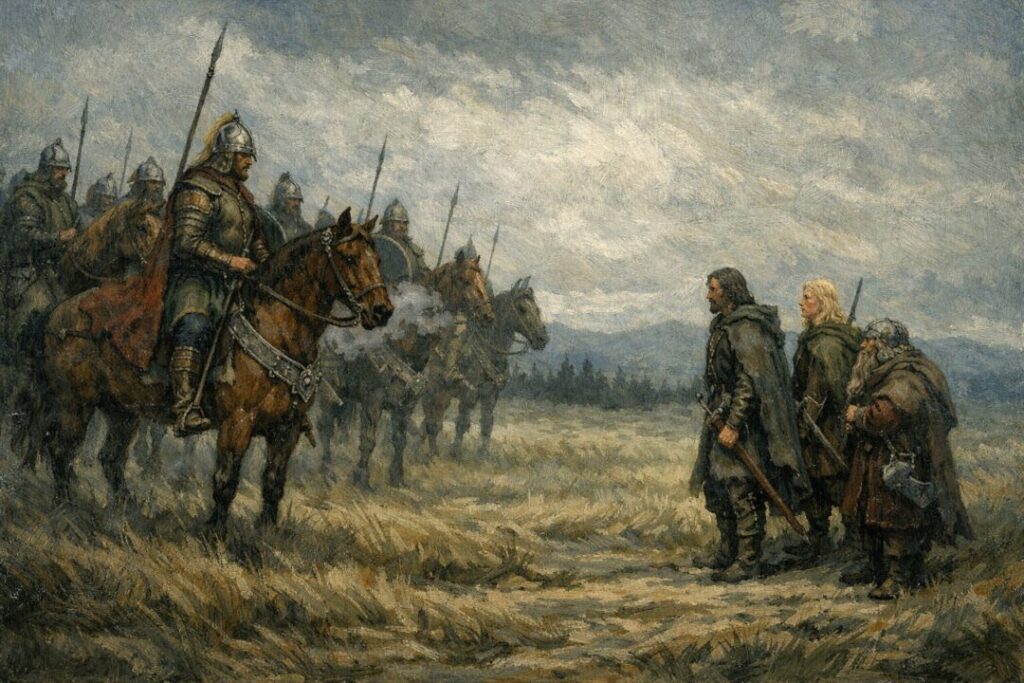
After Éomer questions Aragorn, Legolas, and Gimli, he does something that seems merely decent: he lends them horses—two, to replace the ones they lack.
This is the practical gift that turns a doomed chase into a possible one.
Without those horses, the Three Hunters do not simply travel slower. They become something else entirely: three armed strangers on foot in a suspicious land during wartime, with no proof that their intentions are just, and no speed to catch any moving target.
In the book, those borrowed horses carry Aragorn and company toward Fangorn—and into their next hinge: their meeting with Gandalf the White.
It’s easy to flatten this into fate, as if Gandalf would have found them regardless. But Tolkien’s narrative often works through timing and place—through meetings that occur because someone arrived this day, not another.
If Éomer never disobeys, and therefore never meets them on the plains, the simplest result is:
- Aragorn, Legolas, and Gimli likely do not receive horses.
- Their arrival at the edge of Fangorn (and therefore their meeting with Gandalf) becomes uncertain.
We cannot assert they would fail to meet him. They might still choose the forest. They might still be found. But the clean, canon chain—hunt → meeting → horses → Fangorn → Gandalf—would be broken.
And Tolkien does not give us a second, equally solid chain to replace it.
The third hinge: what happens to Théoden without Éomer in the story’s middle?
In “The King of the Golden Hall,” Gandalf comes to Edoras, confronts Wormtongue’s counsel, and Théoden’s will is renewed. Éomer is brought from imprisonment and restored.
So does Éomer’s earlier disobedience actually matter, if Gandalf “fixes” things anyway?
Yes—because Gandalf’s intervention does not erase the realities outside Meduseld.
Théoden can rise, but he still must act with the pieces available to him.
Éomer is not just a rider; he is a Marshal, a commander with men who will follow him. The text positions him as central to Rohan’s readiness once Théoden chooses war. If Éomer had remained “obedient” inside Edoras, one of two things is likely:
- Either Éomer remains free but passive—meaning no ride against the Orcs, no decisive action on the plains, and no proof that bold resistance still lives in the Mark.
- Or Éomer remains trapped under Wormtongue’s suspicion anyway, because his mere presence is a threat to Gríma’s control.
The second possibility is not wild invention; it is consistent with what the text shows: Wormtongue tries to neutralize those closest to Théoden who might oppose his counsel.
In either case, obedience does not guarantee safety. It may only guarantee inaction.
And in Tolkien, inaction at the wrong hour is not neutral. It is a slow form of defeat.
The fourth hinge: Isengard’s pressure on Rohan
By the time Helm’s Deep arrives, Saruman has already begun his assault on the Westfold. Théoden chooses to ride, then to take refuge in the Hornburg. Gandalf departs to gather help.
In the book, Saruman’s power is already being undermined from another direction: the Ents move, and Isengard is broken while Helm’s Deep is still in play.
That matters because it means Saruman cannot simply regroup and strike again with the same freedom. His base is devastated. His confidence is shaken. His ability to pursue is curtailed.
If Éomer never rides out—if Merry and Pippin never escape to Fangorn—then the Ents’ march is no longer anchored to a canon cause. And if Isengard is not broken at that hour, Saruman remains a more intact threat behind the battle line.
Would Théoden still win Helm’s Deep? Tolkien shows that the battle is desperate even with the broader turning against Saruman.
So here we must be disciplined: we cannot declare “Helm’s Deep falls” as fact.
But we can say something narrower and safer:
- Removing the Ents’ intervention plausibly leaves Saruman with greater freedom and strength after Helm’s Deep than the book allows him.
- That makes Rohan’s recovery more precarious, and the war’s timeline tighter.
And again, timeline is everything for the Ring-Quest.
So does the Quest fail quietly?
If you are looking for a single catastrophic “and therefore Frodo dies,” Tolkien does not write that kind of mechanistic world.
But if you are willing to see failure the way Tolkien often shows it—through roads that close, choices that narrow, and strength that arrives a day too late—then yes: Éomer’s obedience could begin a quiet unravelling.
Not because Éomer is “more important” than the Ring-bearer.
But because Middle-earth is a network of lived loyalties, not a machine.
A single ride changes the placement of pieces:
- An Orc-company is destroyed where it would otherwise run on.
- Two hobbits enter Fangorn alive and free.
- Three hunters receive speed when speed is the difference between meeting and missing.
- A wizard is met in the wild at the hour he must be met.
- Isengard is broken not by a great king’s army, but by the old wood awakened.
And the most disturbing implication is this:
Éomer’s “disobedience” is not defiance against rightful authority. It is a refusal to become inert under a poisoned one.
If he never disobeys, the Quest does not necessarily end with a dramatic defeat. It may simply lose its margins—the small, unplanned mercies that let it keep moving.
That is how Tolkien’s world often turns: not on grand vows, but on a rider who chooses to act before permission arrives.
The question isn’t whether Éomer breaks the rules.
The question is: which rules were already breaking Rohan—and how many victories depended on someone ignoring them for one night.
Sources & Notes
- J.R.R. Tolkien, The Lord of the Rings, Book III, Chapter 2, “The Riders of Rohan” — Éomer’s éored has destroyed the Orc-band near Fangorn, and he gives Aragorn, Legolas, and Gimli horses.
- J.R.R. Tolkien, The Lord of the Rings, Book III, Chapter 3, “The Uruk-hai” — Merry and Pippin escape during the Rohirrim attack and enter Fangorn.
- J.R.R. Tolkien, The Lord of the Rings, Book III, Chapter 4, “Treebeard” — the hobbits’ meeting with Treebeard leads into the Entmoot and the decision to march on Isengard.
- J.R.R. Tolkien, The Lord of the Rings, Book III, Chapter 6, “The King of the Golden Hall” — Éomer’s imprisonment, Wormtongue’s influence, and Théoden’s restoration establish the political stakes in Rohan.
- J.R.R. Tolkien, The Lord of the Rings, Book III, Chapters 7–8, “Helm’s Deep” and “The Road to Isengard” — Saruman’s assault on Rohan and the Ents’ destruction of Isengard show why the timing of these linked events matters.