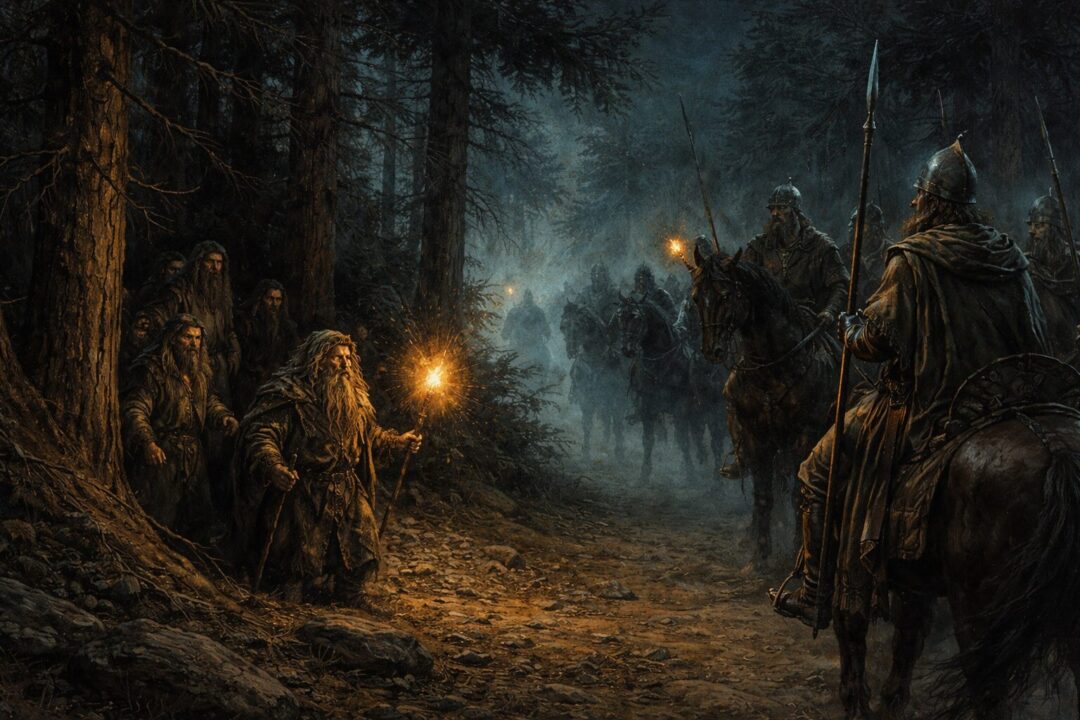
The Drúedain are one of those Middle-earth peoples you can almost miss.
They do not arrive with banners. They do not found a famous realm with a line of kings. They do not get a genealogical appendix that teaches you how to pronounce their names.
They step out of the trees—briefly—at the exact moment when history is moving too fast to look closely.
And yet, that brief moment is precisely why they matter.
Because the Drúedain feel like a surviving layer beneath the familiar map: older than the borders, older than the road-names, older than the confidence with which later peoples assume they “own” a land simply because they can ride through it.
That sensation is not an accident of tone. It is built into where the Drúedain appear, what other peoples call them, and how they choose to remain half-seen.
The names already tell you the story
Even before you learn what the Drúedain do, you learn what happens to them.
They have several names in the tradition: Drúedain (an Elvish term), Drûgs (a shorter form associated with their own usage as preserved in later Mannish tongues), Woses (the Rohirric name), and Púkel-men—a name the Rohirrim use especially for the strange stone figures on the road to Dunharrow, but also as a general label.
Those names do not feel like titles of honor. They feel like the vocabulary of outsiders describing something they do not fully understand.
“Woses” and “Púkel-men,” in particular, carry the sound of folk-speech: quick categories made by travelers to explain what is unsettling on the roadside.
And that is your first clue to why they feel ancient.
The Drúedain are repeatedly encountered as already-present—people you do not meet by invitation, but by passing through their land and realizing, belatedly, that you were never alone.
Where they live is part of the effect
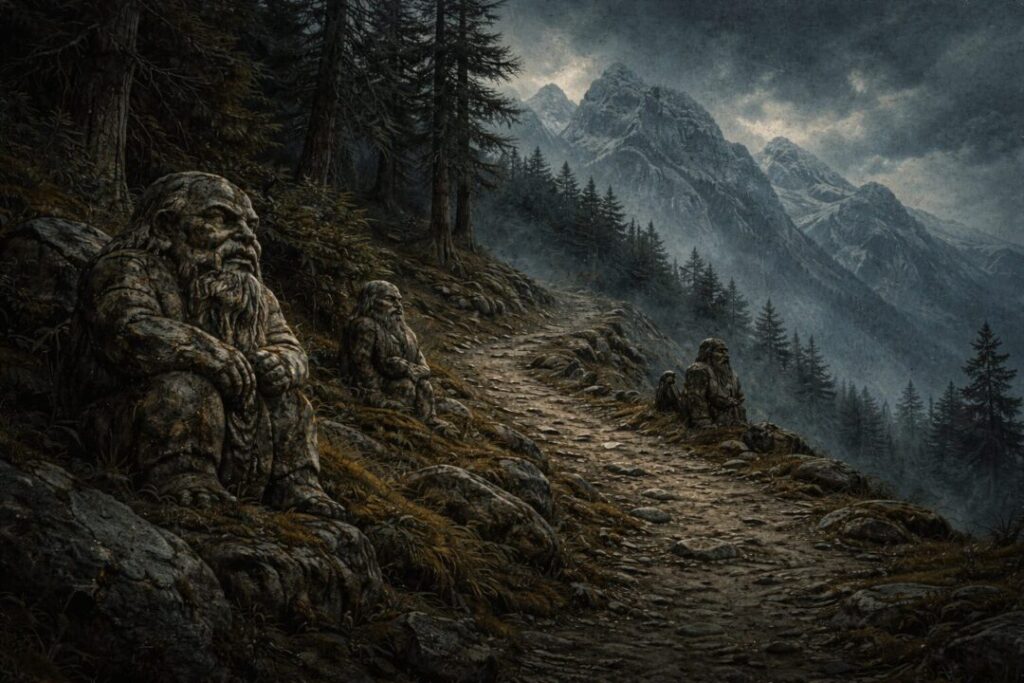
The Drúedain who enter the War of the Ring live in the Drúadan Forest (also called Tawar-in-Drúedain in Sindarin tradition), a wooded region in Anórien, north of Minas Tirith.
This matters because it is not “the far edge of the map.” It is close to the beating heart of Gondor.
And yet the forest remains, in practice, a margin.
The Rohirrim ride the main road. Scouts and messengers move along routes that feel “safe.” The Drúadan Forest is the place you go around—until the night comes when going around is no longer possible.
That is when Ghân-buri-Ghân appears.
Not with a grand speech. Not with a pledge of fealty. But with an offer that is unmistakably practical: he can lead Théoden’s host by secret ways through the woods, slipping past the enemy who waits along the road.
It is one of the quietest turning points in the entire march to Minas Tirith.
And it carries a deeper implication:
The Drúedain know paths that the riders of Rohan—masters of movement—do not.
Not because the Riders are incompetent, but because those paths are not part of the “official” geography of kingdoms. They are the kind of knowledge you only have if you have lived in a place long enough for the land to become a language.
What the Drúedain ask for tells you what they have endured
The bargain with Théoden is often remembered as a helpful detour.
But it is also a revelation of how the Drúedain have been treated.
Ghân-buri-Ghân’s request is not treasure. It is not rank. It is not a treaty that makes his people part of the Rohirrim.
He wants something more basic:
To be left alone.
In the tradition surrounding the Drúadan Forest and its people, the emphasis repeatedly falls on separation—on keeping their forest as their own space, free from intrusion.
That desire reads like more than temperament. It reads like long memory.
Because peoples who are welcomed do not usually have to negotiate for the right not to be hunted, moved, renamed, or absorbed.
Peoples who have been pushed to the edges do.
The texts do not turn this into a modern political parable. They do something subtler: they let a single request imply a history.
The Púkel-men: stone that outlasts understanding
If the Drúedain feel like a forgotten age, it is partly because stone remembers them when narrative barely does.
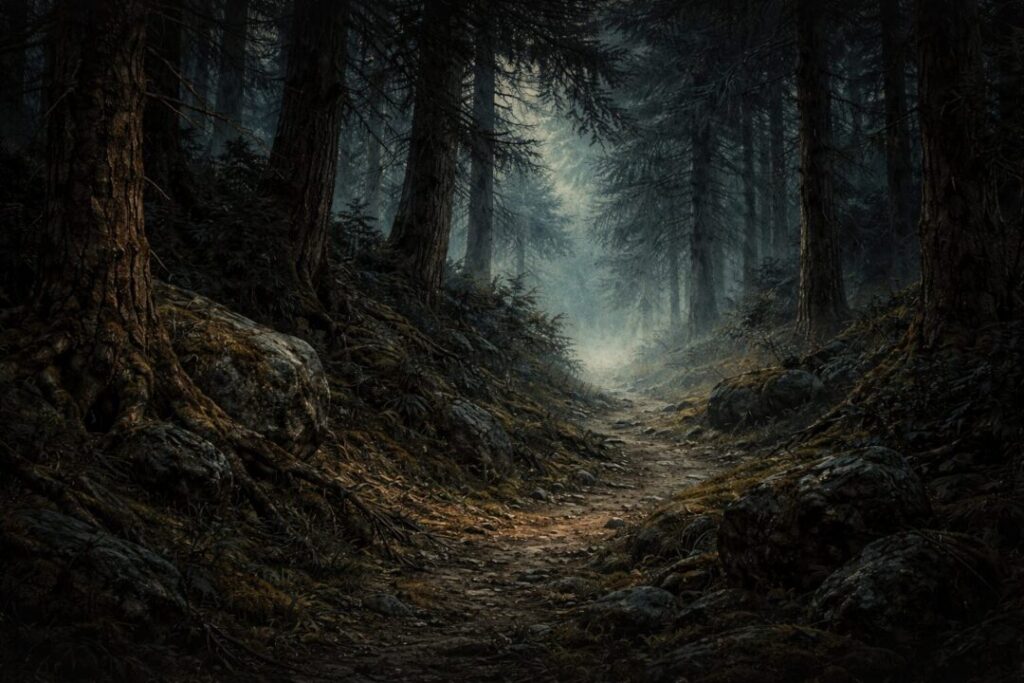
On the road to Dunharrow stand the strange images called the Púkel-men—grim figures that the Rohirrim associate with fear and old tales.
These are not presented as decorative statues made by a thriving later kingdom. They are presented as survivals: old workmanship from a people the Riders do not fully know, still standing in a place of dread and legend.
And that combination—half-recognized, half-feared—is exactly how forgotten ages feel in myth.
Not because the past is truly unknowable, but because later peoples have inherited it without inheriting the key.
Even the name “Púkel-men” has that flavor: a label pasted over something older, like a traveler naming a ruin because the real name is gone.
The deeper root: the Drúedain do not begin in the Third Age
If you stop with Ghân-buri-Ghân, you might think the Drúedain are simply an isolated woodland people who survived near Gondor.
But the wider canon refuses to let them be that small.
In Unfinished Tales, “The Drúedain” places them far earlier in the history of Men, connected with the First Age migrations and with the world that existed before the great Númenórean age reshaped the coasts.
Some traditions place Drúedain living alongside the Folk of Haleth in the Forest of Brethil in Beleriand—suggesting not a random tribe, but a people known in the Elder Days, moving in the same world as the Edain who later become central to Mannish history.
And some Drúedain, we are told in later summaries of that tradition, even came to Númenor—yet did not remain as a visible, lasting community into its final catastrophe.
That last detail is important, and it must be handled carefully.
The tradition tells you that Drúedain were present in Númenor at some point, but it does not give you a long narrative of their lives there on the level of the great houses of the Edain.
They pass through the biggest human story of the Second Age like a people passing through a doorway—present, then gone from sight.
That is exactly the pattern that makes them feel like a forgotten age.
They do not vanish because the world ends. They vanish because history stops looking.
“Forgotten age” does not mean “mystery box”
It is tempting to turn the Drúedain into a puzzle: secret origins, hidden powers, lost kingdoms in the mountains.
But the texts do not require that.
What they actually offer is more haunting than a conspiracy.
They offer a people whose visibility is always conditional—seen clearly only when someone else needs them, and otherwise treated as rumor, fear, or roadside stone.
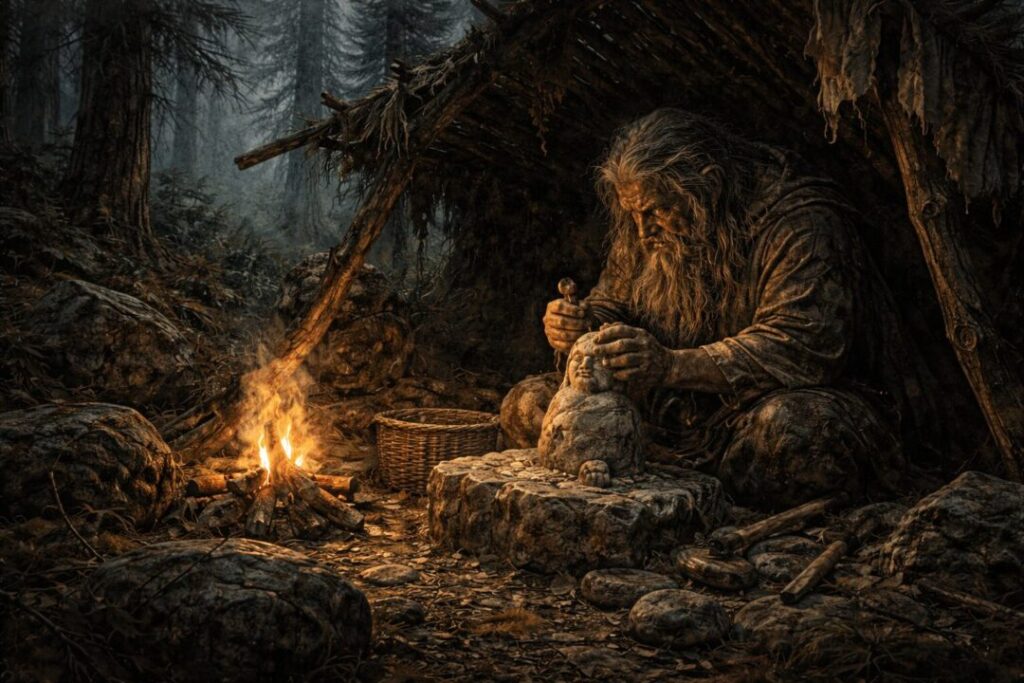
Even their crafts, when discussed, tend to carry that same mood: objects that endure, warnings embedded in wood or stone, watchers that stand where a person cannot always stand.
Unfinished Tales includes material that emphasizes Drúedain skill in making such “watching” things—yet it is best read as a culturally specific craft and tradition rather than as a system of spell-casting with rules the text lays out like a manual.
In other words, they are not a “magic race” inserted to expand the power list.
They are a people whose relationship with the world is shaped by caution, by memory, and by the need to survive among larger, louder neighbors.
Why they feel older than the world around them
By the time you reach the War of the Ring, Middle-earth is full of structures that feel established:
Gondor has stone cities, records, a steward’s line. Rohan has songs, kings, mounds, and a riding culture that remembers its founding.
The Drúedain have none of that public architecture.
They have a forest that others avoid.
They have secret paths that bypass official roads.
They have stone images that stand like punctuation marks in places where later peoples feel uneasy.
They have names given to them by others.
And when they finally speak for themselves, what they want is not glory. It is space.
That is what a forgotten age looks like from the outside.
Not an era of bright chronicles, but an older layer of habitation that later kingdoms built around rather than truly integrating.
And that is why the Drúedain are so revealing.
They force you to notice something Middle-earth often implies without spelling it out:
The great tales—the wars, the thrones, the councils—are not the only way a world is inhabited.
Some peoples endure by refusing the spotlight.
Some survive by becoming part of the land’s “background,” until one night arrives when the background steps forward… and quietly decides whether the marching host will live or die.
If you want the final, unsettling twist, it is this:
The War of the Ring is often described as the last great crisis of the Third Age.
But for the Drúedain, it reads differently.
It reads like one more moment when the mighty discover—too late—that they were never the first people in the wood.
Sources & Notes
- J.R.R. Tolkien, The Lord of the Rings, Book V, Chapter 5, “The Ride of the Rohirrim” — introduces Ghân-buri-Ghân and the Woses of Drúadan Forest, their secret road, and their wish that the Wild Men be left in peace.
- J.R.R. Tolkien, The Lord of the Rings, Book V, Chapter 3, “The Muster of Rohan” — describes the Púkel-men by the road to Dunharrow as old, weathered stone figures feared in Rohirric tradition.
- J.R.R. Tolkien, Unfinished Tales, “The Drúedain” — gives the fuller account of the Drúedain/Drûgs, their names, appearance, forest life, craft, and survival on the margins of later peoples.
- J.R.R. Tolkien, Unfinished Tales, “The Drúedain” — connects Drúedain traditions with the Folk of Haleth in Brethil and with the deeper First Age history of Men.
- J.R.R. Tolkien, Unfinished Tales, “The Drúedain” — preserves the Númenórean tradition that some Drúedain went to Númenor but departed before the Downfall, reinforcing their half-seen place in Mannish history.