
Gondor does not present itself as a forgetful realm.
It is a kingdom of archives.
Of inherited offices.
Of laws that survive the men who wrote them.
So when readers say, “Surely the Stewards would have known where the Heirs of Isildur were,” the instinct makes sense.
And yet the texts repeatedly place a strange tension in front of you:
The Stewards rule “until the Great King returns,” and at the same time Gondor behaves for long stretches of the Third Age as if that returning King is not a practical reality.
To understand why, you don’t need secret conspiracies.
You need three things the texts state plainly:
- Gondor made an early legal choice that narrowed what it would recognize.
- The North actively became difficult to track—by design and by necessity.
- Certain “kingly” knowledge in Gondor became guarded, internal, and self-referential.
Put together, “lost track” begins to look less like a single failure… and more like the predictable outcome of two kingdoms drifting into different kinds of survival.
1) The moment Gondor decides what it will (and won’t) accept
The clearest hinge is the dispute after the death of King Ondoher.
Arvedui of the North-kingdom makes a claim to the crown of Gondor, based on descent from Isildur and marriage to Ondoher’s surviving child.
Gondor’s answer is famously firm.
The Council replies that “the crown and royalty of Gondor belongs solely to the heirs of Meneldil, son of Anárion,”and adds the crucial line: “In Gondor this heritage is reckoned through the sons only.”
Whatever you think of the argument, notice what it does.
It turns the question of kingship away from “Which descendant of Elendil has the best claim?”
and toward “Which line does Gondor recognize as the only relevant line?”
From that point on, Gondor has a precedent: the South will choose its continuity through Anárion’s house as Gondor understands it.
This matters because once you institutionalize a narrowing—once you teach a realm that only one stream counts—you also reduce your incentive to keep close track of any other stream.
Even in the same passage, the perspective gap is visible: Gondor sees the northern realm as small. The text notes that to most in Gondor, “the realm in Arthedain seemed a small thing.”
That’s not an insult. It’s a scale problem.
And scale problems become memory problems.
2) The North becomes “a secret and wandering people”
Now look at what happens after Arvedui.
When the North-kingdom ends, the line does not end.
It continues through the Chieftains of the Dúnedain.
But the mode of existence changes so completely that it almost stops looking like “a royal house” at all.
The text says, starkly:
When the kingdom ended, the Dúnedain “passed into the shadows” and became “a secret and wandering people,” and their deeds were “seldom… recorded.”
That single sentence is enough to explain why Gondor cannot simply “look them up.”
You cannot track what is intentionally unannounced.
You cannot keep tidy records of a people whose work is meant to be unseen.
And the secrecy isn’t only cultural. It’s also strategic.
When Aragorn is fostered in Rivendell, the text states that his true name and lineage “were kept secret” because the Enemy was seeking to discover whether the Heir of Isildur remained.
So the North is not merely dwindling.
It is actively hiding its crown-prince.
That choice is not paranoia; it’s survival. But the consequence is obvious:
The very conditions that keep the line alive also make it easy for distant realms to lose clear sight of it.
3) Proof of kingship is kept out of Gondor’s hands
There is another detail that quietly widens the gap.
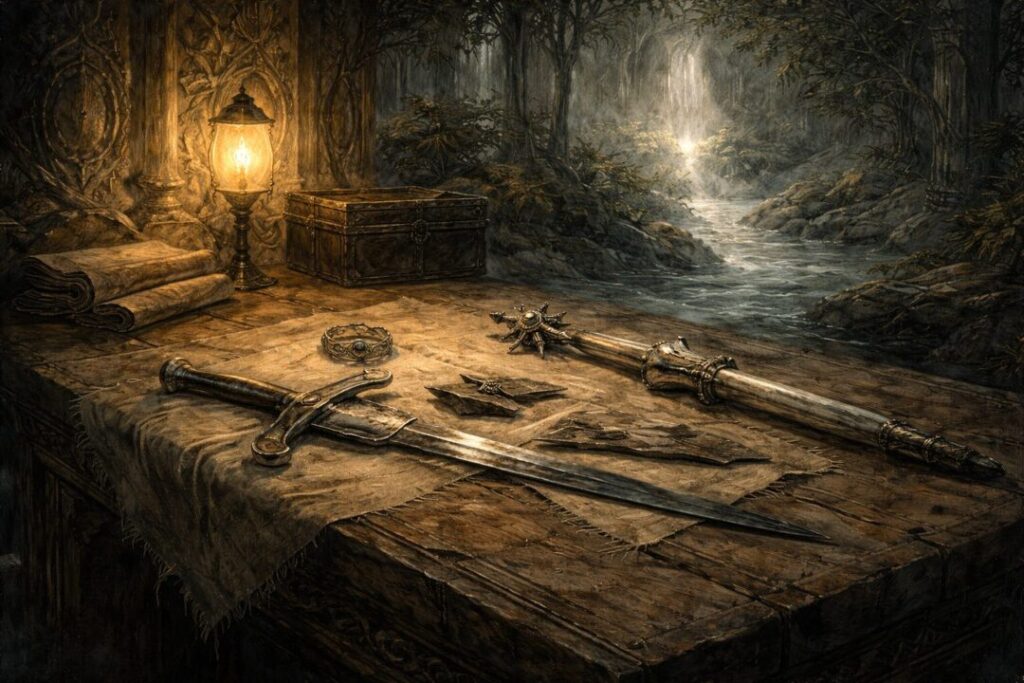
After Arvedui, the heirlooms of the house—items that function as continuity and proof—are kept in Rivendell: the ring of Barahir, the shards of Narsil, the Star of Elendil, and the sceptre of Annúminas.
That does not mean Gondor has no knowledge at all.
But it does mean the North’s “royal evidence” is not sitting in Minas Tirith where Gondorian stewards and councillors can point to it, handle it, display it, and make it part of their own political reality.
Instead it lies far away, guarded by an Elven refuge, bound up with the hidden life of the Rangers.
A realm remembers best what it can physically keep before its eyes.
Gondor cannot do that with the North’s kingship.
4) The loss of the palantíri deepens the separation
Communication and “state memory” in the Númenórean world is not only riders and scrolls.
The palantíri once served as tools of consultation and governance.
But in the North, the chief Stones are lost with Arvedui’s shipwreck, and the text notes that no deputy remained with authority to use them.
If you imagine a world where the great realms could once exchange urgent intelligence through the Stones, that loss is not decorative trivia.
It is a structural break.
After that, the North’s remnant becomes even more what the text already called it: a hidden people, working without being recorded.
5) In Gondor, “kingly” tradition becomes internal—and the Stewards become its gatekeepers
Now return to Gondor and notice a different kind of secrecy.
In Unfinished Tales, a tradition linked to Isildur is described as being sworn to secrecy from the beginning.
Later, when the kings end and the Stewards rule, the text says something unusually direct:
In the matter of the “Tradition of Isildur,” the Stewards “alone were the judges, since it was known only to them.”
That line is easy to glide past.
But it reveals a psychological pattern:
The Stewards inherit not only administrative power, but also custodianship of “what the King should know.”
They become the keepers of royal knowledge—knowledge that now circulates inside their own house.
This is where the “lost track” problem becomes almost inevitable.
If your political identity is built around being the rightful caretakers until the King returns, you face a tension:
- You must preserve the idea of the returning King, because it legitimizes your office.
- But you may not want any particular claimant to become real enough to replace you—especially if that claimant is distant, secretive, and largely unknown to your people.
The texts do not say, “The Stewards plotted to erase the line of Isildur.”
So we should not claim that.
What the texts do show is enough: over generations, Gondor’s kingship becomes something the Stewards administer in absence—while the living continuation of that kingship survives far away in a form Gondor cannot easily see.
That’s how institutions forget: not by burning records, but by letting the relevant records become less and less practical.
6) So why did they “need” the heirs, and still fail to find them?
Because “needing” is not the same as reaching.
Gondor needed legitimacy and continuity.
The Stewards had it—through their office, their lineage, and their custodianship of tradition.
But the heirs of Isildur needed survival.
So they became secret.
They wandered.
They kept their proofs elsewhere.
And between those two needs lies the real answer:
Gondor didn’t misplace a family tree.
It drifted into a political world where the Heir of Isildur became an idea—useful, distant, honorable to speak of—while the living line became increasingly difficult to recognize, and increasingly easy not to pursue.
Which is why the return of the King is not just a triumphant restoration.
It is an event that breaks a long habit of rule—one that had been forming since the day Gondor first answered Arvedui:
“This crown is not yours.”
And once you see that, the Stewards’ long vigilance can read as something sharper than loyalty.
Not rebellion. Not simple ignorance.
A form of waiting that, for centuries, never truly expected the door to open.
Sources & Notes
- J.R.R. Tolkien, The Lord of the Rings, Appendix A, “Gondor and the Heirs of Anárion” — Arvedui’s claim, Gondor’s rejection, and the southern reckoning of the crown through Anárion’s male line.
- J.R.R. Tolkien, The Lord of the Rings, Appendix A, “Eriador, Arnor, and the Heirs of Isildur” — the fall of the North-kingdom and the Dúnedain becoming a secret, wandering people whose deeds were seldom recorded.
- J.R.R. Tolkien, The Lord of the Rings, Appendix A, “The Tale of Aragorn and Arwen” — Aragorn’s true name and lineage are kept hidden in Rivendell because the Enemy is seeking the Heir of Isildur.
- J.R.R. Tolkien, The Lord of the Rings, Appendix A, “Eriador, Arnor, and the Heirs of Isildur” — the heirlooms of the northern line, including the shards of Narsil and other tokens, are kept in Elrond’s house.
- J.R.R. Tolkien, Unfinished Tales, “The Palantíri” — the loss of the northern Stones with Arvedui and the limits on who had authority to use them.
- J.R.R. Tolkien, Unfinished Tales, “Cirion and Eorl and the Friendship of Gondor and Rohan,” “The Tradition of Isildur” — the tradition’s secrecy and the Stewards as its later custodians and judges.