The films gave Sauron a shape you can’t forget.
A towering presence. A fiery pupil. A beam of searching light sweeping the ash-plains of Mordor.
It works because cinema needs something the camera can return to—an image that can substitute for a character who never steps into the scene.
But the book does something more elusive.
In the text, “the Eye of Sauron” is simultaneously:
- a symbol worn by Mordor’s soldiers,
- a figure of speech for his will and attention,
- and, in a few key moments, a vision so vivid it feels almost physical.
If you compress all of that into a single literal object, you gain clarity—but you lose what the story is quietly showing: that the Eye is not a thing so much as a mode of power.
And that distinction matters, because it changes what “Sauron watching” actually means.

The Eye as a device of fear
One reason the Eye works so well in the book is that it doesn’t behave like a machine.
It behaves like attention.
Characters don’t simply say “Sauron sees everything.” They experience his searching as something that can tighten, intensify, and then—crucially—move away.
This is why the Eye becomes terrifying. It isn’t constant surveillance in every direction at once. It is a mind that hunts.
That detail is easy to miss if you come in expecting omniscience. But it’s built into the story’s strategy: the West hopes to win because Sauron’s certainty can be manipulated. His attention can be pulled. His assumptions can be turned against him.
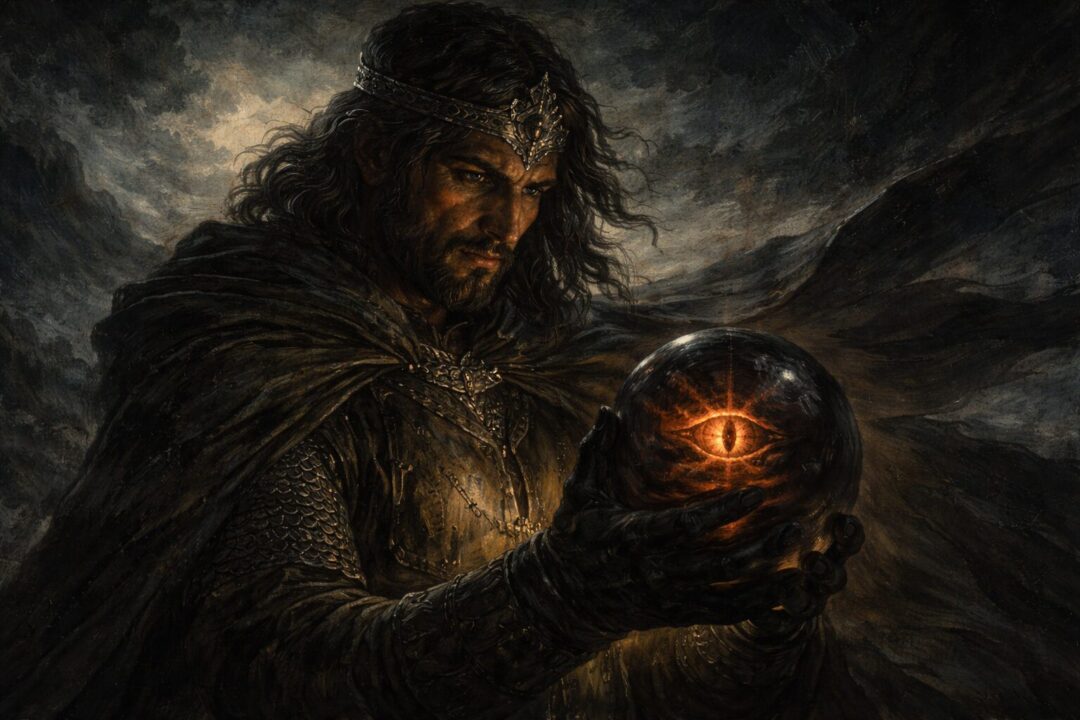
You see this most clearly when Aragorn reveals himself through the palantír. The narrative describes the Eye turning inward, “pondering tidings of doubt and danger,” because something unexpected has entered Sauron’s calculations: a living heir of Isildur, bold enough to look back.
That is not the language of a fixed spotlight.
It is the language of a will that can be startled.
The Eye as a literal emblem
There is also a plain, physical meaning.
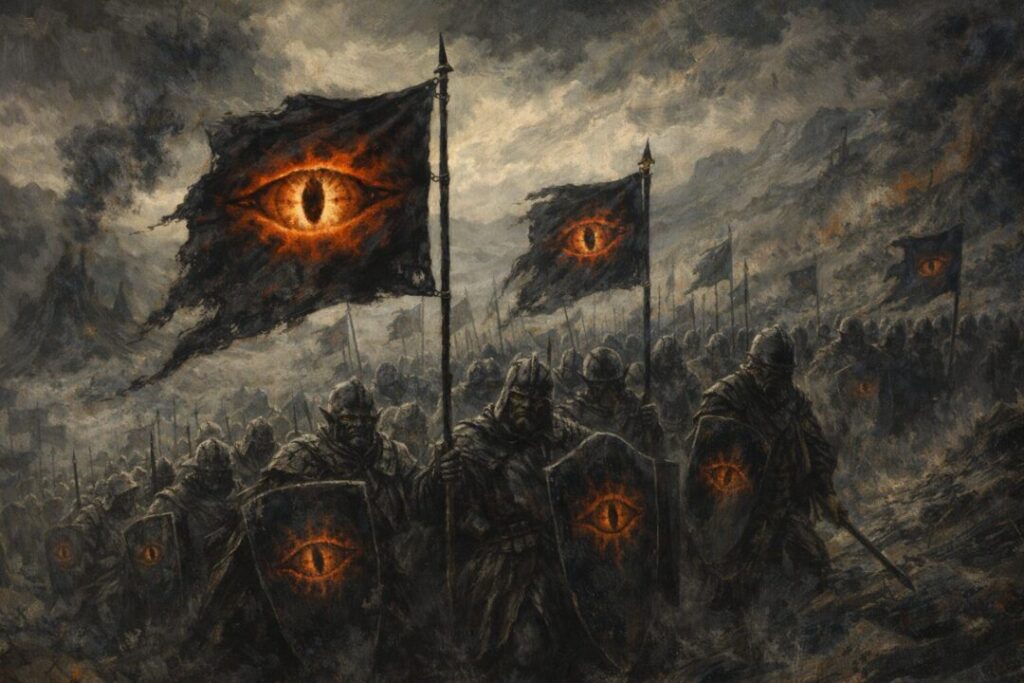
Mordor uses the Red Eye as a mark—painted and displayed by its Orcs. The Eye is on banners, and it appears on gear and livery in places like the Tower of Cirith Ungol.
This is important for a simple reason: it shows the Eye is propaganda.
A tyrant’s sign.
If your soldiers wear the Eye, they become extensions of the watching. The symbol itself tells allies and enemies alike: you are seen; you are within reach; the Dark Lord’s hand is here.
That doesn’t require a literal eye burning on a tower. It requires an empire that wants everyone to feel watched even when the watcher is far away.
So in the book, the Eye is already doing two jobs at once:
- As an emblem, it declares dominion.
- As a metaphor, it communicates terror.
But there’s a third layer that makes the whole thing uncanny.
The Eye as a vision
Frodo sees the Eye in the Mirror of Galadriel.
The description is not vague. The darkness becomes an abyss, and within it a single Eye appears and grows until it fills nearly everything—rimmed with fire, watchful, intent, and dreadful.
This is not presented as Frodo staring at Barad-dûr across hundreds of miles.
It is presented as something shown to him—through a medium that reveals things distant, things possible, and things perilously connected to the Ring.
That context matters.
The Mirror does not function like a window you can casually look through. It is tied to perception, temptation, and the danger of seeing too much. When the Eye appears there, it reads like a collision between two forces:
- the Ring-bearer’s growing connection to Sauron’s domain,
- and the immense pressure of Sauron’s will straining outward.
Whether you call it “vision,” “revelation,” or “spiritual perception,” the key is this: the Eye can be experienced as if it were present, even when it is not physically nearby.
And that is much closer to what the book repeatedly does with Sauron.
He is felt. He weighs on the mind. He presses through distance.
The “window” in Barad-dûr
Then comes the line that most often gets flattened into the film-image.
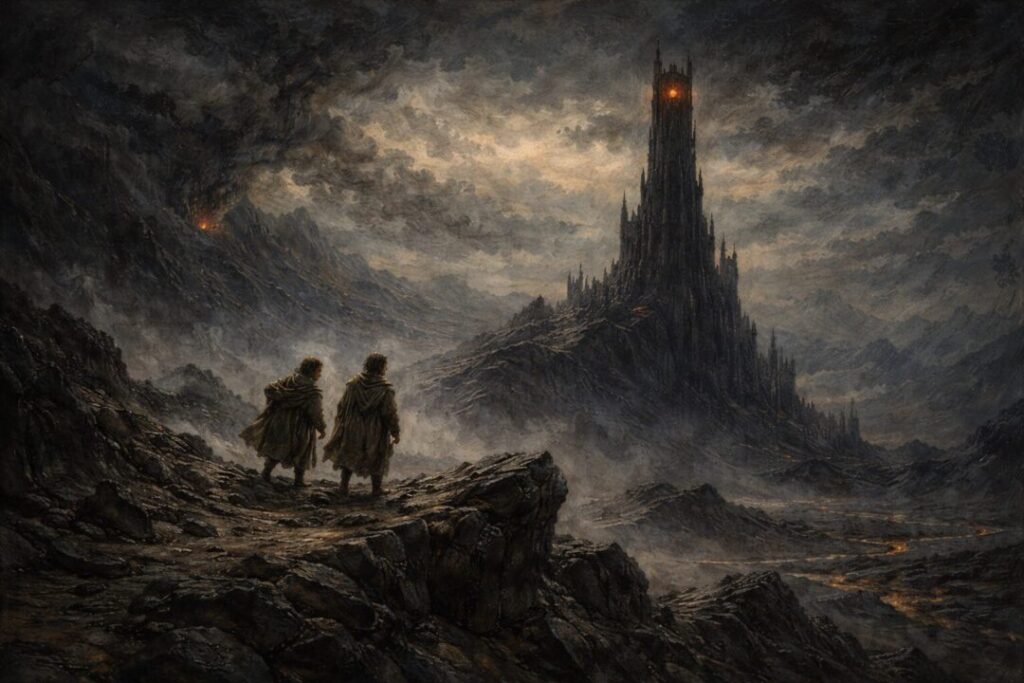
Near the end, in Mordor, the text describes a brief red gleam—like a pupil waking—seen high in the Dark Tower, through what is called a “window.”
This is one of the reasons readers talk about “the Eye” as if it might be a visible manifestation.
But notice what the text does not do.
It does not say there is a gigantic eye sitting exposed above the tower.
It gives you a glimpse: a red flicker, a point of awareness, something that suggests the Dark Lord’s attention has swung outward—and that the world has, for a heartbeat, become a hunted thing.
If you want a conservative reading that stays close to the words, you don’t need a literal flaming eyeball.
You need only this:
- Barad-dûr has heights and openings.
- Sauron has a seat of power there.
- And when his will is actively searching, the narrative allows that search to become visible in image-language: red fire, a pupil, a window.
In other words, the “Eye” is what Sauron’s attention looks like when the story makes inner power legible.
Does Sauron have a body in the War of the Ring?
Yes—at least, the text strongly implies he does.
The clearest hint is not a battle scene. It’s a shuddering aside from Gollum: Sauron has only four fingers on the Black Hand.
That detail is small, and it’s easy to read past it, but it carries weight. Gollum is speaking from experience: he has been taken, questioned, and harmed in Mordor. The statement makes most sense if Sauron is not merely an eye or a disembodied shadow, but an embodied power who can physically torture, command, and handle objects.
At the same time, the story does not describe Sauron walking the battlefield, because that isn’t how his power is framed in this age. He rules through fear, through servants, and through the vast machinery of Mordor.
A body does not require a public appearance.
And the text is careful not to give you the kind of face-to-face confrontation that would shrink him into an ordinary villain.
Why he is not “just an Eye”
There’s another crucial piece of lore that shapes what Sauron can be.
After the Downfall of Númenor, the text says he could never again appear fair to the eyes of Men. His spirit survives, but the ability to wear a pleasing, deceiving form is taken from him.
So by the end of the Third Age, you should not expect “Annatar,” the beautiful stranger, walking into a court.
You should expect something dark, formidable, and concealed—something that prefers the distance of domination to the risk of personal exposure.
This is exactly the kind of being for whom “the Eye” becomes the perfect expression:
- He is present without arriving.
- He reaches without touching.
- He terrifies without stepping into the light.
So what did the films change?
They simplified a layered idea into one persistent visual.
That choice is understandable: a movie needs a recurring image that tells the audience, instantly, “the Dark Lord is active right now.”
But the text is doing something more interesting.
It uses “the Eye” in at least three overlapping ways:
- A political symbol (the Red Eye on banners and gear).
- A lived sensation (the crushing feeling of being searched).
- A visionary image (the Eye seen in the Mirror, and the red glimmer from the Dark Tower).
When you hold all three together, the Eye stops being an anatomy lesson and becomes what it really is in the story:
A translation of power into image.
Not a floating organ. Not a monster perched on a tower.
But a way of showing the reader what it feels like to live under a will so strong that it seems to look through stone, through distance, and through the mind itself.
And once you read it that way, the most chilling detail is not that the Eye is always watching.
It’s that the Eye can turn.
And if it turns, it can miss something—just long enough for a Ring-bearer to take one more step.
The detail that closes the loop
If you’ve ever wondered why the Quest succeeds at all—why Mordor’s net does not simply tighten and end everything—the answer is bound up with this layered “Eye.”
Because the Eye is terrible, but it is not omniscient.
It is attention—immense, fiery, and focused.
And focus can be manipulated.
The West stakes everything on that weakness… and the text gives you just enough glimpses of the Eye turning, searching, narrowing, and swinging away to understand how a plan built on misdirection can actually work.
Once you notice that, the Eye stops being a special effect.
It becomes one of the story’s most important rules.
Sources & Notes
- J.R.R. Tolkien, The Lord of the Rings, Book II, Chapter 7, “The Mirror of Galadriel” — gives Frodo’s fiery vision of the Eye and frames it through the Mirror’s perilous, visionary mode rather than a simple physical sightline.
- J.R.R. Tolkien, The Lord of the Rings, Book III, Chapter 11, “The Palantír” — shows Sauron’s will reaching through a seeing-stone and gives the “red Eye” as an experienced pressure of attention.
- J.R.R. Tolkien, The Lord of the Rings, Book V, Chapter 2, “The Passing of the Grey Company” — has Aragorn reveal himself in the Orthanc-stone, forcing Sauron’s attention and calculations to shift.
- J.R.R. Tolkien, The Lord of the Rings, Book IV, Chapter 3, “The Black Gate Is Closed” — includes Gollum’s memory that Sauron has only four fingers on the Black Hand, implying embodied presence rather than “only an Eye.”
- J.R.R. Tolkien, The Lord of the Rings, Book VI, Chapter 3, “Mount Doom” — describes the Eye turning toward Orodruin at the crisis, making Sauron’s focused but fallible attention central to the Quest’s end.
- J.R.R. Tolkien, The Silmarillion, “Akallabêth” — explains that after Númenor’s Downfall Sauron could no longer take a fair form, supporting the article’s distinction between Annatar-like disguise and late Third Age dread.